
Running a kilometer-scale climate simulation usually means booking months on a supercomputer. Ai2's latest open-weight release proposes a different trade: emulate the physics with neural networks, and get regional high-resolution precipitation from a single GPU instead.
What HiRO-ACE Is: ACE2S Stochastic Emulator Paired with HiRO Diffusion Downscaler
HiRO-ACE is an open-weight, two-model system from the Allen Institute for AI (Ai2) that emulates and downscales a kilometer-scale climate model. Announced on January 21, 2026 , it pairs ACE2S, a stochastic global atmosphere emulator, with HiRO, a diffusion-based downscaler that turns coarse atmospheric fields into 3 km surface precipitation. The work was produced with NOAA's Geophysical Fluid Dynamics Laboratory and documented in a technical report, arXiv:2512.18224, submitted December 20, 2025 .
ACE2S is the core engine: a 1° × 1° (~100 km) stochastic, autoregressive global atmosphere emulator that advances in 6-hour timesteps and outputs temperature, humidity, winds, and precipitation . It is a generative variant of the deterministic ACE2 model, sitting inside Ai2's broader ai2cm/ace family that simulates global atmospheric variability over time scales from hours to centuries.
HiRO (High Resolution Output) handles the spatial detail. It is a diffusion model that performs 32× downscaling, converting ACE2S's 100 km coarse fields into 6-hourly averaged surface precipitation at 3 km resolution over user-specified regions . The division of labor is deliberate: ACE2S handles fast, long global rollouts; HiRO adds regional kilometer-scale precipitation structure on demand.
What grounds the system is its training target. Both components are trained on GFDL's 10-year X-SHiELD simulation — a 3 km global storm-resolving physics model — rather than coarse reanalysis or a low-resolution physics model . In other words, the ML system learns to imitate a genuine kilometer-scale model, which is what makes its convective-scale precipitation output plausible rather than smoothed.
The artifact ships as a checkpoint bundle on Hugging Face. The allenai/HiRO-ACE repository exposes:
ACE2S.ckpt— the atmosphere emulator, 1.83 GBHiRO.ckpt— the downscaler, 921 MB- Inference configs, forcing data, initial conditions, and a
run-hiro-ace.shscript — 9.08 GB total
The repository is licensed Apache-2.0, subject to Ai2's Responsible Use Guidelines, with training and inference handled by the fme package . That packaging — open weights plus a runnable script rather than a paper-only result — is the practical point: you can pull both checkpoints and reproduce the workflow locally.
Why ACE2S Is Stochastic: The Precipitation-Variability Problem Deterministic Emulators Miss

ACE2S is stochastic because deterministic emulators systematically smooth out the very thing precipitation studies care about: intermittent, grid-scale rainfall. A deterministic autoregressive model like ACE2 predicts a single mean trajectory for each timestep, so when it cannot resolve which specific cell will convect, it hedges — spreading a light drizzle across many cells instead of producing the sharp, localized downpours a physics model generates. ACE2S replaces that conditional-mean output with a generative formulation that samples from a distribution of possible atmospheric states, recovering small-scale variability that deterministic ACE2 averages away .
The mechanism matters most in the tails. Sub-grid variability is exactly where extreme-rainfall, flood-risk and convective-event analysis lives, and a model that regresses toward the mean understates both the frequency and the intensity of those events. By drawing samples rather than emitting one expected value, ACE2S preserves grid-scale precipitation variability consistent with what physics-based, storm-resolving models exhibit — Ai2 reports the improvement is most pronounced for surface precipitation, the field deterministic emulators struggle with most .
What is the model actually learning from? The model card describes ACE2S as a stochastic emulator of 100 km-coarsened X-SHiELD, trained on 9 years of data spanning 2014–2022, using an updated training procedure relative to prior ACE models . Because the target is a kilometer-scale physics simulation rather than coarse reanalysis, the stochastic objective has a concrete reference for how much grid-scale intermittency should be present — the model is fit to reproduce a distribution, not a smoothed average.
Two design properties carry over from ACE2 and survive the move to a sampled output:
- Improved small-scale variability. Relative to deterministic ACE2, ACE2S shows better representation of intermittent precipitation, with the gain concentrated in the distribution's tails rather than the bulk mean .
- Exact conservation. ACE2S enforces exact conservation of global dry-air mass and total moisture by design, a constraint the ACE2 lineage introduced as ML-based conservation rather than a soft penalty .
That second point is what keeps the stochastic rollout from drifting. Sampling a different atmospheric state at every 6-hour step is only useful if the sampled trajectory still respects mass and moisture budgets over long runs; without hard conservation, a generative emulator can accumulate spurious water or air across thousands of steps. The ACE2 design encodes those budgets exactly, so ACE2S can draw many independent-looking realizations while remaining physically closed — the property that makes it suitable for ensembles of high-resolution precipitation rather than a single smoothed estimate .
HiRO's 32× Diffusion Downscaling: 100 km Coarse Atmosphere to 3 km Precipitation
HiRO (High Resolution Output) is a diffusion model that performs 32× spatial downscaling, turning ACE2S's 100 km coarse atmospheric state into 6-hourly averaged surface precipitation at 3 km resolution over a user-specified region . It is trained on paired samples — the same 3 km X-SHiELD fields coarsened to 100 km on one side, the native kilometer-scale precipitation on the other — and learns the conditional distribution of fine-scale rainfall given the coarse state rather than a single deterministic mapping . Because it is generative, HiRO samples plausible high-resolution precipitation fields, which is what lets it recover intermittent convective structure that an interpolation or regression downscaler would blur away.
The practical payoff is that physically detailed precipitation emerges from coarse inputs alone. Ai2 reports that HiRO recovers topographic precipitation detail at kilometer scale — mountain rain shadows and orographic enhancement — and generates plausible tropical cyclones, fronts, and convective events without seeing any fine-scale field at inference time . The conditioning carries enough large-scale signal (winds, humidity, the coarse precipitation footprint) that the diffusion model fills in the small-scale texture consistent with the underlying terrain, which is exactly the regime where deterministic ML downscalers tend to produce smooth, low-variance output.
Both components are trained on the same 10-year X-SHiELD simulation from GFDL's 3 km global storm-resolving model, so HiRO learns to reproduce a true kilometer-scale physics model rather than coarse reanalysis . That distinction matters for bias interpretation: HiRO precipitation is representative of X-SHiELD output, not observations. Any biases baked into the parent storm-resolving model — and any places where X-SHiELD diverges from gauge or satellite records — propagate into HiRO's results .
Spatial coverage is also bounded. HiRO is trained and tested only between 66S and 70N, with a hard absolute limit of 88S/88N beyond which it cannot run at all — polar regions are fully excluded. Ai2 also flags blending artifacts for very large regional extents, so the model is best applied to bounded study domains rather than a single global tile .
| Property | HiRO specification |
|---|---|
| Model type | Diffusion-based downscaler (generative) |
| Downscaling factor | 32× (100 km → 3 km) |
| Output | 6-hourly averaged surface precipitation |
| Training data | 10-year X-SHiELD 3 km simulation (GFDL) |
| Tested latitude band | 66S–70N (hard limit 88S/88N) |
| Checkpoint size | HiRO.ckpt — 921 MB |
Decades of Atmospheric Emulation per H100-Day: Annotating Ai2's Measurements
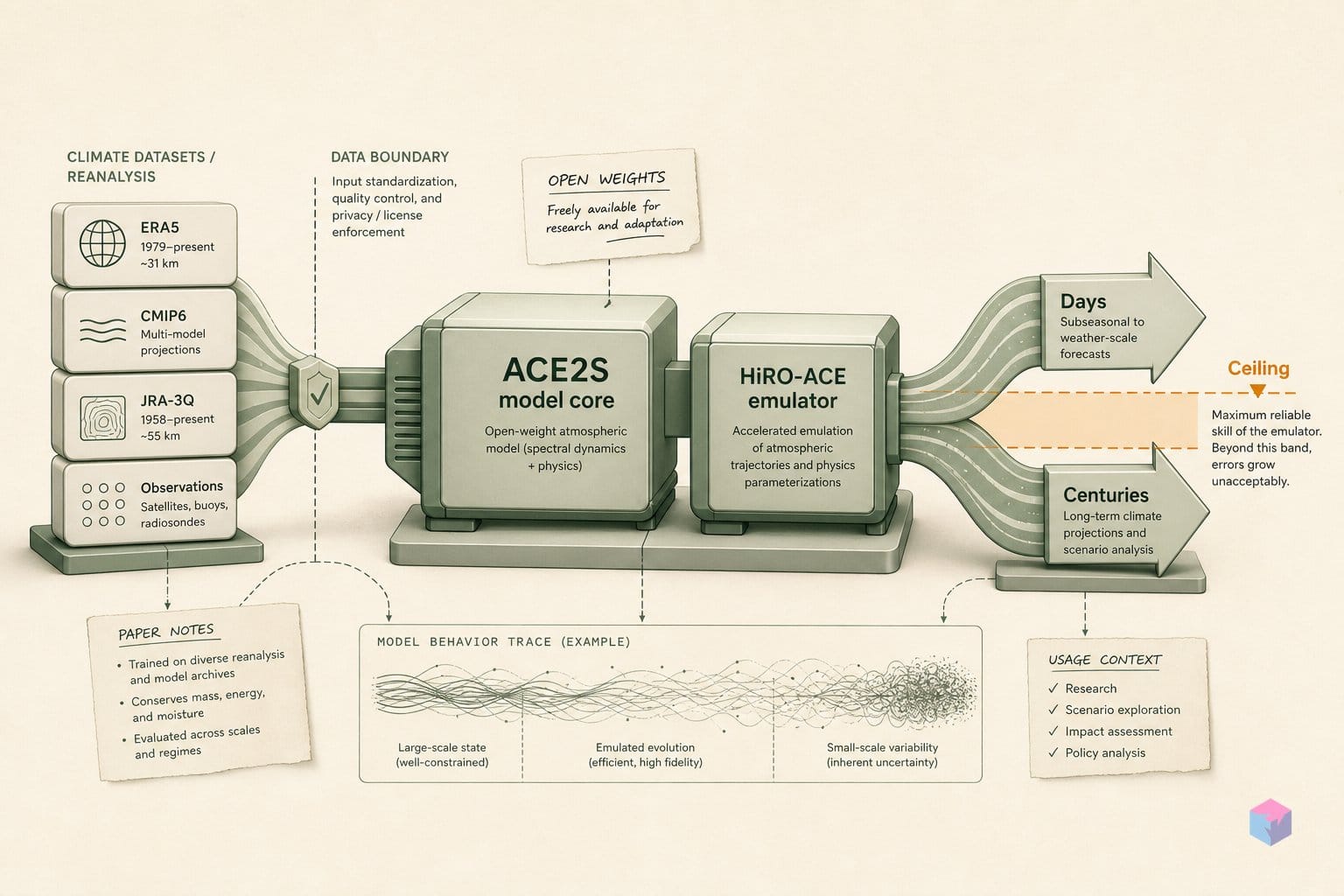
HiRO-ACE's headline claim is throughput at fidelity on commodity accelerator hardware. Ai2 reports that HiRO produces one year of 3 km downscaled surface precipitation over a single region in about 45 minutes on one NVIDIA H100 GPU , and that the full ACE2S + HiRO pipeline can generate decades of 6-hourly high-resolution regional precipitation within a single wall-clock day on that same single H100 . The reference point is the physics-based alternative: the equivalent kilometer-scale storm-resolving run takes months . That gap — minutes-to-a-day versus months — is the practical case for using an emulator at all.
The atmosphere step inherits the ACE family's throughput profile. The ACE2 Nature paper reports roughly 1,500 simulated years per wall-clock day for its 450-million-parameter autoregressive emulator running 6-hour timesteps at 1° resolution across eight vertical layers . Ai2 reports comparable throughput for ACE2S , which makes sense: ACE2S shares the 1° × 1°, 6-hour autoregressive design and adds a stochastic formulation rather than a heavier backbone. Note where the cost actually lands — the coarse global rollout is cheap, and the 45-minute figure is the diffusion downscaler doing per-region 32× super-resolution, which is the more expensive per-output operation.
| Reported measurement | Value | Hardware | Source |
|---|---|---|---|
| HiRO downscaling, 1 year at 3 km, single region | ~45 minutes | 1× NVIDIA H100 | Ai2 blog / preprint |
| Full ACE2S + HiRO pipeline, 6-hourly high-res precip | Decades within 1 wall-clock day | 1× NVIDIA H100 | arXiv:2512.18224 |
| ACE2 atmosphere throughput (450M params, 1°, 6-hr steps) | ~1,500 simulated years/day | GPU (ACE2 baseline) | ACE2 Nature paper |
| ACE2S atmosphere throughput | Reported comparable to ACE2 | Single H100 | arXiv:2512.18224 |
For a developer scoping a workload, the operative read is that the bottleneck scales with downscaled regions and target resolution, not with the length of the atmospheric rollout. Generating many realizations over one bounded domain is cheap; tiling many regions at 3 km multiplies the 45-minute unit cost. Elizabeth Barnes of Boston University framed ACE's value as a "unique combination of speed and fidelity" that makes otherwise "prohibitively expensive" studies — such as tropical-cyclone formation — tractable .
The verification caveat is load-bearing. Every speed and skill figure here derives from Ai2's own technical report, arXiv:2512.18224, submitted December 20, 2025 and last revised February 4, 2026 , plus the accompanying blog post — none of which had completed peer review as of June 2026, and no independent reproduction of the H100 timings is yet published. The numbers are plausible and consistent with the published ACE2 baseline, but treat them as vendor-reported until external benchmarks land. The open weights and `run-hiro-ace.sh` script make that independent timing test something you can run yourself.
How Well Does It Capture Extremes? Unpacking Ai2's Validation
HiRO-ACE's validation centers on the precipitation tail, and the headline result is that it reproduces extreme precipitation distributions through the 99.99th percentile . That percentile matters more than the average: flood-risk and tropical-cyclone studies live in the rare, high-intensity tail, where a deterministic emulator that smooths rainfall would understate the events you actually care about. Ai2 reports the framework also holds time-mean precipitation biases below roughly 10% almost everywhere and recovers kilometer-scale topographic detail — mountain rain shadows and orographic enhancement — from coarse 100 km inputs .
Quick Answer: Ai2 reports HiRO-ACE reproduces extreme precipitation through the 99.99th percentile, keeps time-mean precipitation bias under ~10% almost everywhere, and recovers kilometer-scale topographic detail — but it overestimates tropical-cyclone frequency relative to its own X-SHiELD training baseline .
The stochastic design earns its keep here. ACE2S's central claim over the deterministic ACE2 is improved small-scale variability, especially for surface precipitation, and the preprint's own comparisons show the generative formulation delivering that benefit rather than just asserting it . Concretely, that means grid-scale, intermittent rainfall is preserved instead of averaged into a damp, uniform field — the failure mode that earlier deterministic ML emulators exhibited. Ai2 also reports HiRO-ACE generates plausible tropical cyclones, fronts and convective events from coarse fields, which is the qualitative side of the same capability .
The honest caveat sits inside the same validation. HiRO overestimates tropical-cyclone generation relative to the X-SHiELD baseline it was trained on — the model produces more storms than its own ground truth, so cyclone counts from HiRO-ACE should be read as upper-leaning rather than calibrated . That is a meaningful constraint for anyone using it for cyclone-frequency work specifically, even if intensity and spatial structure look reasonable.
Two framing points are worth keeping. First, the baseline is X-SHiELD, GFDL's 3 km storm-resolving model — so "skillful" means faithful to that physics simulation, not to observations directly . Inherited biases in X-SHiELD carry through. Second, these skill figures come from Ai2's preprint and blog, which had not completed peer review as of June 2026, so independent benchmarking of the percentile and bias claims remains thin . The open weights let you check the tail behavior on a region you know.
The Forcing Constraint: Where HiRO-ACE Cannot Generalize
HiRO-ACE only behaves reliably inside the climate it saw during training, and stepping outside that window can produce unphysical results. ACE2S was trained on just 9 years of X-SHiELD data spanning 2014–2022 . In that window, sea-surface temperatures (SSTs) and CO2 rise together, so the model has no way to disentangle the two forcings — feed it strong future warming or an abrupt CO2 jump and the atmospheric response can break down. Ai2's own model card states the system "is not expected to generalize outside its limited forcing conditions" .
This is not a hypothetical risk. A June 6, 2026 arXiv paper (2606.07928) documented that prior ACE versions responded unphysically to AMIP SST +4 K and abrupt 4×CO2 experiments, precisely because SST and CO2 were correlated in training . The authors propose random-CO2 training and explicit energy constraints as a fix — but that work is a separate line of research and is not incorporated into the HiRO-ACE release you can download today. If your study depends on extrapolating to a hotter-than-trained climate, this emulator is the wrong tool until those constraints ship.
Three further boundaries matter for anyone planning experiments:
- Not a forecaster. ACE2S has no data assimilation and no synoptic initialization, so it cannot do weather forecasting . It emulates statistical variability, not a specific Tuesday.
- "Centuries" is throughput, not validated projection. The model card frames ACE as simulating variability "from days to centuries" , but read that as long, fast autoregressive rollouts enabled by extreme speed — not a peer-validated multi-century forced-climate projection. Ai2 explicitly positions the release as a research and educational tool, not an operational predictor .
- Statistical independence decays past ~9 years. The card warns the model "may not yield statistically independent samples when run much beyond 9 years" in a single chain . The practical implication: prefer many parallel ensemble members over one very long continuous run when you need a large sample of realizations.
None of this negates the speed advantage covered earlier — it scopes it. HiRO-ACE is a strong sampler of variability under conditions close to its training distribution, and a poor choice for stress-testing climate states it never saw. The clean test before trusting any output: confirm your forcing scenario sits inside 2014–2022-like conditions, and run ensembles rather than marathon rollouts.
Getting Started: Install fme, Edit the ACE2S YAML, Execute the Script
Running HiRO-ACE means installing one Python package, pulling the checkpoint repository, and pointing two config files at your local paths. Ai2 ships the fme package (version 2026.5.1) to handle training, running, and evaluating ACE-family models; it supports SFNO, GNNs, UNets, atmosphere and ocean emulation, and downscaling, with documentation at ai2-climate-emulator.readthedocs.io. Install it via pip, then fetch the weights and forcing data from Hugging Face before editing anything.
The artifacts live as a checkpoint repository, not a standalone model page. Cloning allenai/HiRO-ACE pulls roughly 9.08 GB, including ACE2S.ckpt (1.83 GB), HiRO.ckpt (921 MB), inference configs, forcing data, initial conditions, and the run-hiro-ace.sh script. The forcing and initial-condition files are bundled alongside the checkpoints, so you do not need to source reanalysis inputs separately to reproduce the published runs.
Configuration is path editing, not code. Open ace2s_inference_config_global.yaml and the HiRO region-specific configs and update the paths to point at your local checkpoint and forcing-file locations. Then execute run-hiro-ace.sh, which drives the ACE2S autoregressive rollout and the HiRO downscaling pass end to end. The repository is licensed Apache-2.0 (subject to Ai2's Responsible Use Guidelines), and the underlying training and inference code sits in the ai2cm/ace GitHub repository if you need to adapt the pipeline.
- Install:
pip install fme(2026.5.1); confirm GPU access — Ai2's benchmarks assume a single NVIDIA H100. - Clone: pull
allenai/HiRO-ACE(~9.08 GB) with checkpoints, configs, forcing data, and initial conditions. - Edit: set local paths in
ace2s_inference_config_global.yamland the HiRO region configs. - Run: execute
run-hiro-ace.sh.
For baseline context, compare your output against the deterministic siblings in the Hugging Face ACE collection — ACE2, ACE2-ERA5, and ACE2-SOM. Running the same initial conditions through ACE2S and its deterministic predecessor is the quickest way to see the stochastic precipitation variability the earlier sections described, and to sanity-check that your local install reproduces Ai2's reported behavior before you trust it on a new region.
Before Trusting HiRO-ACE: Architecture Gaps, Polar Exclusion, and Artifact Risk
Before you treat HiRO-ACE's headline numbers as settled, weigh three open gaps the release leaves on the table: undisclosed model sizing, thin external validation, and hard geographic limits. None of these breaks the system for research use, but each one shapes how far you should extend its outputs. The most basic is that the model card never states ACE2S's parameter count , so there is no direct sizing comparison against the ACE2 lineage's 450M-parameter autoregressive emulator . You can run the 1.83 GB checkpoint, but you cannot reason about capacity or scaling against its deterministic siblings from the card alone.
Validation depth is the second gap, and Ai2 says so plainly. The model card acknowledges ACE2S was tested less rigorously than ACE2-ERA5, and HiRO's ablation work is explicitly thinner than what backs the reanalysis-trained model . Because both components learn from X-SHiELD rather than observations, their precipitation is representative of that simulation, not the real atmosphere. The meaningful external signal — community benchmarking against ERA5 reanalysis — is still absent, and the speed and skill figures come from Ai2's own preprint and blog rather than independent leaderboards.
The geographic limits are not tunable. HiRO is not trained or tested outside 66S–70N and cannot run beyond 88S/88N, so polar regions are off the table, and large target regions can produce blending artifacts . Treat these as design constraints, not configuration problems to engineer around.
Finally, the provenance. The supporting work is preprint arXiv:2512.18224, submitted December 20, 2025 and last revised February 4, 2026 — not yet peer-reviewed. Until journal acceptance, read the quantitative skill claims (the 99.99th-percentile extremes, the sub-10% mean-bias figures) as provisional.
The practical takeaway: HiRO-ACE is a credible, Apache-2.0 research and educational tool for generating many realizations of regional precipitation cheaply — use it that way. Run it inside 66S–70N, validate against your own reference data before trusting a new region, and do not promote its outputs to operational forecasts or multi-century forced projections until independent benchmarking and peer review catch up.
Frequently asked questions
What is the difference between ACE2S and deterministic ACE2?
ACE2 produces a single deterministic trajectory that behaves like an ensemble mean, smoothing out the sub-grid, intermittent rainfall that physics-based models exhibit. ACE2S adds a generative, stochastic formulation: it samples from a distribution of atmospheric states, so it preserves grid-scale precipitation variability and extreme-tail behavior. Both conserve global dry-air mass and moisture exactly . ACE2S is the better fit when realistic precipitation spread across ensemble members matters; deterministic ACE2, ACE2-ERA5 and ACE2-SOM remain available for comparison in the Hugging Face ACE collection .
Can HiRO-ACE be used for future climate projections or scenario analysis?
No. ACE2S was trained on only 9 years of X-SHiELD data (2014–2022), a window in which sea-surface temperature and CO2 are correlated, so the model is not expected to generalize beyond its limited forcing conditions . A June 6, 2026 preprint documents that prior ACE versions responded unphysically to AMIP SST +4 K and abrupt 4×CO2 for exactly this reason, prompting random-CO2 training and energy constraints as a fix . Ai2 frames HiRO-ACE as a research and educational tool, not an operational climate predictor .
What resolution does HiRO produce, and which regions are supported?
HiRO produces 6-hourly averaged surface precipitation at 3 km resolution over user-specified regions, downscaling the 100 km coarse atmosphere by 32× . It was trained and tested between 66S and 70N and has a hard absolute limit of 88S/88N, so polar regions are excluded; large-region runs can introduce blending artifacts . The output represents X-SHiELD physics-model statistics rather than direct observational reanalysis, which matters when you validate against station or satellite data.
How do I run HiRO-ACE on my own infrastructure?
Install the fme package (version 2026.5.1), which handles training, running and evaluating ACE-family models, then clone the allenai/HiRO-ACE repository from Hugging Face — about 9.08 GB including ACE2S.ckpt (1.83 GB) and HiRO.ckpt (921 MB) . Edit the path variables in ace2s_inference_config_global.yaml and the HiRO region configs, then execute run-hiro-ace.sh; forcing data and initial conditions ship inside the repo . A single NVIDIA H100 is the reference hardware for the roughly 45-minute-per-simulated-year throughput figure .
Is HiRO-ACE suitable for weather forecasting?
No — the model card states this explicitly. ACE2S emulates atmospheric variability over days-to-decades timescales but has no data assimilation and no synoptic-state initialization, so it generates ensemble statistics across climate timescales rather than deterministic near-term forecasts . For forecasting tasks, use a weather-native model such as Pangu or GraphCast; reserve HiRO-ACE for generating many realizations of regional precipitation for risk, extreme-rainfall and tropical-cyclone studies .