
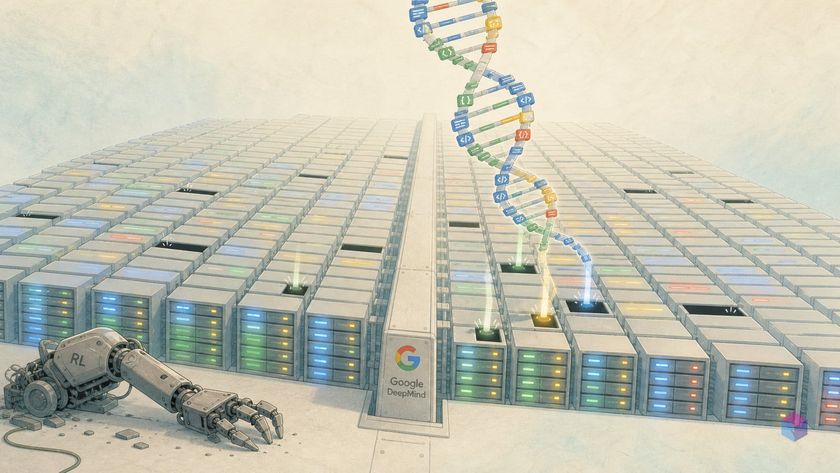
Does the 0.7% Fleet Recovery Stand Up to Scrutiny?
The 0.7% figure is a continuous live-fleet metric, not a benchmark score. According to DeepMind, AlphaEvolve discovered a scheduling heuristic for Borg — Google's cluster-management system — that recovers, on average, 0.7% of worldwide compute that would otherwise sit stranded . This is a sustained production measurement against live workloads, which is a different class of evidence than a synthetic leaderboard result.
Timing matters for credibility. As of the May 14, 2025 announcement, the heuristic had already been running in production for over a year , implying a rollout around early-to-mid 2024. The accompanying white paper, arXiv 2506.13131, posted June 16, 2025, states the heuristic was first evaluated in data-center simulators on historical snapshots, validated on an unseen recent test dataset, and rolled out fleet-wide only after it beat the existing production heuristic — and that post-deployment measurements matched the simulator results .
What's missing is everything an outside reviewer would need to verify the magnitude. Google's figures are entirely self-reported: there is no independent audit of the 0.7% gain, no published A/B test design, no confidence intervals, and no disclosed definition of the baseline it replaced or the measurement window, per the arXiv paper . The exact production start date is also unstated.
The most defensible read: this is an operations engineering team reporting a sustained live-fleet metric, with a simulator-then-rollout validation path. That is more credible than a one-shot synthetic benchmark, and less rigorous than a peer-reviewed controlled trial. Treat the 0.7% as a real, internally-validated efficiency dividend whose precise size you cannot yet independently confirm.
How an Evolutionary Algorithm Discovered Borg's Heuristic
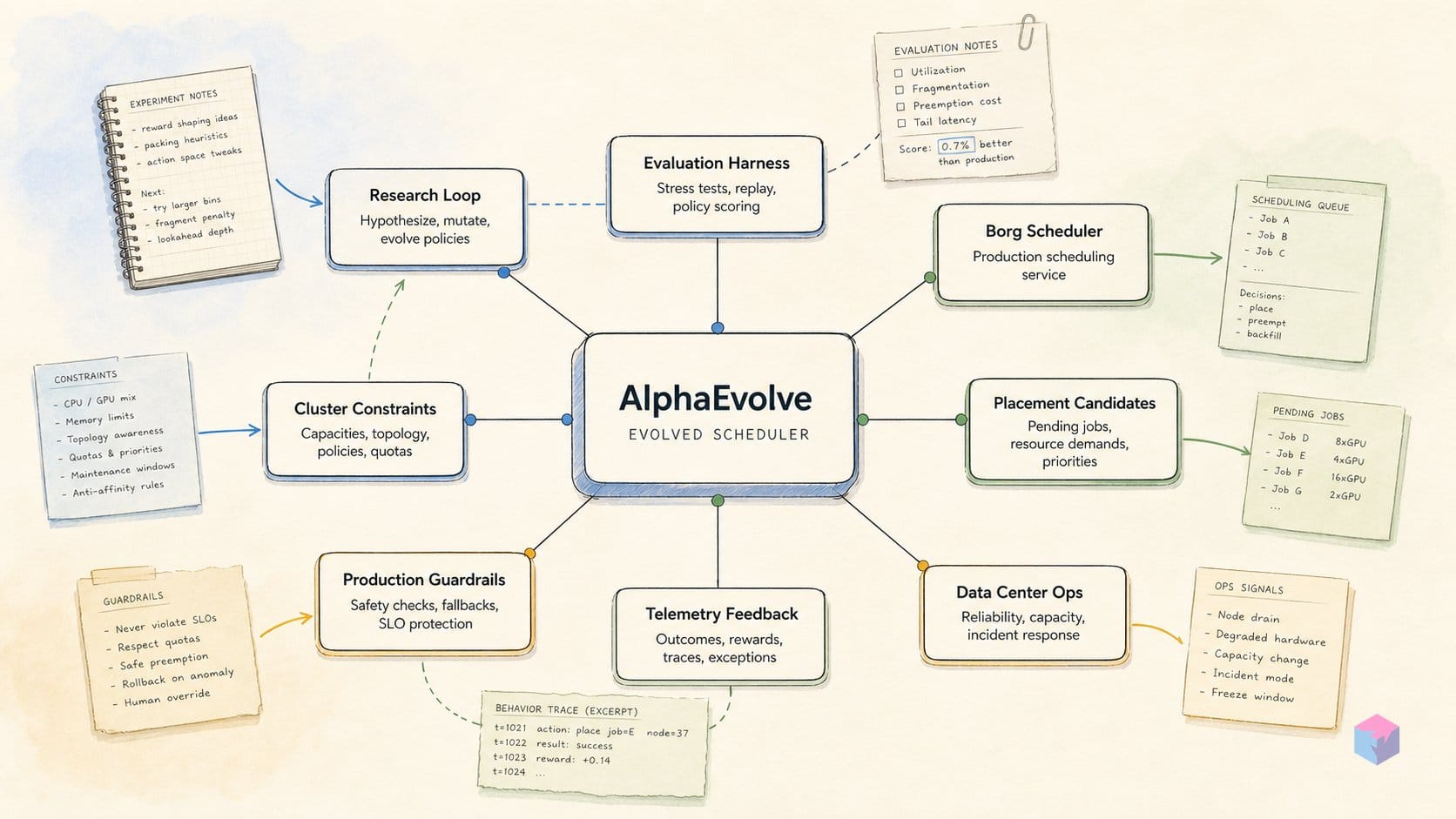
AlphaEvolve found Borg's scheduling heuristic by running a generate-evaluate-select loop over a population of candidate programs, not by training a neural network. An ensemble of Gemini models proposes program variants, an automated harness compiles and scores each one, and an evolutionary algorithm backed by a program database selects survivors to seed the next round . The discovery mechanism is the same one AlphaEvolve applies to kernels and math problems — Borg is one target of a general code-evolving system, publicly described on May 14, 2025 .
The model ensemble splits the work by cost and quality. Gemini Flash generates many low-cost variants for breadth, exploring a wide space of candidate heuristics, while Gemini Pro contributes fewer, higher-quality proposals for depth. Both streams feed the same candidate pool, so the population mixes cheap exploration with more expensive, more considered edits .
Fitness is where Borg-specific rigor enters. Each candidate is compiled and scored inside Google's data-center simulators using historical fleet workload and capacity snapshots, with the objective defined as improvement over the existing production heuristic. Engineers further validated the winner on an unseen recent test dataset before any rollout, then confirmed simulator predictions with post-deployment measurements . A program database retains the top-scoring variants across generations; survivors become prompt material for the next batch of LLM proposals, so selection pressure compounds over many cycles rather than relying on a single lucky draft.
The output is the part that matters most operationally: human-readable source code, not model weights. DeepMind frames this as a deliberate design choice, since a heuristic expressed as ordinary code can be read, tested, reviewed, and shipped through the same engineering process as any other change to a mission-critical scheduler . That property is exactly what made the evolved function deployable into a system as sensitive as Borg.
Why Readable Heuristics Beat RL for Cluster Placement
Google did not arrive at the evolved heuristic by default — it also tried a deep reinforcement-learning policy on the same Borg placement problem and found it performed worse and was harder to operate in production . The decisive factor was not average-case score but legibility: an interpretable scoring function could be reviewed, tested, and shipped through the same engineering process as any other change, while an opaque DRL policy could not .
The operational gap is concrete. A scheduler whose failures can strand entire workloads across the fleet needs edge-case auditing, correctness verification, and safe rollout — exactly the properties a black-box policy resists. Reasoning about a learned network's behavior on an unseen workload mix means probing it empirically; you cannot read it. The evolved function, by contrast, is ordinary code expressed in required-CPU/free-CPU and required-memory/free-memory ratios with cross terms for imbalance, so an SRE can read why a machine was ranked the way it was .
That legibility translates into three deployment-grade guarantees an RL policy struggles to match:
- Reviewable — the scoring logic can be read line by line by cluster-management engineers before it touches the fleet.
- Cleanly A/B testable — Google validated the heuristic in data-center simulators on historical snapshots, confirmed it on an unseen recent test set, and rolled it out only after it beat the production baseline; post-deployment measurements matched the simulator .
- Unambiguously reversible — because the change is a deterministic function affecting placement priority rather than overriding Borg's admission checks, a rollback restores known behavior with no residual model state.
DeepMind states the trade-off plainly: "a single piece of code that can be easily understood, deployed, predictably analyzed and debugged," — DeepMind, on why the readable heuristic was preferred over a deep RL approach for Borg (source: Google DeepMind, 2025-05).
The design implication for builders generalizes beyond Borg. For any system on the critical path, legibility is a hard deployment constraint, not a preference that a model can paper over with better average-case metrics. If you cannot audit an edge case, prove a rollback is clean, or explain a decision to the on-call engineer at 3 a.m., the better benchmark number is not enough to ship it.
How the Evolved Heuristic Reduces Stranded Resources in Borg
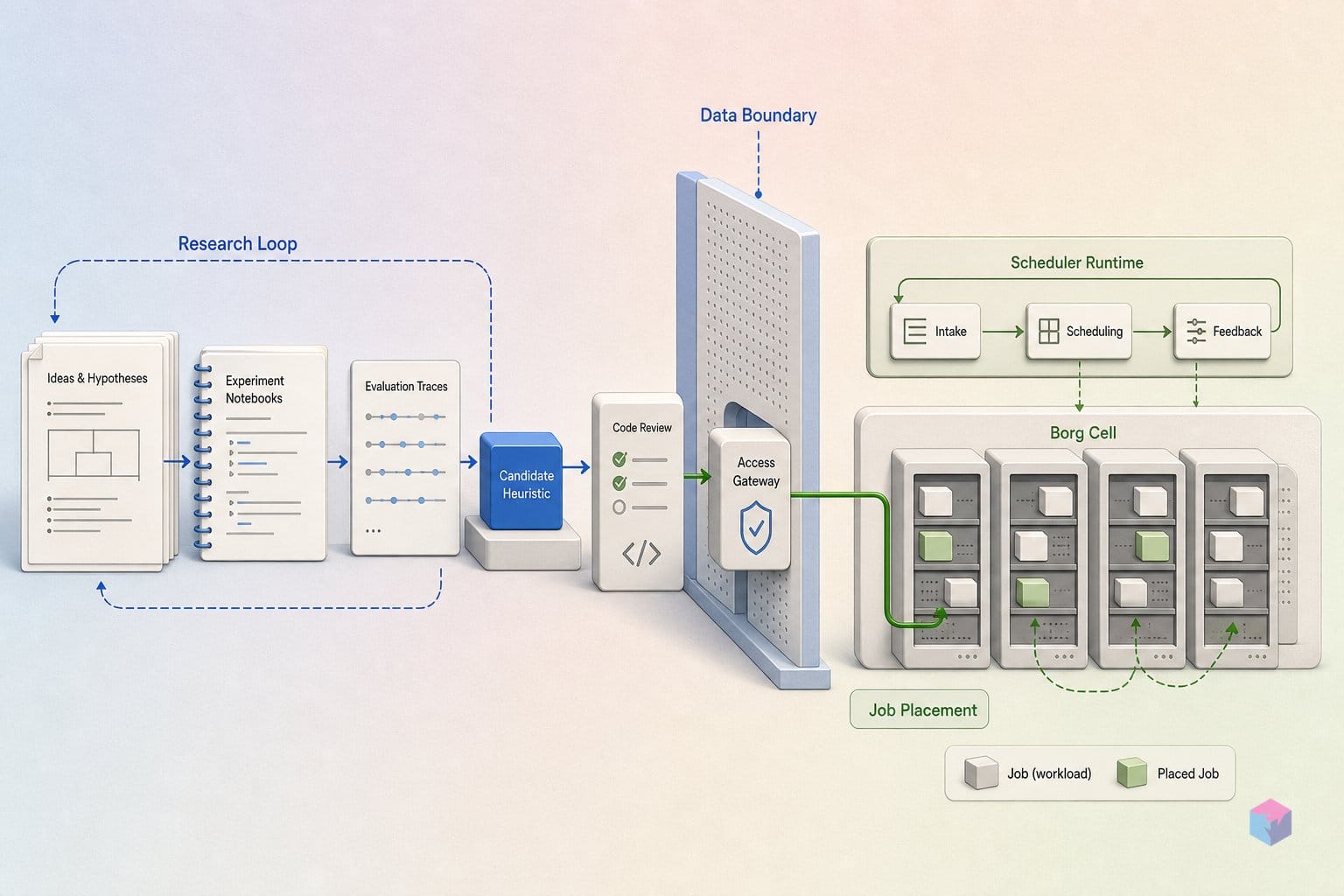
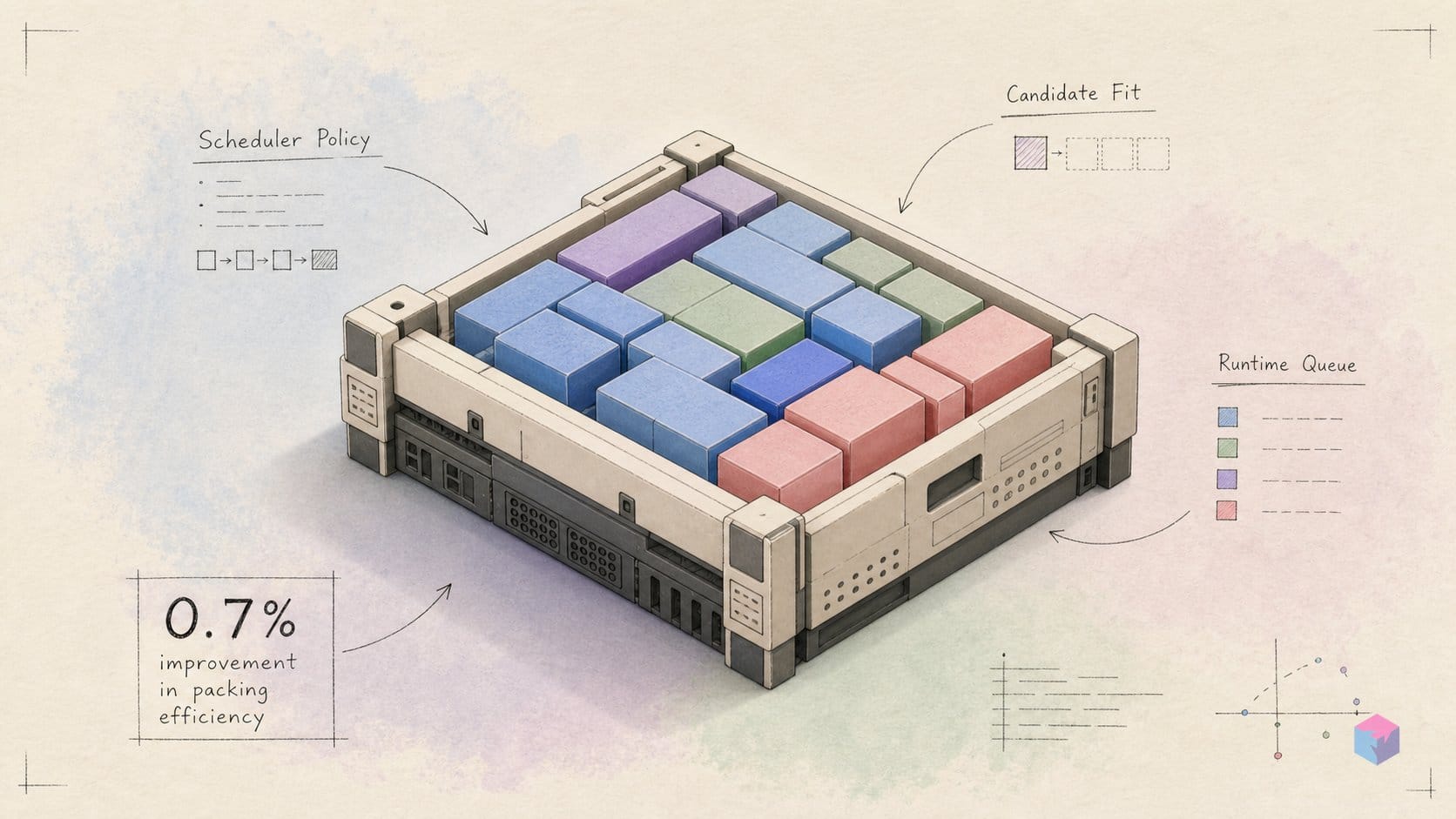
The evolved heuristic is a scoring function that ranks candidate machines for a pending job using two utilization ratios — required-CPU divided by free-CPU, and required-memory divided by free-memory — and combines them with cross terms that penalize imbalance . In plain terms, it answers a placement question Borg already faces millions of times: among the hosts that can legally run this job, which one leaves the fleet in the healthiest packing state afterward? The white paper, posted to arXiv as 2506.13131 on June 16, 2025, frames this as a two-variable vector bin-packing task over CPU and memory .
The imbalance penalty is the mechanism that matters. A machine that would have its memory nearly exhausted while its CPU sits largely idle is a future stranded resource — it can no longer accept additional tasks because one dimension is saturated even though another has slack. The cross terms push those lopsided placements down the ranking, steering jobs toward hosts where CPU and memory drain in step. Better packing recovers usable capacity without proportional additional hardware, so more tasks complete on the same physical footprint .
| Placement candidate | Resulting state | Heuristic treatment |
|---|---|---|
| Memory near-saturated, CPU ample free | Stranded: rejects future tasks | Penalized by cross terms |
| CPU and memory drain proportionally | Balanced: stays schedulable | Ranked higher |
Critically, the function only reorders machines that Borg has already deemed eligible and capable for the job. It affects placement priority after admission-control and correctness checks pass, so existing task constraints, capacity guarantees, and safety invariants are untouched . This is a tuning lever inside a mature scheduler, not an autonomous replacement for it — which is exactly why it could ship to a system this critical.
Fleet-Wide Savings That Compound: Why 0.7% Isn't Trivial
The 0.7% figure is a continuous production saving, not a one-time benchmark: it accrues every scheduling cycle across Borg's worldwide fleet, recovering compute that would otherwise sit stranded . As of the May 2025 announcement, the evolved heuristic had already run in production for over a year, implying a deployment in roughly early-to-mid 2024 . Because the gain repeats on the same physical footprint, it behaves like a recurring efficiency dividend rather than a recovered lump sum.
Scale is what turns a sub-1% number into something material. Google's 2015 EuroSys Borg paper describes the system running hundreds of thousands of jobs from thousands of applications across clusters of up to tens of thousands of machines, with many such clusters worldwide . Applied fleet-wide, 0.7% is roughly equivalent to a large data-center facility's worth of capacity reclaimed without buying or powering new hardware .
| Dimension | What Google disclosed |
|---|---|
| Measured saving | ~0.7% of worldwide compute, sustained in live production [1][2] |
| Absolute CPU / accelerator count | Not published |
| Megawatt draw / energy avoided | Not published |
| Avoided capex (dollars) | Not published |
Google has not converted the figure into CPU counts, accelerator counts, megawatts, or avoided capex, so its weight is inferred from scale rather than stated in dollar or watt terms . The constraint context amplifies it: when GPU and TPU capacity is the bottleneck for training Google's own models, recovering schedulable capacity without adding silicon directly eases that pressure.
Other Evolutionary Findings: Strassen, Attention Optimization, and TPU Rewrites
Beyond Borg, the same generate-evaluate-select loop produced results spanning pure mathematics, kernel performance, and silicon design — evidence that AlphaEvolve is a general code-evolving system, not a one-off scheduler tuner. Its most cited mathematical result: a method to multiply two 4×4 complex-valued matrices using 48 scalar multiplications instead of 49, the first improvement on Strassen's 1969 algorithm in that setting in 56 years .
The math wins were broad rather than isolated. AlphaEvolve improved the state of the art for 14 matrix-multiplication algorithms, and across more than 50 open problems it matched best-known results roughly 75% of the time and improved them about 20% of the time . The same approach paid off on Google's own production stack:
| Target | Result | Where it lands |
|---|---|---|
| Gemini matrix-multiply kernel | 23% faster routine, ~1% cut in total Gemini training time | In production training |
| FlashAttention kernel variant | Up to 32.5% latency reduction | Kernel implementation |
| TPU arithmetic circuit (Verilog) | Removed unnecessary bits in a matrix-multiply unit | Accepted for an upcoming TPU |
All three figures come from DeepMind's own reporting . The Verilog case is the most concrete hardware outcome: AlphaEvolve proposed a rewrite that stripped redundant bits from an arithmetic circuit, and the change was accepted for integration into a future TPU generation rather than left as a research artifact. DeepMind also reports the loop cut kernel-optimization engineering time from weeks to days .
"AlphaEvolve made an engineering choice... that improved a heavily optimized component of Gemini's training stack," DeepMind notes in its announcement, framing the speedups as recurring compute savings rather than benchmark trophies . The through-line with Borg holds: every output is human-readable code an engineer can review, deploy, and own.
What the Program Asks For — and What Independent Forks Omit
Replicating AlphaEvolve outside Google starts with a hard constraint: it is not a self-serve product. As of December 10, 2025, Google Cloud offers an AlphaEvolve Service API only as a private-preview Early Access Program, reached by contacting a Google Cloud representative rather than signing up . Pricing, the general-availability timeline, and rate or compute limits were not disclosed .
Access aside, the system demands three concrete inputs before it can evolve anything:
- A problem specification — the task framed precisely enough for code to attack it.
- An objective evaluation function — logic that compiles, runs, and scores each candidate automatically, with no human in the loop.
- A compile-ready seed program — a working starting point the search mutates from .
That requirement set defines the scope. AlphaEvolve fits problems expressible in code and measurable automatically — scheduling, resource allocation, kernel and circuit optimization, combinatorial search. Open-ended reasoning, where no objective scorer exists, falls outside it .
Open-source "OpenEvolve"-style reimplementations already approximate the core loop — an LLM proposing diffs, an automated evaluator, and an evolutionary selection step — and the recipe is reproducible in spirit . What the forks cannot copy is the evaluator. Google's Borg win leaned on internal data-center simulators, historical fleet snapshots, and direct scheduler integration to validate the heuristic before fleet-wide rollout .
The takeaway for builders: the LLM-propose loop is the easy 20%. Evaluator fidelity — a scoring harness that faithfully models your production system — is the 80% that decides whether evolved code survives contact with real infrastructure. Have that, and AlphaEvolve's method is within reach; lack it, and API access alone buys you little.
Frequently asked questions
What exactly did AlphaEvolve change in Borg?
AlphaEvolve changed only the machine-ranking scoring function — the heuristic that prioritizes among machines Borg has already deemed eligible and capable for a pending job. It did not touch admission control, task constraints, or correctness checks . The evolved function uses required-CPU/free-CPU and required-memory/free-memory ratios, penalizing imbalance through cross terms so a job is steered away from machines where it would strand the other resource. Because it only reorders already-valid placements, the change affects placement priority rather than overriding Borg's existing admission and correctness logic .
Why didn't Google use deep RL for this scheduling improvement?
Google did try deep reinforcement learning for the same placement problem, but it performed worse than the evolved heuristic and was harder to operate . For a critical-path cluster scheduler, an opaque neural policy makes auditing, edge-case verification, and safe rollout impractical. AlphaEvolve's output is human-readable code, so DeepMind explicitly frames interpretability, debuggability, and predictable behavior as the deciding deployment requirement — the evolved heuristic could be read, simulated, and reasoned about line by line, which an RL policy's weights cannot .
How can I replicate AlphaEvolve's approach for my own scheduler?
The loop itself is reproducible: LLM-based candidate generation, an automated evaluator that objectively scores each candidate against a metric, and an evolutionary selection step that seeds the next round from the best programs . Several open-source "OpenEvolve"-style reimplementations already replicate this structure . The hard-to-copy piece is the evaluator: Google validated the heuristic in high-fidelity data-center simulators built from historical workload and capacity snapshots before fleet-wide rollout . Without that simulation fidelity, the propose-and-select loop generates candidates you cannot trust.
Is the 0.7% compute recovery independently verified?
No independent audit exists. The roughly 0.7% of worldwide compute recovered is self-reported by Google from live fleet measurements . The arXiv white paper (2506.13131, posted June 16, 2025) states the simulator results were validated on an unseen recent test dataset before rollout and that post-deployment measurements matched the simulator . But the figure is not peer-reviewed, and Google has not published confidence intervals, the baseline heuristic it replaced, the metric's measurement window, or the A/B design needed for outside replication.
When will AlphaEvolve be available as a public API?
There is no public, self-serve API yet. As of December 10, 2025, Google Cloud offers an AlphaEvolve Service API only as a private preview through an Early Access Program, accessed via a Google Cloud representative . To use it, customers must supply a problem specification, evaluation logic that objectively scores candidates, and a compile-ready seed program. No general-availability date, pricing, rate limits, or compute quotas have been disclosed .