
Google's medical-AI research just cleared a notable peer-review bar: on 17 June 2026, Nature published a study showing AMIE managing patients across multiple visits, beating primary care physicians on treatment precision in simulation. The catch is in that last word.
What the AMIE chronic care paper actually measured
The paper is a peer-reviewed simulation result, not a product. Published in Nature on 17 June 2026 (DOI 10.1038/s41586-026-10764-5), it extends AMIE (Articulate Medical Intelligence Explorer) from one-off diagnosis into longitudinal chronic disease management, tracking progression and adjusting investigations, treatments, and prescribing across visits, grounded in clinical guidelines and drug formularies .
Quick Answer: A Nature paper (17 June 2026) found AMIE non-inferior to primary care physicians on overall management reasoning and superior on treatment precision across multi-visit chronic care, scoring 88% vs 74% on visit-1 plan appropriateness, but only in a blinded simulation, with no API, deployment, or clinical clearance.
The evaluation ran 100 multi-visit OSCE scenarios across five specialties (cardiology, pulmonology, OB/GYN/urology, gastroenterology, and neurology), comparing AMIE against 21 board-certified PCPs, with 10 blinded specialist physicians rating the management plans .
The headline: AMIE was non-inferior to PCPs on overall management reasoning and superior on investigation precision, treatment precision, and guideline alignment. Visit-1 overall plan appropriateness reached 88% for AMIE versus 74% for physicians (p=0.019) .
What this is not matters as much as what it is:
- No general availability, API, or pricing; AMIE remains an internal Google Research and DeepMind system .
- No clinical deployment and no evidence of improved patient outcomes.
- Text-chat scenarios with trained patient actors, not live clinics.
The authors are explicit about the gap. As the AMIE research team writes via Google Research, "further research would be needed before this could be translated to real-world clinical practice" (source: Google Research). For builders, the durable signal is methodological, not clinical, as the next sections explain.
How AMIE splits dialogue from clinical planning
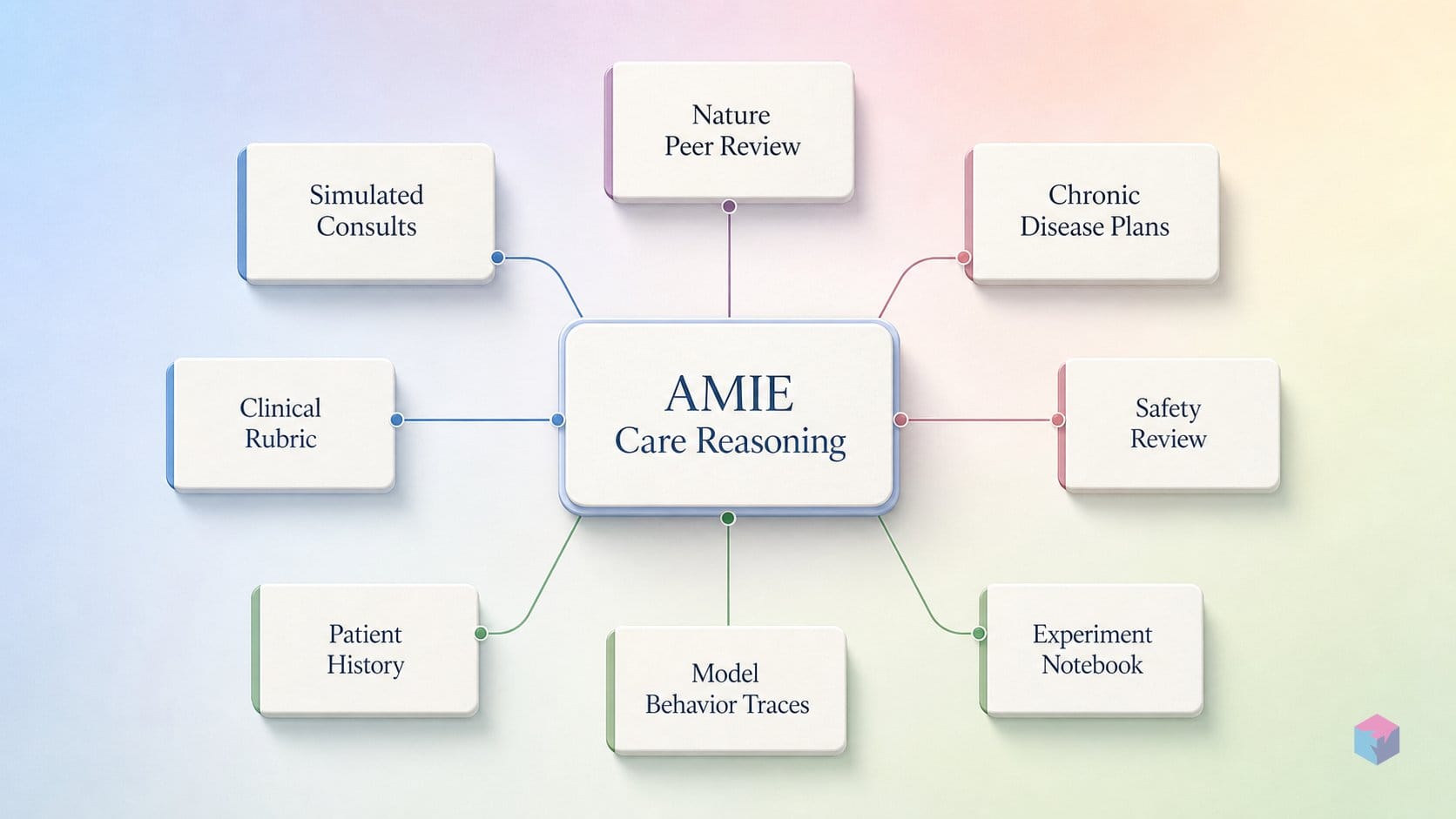
AMIE separates the conversation from the clinical reasoning into two distinct agents built on the Gemini model family . A user-facing Dialogue Agent handles the real-time patient exchange and carries visit history across sessions. A Management Reasoning Agent (the "Mx Agent") runs structured clinical reasoning separately, producing plans for investigations, treatments, prescriptions, and follow-up.
The Dialogue Agent was built on Gemini 1.5 Flash, replacing the earlier PaLM-2 base, and trained with supervised fine-tuning plus RLHF/RLAIF . Its job is narrow: maintain an empathetic, low-latency conversation and keep conversation state consistent as a patient returns across multiple visits. It does not do the heavy clinical planning.
The Mx Agent does. It performs deep, structured reasoning over patient context and clinical knowledge, using iterative drafting and structural constraints to produce plans grounded in guidelines and drug formularies . The grounding corpus is large and specific:
- 627 guideline documents: 527 NICE Guidance plus 100 BMJ Best Practice
- Medication grounding via the British National Formulary (BNF) and US FDA resources
- ~46 million characters / ~10.5 million tokens total across the corpus
Long context is load-bearing, not decorative. Per reasoning pass, the Mx Agent ran a coarse retrieval over the ~10.5M-token corpus, then loaded roughly six guideline documents into a 256,000-token external-knowledge window . Gemini's extended window is what lets the planning step reason over full guidelines rather than truncated snippets.
The portable principle for builders sits in that split. Separating stateful conversation from structured domain reasoning is the architectural primitive worth copying. The two roles can be different models, scaled independently, and optimized without coupling conversational latency to the slower, deeper planning passes.
Practically, that means a cheap, fast model can own the chat loop while a heavier reasoning model, fed retrieved authoritative context, owns correctness. You tune each for its own constraint: responsiveness on one side, grounded accuracy on the other. The pattern generalizes well beyond medicine to any domain where a real-time interface must sit on top of audited, rule-bound reasoning.
94% vs 67% on treatment plans: what the OSCE actually tested
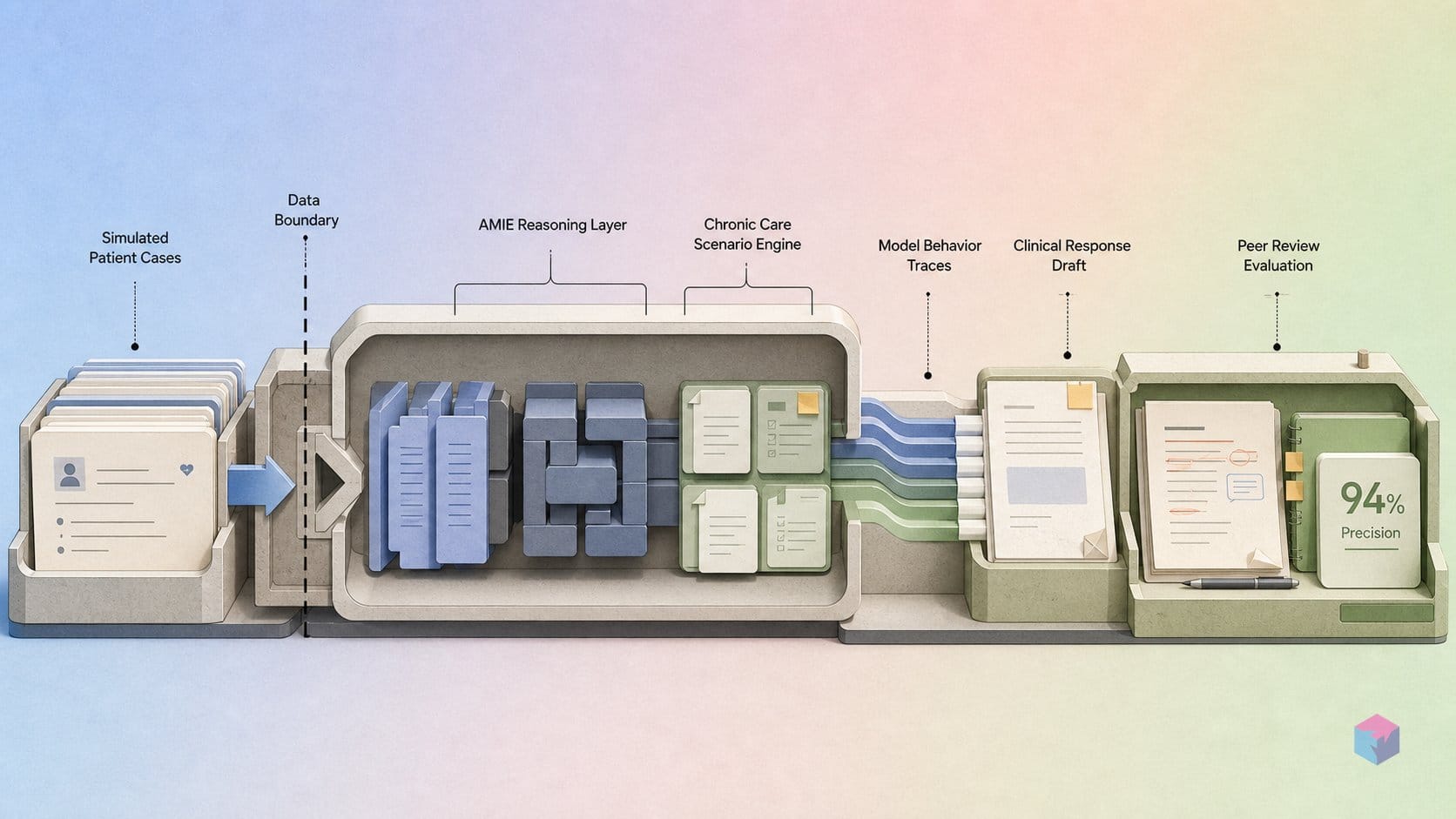
The headline gap comes from a randomized, blinded virtual OSCE in which specialist raters scored each treatment plan for precision. AMIE hit 94% treatment precision at the first visit against 67% for primary care physicians . The lead held across all three visits, and every difference was statistically significant . "Precision" here means how well the proposed investigations and treatments matched what the case warranted: fewer unwarranted orders, not just more of them.
Investigation precision started tied at 91% each at the initial visit, then diverged as cases unfolded. The pattern is the interesting part: AMIE's edge widens on later visits, where managing a patient depends on prior context rather than a fresh first impression.
| Metric | Visit 1 (AMIE / PCP) | Visit 2 | Visit 3 |
|---|---|---|---|
| Treatment precision | 94% / 67% | 90% / 70% | 91% / 70% |
| Investigation precision | 91% / 91% | 99% / 84% | 100% / 88% |
| Treatment guideline alignment | 89% / 75% | 91% / 76% | 93% / 81% |
| Explicit guideline citation | 98% / 86% | 100% / 87% | 100% / 88% |
Source: arXiv preprint 2503.06074 .
"AMIE was non-inferior to primary care physicians in overall management reasoning and superior in the precision of investigations and treatments and in alignment with clinical guidelines." Google Research / DeepMind authors, reporting the Nature results (source: Google Research).
Read the design before the numbers, though. This was text chat only, with trained patient actors working from fixed case scripts and constructed scenarios . Visits were spaced 1 to 2 actual days apart even when the narrative implied weeks or months, so real temporal dynamics (adherence drift, slow lab trends, recall gaps) were not exercised.
The scoring instrument also matters. Plans were graded on MxEKF, a rubric covering 15 management-plan axes built specifically for this study and not yet independently validated . So the verification gap is concrete: these are simulated-exam results scored on an in-house metric, not a measure of how AMIE performs against live patients or whether better plans translate into better outcomes.
RxQA: how the medication prescribing test was designed
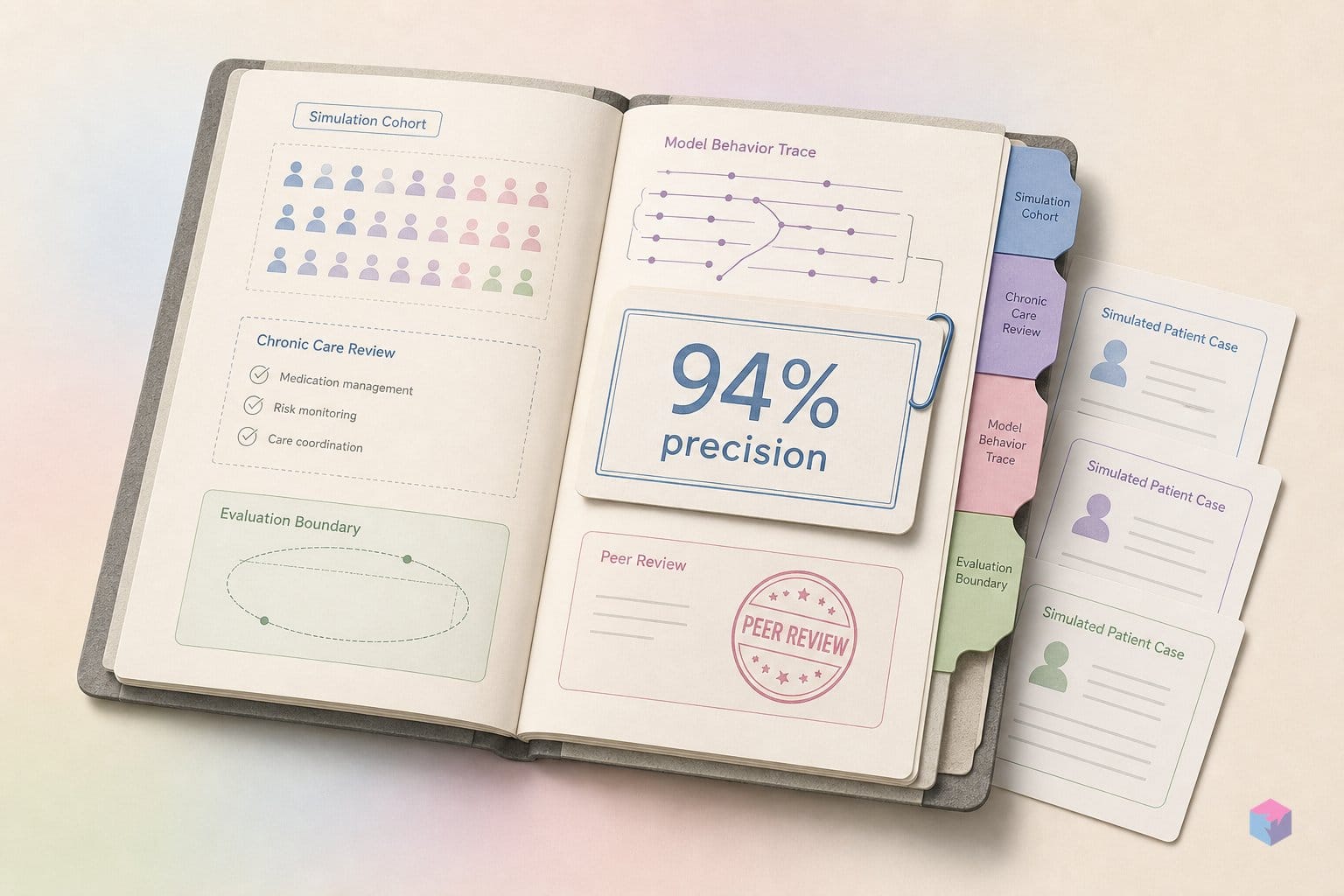
RxQA is a 600-question multiple-choice benchmark built to probe medication reasoning specifically, not general diagnosis. Google's team drew the items from OpenFDA and the British National Formulary, then had board-certified pharmacists revise them . The questions span five prescribing dimensions, which is what makes it relevant to chronic care where drugs are titrated over months.
The covered axes are:
- Indications: when a drug is the right choice
- Contraindications: when it is not
- Dosages, including titration ranges
- Side effects
- Drug interactions
The results show this is a hard test for everyone. On lower-difficulty questions in the open-book setting, peak accuracy stayed under 75%: AMIE at 73.8% versus 67.4% for primary care physicians . That ceiling matters: medication-specific recall is a measurable weak point even for trained clinicians with references in hand.
On the harder items, AMIE leads but both groups operate near chance.
| Higher-difficulty RxQA | AMIE | PCPs | Significance |
|---|---|---|---|
| Closed-book | 50.6% | 41.5% | p=0.013 |
| Open-book | 57.9% | 47.8% | p<0.001 |
The gaps are statistically significant , but a top score under 58% on the hardest questions is a reminder that neither AMIE nor human physicians have solved prescribing reasoning; they are differentiated at a low absolute level.
For developers, RxQA is arguably the most portable artifact in the paper. The OSCE setup needs validated patient actors, specialist raters, and a custom MxEKF rubric to reproduce. RxQA is pharmacist-validated, fully described, and runnable against any clinical LLM you want to test . That makes it a more durable contribution than the simulation it sits inside: a reusable yardstick rather than a one-off result.
Simulation passed, clinic pending: AMIE's remaining hurdles
AMIE's results are credible but single-source. Every number above traces to one peer-reviewed Nature paper published 17 June 2026, Google's own research blogs, and the March 2025 arXiv preprint 2503.06074 . No external lab has reproduced the OSCE setup or re-scored plans with the MxEKF rubric, so independent replication does not yet exist .
Several gaps sit outside what the study tested. The paper does not resolve how AMIE prevents hallucination as multi-visit state accumulates, nor how stored patient context is audited across visits. There is also a grounding mismatch worth flagging: comparator physicians came from North America and India, while case grounding leaned on UK NICE guidance and the British National Formulary .
The open questions a builder should track:
- Replication. Until another group runs the OSCE or the RxQA benchmark independently, the precision figures (94% vs 67% treatment precision at visit 1) remain unverified outside Google .
- Access. AMIE is not open-sourced. The authors cite the safety implications of unmonitored medical use and commit to working with research partners, regulators, and providers, with no timeline attached .
- Next targets. Congestive heart failure and diabetes are named as future application areas, both long-horizon conditions that would stress the multi-visit state handling the OSCE only simulated over 1 to 2 days .
One more dependency: the MxEKF rubric itself needs external validation before it can serve as a portable standard for evaluating clinical AI. Right now it is a Google-defined scoring instrument used by Google-recruited raters on Google-constructed scenarios.
The takeaway for builders: treat this as a methods contribution, not a deployable system. The reusable pieces (RxQA, the long-context two-agent pattern, and a multi-visit evaluation paradigm) are usable today. The clinical claims are not. A non-inferior result in a blinded simulation is a real milestone, but it is not regulatory clearance, deployment, or evidence of better patient outcomes .
Frequently asked questions
What is AMIE and how does it differ from a general-purpose medical chatbot?
AMIE (Articulate Medical Intelligence Explorer) is an internal research system from Google Research and Google DeepMind, not a consumer product. Unlike a general-purpose medical chatbot tuned for user satisfaction, AMIE uses a two-agent architecture grounded in specific guideline corpora (NICE, BMJ Best Practice, and the British National Formulary) and was evaluated against board-certified physicians in a formal, blinded OSCE rather than on engagement metrics .
Is AMIE available via API or for any clinical use?
No. AMIE has no API, no pricing, and no general availability. The Nature paper published 17 June 2026 is scientific validation of a methodology, not a product launch, and the authors explicitly state that further research is required before real-world translation . There is no clinical deployment, regulatory clearance, or evidence of improved patient outcomes.
What is an OSCE and why does this one's design matter?
An OSCE (Objective Structured Clinical Examination) is a standardized assessment used in medical training. AMIE's version was randomized and blinded: 21 validated patient actors from India and Canada played 100 multi-visit scenarios across three text-chat visits, and 10 specialist physicians blindly rated the plans . The gap between actor-based simulation and live clinical performance remains the central open question.
What is RxQA and can other teams run it?
RxQA is a 600-question multiple-choice medication-reasoning benchmark built from OpenFDA and the BNF and revised by board-certified pharmacists, covering indications, contraindications, dosages, side effects, and drug interactions . The paper documents its construction in enough detail to be reproducible, making it the most portable artifact here for anyone building or evaluating clinical AI.
Why does a two-agent split matter compared to a single-model approach?
Separating the user-facing Dialogue Agent (real-time conversation and multi-visit state) from the Management Reasoning Agent (structured clinical planning) lets each be optimized and scaled independently. The Mx Agent ran coarse retrieval over roughly 10.5 million tokens and loaded about six guideline documents into a 256,000-token context, heavy long-context work that would otherwise degrade conversational latency .