
Google's medical AI just graduated from answering "what's wrong?" to the harder question of "what do we do over the next three visits?", and the results land somewhere between impressive and carefully hedged.
What the AMIE chronic disease paper found
AMIE (Articulate Medical Intelligence Explorer) matched or exceeded 21 board-certified primary care physicians on 15 management-plan quality axes across three blinded, simulated virtual visits, according to Google Research . That is the core claim of the disease-management study (preprint arXiv:2503.06074, submitted 8 March 2025) , but it is a research result, not a shipped product.
The headline number specialist raters produced: first-visit care-plan appropriateness of 88% for AMIE versus 74% for PCPs (p = 0.019) . The evaluation spanned 100 multi-visit scenarios across five specialties (cardiology, pulmonology, OB/GYN/urology, gastroenterology, and neurology) with 21 validated patient actors and 10 specialist raters, all blinded to source .
But two different stories sit inside one paper. Plan quality favored AMIE on precision and guideline grounding; prescribing capability, measured separately on the new RxQA benchmark, peaked below 75% for both groups, a clear ceiling rather than a clean win . The rest of this article works through what AMIE actually changed, how it grounds its reasoning, and where the simulated setup stops short of real chronic care.
From diagnosis to longitudinal management: the core shift
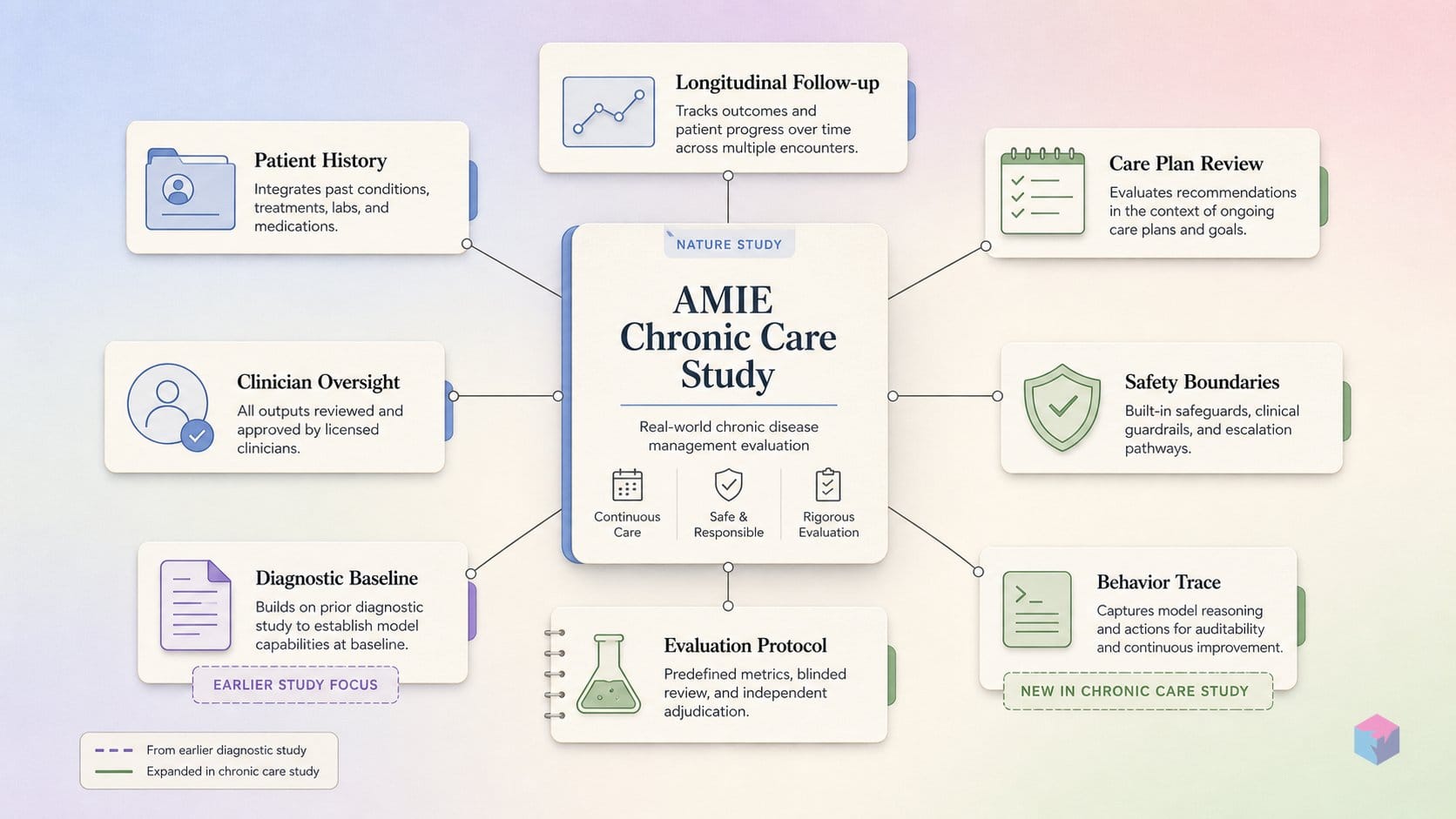
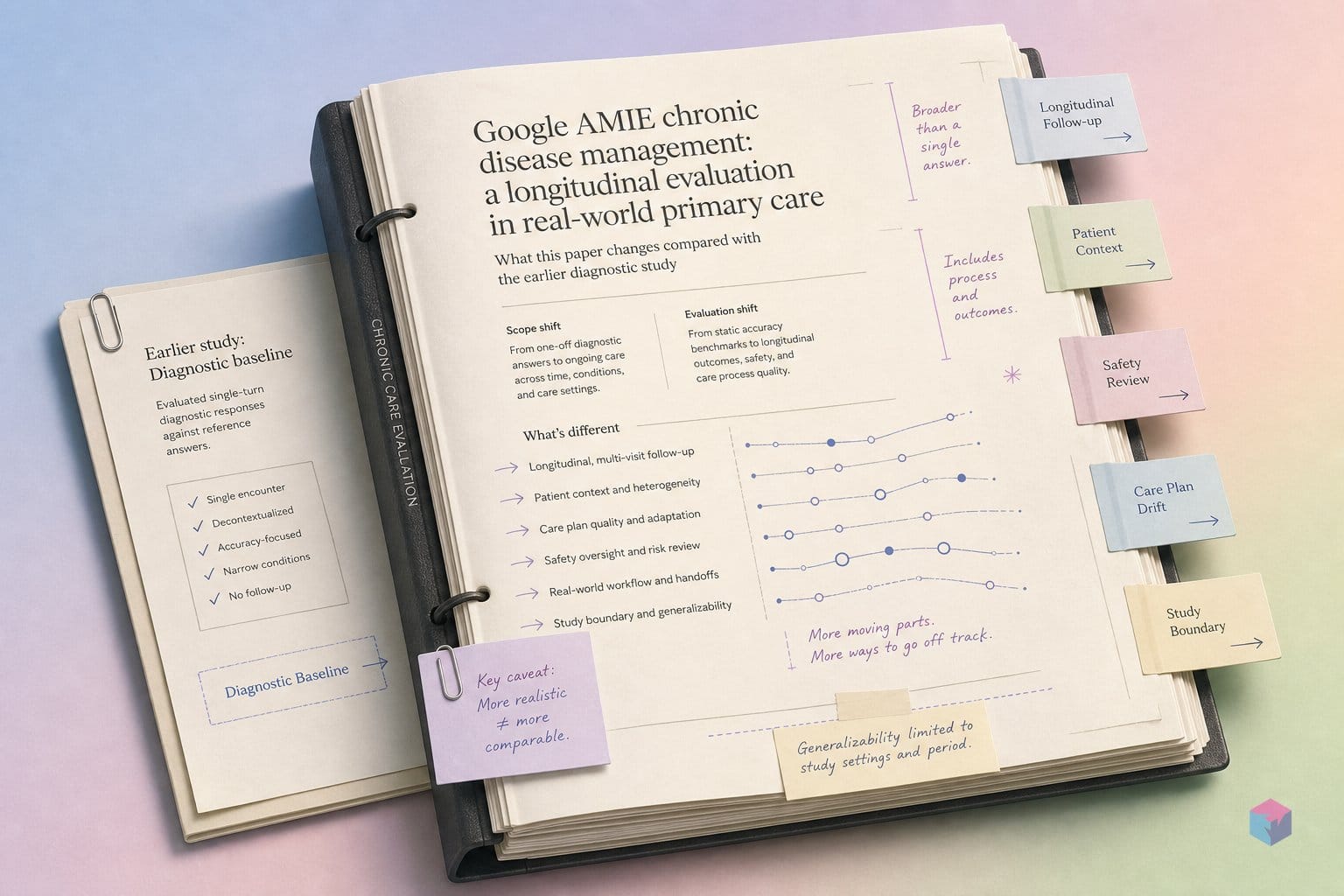
The shift is a change of question, not just a model upgrade. The original AMIE, published in Nature and submitted as a preprint on 11 January 2024 , was a PaLM 2-based system built for a single visit: take a history in text chat and output a differential diagnosis. The new disease-management paper, submitted 8 March 2025 , swaps the base model to Gemini 1.5 Flash, adds persistent state across visits, and generates a structured, citation-backed management plan at each appointment .
Put plainly, the scope moves from "can an AI reach a correct differential?" to "can an AI manage a patient across three appointments as the evidence evolves?" That is a different engineering problem. Diagnosis is a one-shot inference over a fixed history; management is a stateful loop where each visit must remember the last, react to test results, and adjust treatment without contradicting prior decisions.
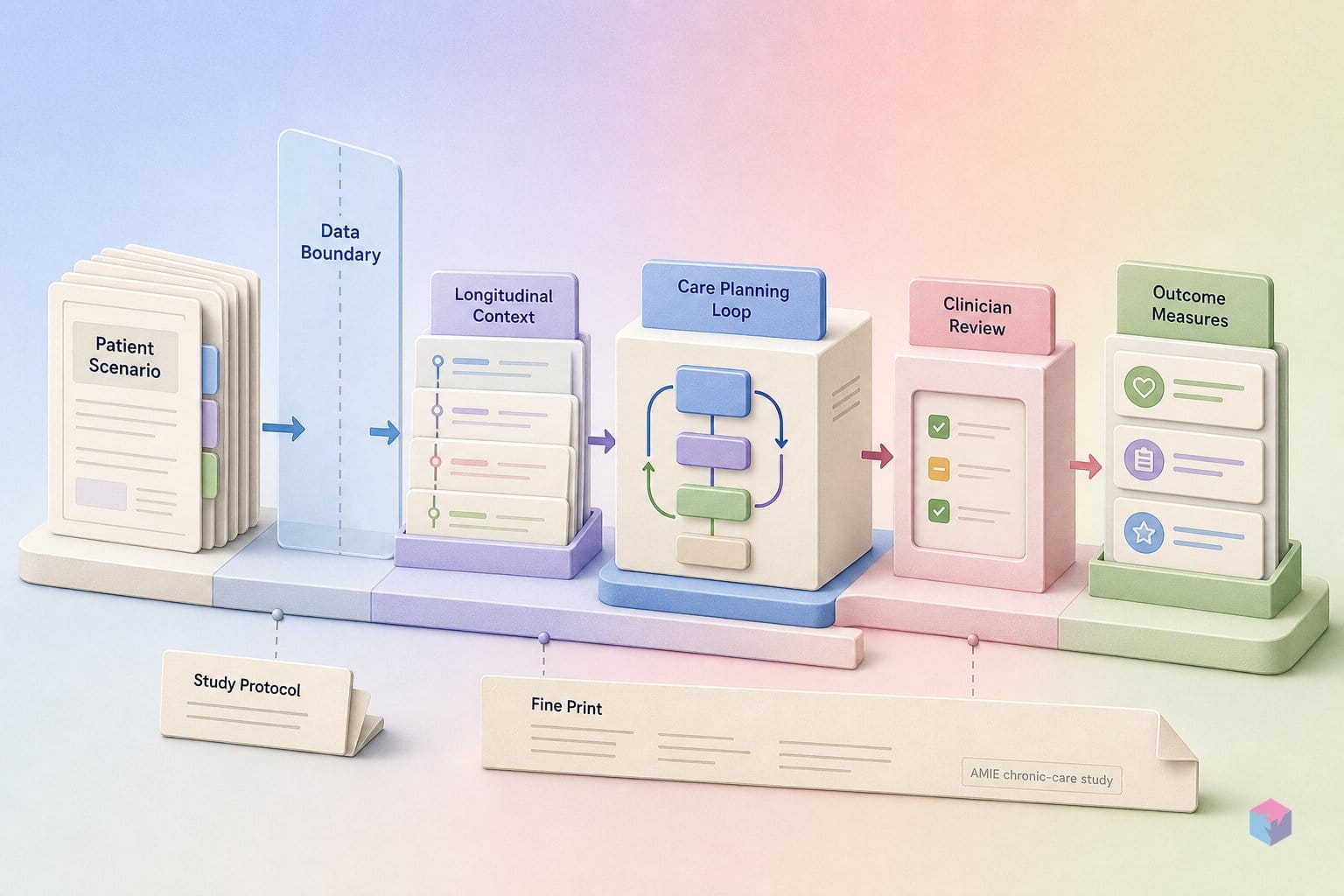
The case design reflects that. Across 100 multi-visit scenarios, each spanning three visits at least 24 hours apart in study logistics, the team deliberately built in evolving symptoms, treatment responses, test and imaging results, internal inconsistencies, and multi-morbidity, rather than the clean vignettes that flatter single-shot models . The multi-visit structure is the methodological novelty: it tests memory, synthesis, and consistent communication across an episode of care, not isolated accuracy.
The authors are explicit that this remains a constrained test. As the Google Research team notes of the earlier OSCE format, synchronous text chat "is unfamiliar to physicians and not normal clinical practice." That caveat carries straight into the longitudinal setup . The reframing matters because it sets up everything that follows: grounding, plan quality across visits, and prescribing limits.
How AMIE separates dialogue from clinical planning
AMIE splits the job in two: a patient-facing Dialogue Agent handles real-time, empathetic conversation, while a separate, slower Mx (management-reasoning) Agent runs guideline cross-referencing offline before any plan is surfaced . Both run on Gemini 1.5 Flash, but they are tuned for opposite priorities: responsiveness on one side, auditable reasoning on the other. This is the design pattern most directly transferable to anyone building clinical AI.
Quick Answer: AMIE uses a two-agent architecture: a Dialogue Agent talks to the patient in real time, while a slower Mx Agent reasons over clinical guidelines offline, drafts four candidate plans, merges them, and attaches a guideline citation to every recommendation, keeping auditable reasoning out of the latency path .
The Mx Agent does not answer in one pass. It generates four independent draft management plans, then refines and merges them into a single recommendation set, attaching a guideline citation to each recommendation before it reaches the conversation . The draft-and-merge step works like an ensemble: it surfaces competing options before committing, rather than emitting the first plausible plan. For builders, the takeaway is that plan quality here is a function of deliberate multi-draft reasoning, not a single prompt.
Drug knowledge is treated as a grounding problem, not a recall problem. Instead of trusting the base model's parametric memory for dosing or interactions, the Mx Agent grounds prescribing against the British National Formulary and FDA/OpenFDA labeling . The same instinct shows up in the dedicated RxQA benchmark the team built to test exactly this, a sign that medication safety was designed as a first-class, auditable subsystem rather than an emergent model behavior.
The reason to separate the two components is operational, not cosmetic. The Mx Agent's retrieval, multi-draft generation, and citation steps are expensive; running them inside the patient turn would add latency to every message. By keeping that reasoning offline, AMIE produces citation-backed, traceable plans while the Dialogue Agent maintains a fluent conversation.
"A user-facing dialogue agent manages real-time conversation, while a separate management-reasoning agent cross-references authoritative clinical knowledge to produce structured, citation-backed plans," according to the Google Research and Google DeepMind team (source: Google Research).
That division (empathetic conversation in front, slow guideline-grounded reasoning behind) is the architectural lesson worth porting outside healthcare. Wherever an answer must be both fast and defensible, decoupling the response layer from the verification layer lets each be optimized without compromise .
The 627-guideline corpus that grounds AMIE's care plans
The Mx Agent's authority comes from a fixed reference library, not the model's parametric memory. AMIE's reasoning layer draws on a corpus of 627 documents (527 from NICE Guidance and 100 from BMJ Best Practice) totaling roughly 10.5 million tokens of curated clinical knowledge . That corpus is what every citation-backed management plan is checked against, which is why the system can annotate recommendations with explicit guideline references instead of unverifiable assertions.
There is an obvious engineering constraint: Gemini 1.5 Flash, the base model here, has a context window of about 2 million tokens; the guideline corpus exceeds that by roughly 5× . Full-context loading is not an option at this scale, so AMIE retrieves at inference time. Gecko 1B embeddings plus model-generated search queries select the relevant material, allocating 256,000 tokens per inference call to external knowledge and pulling about six guideline documents on average for a given case .
| Knowledge layer | Scale | How it is used |
|---|---|---|
| Full guideline corpus | 627 docs / ~10.5M tokens | Indexed, not loaded |
| Gemini 1.5 Flash context | ~2M tokens | Hard ceiling (5× smaller than corpus) |
| Per-call external budget | 256K tokens | Retrieved via Gecko 1B embeddings |
| Docs used per case | ~6 on average | Selected by generated search queries |
Drug knowledge follows the same grounding discipline: rather than trusting parametric recall, AMIE checks medication reasoning against the British National Formulary and FDA labeling via OpenFDA . The agent then generates four draft management plans, refines and merges them, and attaches guideline citations to the result.
The implication generalizes well beyond clinical AI. Even a large, authoritative corpus cannot live in context; retrieval at inference time is the only workable pattern at this scale. For builders, the lesson is that grounding quality depends less on raw context size than on the embedding model, query generation, and the token budget you choose to spend per call.
AMIE vs PCPs on care plans: specialist ratings across visits
When ten specialist raters scored the plans blind, AMIE was rated non-inferior to 21 board-certified primary care physicians across all 15 management-plan quality axes over three visits, and clearly stronger on precision and guideline grounding . The pattern matters more than the headline: the gaps that favor AMIE are exactly the ones a retrieval-grounded reasoning agent should produce (fewer off-guideline treatments and more explicit citations), and several of them widen as the episode of care progresses.
Treatment precision is the largest and most consistent gap in the dataset. AMIE scored 94% / 90% / 91% across the three visits versus 67% / 70% / 70% for PCPs . Guideline alignment of treatment recommendations also favored AMIE and grew over time: 89% / 91% / 93% versus 75% / 76% / 81%, and explicit guideline references in the plans were near-total for AMIE (98% / 100% / 100%) against a stable ~87% for PCPs .
| Metric (Visit 1 / 2 / 3) | AMIE | PCPs |
|---|---|---|
| Treatment precision | 94% / 90% / 91% | 67% / 70% / 70% |
| Treatment guideline alignment | 89% / 91% / 93% | 75% / 76% / 81% |
| Explicit guideline references | 98% / 100% / 100% | 86% / 87% / 88% |
| First-visit plan appropriateness | 88% | 74% |
First-visit overall plan appropriateness was 88% for AMIE versus 74% for PCPs (p = 0.019), appropriate treatment at the first follow-up was 85% versus 71% (p = 0.014), and follow-up investigation precision reached 99% versus 84% at visit 2 and 100% versus 88% at visit 3 . The direction is uniform, which is itself a signal: precision advantages that hold across three separated visits are harder to attribute to a single lucky scenario.
The softer measure tempers the story. On the Management Reasoning Empirical Key Features rubric (MXEKF), which covers monitoring and adjustment, shared decision-making, competing priorities, prognostication, and encounter organization, roughly half of comparisons were ties or not applicable. Where a rater did express a preference, AMIE's median win rate was 42% versus 8% for PCPs across 51 rater-axis-visit combinations .
"AMIE was non-inferior to PCPs across management-plan quality axes and demonstrated higher precision and guideline-aligned reasoning," reported the Google Research and DeepMind team, framing the result as comparable judgment with tighter grounding rather than a wholesale replacement (source: Google Research).
Read carefully, the numbers say AMIE is more consistently on-guideline and better at citing its work, while raters split nearly evenly on the harder-to-quantify reasoning skills. That is a precision-and-traceability win, not proof of better clinical judgment. The next section's prescribing results sharpen that distinction further.
Drug prescribing in chronic care: where the ceiling is
Prescribing is where AMIE's lead narrows to something honest. To probe medication safety directly, the team built RxQA, a 600-question multiple-choice benchmark derived from OpenFDA and the British National Formulary and revised by board-certified pharmacists, covering indications, contraindications, dosing, side effects, and interactions . The items split into 282 lower-difficulty and 318 higher-difficulty questions, and AMIE's drug knowledge was grounded against the BNF and FDA labeling rather than left to parametric recall . RxQA matters less as a scoreboard than as a reusable public artifact: clinical-AI builders can run their own systems against the same questions to stress-test pharmacological reasoning.
The scores reward caution. On lower-difficulty open-book items, peak performance reached 73.8% for AMIE versus 67.4% for the PCPs . The gap is real, but the absolute ceiling is not high: neither group cleared 75% even with reference material open. On the harder items the ordering held and the margin widened: AMIE scored 57.9% against 47.8% open-book (p < 0.001), and 50.6% versus 41.5% closed-book (p = 0.013) .
Read against the care-plan ratings, the pattern is consistent rather than contradictory. AMIE is more reliably on-guideline and edges out clinicians on isolated pharmacology questions, but a sub-75% peak on a contrived multiple-choice test is a sobering data point for anyone imagining autonomous titration or interaction-checking in production. Higher-difficulty dosing and contraindication questions are exactly the cases where a wrong answer harms a patient, and that is where both groups still missed roughly half the time. The takeaway for builders: treat grounded drug knowledge as an assist that needs verification, not a settled capability, and use RxQA as the kind of adversarial benchmark that surfaces the ceiling before deployment does.
What AMIE's simulated chronic care doesn't cover yet
AMIE's chronic-care results come from a simulated, text-only OSCE, which means the full clinical information environment that real disease management depends on is absent. There is no EHR chart access, no imaging review, no real lab integration, and no order entry; the system reasons only over what arrives in the chat transcript . A care plan that looks rigorous against a clean dialogue can still fail when it has to reconcile a messy chart, a borderline imaging read, or a conflicting prior order.
Two further constraints bound the generalizability of the numbers in earlier sections:
- Compressed timelines. The three visits per case were separated by at least 24 hours in study logistics, but real chronic disease unfolds over weeks or months between appointments . The test of longitudinal memory is real; the test of long-interval drift is not.
- UK-centric guidelines. The 627-document corpus draws on NICE Guidance and BMJ Best Practice, with no local formulary adaptation for other health systems . Plans grounded in one jurisdiction's pathways do not transfer unedited to another's.
The authors are explicit about the deployment gap: AMIE's code and weights are not open-sourced, citing patient safety, and they call for prospective feasibility studies with ethical and safety oversight before any clinical use .
"Clinical use requires prospective feasibility studies with appropriate ethical and safety oversight," according to the Google Research / DeepMind AMIE team (source: Google Research).
That caution is warranted by the one real-world data point so far. A separate 2026 feasibility study of 100 urgent-care adults reported no required safety-supervisor stoppages, the final diagnosis in AMIE's differential 90% of the time, and 75% top-3 accuracy, but that was pre-visit diagnostic support, not longitudinal management, and PCPs still outperformed AMIE on the practicality and cost-effectiveness of plans .
The concrete takeaway: read this paper as a strong existence proof that guideline-grounded, multi-visit reasoning can match PCPs in a controlled setting, not as evidence of safe autonomous chronic care. If you build on this pattern, treat the simulated OSCE numbers as an upper bound, design for the EHR, imaging, and order-entry surfaces AMIE never touched, and assume local guideline adaptation and prospective trials are prerequisites, not afterthoughts.
Frequently asked questions
How does the AMIE disease management paper differ from the original diagnostic AMIE study?
The two studies share a name but differ in base model, scope, and outcome instruments. The original AMIE ("Towards conversational diagnostic artificial intelligence," arXiv:2401.05654, submitted January 2024) was a PaLM 2-based system optimized for single-visit history-taking and differential diagnosis, evaluated over 149 OSCE scenarios . The disease-management paper (arXiv:2503.06074, submitted March 2025) switches the base model to Gemini 1.5 Flash, adds persistent state across three visits, and replaces a diagnosis-centric metric with 15 management-plan quality axes, guideline grounding, and a dedicated prescribing benchmark (RxQA) .
What is the Mx component in AMIE's chronic care design and why does the separation matter?
The Mx Agent is a dedicated management-reasoning layer that runs slowly and offline from the live patient conversation, while a separate empathetic Dialogue Agent handles real-time chat. The Mx Agent queries the 627-document guideline corpus, generates four independent draft management plans, refines and merges them, and annotates each recommendation with guideline citations . The separation matters because it produces auditable, citation-backed plans without blocking responsive dialogue. That is the transferable pattern for builders: decouple the user-facing conversation from heavier retrieval-grounded reasoning.
What is RxQA and can I use it to benchmark my own clinical-AI system?
RxQA is a 600-item multiple-choice pharmacology benchmark introduced in this paper, derived from OpenFDA and the British National Formulary and revised by board-certified pharmacists. It splits into 282 lower-difficulty and 318 higher-difficulty items covering indications, contraindications, dosing, side effects, and interactions . The authors position it as a reusable community benchmark for safe-prescribing evaluation; check the paper's supplementary material for access details before integrating it into your own test suite.
Is AMIE's chronic disease management capability available via an API or open-source release?
No. AMIE's code and model weights are not open-sourced, and the authors cite patient safety as the explicit reason . There is no SDK, API endpoint, or checkpoint to download. What is available is the architecture: a separate dialogue agent and management-reasoning agent, with retrieval over a guideline corpus and drug grounding against authoritative labeling. That pattern is documented and reproducible with your own stack, but you cannot call or fine-tune AMIE itself.
What does 'non-inferior to PCPs' actually mean in this evaluation context?
It means specialist raters, blinded to the source of each plan, judged AMIE's management plans at least as good as those from board-certified primary care physicians across the 15 management axes over three visits, and stronger on precision and guideline grounding . It does not mean AMIE is safe or ready for autonomous clinical use. The result holds inside a simulated, text-only OSCE with no EHR integration, no real order entry, and no measured patient outcomes; the authors state real-world use requires prospective feasibility studies with ethical and safety oversight.