

For two years, AMIE was a diagnostic chatbot: one conversation, one differential, done. Google's latest work pushes it past that single visit into the messier reality of ongoing care — choosing therapies, ordering tests, and writing prescriptions across multiple appointments.
AMIE's Extended Scope: Therapy Selection, Follow-up, and Prescribing
AMIE (Articulate Medical Intelligence Explorer) is Google Research and Google DeepMind's medical large-language-model system, and its newest study extends it from one-off diagnosis into longitudinal disease management. Where earlier AMIE produced a differential diagnosis and stopped, the disease-management version reasons about continuing care: therapy selection, monitoring disease progression, evaluating therapeutic response, ordering appropriate investigations, scheduling follow-up, and guideline-aligned prescribing . That is a conceptual shift from answering "what is wrong" to managing "what happens next."
Quick Answer: AMIE is Google's medical LLM, now extended from single-visit diagnosis to multi-visit disease management — therapy selection, monitoring, investigations, follow-up, and prescribing. The disease-management study was accepted at Nature on 4 June 2026, with an accelerated preview surfacing around 21 June 2026.
This builds directly on the 2025 Nature diagnostic paper (preprinted as arXiv:2401.05654), which established AMIE's conversational diagnosis line of work . The disease-management extension was first posted to arXiv on 8 March 2025 (arXiv:2503.06074), then cleared peer review at Nature — accepted 4 June 2026 and released as an accelerated article preview that surfaced in coverage on or around 21 June 2026 .
The clinical cases were constructed around UK NICE Guidance and BMJ Best Practice content, and that grounding is now structural: Google DeepMind has partnered with BMJ to make BMJ Best Practice a formal reference standard for its clinical-AI evaluation . One framing caveat matters before reading any benchmark number: Google calls this strictly experimental. There is no product launch, no deployment timeline, and no open weights — the model code and weights are withheld, citing the safety risk of unmonitored medical use .
Separating the Patient-Facing LLM from the Prescribing Reasoner
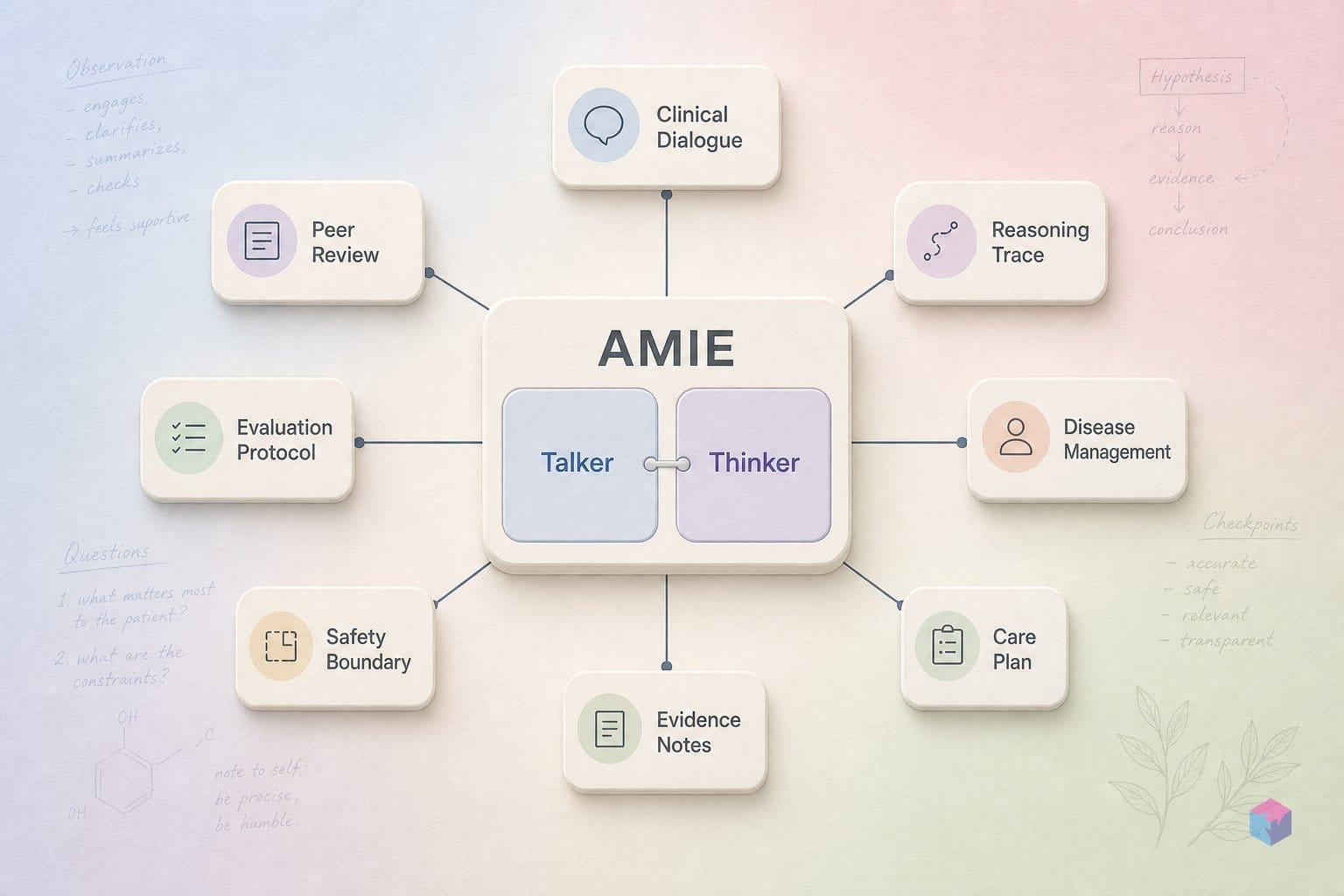
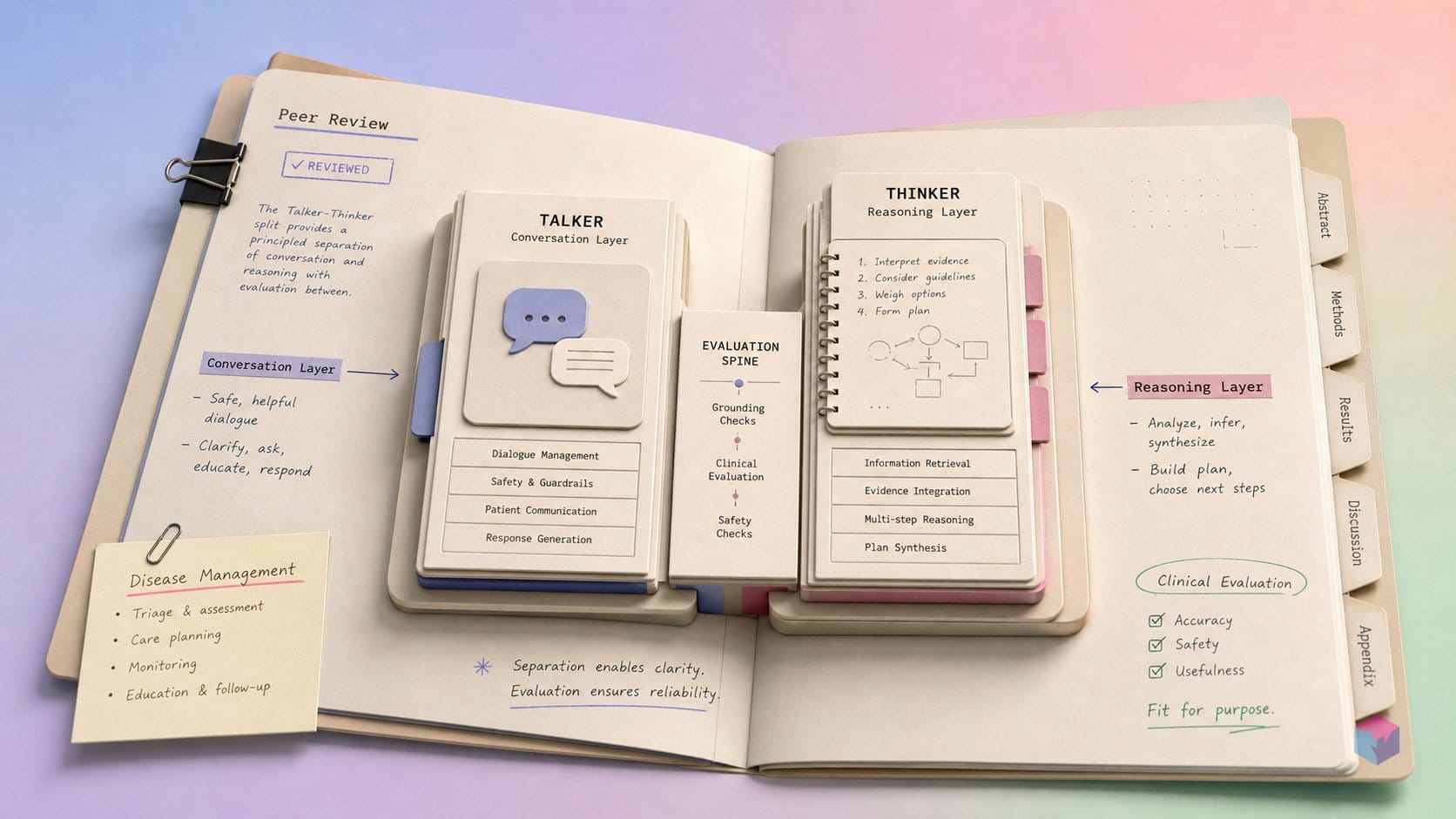
AMIE's biggest architectural change is that it stopped being one model. The disease-management version splits into two agents: a patient-facing Dialogue Agent that runs the live text conversation, and a separate Management Reasoning Agent — the authors call it the "Mx Agent" — that does the heavy clinical reasoning offline from the chat. This decouples a latency-sensitive front end from a slow, document-grounded back end, and it is the part of the paper most worth copying .
The Dialogue Agent handles the synchronous, empathetic exchange: it gathers history, maintains state across the multiple appointments, and keeps the conversation moving. It runs on Gemini 1.5 Flash with supervised fine-tuning plus RLHF/RLAIF over medically relevant tasks — a deliberate swap from the PaLM-2 base used in the earlier diagnostic AMIE work . Flash is the cheaper, faster tier, which fits a component whose job is responsiveness, not deep retrieval.
The Mx Agent does the opposite. It uses a Gemini long-context model to cross-reference the full longitudinal patient record against authoritative sources — hundreds of pages of clinical guidelines and drug formularies — and emits a structured, multi-visit care plan with inline citations back to that source material . The reasoning is grounded in documents the model reads at inference time, not baked into weights, so the care plan can point at the guideline it followed.
The model-family choice was explicit. The team cites Gemini's long-context capability and comparatively low hallucination rates as the reasons it anchors the reasoning agent there rather than in a smaller or shorter-context model . When you are pulling guideline text and a patient timeline into a single prompt and asking for prescribing decisions, context window and fabrication rate are the constraints that actually bind.
"Long-context reasoning lets the management agent cross-reference a full longitudinal record against authoritative guidelines and formularies before proposing a plan," is how the Google Research and DeepMind authors frame the design (source: Google Research).
Strip away the medicine and the portable pattern is plain: a fast conversational front end for the user-facing loop, plus a slower, retrieval-grounded reasoning back end for anything that has to be correct against external authority. For developers building vertical LLM applications — legal, finance, compliance — that separation of concerns is the transferable lesson, independent of whether AMIE itself ever ships .
Formulary-Based Drug Exam: PCP vs. AMIE Across Difficulty Tiers
To stress-test that reasoning back end on medication decisions specifically, the team built RxQA, a new benchmark of roughly 600 multiple-choice questions derived from two national drug formularies — the US OpenFDA dataset and the British National Formulary (BNF) . Board-certified pharmacists validated the answers and calibrated each item into a lower-difficulty tier (N=282) and a higher-difficulty tier (N=318), spanning indications, contraindications, dosing, side effects, and drug interactions . RxQA matters because no comparable open, formulary-grounded medication-reasoning benchmark existed at this scope, which lowers the construction cost for anyone evaluating clinical LLMs.
The results split cleanly by difficulty. On lower-difficulty open-book questions, AMIE reached 73.8% against 67.4% for primary care physicians (PCPs) — a gap that does not clear standard significance thresholds (p=0.071). The separation appears on the harder, label-dependent items, exactly where retrieval-grounded reasoning over the formulary text should pay off.
| RxQA tier / condition | AMIE | PCPs | Significance |
|---|---|---|---|
| Lower-difficulty, open-book (N=282) | 73.8% | 67.4% | p=0.071 (not significant) |
| Higher-difficulty, open-book (N=318) | 57.9% | 47.8% | p<0.001 |
| Higher-difficulty, closed-book | 50.6% | 41.5% | p=0.013 |
On the higher-difficulty tier, AMIE scored 57.9% versus 47.8% open-book (p<0.001), and 50.6% versus 41.5% closed-book (p=0.013) . Two things are worth flagging for builders. First, even the winning system tops out near 58% on the hard questions — RxQA is genuinely difficult for humans and machines alike, so it is a discriminating benchmark rather than a saturated one. Second, AMIE's edge widens when the questions demand the kind of label-dependent retrieval its Management Reasoning Agent is built for, and narrows to statistical noise on routine items most clinicians answer from memory. That pattern — gains concentrated where grounding against external authority is decisive — is the empirical case for the dialogue-plus-reasoner split, not just an architectural preference .
Blinded Specialist Assessment: Simulated Appointments Across 21 PCPs
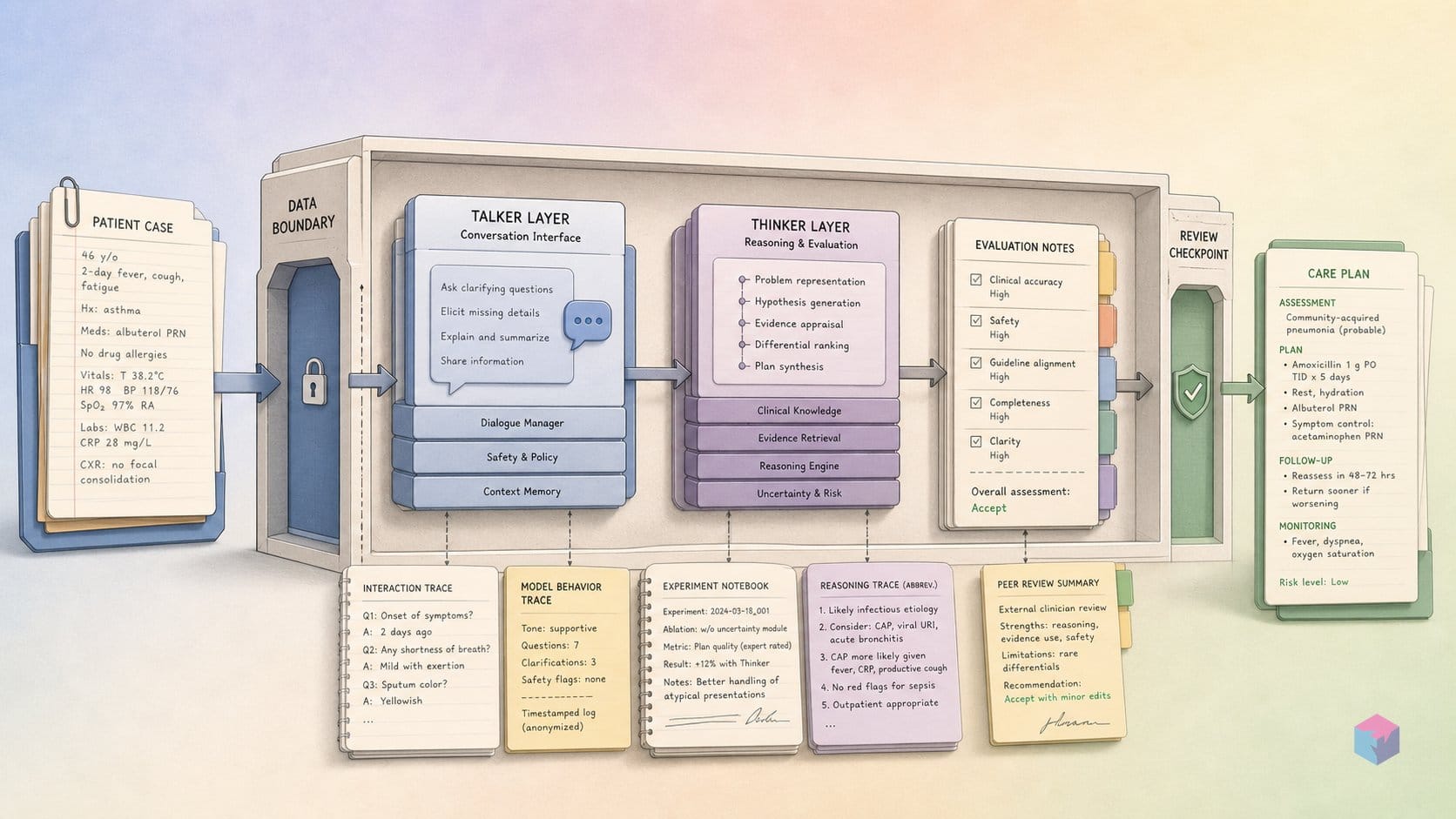
The core evidence comes from a randomized, blinded virtual OSCE in which AMIE was measured against 21 primary care physicians across 100 multi-visit case scenarios, each structured as three text-based appointments to simulate longitudinal follow-up . Trained patient actors played the patients, and specialist physicians — blind to whether they were scoring AMIE or a human — graded every encounter across 15 management-plan axes over the three visits. Cases were built on UK NICE Guidance and BMJ Best Practice content, anchoring the rubric to published standards rather than rater intuition .
Overall, raters judged AMIE's management plans at least as good as PCP plans, with significant separation on specific dimensions. First-appointment overall appropriateness landed at 88% for AMIE versus 74% for PCPs (p=0.019), and appropriate follow-up recommendations at the first visit reached 100% versus 98% (p<0.001) . Those margins matter less for the headline number than for what they reveal about consistency: AMIE rarely dropped a required follow-up step that a guideline would expect.
The widest and most stable gap was specificity — whether a recommendation was precise enough to act on, rather than vaguely correct. Treatment-recommendation specificity held near 90% for AMIE across all three appointments while PCPs sat around 70%, and investigation specificity diverged after the first visit as AMIE selected appropriate tests while avoiding unnecessary ones, citing the underlying guideline each time.
| Specificity axis | Visit 1 | Visit 2 | Visit 3 |
|---|---|---|---|
| Treatment — AMIE | 94% | 90% | 91% |
| Treatment — PCPs | 67% | 70% | 70% |
| Investigation — AMIE | 91% | 99% | 100% |
| Investigation — PCPs | 91% | 84% | 88% |
Investigation specificity started tied at 91% on the first appointment, then AMIE pulled ahead to 99% versus 84% on visit two and 100% versus 88% on visit three . The pattern points to the same mechanism the formulary results exposed: the Management Reasoning Agent's long-context grounding pays off most where a plan must be defended against an explicit reference standard.
"Specialist raters judged AMIE's management plans to be at least as good as those from primary care physicians overall, and significantly better on several specific axes including the precision of treatment and investigation recommendations." — Google Research, summarizing the Nature study (source: Google Research, 2026-06)
Where AMIE Outperformed PCPs on Specificity — and Where Differences Vanished
AMIE's most durable edge was specificity, not appropriateness. Across the three simulated visits, specialist raters judged AMIE's treatment recommendations "sufficiently precise" 94%, 90% and 91% of the time, versus 67%, 70% and 70% for primary care physicians . Investigation precision started level at 91% on visit one, then separated to 99% versus 84% on visit two and 100% versus 88% on visit three . The pattern is consistent: AMIE selected appropriate tests while avoiding unnecessary ones, and it tied each step to a named guideline.
That grounding is the mechanism behind the gap. Plans that cite NICE or BMJ Best Practice content explicitly are easier for a blinded specialist to rate as precise, because the reference standard is on the page rather than implied.
"Specialist raters judged AMIE's management plans to be at least as good as those from primary care physicians overall, and significantly better on several specific axes including the precision of treatment and investigation recommendations." — Google Research, summarizing the Nature study (source: Google Research, 2026-06)
The advantage is conditional, though. On lower-difficulty RxQA items, AMIE scored 73.8% against 67.4% for PCPs — a difference that was not statistically significant (p=0.071). AMIE's drug-knowledge lead concentrated on harder, label-dependent questions, which matters for deployment: in routine, low-complexity decisions the model offered no measurable benefit over a physician. The open-book RxQA setup also inherently favors retrieval-augmented systems. The closed-book result — AMIE 50.6% versus 41.5% (p=0.013) — is the more informative signal for any workflow without live formulary access at inference time.
Read these percentages as pilot-scale feasibility signals, not production-floor guarantees. The authors note that the 15-axis management-scoring rubric still requires further independent validation, so the margins reflect a controlled OSCE under one scoring framework rather than a settled accuracy floor for real care .
What the Authors Flagged: Patient Actors, Artificial Timelines, No Measured Outcomes
Every limitation in this study points the same direction: it was a controlled simulation, not clinical evidence. AMIE is explicitly experimental and untested in real care, and the authors are direct about why the OSCE numbers should not travel unchanged into a deployment decision . The encounters used trained patient actors, constructed cases, and text-only visits — none of the three is how routine primary care actually runs .
Several design choices compress or sidestep real-world difficulty:
- Artificial timelines. Inter-visit gaps were roughly 1–2 days , not the weeks-to-months intervals over which chronic disease actually progresses — so longitudinal "follow-up" was tested without the memory, drift, and lost-to-follow-up problems clinicians face.
- Geographic and guideline mismatch. Cases were built on UK NICE Guidance and BMJ Best Practice, while the 21 comparison PCPs were drawn from North America and India — a home-field advantage for an agent grounded in those same documents.
- Single-system oversimplification. Simulated single-health-system scenarios omit the fragmented records, referrals, and payer constraints of real practice, and the text-only interface diverges from multimodal telehealth .
The measurement gaps matter just as much. No real patient outcomes were recorded; the study measured rubric scores, not recovery, harm, or cost . The 15-axis management-scoring rubric still needs further validation, and RxQA may over-index hard, label-dependent items relative to real-world, pharmacist-supported medication decisions .
For builders, the most consequential caveat is access: AMIE's model code and weights are not open-sourced, with Google citing the safety risks of unmonitored medical use . Google describes a nationwide randomized study of AI in real-world virtual care as future work, but no timeline, product, or pricing has been announced . Treat this as a feasibility milestone you can learn architecture from — not a system you can run, audit, or deploy.
Architecture Takeaways: Why the Separation of Concerns Held Up
The most portable result here is architectural, not medical: split the patient-facing conversation from the authoritative-document reasoning, and run each on a model tuned for its job. AMIE routes the synchronous chat to an empathetic Dialogue Agent built on Gemini 1.5 Flash with supervised fine-tuning plus RLHF/RLAIF, while a separate deep-thinking Management Reasoning Agent ("Mx Agent") uses Gemini long-context reasoning to cross-reference a full longitudinal record against hundreds of pages of guidelines and formularies . That dialogue-plus-reasoner pattern, grounded in long-context retrieval over vetted corpora, is the design choice you can lift into other domains.
Two assets make this more than a single study. First, RxQA — roughly 600 multiple-choice questions drawn from OpenFDA and the British National Formulary, validated and difficulty-rated by board-certified pharmacists — is now a reusable, formulary-grounded medication benchmark, which lowers the cost of evaluating clinical LLMs instead of rebuilding a test set per team . Second, Google DeepMind has adopted BMJ Best Practice as a formal reference standard for clinical AI evaluation . That signals where guideline-anchored benchmarking is heading: expect analogous authoritative-corpus patterns in any vertical with established long-document standards — legal codes, financial regulations, engineering specifications.
The practical constraint is the part teams will underweight. AMIE's measured advantages — precise treatment recommendations rated 94%, 90% and 91% across three visits versus PCPs at 67%, 70% and 70% — lean heavily on licensed, current guideline and formulary content feeding the reasoner . Build the same two-component architecture without authoritative external corpora and you get a materially weaker reasoner; the structure is portable, but the grounding is the product.
The concrete takeaway: copy the separation of concerns and the long-context grounding now, and budget for the licensed corpus and a domain benchmark before you expect the precision gains to follow.
Frequently asked questions
What is Google's AMIE disease management system?
AMIE (Articulate Medical Intelligence Explorer) is Google Research and Google DeepMind's large-language-model medical AI. The disease-management extension, published in Nature as an accelerated article preview around mid-June 2026 , moves AMIE beyond one-off diagnosis into longitudinal care: therapy selection, ordering appropriate investigations, monitoring disease progression, evaluating therapeutic response, scheduling follow-up, and guideline-aligned prescribing. It builds on the earlier diagnostic AMIE work that Nature published in 2025 .
How does the two-component architecture in the new AMIE work?
AMIE splits one chatbot into two specialized agents. An empathetic Dialogue Agent — built on Gemini 1.5 Flash with supervised fine-tuning plus RLHF/RLAIF, replacing the earlier PaLM-2 base — runs the real-time, patient-facing text conversation and maintains state . A separate deep-thinking Management Reasoning Agent (the "Mx Agent") uses Gemini long-context reasoning to cross-reference the full longitudinal patient record plus hundreds of pages of clinical guidelines and drug formularies, producing a structured multi-visit care plan with citations . Long-context capacity and low hallucination rates were the stated reasons for choosing the Gemini family.
What is RxQA and what did AMIE's scores show?
RxQA is a new benchmark of roughly 600 multiple-choice medication questions derived from national drug formularies — OpenFDA and the British National Formulary — with difficulty tiers validated and rated by board-certified pharmacists . AMIE's advantage concentrated on harder, label-dependent items: on higher-difficulty open-book questions it scored 57.9% versus 47.8% for primary care physicians (p<0.001), but the lower-difficulty gap (73.8% versus 67.4%) was not statistically significant (p=0.071) .
Was the OSCE evaluation conducted with real patients?
No. The randomized, blinded virtual OSCE used trained patient actors across 100 multi-visit case scenarios, each structured as three text-based simulated appointments, with specialist physicians scoring encounters blind across 15 management-plan axes . No real clinical outcomes were measured — a limitation the authors explicitly flag, alongside a geographic-guideline mismatch (UK-based NICE and BMJ Best Practice cases scored against PCPs drawn from North America and India) and artificially short 1–2 day inter-visit gaps .
Can developers access AMIE or its model weights?
No. AMIE's model code and weights are not open-sourced; Google cites the safety implications of unmonitored medical use . The transferable artifacts are the dialogue-plus-reasoner architectural pattern and RxQA as a reusable, open-formulary medication-reasoning benchmark. Google describes a nationwide randomized study of AI in real-world virtual care as future work, but no product, pricing, availability, or timeline has been announced .