

Google's medical AI just cleared a higher bar than diagnosis. In a blinded trial published this week, AMIE's multi-visit treatment plans were rated non-inferior to primary care physicians, and on prescription precision, it pulled ahead.
AMIE in Nature 2026: what the longitudinal trial showed
AMIE (the Articulate Medical Intelligence Explorer) is Google's research system for clinical conversation, and its second Nature paper moves it from one-shot diagnosis to longitudinal disease management: planning, prescribing, and titrating treatment across multiple visits. Published June 17, 2026 by Google Research and Google DeepMind , the study reports that specialist raters judged AMIE's management plans non-inferior to PCPs across 15 scored axes, and significantly better on several, including overall plan appropriateness at the first visit (88% vs 74%, p=0.019) and treatment recommendation precision (94% vs 67%) .
Quick Answer: In a randomized, blinded virtual OSCE of 100 multi-visit scenarios, Google's AMIE produced treatment plans rated non-inferior to primary care physicians and more precise on prescriptions: 94% vs 67% treatment-recommendation precision at visit 1 . It is a research result, not a deployed product.
Read the format before the headline. This was a randomized, blinded virtual Objective Structured Clinical Examination: 100 scenarios, three visits each, scored by specialist raters who did not know whether a plan came from AMIE or a human . There were no real patients, no electronic health record, and the entire interaction was text-only, closer to a controlled exam than a clinic.
It is also the second AMIE paper, and the architecture changed. The 2025 Nature study covered diagnostic dialogue on a PaLM 2-based system ; the 2026 work rebuilds AMIE on Gemini 1.5 Flash for treatment planning and titration across visits . Alongside the paper, the team released RxQA, a 600-item medication-reasoning benchmark derived from OpenFDA and the UK British National Formulary, as a reusable external evaluation .
Diagnosis was the floor: AMIE's move to longitudinal care
The shift from the 2025 to the 2026 AMIE is a shift in job description. The diagnostic AMIE was optimized for a single encounter (clinical history-taking and differential-diagnosis dialogue) and was judged primarily on diagnostic accuracy and conversational quality . The 2026 management AMIE assumes the diagnosis is already in hand and asks the harder follow-on question: what to prescribe, how to titrate it, and what to monitor over multiple visits . The paper's own framing is that diagnosis is necessary but insufficient for care.
"Diagnosis is necessary but insufficient for care" is the central argument of Towards conversational AI for disease management, which reframes AMIE around management reasoning rather than diagnosis (source: Nature, 2026-06).
In practice, "management reasoning" expands AMIE's scope to a set of tasks the diagnostic version never owned :
- Selecting and timing investigations rather than only reaching a differential.
- Prescribing and titrating treatments, then reasoning over treatment response and disease progression.
- Ensuring medication safety and grounding choices in authoritative guidelines.
- Arranging follow-up across an evolving multi-visit picture.
The question shifts from "what is wrong with the patient" to "what should be done, over multiple visits, and is it guideline-concordant and safe" .
The authors argue this is where AI has the most leverage. Fragmented care (patients moving between clinicians with no single owner of the longitudinal plan) is the failure mode that multi-visit continuity is meant to address, and they point specifically at chronic conditions such as heart failure and diabetes as candidate beneficiaries . That is the motivation rather than a demonstrated outcome: the study rebuilds AMIE on Gemini 1.5 Flash for treatment planning and titration across visits , but it stops short of proving improved chronic-disease results in a prospective trial.
One caveat is baked into the methodology. To score management quality, the team had to invent its own yardstick, the Management Reasoning Empirical Key Features (MXEKF) rubric, created specifically for this paper . The authors list it as a stated limitation: MXEKF has not yet received external validation, so the instrument measuring AMIE's gains is itself new and unproven. For a developer reading benchmark claims, that is the line to underline: the metric and the result shipped together .
How AMIE separates bedside manner from prescription planning
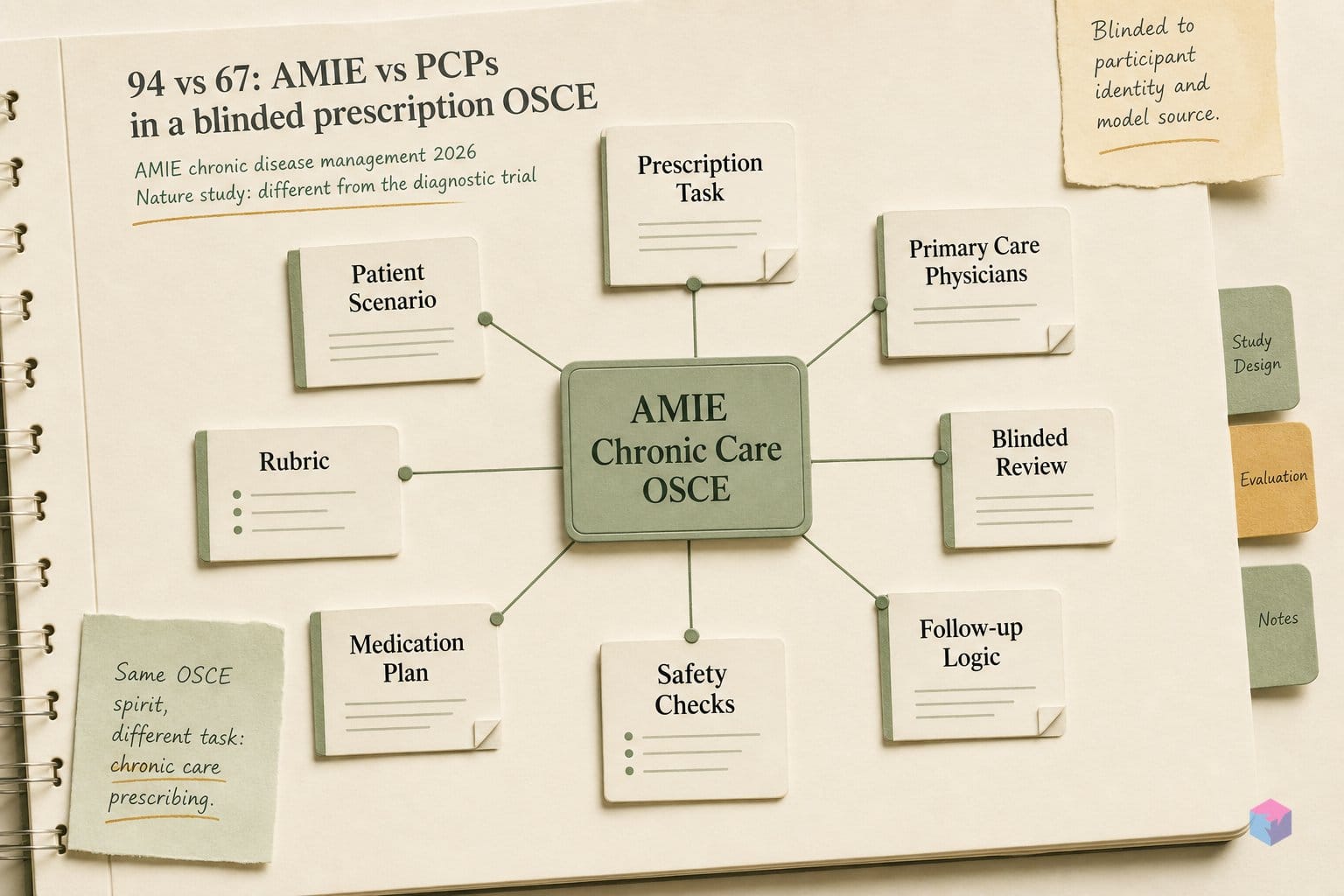
The management version of AMIE splits the job into two distinct processes: a Dialogue Agent that runs real-time, empathetic patient conversation, and a Management Reasoning Agent (the "Mx Agent") that does slow, guideline-grounded planning . This is a deliberate decoupling. The front-end optimizes for tone, history-taking, and continuity; the back-end optimizes for correctness against clinical guidelines and drug formularies. The earlier diagnostic AMIE folded everything into one PaLM 2 model and a single chain-of-reasoning loop, so this two-agent design is the architectural change that makes longitudinal planning tractable .
The Mx Agent does not produce a plan in one shot. It drafts four candidate management plans independently, then merges and refines them into a single structured output with inline citations . That is a planning loop, not single-pass generation: closer to sampling several reasoning paths and reconciling them than to asking a model for one answer. Before drafting, the agent retrieves guideline documents using Gecko 1B text embeddings, can generate up to five natural-language search queries, and assembles a 256,000-token knowledge context averaging about six guideline documents per case . The retrieval-then-draft-then-merge sequence is where the guideline grounding actually happens.
State handling is split too. The Dialogue Agent maintains patient state across visits, while the Mx Agent re-reads the full longitudinal history each visit before updating the plan . With three visits per scenario and a minimum of 24 hours between them, the planner is repeatedly re-grounded on evolving symptoms, test results, and treatment responses rather than carrying forward a compressed summary . The long context is the memory.
For builders, the pattern generalizes beyond the clinic. Keeping a low-latency conversational front-end in front of an expensive, long-context reasoning back-end is a composable design: the user-facing agent stays responsive while the planning agent runs slower retrieval and multi-candidate generation off the critical path. The same shape fits any domain where you want fluent interaction but need answers grounded in a large authoritative corpus (legal, compliance, financial advisory) rather than improvised from model priors. AMIE's contribution here is less the medicine than the demonstration that separating "how you talk" from "what you decide" lets each half be optimized, evaluated, and grounded on its own terms.
AMIE's guideline corpus: 627 NICE and BMJ entries at once
The Management Reasoning Agent grounds its plans in a fixed corpus of 627 guideline documents: 527 from UK NICE Guidance and 100 from BMJ Best Practice, totaling roughly 10.5 million tokens, or about 46 million characters . That corpus is the substrate for every prescribing and titration decision: rather than improvising from model priors, the Mx Agent retrieves the relevant sections and cites them, which is what makes the planning auditable.
Retrieval runs on Gecko 1B text embeddings. For each planning cycle the Mx Agent generates up to five natural-language search queries to locate the most relevant guideline sections, then assembles a working context . That context is capped at 256,000 tokens per planning session and, in practice, loads about six guideline entries at once . So the system is not stuffing all 10.5 million tokens into one prompt: it narrows 627 documents down to the handful that actually bear on the patient in front of it, which keeps the context budget within a single long-context window.
| Parameter | Value |
|---|---|
| Total guideline documents | 627 (527 NICE + 100 BMJ Best Practice) |
| Corpus size | ~10.5M tokens (~46M characters) |
| Embedding model | Gecko 1B |
| Search queries per cycle | Up to 5 |
| Knowledge context cap | 256,000 tokens |
| Documents loaded per session | ~6 (average) |
The detail that makes the headline numbers interpretable: both AMIE and the PCPs accessed the same corpus during the evaluation . The clinicians were not working from memory against a model with a reference library; everyone had NICE and BMJ on hand. That design choice matters because it isolates what is being measured. The trial is not testing knowledge recall (who has read more guidelines) but planning and citation precision: given the same authoritative source material, who selects the right intervention and grounds it correctly. When AMIE later posts higher guideline-concordance and citation rates, those gains can't be attributed to a knowledge gap, because the knowledge was shared.
For builders, the pattern is the reusable part. A 256k-token budget filled by embedding retrieval over a curated corpus, with explicit query generation and a hard document cap, is a concrete recipe for grounding safety-critical decisions in a large authoritative source set . The corpus happens to be clinical guidelines; the architecture would apply to any retrieval-grounded planning task where citing the source is as important as reaching the answer.
How the OSCE was constructed: specialties, visits, and blinding
The evaluation was a randomized, blinded virtual Objective Structured Clinical Examination (OSCE) built on 100 multi-visit scenarios, each spanning three visits with a minimum of 24 hours (roughly two days) between encounters . The three-visit structure is the point: rather than scoring a single prescribing decision, the design forced both AMIE and the physicians to revise plans as new information arrived. Scenario packs introduced evolving symptoms, fresh test results, treatment responses, and imaging findings across visits, so the rubric measured longitudinal plan adaptation, not just the opening move .
The scenarios were authored by providers in Canada and India and designed to reflect UK NICE Guidance and BMJ Best Practice, the same corpus both arms could query during the exam . Importantly, this was not a primary-care-only sweep. The set was balanced across five specialties at 20 scenarios each: cardiology, pulmonology, OB/GYN/urology, gastroenterology, and neurology . That spread matters when reading the headline numbers: AMIE was compared on management problems that often sit at or beyond the edge of a generalist's daily scope.
Three human cohorts populated the trial. The comparison arm was 21 board-certified PCPs with a median nine years of post-residency experience; 21 validated patient actors drove the conversations; and 10 specialist physician evaluators (median five years) scored the resulting plans . The blinding is the load-bearing design choice: evaluators did not know whether a plan came from AMIE or a human, which removes the obvious source of bias when raters know they are grading a machine.
"Scenario packs included evolving symptoms, test results, treatment responses and imaging findings, so the evaluation targeted longitudinal plan adaptation rather than only the initial diagnosis," according to Google Research and Google DeepMind, Towards conversational AI for disease management (source: Nature, 2026-06).
Two caveats are baked into the construction itself. The guidelines were largely UK-derived with no local adaptation, even though the scenarios came from Canadian and Indian authors, and the entire exam was text-only chat with trained actors rather than real patients . For developers reading the results, that is the boundary of the claim: a controlled, source-symmetric benchmark where both sides drew from the same documents, not a test against the messy, multimodal reality of a live clinic.
Where AMIE outpaced PCPs: prescription precision and guideline citations
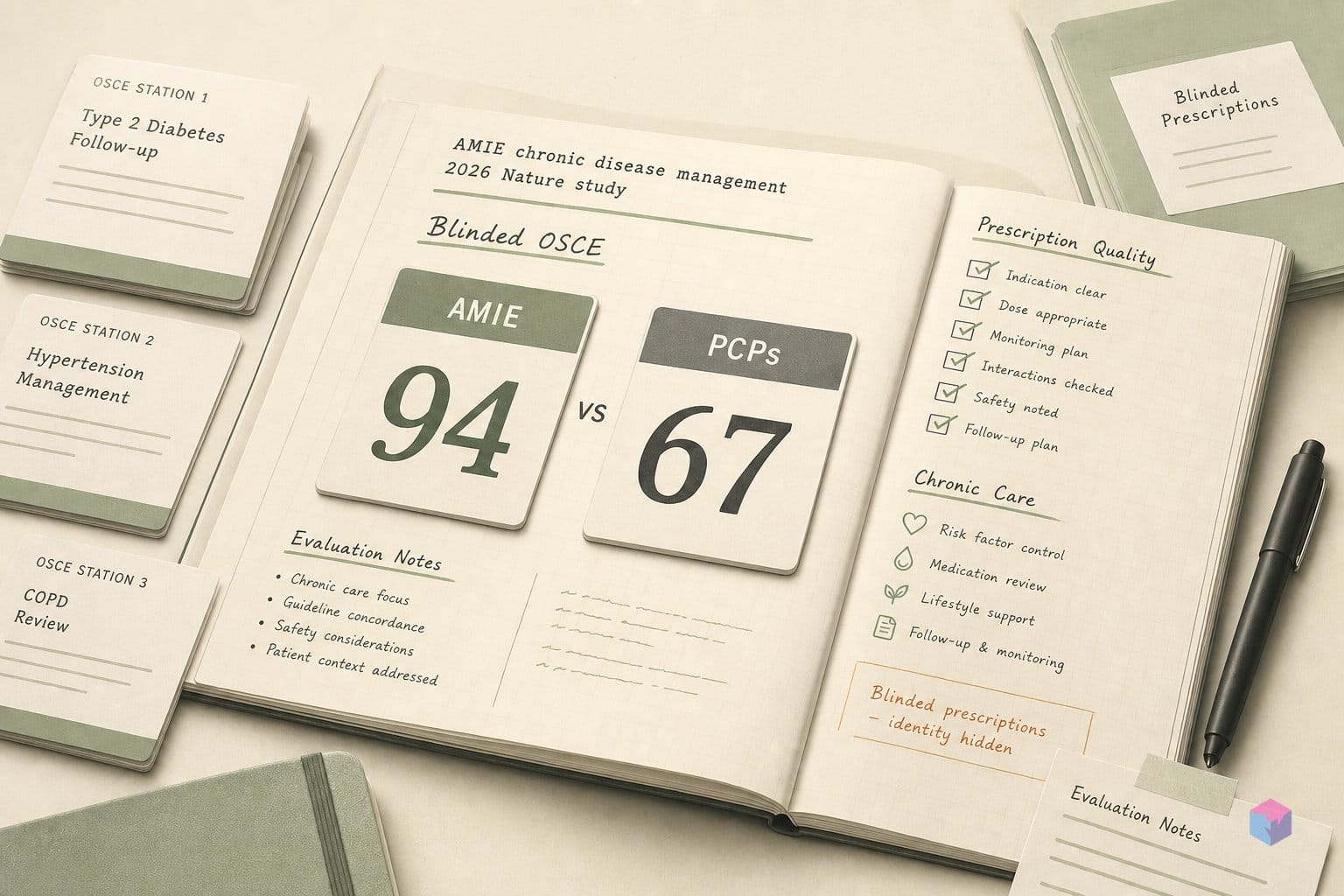
Inside that source-symmetric benchmark, AMIE's clearest edge was prescription precision, and it held across every visit rather than fading after the first. Specialist raters scored AMIE's treatment recommendations as precise in 94% of plans at visit 1, 90% at visit 2, and 91% at visit 3, versus 67%, 70%, and 70% for the primary care physicians . The roughly 20-to-24-point gap did not depend on the novelty of an initial encounter: it persisted as scenarios introduced new test results, treatment responses, and imaging findings across the three-visit arc.
Quick Answer: In Google's blinded OSCE, specialist raters judged AMIE's treatment recommendations precise in 94% of first-visit plans versus 67% for primary care physicians, and the gap held at later visits (90-91% vs 70%). AMIE also cited guidelines in 98-100% of plans versus the PCPs' 86-88% .
Investigation precision told a subtler story. At visit 1 the two were comparable, but AMIE pulled ahead as the encounters accumulated: 99% versus 84% at visit 2 and 100% versus 88% at visit 3 . The widening margin is consistent with what you would expect from a system that maintains explicit patient state and replans over a 256,000-token guideline context: the plan adapts more precisely as new findings arrive, rather than anchoring on the first visit's workup.
| Axis | Visit 1 (AMIE vs PCP) | Visit 2 | Visit 3 |
|---|---|---|---|
| Treatment precision | 94% vs 67% | 90% vs 70% | 91% vs 70% |
| Investigation precision | comparable | 99% vs 84% | 100% vs 88% |
| Guideline-aligned treatment | 89% vs 75% | 91% vs 76% | 93% vs 81% |
| Explicit guideline citation | 98% vs 86% | 100% vs 87% | 100% vs 88% |
The sourcing gap is the part developers should sit with. AMIE explicitly referenced guidelines in 98-100% of its plans across the three visits, against 86-88% for the PCPs, and the spread widened slightly by visit 3 . That is a structural consequence of the Management Reasoning Agent's design: retrieval over the shared 627-document NICE and BMJ corpus, then a structured plan that carries citations by construction. Aligning a recommendation with a guideline (89-93% for AMIE vs 75-81% for PCPs) and naming the guideline are different things, and the architecture optimizes for the second almost for free.
The headline deserves a qualifier, though, because "94 vs 67" is not the whole rubric. Scoring used the Management Reasoning Empirical Key Features (MXEKF) key, and across 51 axis/visit/rater combinations roughly half were ties or not applicable; where a preference did exist, AMIE's median win rate was 42% versus 8% for the PCPs .
"Specialist raters found AMIE's management plans non-inferior to those of primary care physicians across the rated axes, and superior on several (including treatment precision and guideline-concordant prescribing), while many comparisons were ties," the study's authors report in Nature (source: Towards conversational AI for disease management, 2026-06).
Read precisely, the result is "non-inferior overall, decisively better on precision and sourcing, and tied on much of the rest." That is not a wholesale defeat of human clinicians. For anyone building guideline-grounded agents, that distinction is the useful signal: the wins cluster exactly where retrieval and structured citation do the work .
RxQA: 600 medication items on indications, contraindications, and dosing
RxQA is a standalone 600-question multiple-choice benchmark the team built to stress-test medication reasoning in isolation, separate from the OSCE conversations . Each item probes one of five competencies (indications, contraindications, dosing, side effects, and drug interactions) and the questions are derived from two authoritative drug references: OpenFDA in the United States and the UK British National Formulary . The point of pulling it out of the longitudinal trial is portability: RxQA tests the safety-critical core of prescribing without requiring patient actors, multi-visit packs, or specialist raters.
The provenance matters for anyone who has seen benchmarks quietly auto-generated from model output and then used to score the same family of models. RxQA is not crowd-sourced or machine-authored. Four board-certified pharmacists in each jurisdiction (US and UK) revised and rated every question, anchoring the answer keys to human clinical judgment rather than to whatever the model under test would have produced . That review step is what lets the benchmark function as an independent yardstick instead of a circular one.
On the harder subset of questions, the gap between AMIE and the primary care physicians was statistically significant in both test conditions:
- Closed-book (no formulary access): AMIE 50.6% vs PCPs 41.5%, p=0.013 .
- Open-book (formulary access allowed): AMIE 57.9% vs PCPs 47.8%, p<0.001 .
The easier items tell a different and more honest story. There AMIE still scored higher (52.8% vs 46.5% closed-book and 73.8% vs 67.4% open-book) but neither difference reached statistical significance . In other words, the measurable separation shows up precisely where the reasoning is hardest, which is consistent with the OSCE pattern: the model's edge concentrates in retrieval-heavy, guideline-dense decisions rather than across the board.
For builders, the more durable contribution may be the artifact itself. RxQA is released as a reusable, self-contained medication-reasoning evaluation, so any clinical-AI system can run it directly without reconstructing the full multi-visit OSCE infrastructure . That lowers the barrier to comparable, apples-to-apples reporting on the one capability where errors are least forgiving, and it gives the field a shared, pharmacist-validated target instead of yet another bespoke internal score.
OSCE ≠ clinic: what makes this a milestone, not a product
The blinded OSCE result is a research milestone, not a deployable product: AMIE was never tested against real patient outcomes. The scenarios used 21 trained patient actors, constructed symptom progressions, and text-only chat across three visits . No actual prescriptions were filled, dispensed, or monitored, and the authors state plainly that AMIE is not ready for clinical care . Read it as evidence of capability under controlled conditions, not proof of clinical effect.
The gap between the OSCE and a clinic is structural, not cosmetic. Real visits are multimodal and involve EHR review, order-entry constraints, pharmacy oversight, local formularies, and messy, irregular longitudinal histories, none of which the simulation captured . The guideline corpus is also UK-derived: 527 NICE documents and 100 BMJ Best Practice entries, used largely without local adaptation, so the evaluation is anchored to one jurisdiction's standards . And the scores themselves rest on the Management Reasoning Empirical Key Features (MXEKF) rubric, a measure introduced for this study that the authors say still needs external validation before it can serve as a standard .
AMIE's model code and weights are not open-sourced, so there is nothing to deploy or self-host from this paper . The signal worth tracking next is prospective: Google says it has launched a nationwide study to assess AI in real-world virtual care, which is where constructed scenarios give way to actual patients and where any claim of improved chronic-disease management (heart failure, diabetes) would finally be testable . Until that data lands, the "longitudinal care" framing remains plausible but unproven.
For engineers, the durable value sits below the medical framing. Two architectural patterns travel well to other domains: decoupling an empathetic Dialogue Agent from a slower, guideline-grounded Management Reasoning Agent, and leaning on long-context retrieval over an authoritative corpus to constrain output in safety-critical decisions . Both are composable beyond healthcare: any system that has to be both conversational and verifiably correct faces the same split. The concrete takeaway: treat the 94% vs 67% prescription-precision headline as a controlled-setting result, watch the nationwide virtual-care trial for the first real-patient evidence, and reuse RxQA today as the portable part you can actually run.
Last updated: 2026-06-20. Reviewed against the Nature study (s41586-026-10764-5) published 2026-06-17.
Frequently asked questions
What is AMIE and how does it differ from a standard medical chatbot?
AMIE (Articulate Medical Intelligence Explorer) is a research clinical AI from Google Research and Google DeepMind, evaluated in Nature on 17 June 2026 . The key architectural difference from a single-turn chatbot is a two-agent split: an empathetic Dialogue Agent runs the patient conversation and maintains patient state across visits, while a separate "deep-thinking" Management Reasoning Agent (Mx Agent) does slower, long-context planning grounded in retrieved guideline documents . Standard chatbots answer one turn from parametric memory; AMIE retrieves guidelines via Gecko embeddings, drafts four candidate plans, and merges them into a cited management plan .
Is AMIE available for clinical use?
No. AMIE is a research system only: it is text-only, not open-sourced (neither code nor weights), and was tested entirely in a simulated OSCE, never with real patients . The authors state explicitly that it is not ready for clinical care. Google has announced a nationwide study to assess AI in real-world virtual care as the next phase, which would be the first live-patient evaluation, but until that produces results, AMIE is a benchmark milestone, not a deployable tool .
What does RxQA measure that other medication evaluations don't?
RxQA is a 600-question multiple-choice benchmark covering indications, contraindications, dosing, side effects, and drug interactions . Its distinguishing features are jurisdiction-specific sourcing and review: questions are derived from OpenFDA (US) and the UK British National Formulary, then revised and rated by four board-certified pharmacists in each jurisdiction . Because it is a portable, standalone multiple-choice set rather than an embedded conversational rubric, it is the one component of the study a developer can reuse directly to test a model's medication reasoning.
How does this paper differ from Google's 2025 diagnostic AMIE paper?
The 2025 paper ("Towards conversational diagnostic AI," Nature s41586-025-08866-7) was built on PaLM 2 and focused on history-taking and differential diagnosis within a single encounter . The 2026 paper rebuilds AMIE on Gemini 1.5 Flash and shifts the task from "what is wrong" to "what should be done," covering treatment selection, titration, and plan adaptation across three-visit longitudinal scenarios with roughly two days between visits . In short: diagnosis in one turn versus management reasoning over time.
Why did AMIE and PCPs have equal access to the same guidelines during the OSCE?
Both AMIE and the 21 PCPs could query the same 627-document corpus (527 NICE Guidance, 100 BMJ Best Practice) during the evaluation . Equalizing access removes raw knowledge recall as a variable, so the comparison isolates planning quality (citation precision, plan coherence, and adaptation across visits) rather than who memorized more formulary entries. That framing is what makes results like AMIE's 94% vs 67% treatment-recommendation precision at visit 1 a statement about reasoning under shared information, not about a larger knowledge base .