
When a Google DeepMind medical model clears Nature's peer review, the headline writes itself — but the fine print is where the actual signal lives.
What AMIE's Nature Peer Review Actually Confirmed
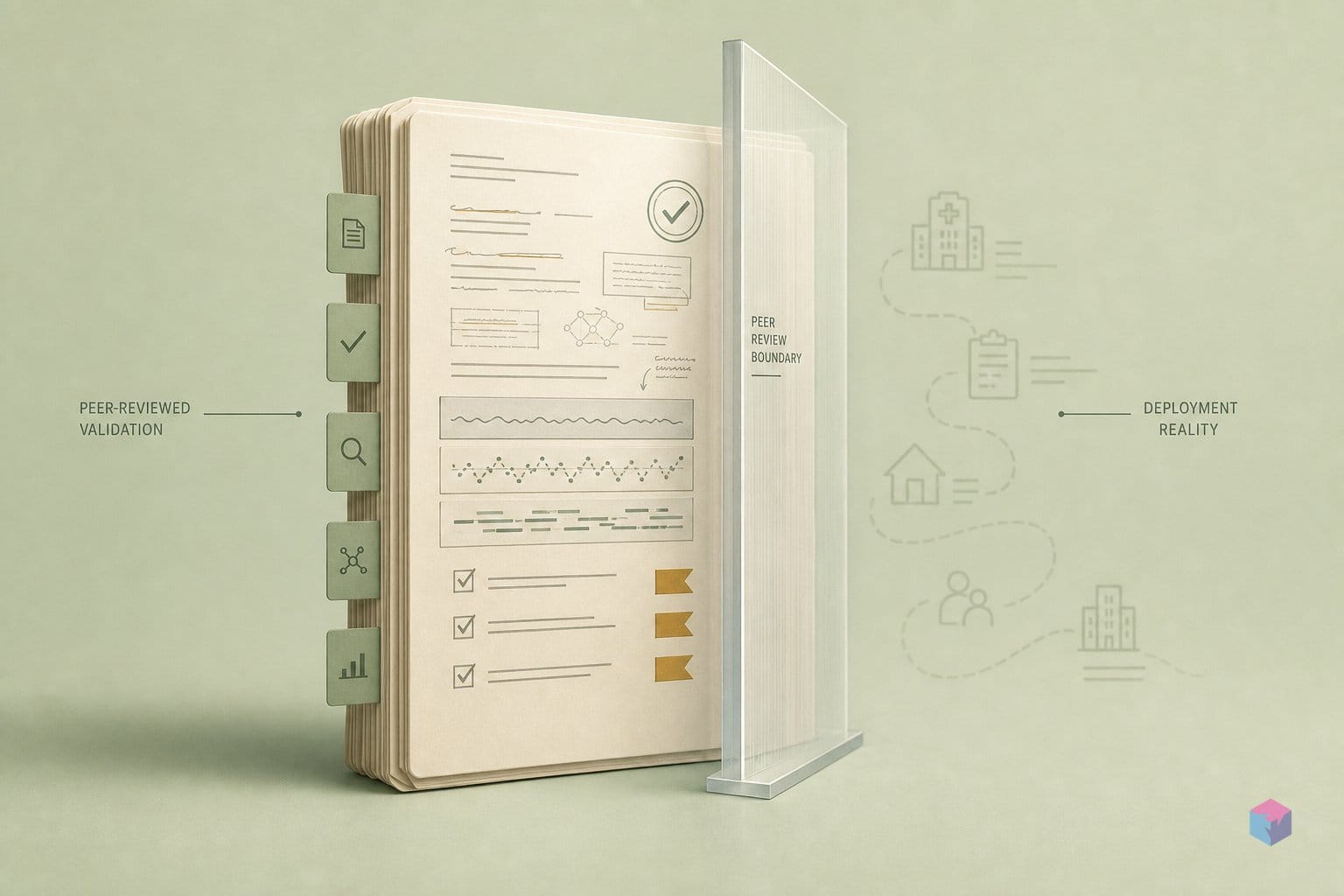
AMIE's Nature paper confirmed one narrow thing: on a controlled, simulated exercise, the system was non-inferior to board-certified primary care physicians at longitudinal disease management, and measurably better on plan precision and guideline citation. Published as s41586-026-10764-5 with press coverage on June 21, 2026 , the study extends the Articulate Medical Intelligence Explorer from single-encounter diagnosis to multi-visit chronic care. Peer review validated reasoning quality against a rubric — not a deployed clinical trial, patient outcomes, or deployment safety .
Quick Answer: AMIE's June 2026 Nature paper (s41586-026-10764-5) confirmed that in a blinded, simulated multi-visit study, AMIE was non-inferior to board-certified physicians on disease-management reasoning — scoring 88% vs 74% on plan appropriateness at visit 1 (p=0.019). It validated simulated reasoning, not real-world clinical safety.
This builds directly on the group's earlier Nature diagnostic paper (s41586-025-08866-7) , shifting the question from "can it diagnose?" to "can it manage over time?" — both answers remain simulation-bound. The work first appeared as arXiv:2503.06074 in March 2025 ; notably, Google's own publications page still listed the venue as "arXiv (2025)" at the time of the Nature release.
The authors are explicit about the ceiling: they caution that these results do not mean AMIE is ready for clinical care, and that prospective feasibility studies with ethical and safety oversight are still needed (source: Google Research, 2026-06).
How AMIE Separates Conversation From Deliberation
AMIE splits the work of a clinical encounter into two cooperating agents. A Dialogue Agent, built on Gemini 1.5 Flash, handles turn-by-turn conversation and rapport, responding from its current understanding of the patient. A separate Management Reasoning (Mx) Agent runs continuous, deliberate analysis — synthesizing the full dialogue across multiple visits alongside retrieved clinical guidelines and drug formularies . Conversation and clinical reasoning are decoupled, each optimized for a different job.
The architecture upgrade is not incidental. The prior diagnostic AMIE was PaLM-2-based and built for a single encounter; the move to the Gemini model family's long-context capability is what lets the system stay coherent across an evolving chronic-disease trajectory, where symptoms, treatment responses, and test results change between appointments . Long-context grounding over a multi-visit history is the core advance over the single-encounter design .
The Mx Agent is also not a single-pass retrieval-augmented generation call. It combines in-context retrieval with structured reasoning, iteratively drafting and merging candidate management plans, then applying structural constraints to align outputs with the allocated guideline subset and formularies .
For builders, the engineering affordance is the separation itself. Real-time conversational latency requirements are fully decoupled from slow, deliberative processing: the fast dialogue layer and the heavier reasoning layer can be scaled, rate-limited, and tuned independently. That is the reusable design pattern this work demonstrates — a conversational surface that never blocks on the expensive reasoning happening behind it.
The Peer Review Exercise: 21 Physicians and Actor-Patients
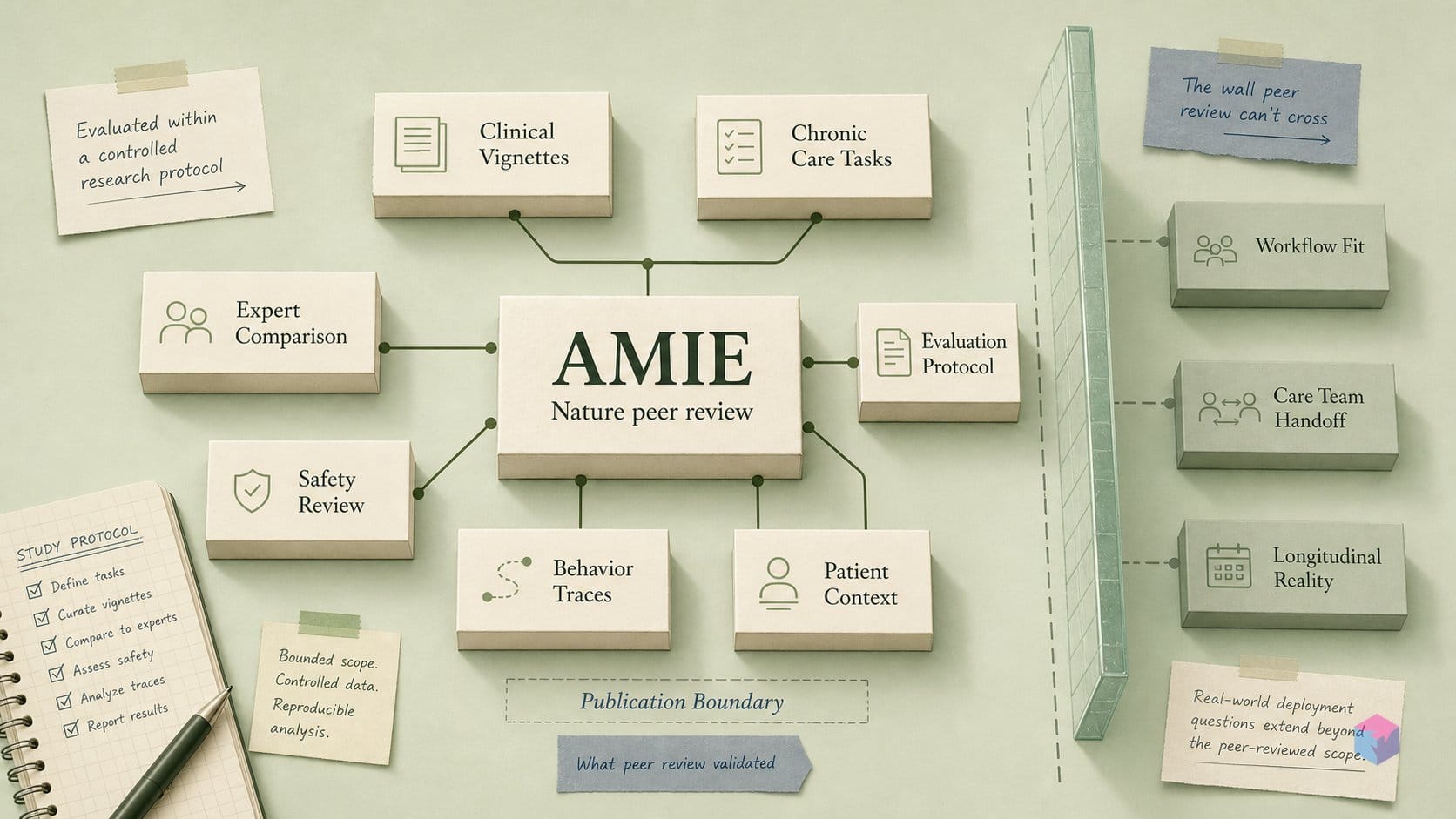
The validation that Nature reviewed was a randomized, blinded, virtual OSCE-style study — not a clinical deployment. AMIE was compared against 21 board-certified primary care physicians across 100 multi-visit case scenarios, each structured as three sequential text-based appointments in which symptoms, treatment responses, and test results changed between visits . That longitudinal structure is what distinguishes this exercise from prior single-encounter diagnostic tests: graders scored how well each participant reasoned across a changing patient state, not a one-shot answer.
The rubric is auditable because it is anchored to a specific corpus. Cases were built around UK NICE Guidance and BMJ Best Practice, and BMJ Group confirmed that BMJ Best Practice was selected by Google DeepMind as an authoritative knowledge source for the evaluation . Trained patient actors played the patients, and specialist physicians independently graded management outputs on axes including appropriateness, completeness, guideline adherence, and patient-centeredness — with all graders blinded to whether an output came from AMIE or a human PCP .
One methodological caveat matters for anyone reading the numbers. The PCPs were drawn from North America and India, while the cases used UK-specific guidelines — a geographic mismatch the authors explicitly flag as a limitation on generalizability . As the authors caution, the findings do "not mean AMIE is ready for clinical care," and prospective feasibility studies with ethical and safety oversight are needed . In other words, the humans were being scored against a rulebook that was not native to their own practice.
94% vs 67%: AMIE's Edge Over Physicians, Each Appointment
Judged against that rulebook, AMIE did not just keep pace — it pulled ahead on treatment precision and held the lead across every appointment. On treatment appropriateness, AMIE scored 94% vs the physicians' 67% at appointment one, 90% vs 70% at appointment two, and 91% vs 70% at appointment three . The margin stayed roughly constant as each simulated case evolved, which matters more than any single-visit number: longitudinal management is where accumulated context usually degrades human recall.
Investigation and testing precision started tied at 91% each on the first appointment, then diverged as cases progressed — AMIE reached 99% vs 84% at appointment two and 100% vs 88% at appointment three . On overall plan appropriateness, AMIE led 88% vs 74% at the first visit (p=0.019), and on appropriate follow-up recommendations it hit 100% vs 98% (p<0.001) .
| Metric | Appt 1 (AMIE / PCP) | Appt 2 | Appt 3 |
|---|---|---|---|
| Treatment precision | 94% / 67% | 90% / 70% | 91% / 70% |
| Investigation precision | 91% / 91% | 99% / 84% | 100% / 88% |
| Guideline citation for treatments | 98% / 86% | 100% / 87% | 100% / 88% |
The guideline-citation axis is worth separating from clinical accuracy. AMIE attached a source to nearly every treatment — 98%, then 100%, then 100% — while physicians did so 86% to 88% of the time . That is partly a documentation-quality gap, not proof of better medicine: a model instructed to ground its output will cite reflexively, whereas a physician making a correct call may simply not write down the reference. Read the citation numbers as a measure of traceability, and the precision numbers as the harder claim.
A Formulary Knowledge Quiz, Constructed From Scratch
Alongside the multi-visit exam, the team built RxQA, a medication-reasoning benchmark of roughly 600 multiple-choice questions derived from two national drug references — OpenFDA and the British National Formulary — then revised and validated by board-certified pharmacists . Questions were split into lower- and higher-difficulty tiers, each tested in open-book (drug labels available) and closed-book settings, so the benchmark isolates recall from reasoning-with-references.
The pattern is consistent: AMIE's margin over primary care physicians widens as the questions get harder. On the easy tier, the open-book gap was not statistically significant (p=0.0708) . On the hard tier, AMIE led in both settings.
| Tier / setting | AMIE | PCP |
|---|---|---|
| Lower difficulty, open-book | 73.8% | 67.4% |
| Lower difficulty, closed-book | 52.8% | 46.5% |
| Higher difficulty, closed-book | 50.6% | 41.5% |
| Higher difficulty, open-book | 57.9% | 47.8% |
Figures are from the study's reported results . For builders, RxQA is the more portable artifact than the OSCE rubric: any team assembling a medication-handling LLM pipeline can reuse it as an evaluation scaffold. But read its scope honestly. The set was deliberately skewed toward harder cases where the model first needed drug labels, so it does not reflect routine prescribing — and it benchmarks against physicians, not pharmacists, even though real prescribing usually carries pharmacist oversight . It is a benchmark-level reasoning signal, not a prescribing-safety claim.
What the Nature Publication Explicitly Concedes
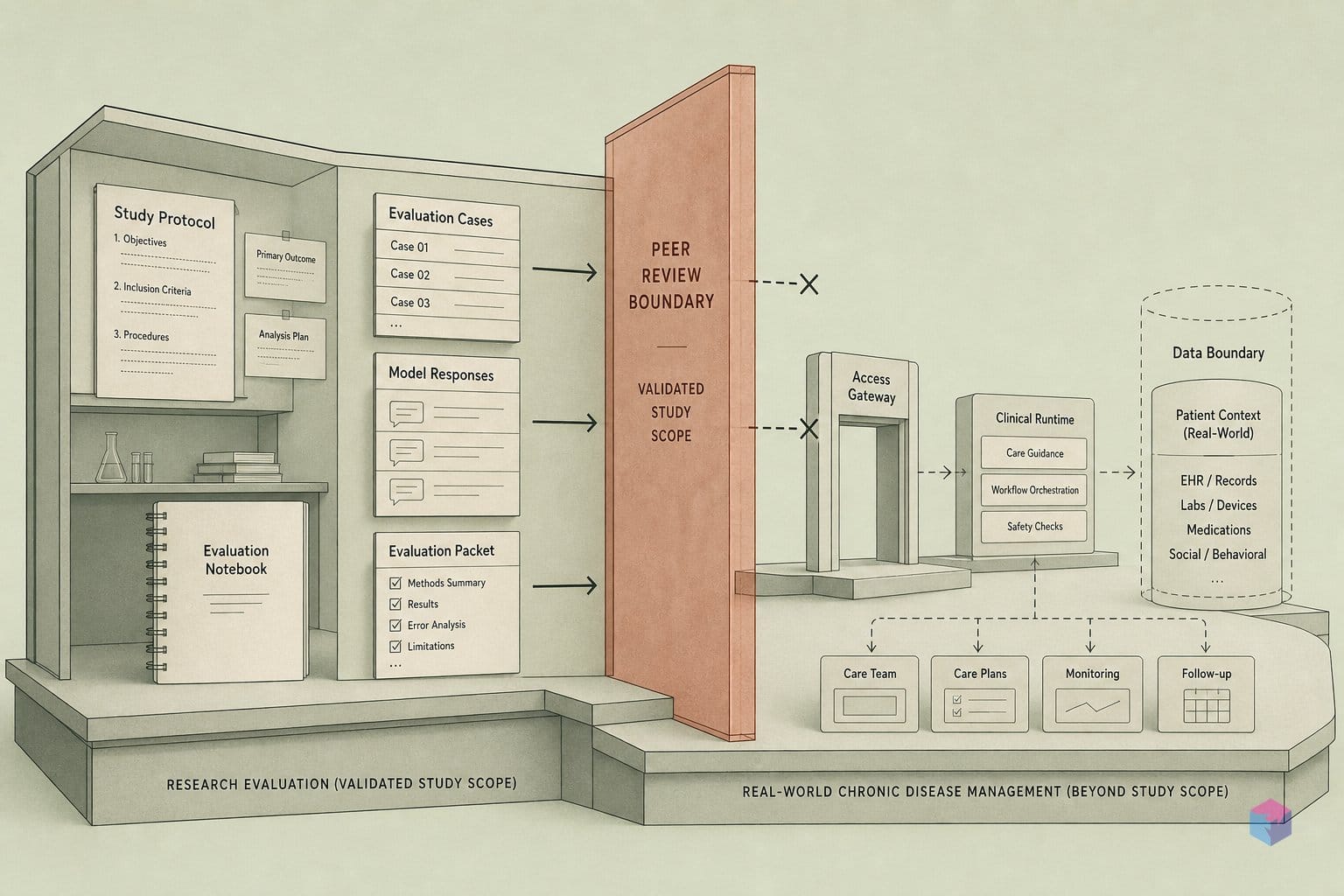
The Nature paper is unusually direct about what it did not test. The authors state plainly that AMIE is not ready for clinical care and that prospective feasibility studies with ethical and safety oversight are required . That is not defensive hedging appended to a strong result — it is the paper's own placement of the work on the readiness curve.
The concessions are structural. The evaluation involved no EHR interaction and no chart review, ran through a text-only interface, and used cases constructed with definitive answers . None of those properties hold in real chronic disease management, where ambiguity, legacy records, and partial information are the norm. The case mix is also not representative of routine primary care volume or complexity.
Timing and jurisdiction add further gaps. Appointments framed as weeks or months apart in the narrative actually occurred only 1–2 days apart during the exercise, and the physician panel drew from North America and India while every case used UK NICE guidance — a cross-system mismatch the study leaves unresolved . Patient-outcome effects were never measured, and the authors note the management rubric itself needs further validation.
Read together, these caveats define the boundary of the claim: the work validated simulated management reasoning under controlled conditions, not safety, real-world efficacy, or deployment readiness .
How AMIE Navigated a 627-Item Longitudinal Knowledge Corpus
AMIE's Management Reasoning (Mx) Agent grounded its plans in a curated guideline corpus of 627 documents totaling roughly 10.5 million tokens — far more than the Gemini 1.5 Flash backbone can hold in any single context window. Because the whole corpus could not fit, the system allocated 256,000 tokens for external knowledge per case, selecting an average of about six guideline documents per case through in-context retrieval .
This is not plain top-k RAG. The pipeline combines document selection, iterative drafting and merging of candidate management plans, and structural output constraints that align the result with current guidelines and formularies . The 256K ceiling is a hard engineering constraint, which makes the loop a managed allocation problem: what gets into the window matters more than how big the window is.
For anyone building on Gemini or other long-context models, the takeaway is that the bottleneck is corpus selection fidelity, not context length. If the wrong six documents surface, the reasoning inherits the gap regardless of headroom. There is a second, quieter constraint: guidelines change, so the corpus must too — and the published system describes no continuous-update mechanism . Curated, static knowledge is a reasonable choice for a controlled evaluation, but a production clinical agent would need a refresh path the study does not specify.
AMIE Outside the Controlled Exam: Feasibility in Urgent Appointments
A separate feasibility study moves AMIE off the simulated bench and into a live setting — and the results are more mixed than the Nature paper's controlled figures. Submitted to arXiv in March 2026 (not the peer-reviewed Nature validation), it tested AMIE on 100 adult urgent-care patients with a human safety-supervisor watching each case . This is a different question than the OSCE study answered: not "how good is the management reasoning under a rubric," but "does anything break when real patients are on the other end."
The safety signal was clean — no supervisor interventions were required across the 100 cases. AMIE included the eventual final diagnosis in its differential 90% of the time, and its top-three differential accuracy reached 75% . But the gap that matters most for adoption reappeared: primary care physicians still outperformed AMIE on the practicality and cost-effectiveness of their management plans . Precise, guideline-cited plans in an exam do not automatically translate into plans a clinician would call workable and affordable in a real clinic.
Treat these two studies as separate signals, not one validation. The Nature paper measured simulated management-reasoning quality; this feasibility run is an earlier-stage, non-peer-reviewed look at live behavior. They should not be cited interchangeably.
The Separation of Concerns AMIE Demonstrates
The most portable lesson from AMIE is an architectural one, and it survives even if you never touch a medical model. The pattern: decouple a low-latency conversational layer from a high-latency deliberative loop that holds the authoritative knowledge. AMIE splits these across a Dialogue Agent on Gemini 1.5 Flash and a separate Management Reasoning agent that retrieves and reasons over external guidelines . That separation matters anywhere policies change faster than model training cycles — the chat surface stays responsive while the slow loop consults a corpus that can be updated without retraining.
The deliberative half is itself a repeatable pipeline: retrieve relevant external knowledge, draft candidate plans iteratively, merge them, then apply structural constraints to align with current guidelines and formularies . Swap the corpus and that loop transfers directly to legal, financial, or pharmaceutical-compliance agents where the ground truth lives outside the weights.
The evaluation artifacts are worth lifting too. RxQA — roughly 600 pharmacist-validated medication questions — is a ready-made scaffold for testing a medication-handling subsystem, and the multi-appointment OSCE rubric is a template for longitudinal agent evaluation that single-turn benchmarks miss .
What is not extractable: AMIE has no API, no open weights, and no public deployment. Gemini 1.5 Flash is reachable through the Gemini API, but the full Mx agent and its retrieval corpus remain research artifacts with no confirmed release path. Treat the design pattern as the deliverable, not the system.
Google DeepMind's Forward Agenda: Nationwide RCT and Feasibility Trials
Google's stated roadmap treats the Nature paper as a starting line, not a finish. The team names two pre-deployment prerequisites: prospective feasibility studies with ethical and safety oversight, followed by a planned nationwide randomized controlled trial of AI in real-world virtual care . Neither is optional; the authors explicitly state the current findings do not mean AMIE is ready for clinical care .
For developers, the distance between a simulation-validated publication and a nationwide RCT is large in time, regulatory scope, and IRB clearance. Read the Nature acceptance as a prerequisite milestone, not a deployment green light.
One engineering constraint deserves attention if you build on this pattern: guideline currency. The Mx Agent's corpus of 627 documents totaling 10.5 million tokens was fixed at publication . Chronic-disease guidelines revise regularly, so any production extension needs a continuous knowledge-base update pipeline — a stale formulary or superseded NICE guidance quietly degrades every downstream plan.
The concrete takeaway: watch for the next paper, not the next demo. A peer-reviewed feasibility study with real patients, safety monitoring, and outcome data will carry more weight for clinical-AI adoption decisions than today's controlled-exam validation. Until then, the reusable deliverable is the two-agent, long-context grounding design — not a system you can ship.
Frequently asked questions
Is AMIE available as an API or open-source project developers can use?
No. AMIE is a research prototype from Google DeepMind with no API, no pricing, and no public release — it is a system described in a paper, not a product you can call. The Dialogue Agent backbone, Gemini 1.5 Flash , is reachable through the Gemini API, but the Management Reasoning (Mx) agent, the retrieval corpus, and the evaluation scaffold are not published artifacts. If you want to reproduce any part of it, check the Nature paper supplementary materials and Google Research repositories for code releases rather than assuming availability.
What exactly is RxQA and can developers use it as an evaluation benchmark?
RxQA is a medication-reasoning benchmark of roughly 600 multiple-choice questions derived from two national drug formularies — OpenFDA and the British National Formulary — and revised and validated by board-certified pharmacists . It runs in both open-book and closed-book settings across lower- and higher-difficulty tiers, and was introduced in the Nature study as an evaluation artifact for prescribing-related LLM reasoning. Public availability and licensing were not confirmed at publication, so treat it as a benchmark design you may need to reconstruct — check the paper's supplementary data and Google Research GitHub before planning around it.
Does publication in Nature mean AMIE is safe or ready for clinical deployment?
No. Nature peer review validated simulated management-reasoning quality under controlled, OSCE-style conditions — not patient safety, real-world efficacy, or deployment readiness. The authors explicitly state that prospective feasibility studies with ethical and safety oversight are required before any clinical use . The scenarios omitted chart review and EHR interaction, used a text-only interface, and compressed visits that were weeks apart in the narrative into 1–2 days in the study. The paper is a prerequisite milestone toward clinical evaluation, not an endpoint.
Why did AMIE underperform PCPs on practicality and cost-effectiveness in the live feasibility run?
The Nature evaluation graded plans on a structured rubric optimized for appropriateness, completeness, and guideline adherence — neither cost nor real-world feasibility was a scored axis. In a separate live urgent-care feasibility study of 100 adult patients (arXiv, submitted March 2026), physicians still outperformed AMIE on practicality and cost-effectiveness of management plans . That gap suggests the controlled rubric rewards thorough, guideline-cited behavior, while clinical judgment under resource constraints optimizes for something the exam did not measure. Note that feasibility study is not itself a peer-reviewed Nature validation.
How does AMIE's two-layer architecture compare to a standard retrieval-augmented generation pipeline?
Standard RAG retrieves documents and passes them to a single model for a single-turn response. AMIE's Mx agent adds iterative drafting, merging of candidate plans, structural output constraints, and state carried across appointments — closer to a multi-step reasoning loop with managed retrieval-augmented working memory than to one-shot retrieval. It searched a 627-document corpus of 10.5 million tokens, allocating 256,000 tokens for external knowledge and averaging about six guideline documents per case . The Dialogue Agent is decoupled entirely, letting the conversational surface be latency-optimized independently of the deliberative layer.