

Anthropic's open-source knowledge-work-plugins marketplace ships drop-in bundles for Claude Cowork and Claude Code — but if you trust the Finance plugin's README skill count, you'll undercount what actually installs. The documentation lags the directory tree.
Finance README vs. Folder Tree: More Subdirectories Than Documented
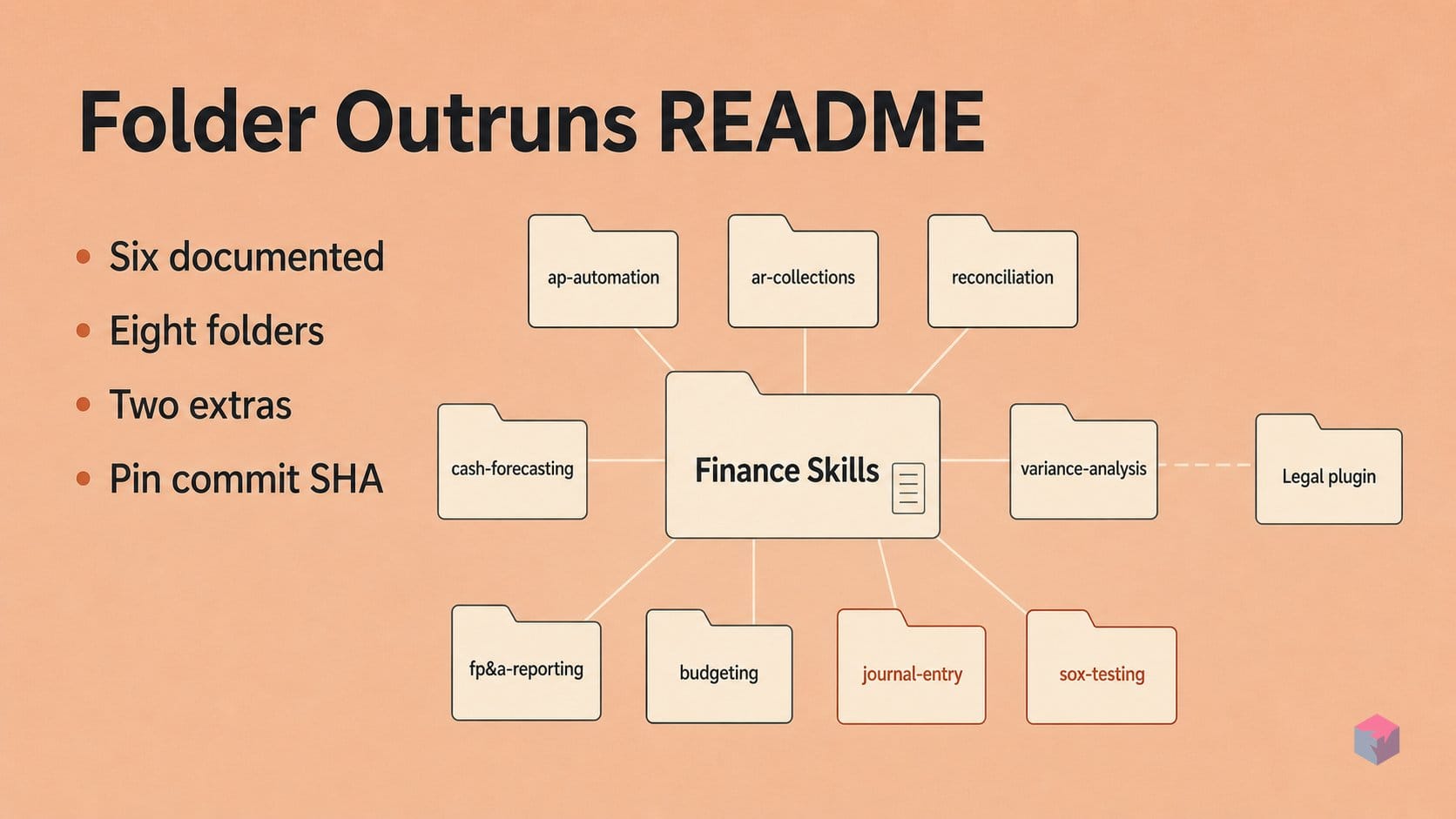
The Finance plugin's README lists six skills, but the live finance/skills/ directory holds eight folders. The README table names journal-entry-prep, reconciliation, financial-statements, variance-analysis, close-management, and audit-support . The tree adds two more that the prose never mentions — journal-entry and sox-testing . Both plugins are versioned 1.3.0, authored by Anthropic.
Quick Answer: Anthropic's Finance plugin README documents six skills, but the live finance/skills/ folder contains eight — adding journal-entry and sox-testing. The repo ships no formal semver releases across ~395 commits, so folder contents outrun the README. Pin to a commit SHA for reproducibility.
The Legal plugin shows the same pattern, only wider. Its README documents six skills while legal/skills/ carries nine folders: brief, compliance-check, legal-response, legal-risk-assessment, meeting-briefing, review-contract, signature-request, triage-nda, and vendor-check . This is documentation lag, not a bug — the repository ships roughly 395 commits and no published semver releases . Versions are commit-based, so the skill folders evolve faster than the README prose describing them. If reproducibility matters for your team, pin your install to a commit SHA rather than main.
| Plugin (v1.3.0) | README skills | Live folder count | Slash commands | Connector categories |
|---|---|---|---|---|
| Finance | 6 | 8 | 5 | 7 (erp-accounting, data-warehouse, spreadsheets, analytics-bi, documents, email, chat) |
| Legal | 6 | 9 | 5 | Not listed in README |
The takeaway for anyone auditing what a paid Claude install actually adds: read the tree, not the table. The README is a directional map; finance/skills/ and legal/skills/ are the ground truth .
Cowork and Claude Code Exclusively — Not Claude.ai Chat
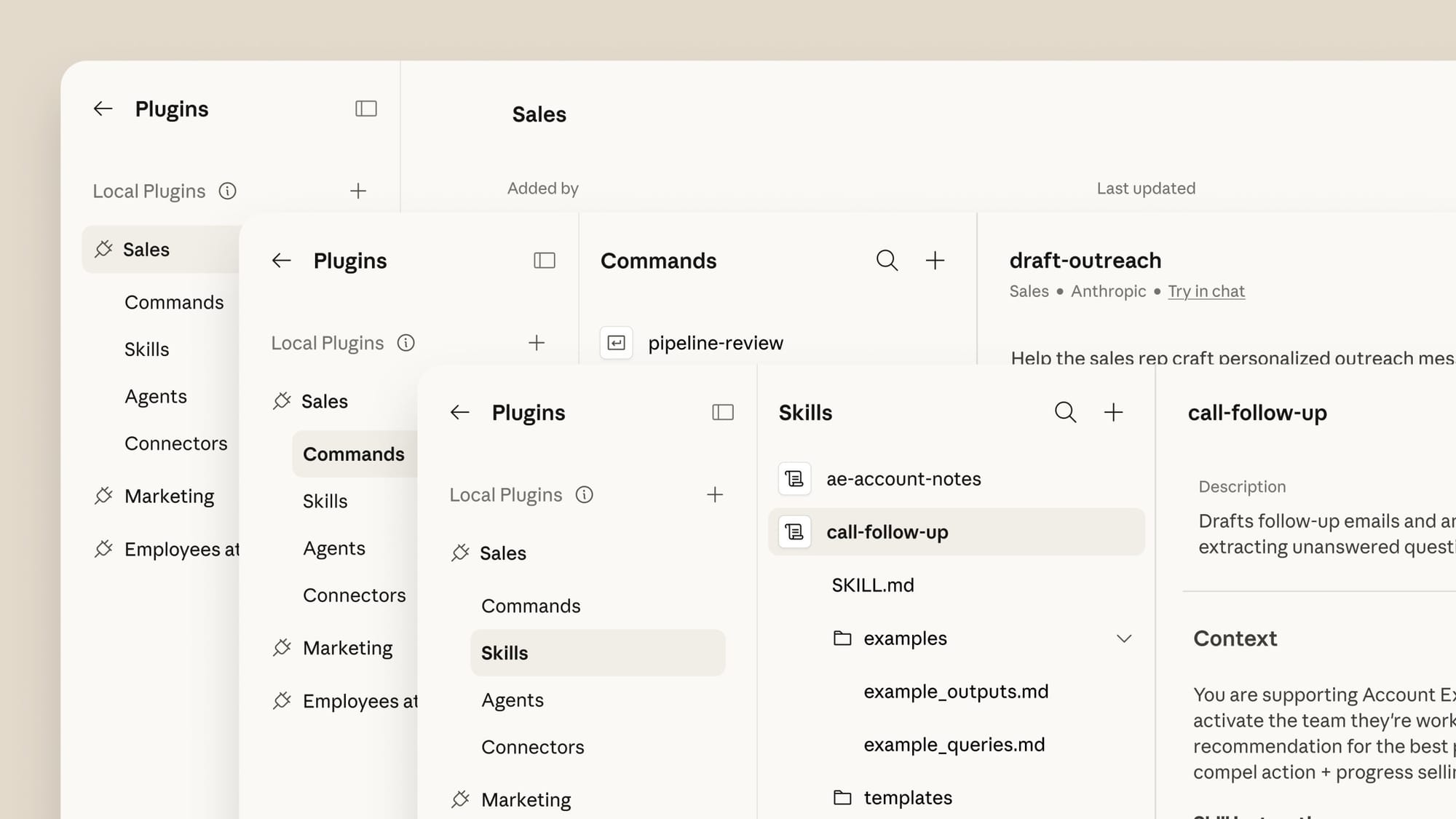
Skills and slash commands only activate on two surfaces: Claude Cowork and Claude Code. Cowork — the agentic desktop app Anthropic launched as a research preview on January 12, 2026 — is available on Pro, Max, Team, and Enterprise plans, with the web and mobile rollout starting with Max subscribers . Claude Code exposes the programmatic path: Max, Team, or Enterprise subscribers use the claude plugin subcommand to add the marketplace and install finance or legal .
Claude.ai Chat has no plugin surface at all. So "any Claude Max workspace" is directionally right but too broad — Cowork and Code are the only places these bundles run . One more caveat: MCP connector authentication is a separate post-install step. The finance .mcp.json wires categories — erp-accounting, data-warehouse, spreadsheets, analytics-bi — but not the vendor; each connection still needs your own credentials .
Deploying Finance or Legal in Cowork or Code
Installation follows one of two paths depending on your surface. In Cowork it is a single click with no terminal: open claude.com/plugins, locate the Finance or Legal bundle, and click install . In Claude Code you register the marketplace, then install the plugin by name — Finance and Legal are both version 1.3.0, authored by Anthropic .
The two Claude Code commands are:
claude plugin marketplace add anthropics/knowledge-work-plugins
claude plugin install finance@knowledge-work-plugins
Substitute legal@knowledge-work-plugins in the second command for the contract- and NDA-review bundle . Any GitHub repository can act as a marketplace, so the same two-step pattern works for forks you host yourself.
After install, the split between automatic and explicit invocation matters. Skills activate on their own — Claude draws on them when a task calls for domain knowledge, with no command needed. Slash commands are explicit and require the plugin prefix: /finance:reconciliation, /finance:sox-testing, /legal:triage-nda, /legal:review-contract, and /legal:vendor-check .
The connector story is category-based, not vendor-locked. The finance .mcp.json defines seven connector categories — erp-accounting, data-warehouse, spreadsheets, analytics-bi, documents, email, and chat — and the README names Snowflake, Databricks, BigQuery, Slack, and Microsoft 365 only as examples that slot into those slots . That design means you wire your own stack into a category rather than adopting a hard-coded vendor — but, as noted, each connection still needs its own credentials before a skill can reach live data.
U.S.-Only Playbook, No-Advice Disclaimer, and README Lag
Before you trust either bundle's output, read the fine print baked into the files. The Legal plugin's default playbook examples assume U.S. positions — Delaware incorporation, New York and California governing law . Teams under EU, UK, Netherlands, or Australian law must override those defaults in .claude/legal.local.md, which is structured around standard positions, acceptable ranges, and escalation triggers across categories like limitation of liability, indemnification, IP ownership, and governing law . Skip that step and the model will confidently apply Delaware defaults to a Dutch contract.
Both bundles ship the same load-bearing caveat, and Anthropic states it plainly:
"The plugin does not provide financial, tax, or audit advice" and "does not provide legal advice" — outputs should be reviewed by qualified professionals before reporting, filings, audit documentation, or actual legal matters. — Anthropic (source: knowledge-work-plugins)
There is a systems reason for the hedge: Cowork's agentic design and live internet exposure make it unsuitable for production regulatory workflows without additional organizational controls . Finally, treat the README's documented skill counts as a floor, not a ceiling — the Finance table lists six skills while the live directory holds eight . The repo has no formal semver releases; versions are commit-based . For reproducible org-wide deployments, check the current tree or pin to a specific commit SHA.
After Deploying: Forking the Playbook and the Dedicated financial-services Offering
Because every plugin is plain markdown and JSON with no build step, forking anthropics/knowledge-work-plugins is the primary customization path: edit skill markdown directly, rewire connector categories in .mcp.json for your stack, and open a pull request upstream — the repo showed roughly 2,700 forks at research time. For teams, admins can register a private GitHub repo as a marketplace source (private beta), provision plugins per user, and auto-install them, within hard limits of 200 MB uncompressed and 5,000 files per package, 500 packages per marketplace, and 25 marketplaces per org.
Do not conflate this folder with anthropics/financial-services. The knowledge-work finance plugin is CFO-office and accounting-oriented — close, reconciliations, statements, variance, SOX — while the separate financial-services repo targets investment banking, equity research, private equity, and wealth management with institutional data connectors [1][6].
The concrete takeaway: with no formal releases and an evolving tree, pin your org deployment to a specific commit SHA. Referencing main introduces silent drift between what the README documents and what actually installs.
Frequently asked questions
Can I use the Finance or Legal plugin in Claude.ai Chat?
No. The skill and slash-command layer exists only in Claude Cowork and Claude Code — the two agentic surfaces that read plugin files. Claude.ai Chat has no plugin surface, so users on any plan (Pro, Max, Team, Enterprise) cannot install or invoke these bundles there . Cowork itself is available on paid plans, with the web and mobile beta rolling out starting with Max.
Why does the Finance plugin README list 6 skills when the folder has 8?
The repository has no formal versioned releases and evolves through commits, so folder contents outpace README updates. The Finance README's skills table lists six skills, but the live finance/skills/ directory shows eight folders — the documented six plus journal-entry and sox-testing . Check the live directory tree for the accurate count rather than trusting the README table, and pin deployments to a commit SHA to avoid silent drift.
Do these plugins provide professional financial or legal advice?
No. Both plugins carry explicit disclaimers stating they do not provide financial, tax, audit, or legal advice . Outputs must be reviewed by qualified professionals — accountants, licensed attorneys, or auditors — before use in filings, reports, reconciliations, or legal matters. Anthropic also advises against regulated workloads given Cowork's agentic nature and internet access, which is why the human-review caveats are foregrounded.
How do I adapt the Legal playbook for EU or UK jurisdiction?
Edit .claude/legal.local.md. Out-of-box examples assume U.S. positions for Delaware, New York, and California, so teams operating under EU, UK, Netherlands, Australian, or other systems must customize this file . It is structured around standard positions, acceptable ranges, and escalation triggers across categories including limitation of liability, indemnification, IP ownership, and governing law.
What's the difference between knowledge-work-plugins/finance and anthropics/financial-services?
Entirely different scope. The knowledge-work-plugins/finance folder is accounting-oriented — month-end close, reconciliations, financial-statement generation, variance analysis, and SOX testing for the CFO's office . The separate anthropics/financial-services repo targets investment banking, equity research, private equity, and wealth management, shipping a core financial-analysis plugin plus institutional data connectors . Treat the knowledge-work folders as starter kits, not turnkey regulated tooling.
Enjoyed this article? Subscribe to get new stories by email whenever they're published.