

What Anthropic's Legal Automation Actually Does — and Where It's Still Limited
Anthropic's legal plug-in is an add-on for Claude Cowork, its agentic desktop app, that automates a defined set of templated legal tasks: contract review, NDA triage, compliance work, briefings, and templated responses. It launched on February 3, 2026, and Anthropic was explicit that the tool "assists with legal workflows but does not provide legal advice" . The scope matters: this is workflow automation for repetitive, structured document tasks, not an autonomous legal reasoning engine.
How it was built is part of the story. According to a Bloomberg Podcasts segment, Anthropic ships products at roughly monthly cadence, and the legal layer was "coded almost entirely" by the company's own coding agent, with humans overseeing rather than writing code (video: Bloomberg Podcasts) . An earlier coding-agent demo had already pressured DevOps software names, so the legal release landed as the second data point in a pattern: agentic tooling moving up the value chain from code generation into vertical professional workflows.
Where it stops is equally important. Analysts at ComplexDiscovery labelled the plug-in "relatively basic" compared with mature enterprise platforms like Westlaw, Practical Law, and established contract-lifecycle systems — products backed by decades of curated, annotated case-law and proprietary contract data . The incumbents' moat is the data corpus and editorial curation, not the chat interface. A general-purpose agent can draft an NDA summary; it does not yet replicate decades of annotated precedent.
"It assists with legal workflows but does not provide legal advice," — Anthropic, on the Claude Cowork legal plug-in (source: Morningstar).
The market reaction told the more interesting story. On the launch, Thomson Reuters fell roughly 16–18%, RELX about 14%, and Wolters Kluwer around 13%, with Pearson, Sage, and Experian off 4–10% . The signal for builders: even a limited automation layer aimed at templated legal tasks was enough to reprice incumbents with high legal-EBIT concentration. Markets now treat each capability release as a potential earnings event — and release timing itself has become market-moving.
Why Thomson Reuters Lost More Than RELX and Wolters Kluwer
Thomson Reuters fell hardest because it carries the most concentrated legal exposure of any incumbent hit on February 3, 2026: roughly 45% of its EBIT comes from legal products — Westlaw, Practical Law, and HighQ. When Anthropic's Claude legal plug-in signaled that templated contract review and NDA triage could be automated, the market repriced each incumbent in proportion to how much of its profit sat directly in the line of fire. That is why the drawdowns fanned out so unevenly across names that all sell into the same broad professional-information market.
The asymmetry is structural, not sentiment. RELX draws only about 10–13% of EBIT from its LexisNexis legal segment; the bulk sits in scientific publishing, risk analytics, and exhibitions, which gave it a thick cushion against a legal-specific shock. Wolters Kluwer is similar at roughly 13% legal EBIT, partly offset by financial and tax-compliance lines. London Stock Exchange Group, with the weakest direct legal tie of the four, took the smallest hit.
| Company | Core legal assets | Legal share of EBIT | Feb 3, 2026 stock move |
|---|---|---|---|
| Thomson Reuters | Westlaw, Practical Law, HighQ | ~45% | −16% to −18% |
| RELX | LexisNexis | ~10–13% | ~−14% |
| Wolters Kluwer | Legal & regulatory | ~13% | ~−13% |
| London Stock Exchange Group | Limited direct legal | Minimal | ~−8% |
The drops tracked exposure almost linearly: Thomson Reuters fell 16–18%, RELX about 14%, Wolters Kluwer roughly 13%, and LSEG about 8%.
Analysts flagged the move as a likely overreaction, and the technical reason matters for builders. According to Morningstar, the plug-in was characterized as relatively basic next to mature enterprise platforms, while incumbents retain decades of proprietary, curated case-law and contract annotation. That data moat is the asset an automation layer cannot quickly replicate or license — a generation model can summarize a document, but it does not own the editorially maintained citation graph of Westlaw or LexisNexis. The selloff priced the threat to workflow tooling; it did not yet test the durability of the underlying data assets.
Micron -13%, SK Hynix -12%: The AI Hardware Selloff Unpacked

The June 23, 2026 hardware rout was a risk-off repricing, not an earnings shock. No memory maker missed a number that day; investors simply marked down the most crowded AI-infrastructure trades at once. In early trading the Nasdaq Composite fell about 2.5% and the S&P 500 roughly 1%, with the Nasdaq later settling down ~2.2%, the S&P 500 ~1.4% and the Dow ~0.7% . Selling concentrated in memory and storage, the parts of the stack whose pricing had been extrapolated furthest into the future.
The single-name moves show how tightly clustered the pain was. Micron Technology dropped about 13%, Sandisk more than 12%, and Seagate and Western Digital each roughly 8% . In Asia, Barron's reported SK Hynix and Samsung Electronics each off more than 12%, dragging South Korea's Kospi down 10% after a record close . The tell is what these names had done before the drop:
| Name | 2026 YTD gain before June 23 | June 23 move |
|---|---|---|
| SK Hynix | +292% | −12%+ |
| Micron | +273% | −13% |
| Samsung Electronics | +159% | −12%+ |
| Kospi (index) | ~+100% | −10% |
Those figures, reported by Barron's, frame the dynamic: these were not stocks discounting weak demand but positions that had already priced in years of elevated memory prices, data-center buildout and hyperscaler spending . When a crowded trade reverses, the highest-beta winners unwind hardest — which is exactly the pattern the tape printed.
June 23 was the third leg of an existing de-risking move, not its origin. On June 8 the Nasdaq sank 4.18% and the Philadelphia Semiconductor (SOX) index 10.26%, with the Kospi down 8.29% . Days earlier, a June 4 session had already handed the Nasdaq a roughly 4% loss — its worst day since April 2025 — as traders fled chip stocks .
The driver was diffuse rather than singular. UBS chief economist Paul Donovan characterized the selloff as having "no single cause, rather a general sense of increasing risk" . That sentiment shift drew on three threads at once: stretched valuations, with the Shiller CAPE above 40 for the first time since the dot-com peak; Fed projections flagging PCE inflation near 3.6% and the possibility of a rate increase later in 2026, which hits long-duration growth names hardest; and the SpaceX IPO — a litmus test for appetite toward unprofitable AI-adjacent stocks — reportedly trading above 100x sales despite a GAAP operating loss . For builders watching their cloud and memory supply chain, the takeaway is that this leg priced positioning and rates, not a deterioration in AI hardware orders.
Quarterly Earnings vs. Capex Guidance: The Widening Gap
The reported numbers behind the AI trade show no demand cliff — the friction is that spending guidance keeps climbing faster than the payback investors can yet see. On May 20, 2026 Nvidia reported fiscal Q1 2027 revenue of $81.6 billion, up 85% year over year, with Data Center revenue of $75.2 billion (up 92%), a 74.9% GAAP gross margin, net income of $58.3 billion, a fresh $80.0 billion buyback authorization, and Q2 guidance of $91.0 billion ±2% . Those are not the figures of a deteriorating market; they are the figures of a supplier whose customers are still writing larger checks each quarter.
The customers confirm it. Microsoft's quarter ended March 31, 2026 showed revenue of $82.9 billion (up 18%), Azure and other cloud services up 40%, commercial remaining performance obligation up 99% to $627 billion, and an AI business past a $37 billion annualized run rate, up 123% year over year . That $627 billion RPO is the backlog the buildout is meant to service. The tension surfaces on the spend line: Meta reported Q1 2026 revenue of $56.31 billion (up 33%) but raised full-year 2026 capex guidance to $125–$145 billion from $115–$135 billion, citing higher component pricing and data-center costs . Alphabet pushed 2026 capex to $180–$190 billion from $175–$185 billion and flagged a further increase in 2027 .
| Company | Latest quarter | Revenue (YoY) | Capex / spend signal |
|---|---|---|---|
| Nvidia | Fiscal Q1 2027 (May 20, 2026) | $81.6B (+85%) | Data Center $75.2B (+92%); Q2 guide $91.0B |
| Microsoft | Q3 FY2026 (Mar 31, 2026) | $82.9B (+18%) | Azure +40%; RPO +99% to $627B |
| Meta | Q1 2026 | $56.31B (+33%) | FY26 capex raised to $125–145B |
| Alphabet | Q1 2026 | — | FY26 capex raised to $180–190B; 2027 higher |
Stack the guidance and the gap is the story. Goldman Sachs has put cumulative hyperscaler AI capex at $7.6 trillion through 2031 . The physical commitment is just as steep: the IEA projects data-center power demand more than doubling to about 945 TWh by 2030, with AI the leading driver , and roughly 3,500 announced data-center projects still sit unbuilt .
For builders, the read-through is concrete. Every upward capex revision is order flow that feeds suppliers now — more GPUs, more memory, more grid capacity — which is why Nvidia's margins hold. But each revision also lengthens the payback runway, and markets are no longer extending unlimited credit on that runway. The earnings are real; the question the tape is asking is whether $7.6 trillion of buildout converts into durable, high-margin end-demand, or whether the spend keeps outrunning the revenue it is supposed to unlock.
Shiller CAPE Above 40: What the 1999 Parallel Actually Tells Us
The clearest signal that the market is pricing the buildout aggressively is valuation breadth: the Shiller cyclically adjusted price-to-earnings ratio pushed above 40 for the first time since the dot-com peak, and AI-related names accounted for roughly 80% of U.S. equity gains by mid-2026 . CAPE at that level is a condition, not a catalyst — it tells you the margin of safety is thin, not when the air-pocket arrives.
The 1999 comparison is instructive precisely because it cuts both ways. When CAPE last crossed 40, the Nasdaq did not roll over; it kept climbing for months before peaking, then fell roughly 78% over about two and a half years . The lesson for developers reading the tape is mechanical: elevated CAPE is a warning, not a timer. Concentration this extreme has historically preceded mean-reversion even inside genuine technology booms, but it offers no edge on timing — momentum can run for quarters past the point where the multiple looks stretched.
What separates 2026 from 1999 is the quality of the earnings underneath the multiple. The dot-com leaders were largely pre-revenue; today's index drivers are not. Nvidia, Microsoft, Meta and Alphabet are profitable at scale with growing free cash flow — Nvidia alone reported $58.3 billion of net income on $81.6 billion of revenue in its fiscal Q1 2027 . The open question is not whether these companies make money; it is whether current prices already discount 2031 earnings, leaving little room for the capex payback to disappoint.
The discount rate makes that question sharper. The Fed's June 2026 projections flagged PCE inflation near 3.6% and opened the door to a possible rate increase later in the year . Raising the discount rate on long-duration assets at the exact moment CAPE sits at dot-com highs compresses the present value of those distant cash flows the most. Context matters too: the Nasdaq had risen about 26% and the SOX more than 100% from the March 30 low before this leg down , so a high CAPE here reflects a powerful run, not yet a proven top.
Which SaaS Incumbents Survive AI Automation — and Which Don't
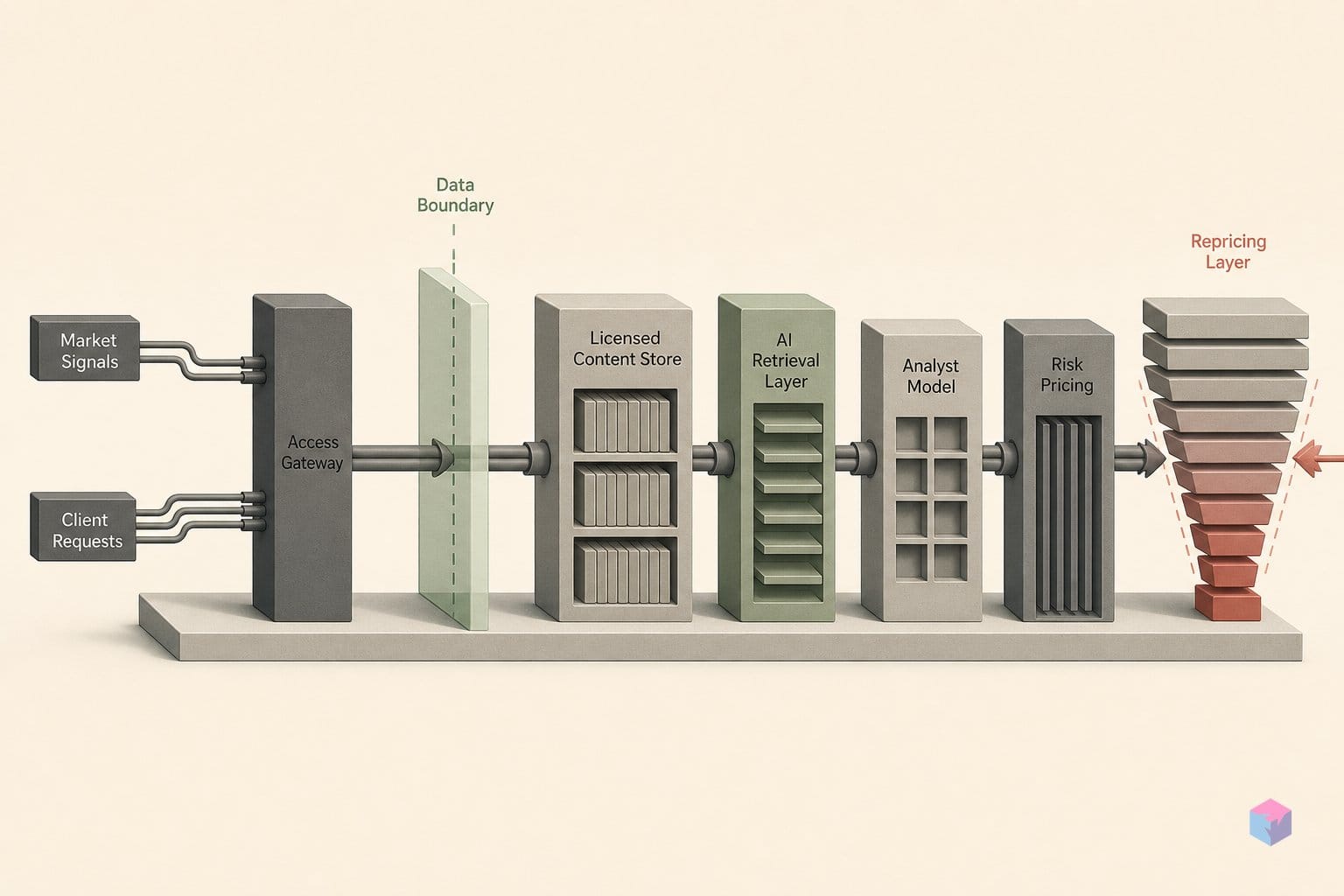
The dividing line is data ownership, not size. SaaS and data incumbents survive AI automation when their value rests on a proprietary corpus that labs cannot cheaply rebuild — multi-decade annotation of case law (Westlaw), curated regulatory precedent, and contract-clause histories built from millions of negotiated documents. Businesses whose product is generic document assembly are exposed, because that is exactly the layer Anthropic's legal plug-in for Claude Cowork targeted at launch on February 3, 2026.
The defensible moat is the curated corpus. AI labs can match the reasoning layer quickly; they cannot quickly license decades of structured, editorially maintained case-law and clause data at scale. That asymmetry is why analysts called the plug-in "relatively basic" against mature enterprise platforms and noted incumbents retain proprietary data depth . It also explains the differential damage: Thomson Reuters draws about 45% of EBIT from legal and fell ~16-18%, while RELX, with ~10-13% legal exposure, fell less .
What is exposed is the standardized middle: NDA drafting, boilerplate compliance checklists, templated responses — high-volume, low-margin tasks the agentic layer handles first. The structural risk is cadence. Anthropic ships products at roughly monthly intervals, and it said the legal tool was coded almost entirely by its own coding agent with humans overseeing rather than writing code (video: Bloomberg Podcasts). An earlier coding-agent demo had already pressured DevOps software names on the identical pattern . Each new vertical entry now becomes a recurring earnings-call event rather than a one-time shock.
"Traders are dumping software stocks as AI fears erupt" — Bloomberg Podcasts, reporting that markets now treat each Anthropic capability release as a potential earnings threat (source: Bloomberg Podcasts).
For builders, the playbook is concrete: agentic AI enters a vertical at its highest-volume, lowest-margin workflows first, then climbs. Curated-corpus businesses have a defensible window measured in years; standardized-template SaaS has months. If your moat is a unique, hard-to-relicense dataset, you can out-iterate the automation layer. If your moat is a workflow wrapper around tasks a general-purpose agent can already do, repricing — not disruption later — is the near-term threat.
Rebalancing or De-Rating: The Bull and Bear Case for AI Equities Now
The same question hangs over hardware and software: is June 23, 2026 a rebalancing inside an ongoing AI capex supercycle, or the first leg of a prolonged de-rating? Both readings are defensible on the current data. The bull case is that earnings momentum is intact and the selloff is positioning, not fundamentals — the Nasdaq had risen roughly 26% and the Philadelphia Semiconductor index more than 100% from their March 30 low before the rout , so a multi-day pullback unwinds froth without breaking the trend. Wedbush's Dan Ives framed the move in exactly those terms.
"This is a gut check moment, not a structural break," — Dan Ives, Managing Director at Wedbush Securities (source: ComplexDiscovery, 2026-06).
The bear case is more structural than sentiment. A June 1, 2026 arXiv paper, "Boom, Bubble, or Buildout?", argues AI is a genuine technological shift carrying localized bubble dynamics: capex is outpacing demonstrated monetization, private-market concentration is extreme, and valuations are capitalizing future productivity before the cash flows arrive . That is the through-line of every section above — Anthropic's legal plug-in repricing data incumbents, repeatedly upward-revised hyperscaler capex, and a Shiller CAPE above 40. None of those are sentiment; they are the inputs a de-rating would discount.
What would actually shift the calculus is narrow and observable. Watch for three signals: hyperscalers guiding capex down rather than up at the next earnings cycle, after Meta lifted 2026 capex to $125–$145 billion and Alphabet to $180–$190 billion; demonstrable Fortune 500 ROI from production AI deployments rather than pilots; and sustained improvement in AI-SaaS gross retention. Any one would tilt the read toward buildout; their continued absence tilts it toward bubble.
The honest position as of Q2 2026 is that this is unresolved, and pretending otherwise is the mistake. For builders and allocators, the takeaway is to stop trading the index narrative and start tracking the three signals above per name. Spending that compounds without payback evidence is the risk; payback evidence that arrives is the thesis. Until the next guidance prints, you are watching, not concluding.
Watch / Sources
Frequently asked questions
Did Anthropic's legal automation directly cause the 2026 tech stock selloff?
No — these were two separate events. Anthropic's legal plug-in for Claude Cowork launched on February 3, 2026 and hit legal-data incumbents specifically, with Thomson Reuters down ~16–18%, RELX ~14% and Wolters Kluwer ~13% on the news . The broader June 2026 rout — the Nasdaq fell ~2.2% and memory names like Micron dropped ~13% on June 23 — was driven by AI capex anxiety, a Shiller CAPE above 40, and crowded memory and megacap positions unwinding, not by any single product release.
Why did Thomson Reuters fall harder than RELX on the Anthropic announcement?
Because the market repriced each name by its proportional exposure to legal revenue, and Thomson Reuters is the most concentrated. Thomson Reuters draws about 45% of EBIT from legal, versus roughly 10–13% for RELX and Wolters Kluwer . RELX's scientific, exhibitions and risk divisions provided insulation that Thomson Reuters lacked, so an automation threat to contract review and NDA triage mapped almost directly onto the bulk of TR's profit pool while touching only a slice of RELX's. The repricing was an exposure trade, not a verdict that the plug-in is technically superior to either incumbent's platform.
Is Shiller CAPE above 40 a reliable indicator that a crash is imminent?
No. The cyclically adjusted P/E signals long-run return compression, not precise timing. In mid-2026 CAPE pushed above 40 for the first time since the dot-com peak , but the 1999 precedent is instructive: the Nasdaq kept rising for months after CAPE crossed 40 before the eventual collapse. A high CAPE tells you forward returns are likely lower and the market is fragile to shocks; it does not tell you the quarter or year a drawdown begins. Treat it as a valuation warning, not a countdown clock.
Which SaaS categories face the most immediate exposure to AI automation?
The most exposed work is high-volume, low-margin and lacks a proprietary data moat: generic document templating, standard compliance checklists, and boilerplate NDA drafting — exactly the tasks Anthropic's plug-in targets for contract review, compliance and templated responses . More defensible near-term are curated databases built on decades of annotated, proprietary case-law and contract data, which agentic tools cannot reproduce from public sources alone. The dividing line is the data moat: workflows whose value is execution speed are vulnerable; workflows whose value is exclusive, structured corpus are harder to displace.
What evidence would confirm a genuine AI bubble rather than a valuation correction?
Three signals would distinguish a structural bubble from a repricing: sustained acceleration in enterprise churn for AI SaaS, hyperscalers guiding capex down rather than up, and AI revenue growth decelerating materially against expectations despite existing deployments. As of Q2 2026 none are present — Nvidia reported fiscal Q1 2027 revenue of $81.6 billion, up 85% year over year , while Meta and Alphabet both raised, not cut, 2026 capex guidance, to $125–$145 billion and $180–$190 billion respectively . Upward-revised spending against rising revenue is consistent with a correction in crowded valuations, not yet a demand collapse.