Anthropic put its name on a Seoul office in June 2026, but the demand had been building for years. By the time the lights came on, Korea was already one of Claude's busiest markets on the planet — and the numbers explain why a country office was overdue rather than aspirational.
Why Korea was already in Claude's top-five before Seoul got an office
South Korea ranks in the world's top five for both total and per-capita Claude usage as of June 2026 . That standing is not a launch-week talking point — it predates the office. Anthropic said in May 2026 that Koreans use Claude.ai at more than 3.5x the rate expected from population size, with activity skewing toward technical and creative work .
The developer signal is sharper still. Weekly active Claude Code users in Korea grew roughly 6x over four months, and Anthropic describes a Korean software engineer as its single top Claude Code user worldwide . The regional pull is broad, too: more than a quarter of Anthropic's entire Claude Code user base comes from Asia-Pacific .
Read together, the figures point to one thing: organic demand outran local infrastructure. The Seoul launch formalizes a go-to-market that the market itself was already forcing.
- Adoption rate: Claude.ai usage at >3.5x the population-adjusted expectation (Anthropic, May 2026) .
- Global standing: Top five for both total and per-capita Claude usage as of June 2026 .
- Claude Code growth: ~6x weekly active users in four months; the world's top Claude Code user is a Korean engineer .
- Regional weight: >25% of the Claude Code user base sits in Asia-Pacific .
Anthropic's own leadership frames Korea as a near-term scaling story rather than a finished one. International Managing Director Chris Ciauri said at the Seoul press conference on June 17, 2026 that Korea is expected to enter Anthropic's top 10 markets by Claude usage volume in the near future . For builders, the takeaway is that the office is a response to existing pressure — not an attempt to manufacture interest that wasn't there.
What the Seoul office brings: on-the-ground go-to-market, not discounted API pricing
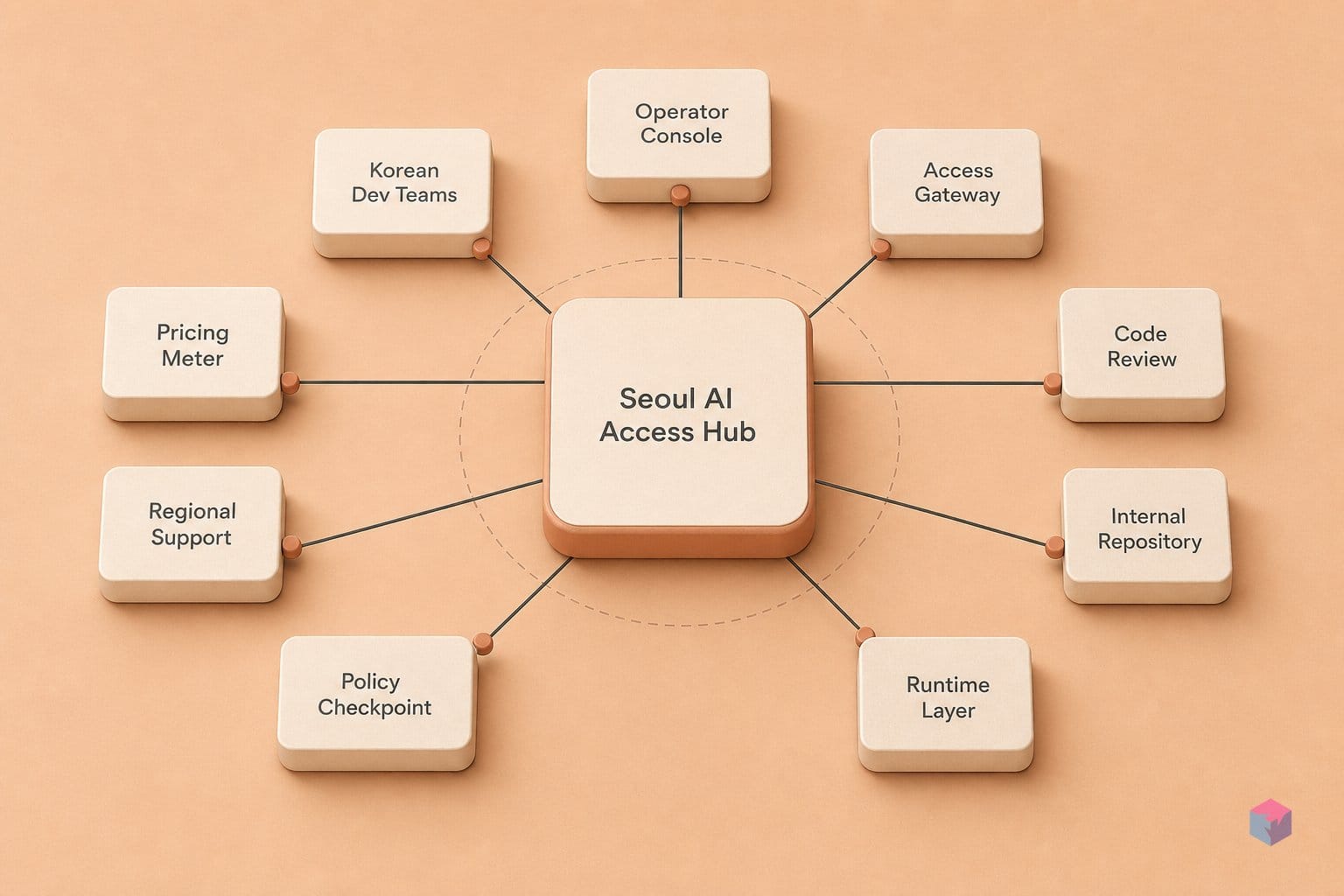
The Seoul office is a local sales, support, and developer-access push — not a price cut. Anthropic announced no Korea-specific API pricing, no won-denominated rate card, and no local cloud region, so Korean builders still buy at standard USD global rates . What changes is proximity: local enterprise engagement, faster support, and structured paths into Claude for startups and founders.
The most tangible offer for early-stage teams is the Claude for Startups program, now active in Korea . One caveat matters for architecture decisions: the credits apply to the first-party Claude API through Claude Console only — not AWS Bedrock, Google Cloud Vertex AI, or other third-party marketplaces . If you want the free credits, you build directly against Anthropic, not through a cloud reseller.
The ecosystem programming is concrete, not symbolic:
- Claude Meetups have drawn hundreds of Korean developers since September 2025 .
- A Build Day co-hosted with BASS Ventures drew 100+ Korean founders and developers .
- A 'Push to Prod' hackathon is planned with Replit, Korea Investment Partners, and Korea Investment Accelerator .
The leadership hire signals intent. KiYoung Choi, named Representative Director of Korea, is a three-decade tech veteran whose prior Korea leadership roles span Snowflake, Google Cloud, Adobe, Autodesk, and Microsoft . That résumé is go-to-market and enterprise-facing, not research — consistent with an office built to sell, support, and onboard rather than to run a local lab.
Anthropic frames the bet plainly. International Managing Director Chris Ciauri said Korea is expected to enter the company's top 10 markets by Claude usage volume in the near future . For builders, the practical read is simple: expect better local access, credits, and events — not cheaper tokens.
NAVER, Samsung, Nexon: the Korean organizations already on Claude
The enterprise footprint is what makes that bet concrete. NAVER, Korea's largest internet company, has rolled out Claude Code across its entire engineering organization — thousands of engineers . Samsung SDS is deploying Claude, Claude Code, and Claude Cowork across Samsung Electronics, and LG CNS is putting Claude in front of thousands of employees with group-wide expansion planned .
These are not pilots. They are standardization decisions inside organizations that ship code and run live services at national scale — the kind of reference accounts a go-to-market office exists to support.
| Organization | What they run | Scope |
|---|---|---|
| NAVER | Claude Code | Entire engineering org (thousands of engineers) |
| Samsung SDS | Claude, Claude Code, Claude Cowork | Deployment across Samsung Electronics |
| LG CNS | Claude | Thousands of employees; group-wide expansion planned |
| Nexon | Claude Code | Live-service game development |
| Channel Corp | Claude (in Channel Talk) | Customer-AI platform used by 230,000+ companies |
| Hanwha Solutions | Claude via AWS Bedrock | Data-residency compliance |
The deployment patterns differ in ways that matter for builders. Nexon uses Claude Code for live-service game development, where the work is iterative and tied to running titles . Channel Corp embeds Claude directly in Channel Talk, a customer-AI platform used by more than 230,000 companies across Korea, Japan, and the United States .
Hanwha Solutions is the tell for regulated teams: it runs Claude through AWS Bedrock specifically for data-residency compliance — a route that matters because the first-party Claude API carries no guaranteed Korean data residency . WRTN Technologies and Law&Company round out the named customer list .
The reach extends into research, too. Through a partnership with the National AI Research Lab (NAIRL), Anthropic is giving free Claude access to roughly 60 researchers across KAIST, Korea University, Yonsei University, and POSTECH . It is a small cohort, but it seeds the next wave of Korean teams already fluent in Claude before they ever reach an enterprise contract.
What Korean builders pay: flat USD billing, no Korean discount
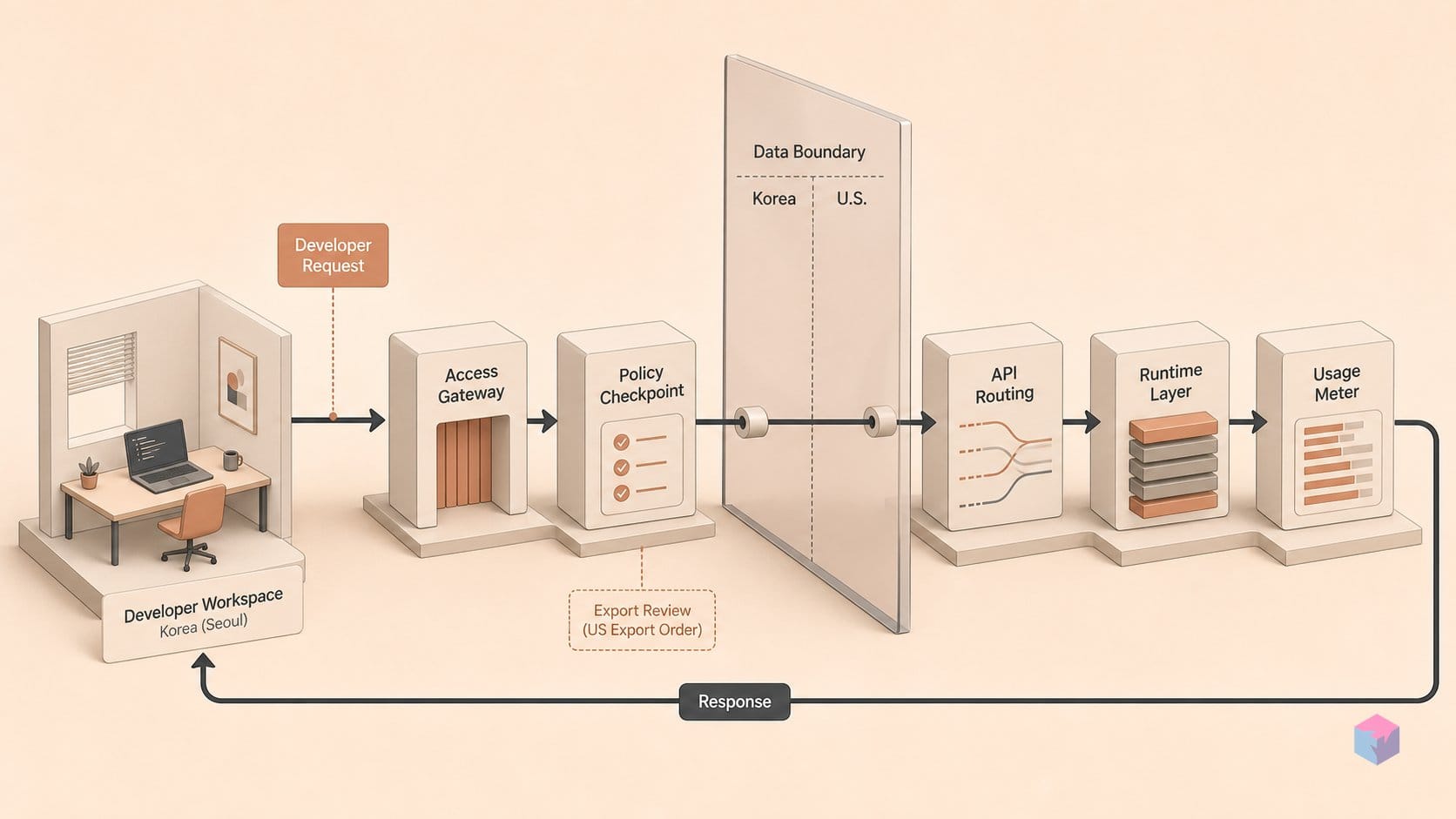
Korean teams buy Claude at the same USD rates as everyone else — Anthropic announced no won-denominated card, no local discount, and no Korea-specific tier at the Seoul launch . Billing is per million tokens (MTok), split between input and output, and identical whether you call the API from Seoul or San Francisco.
The current rate card, as of mid-2026, covers three available models. Claude Opus 4.8, the flagship released May 28, 2026, is the priciest; Haiku 4.5 is the cheapest .
| Model | Input ($/MTok) | Output ($/MTok) | Cache read ($/MTok) |
|---|---|---|---|
| Claude Opus 4.8 | $5 | $25 | $0.50 |
| Claude Sonnet 4.6 | $3 | $15 | $0.30 |
| Claude Haiku 4.5 | $1 | $5 | $0.10 |
Two levers cut that bill without any regional deal. Prompt caching can reduce cached input cost by up to 90% — Opus 4.8 cache reads land at $0.50/MTok versus $5 for fresh input — and batch processing saves roughly 50% against standard input/output billing . For high-volume Claude Code workloads, the math here matters more than any local price negotiation.
For larger Korean engineering orgs, the Enterprise plan runs about $20 per seat per month plus usage at standard API rates . What you get for the seat fee is operational, not discounted tokens:
- Extended context — up to 500K tokens on Sonnet, 1M with Claude Code
- Audit logs, SCIM provisioning, and IP allowlisting
- A Compliance API and HIPAA readiness for regulated teams
Spend caps and rate limits follow the same account-based logic, not geography. Monthly caps run $500 on Start, $1,000 on Build, and $200,000 on Scale, with no fixed cap on Custom; higher limits are requested through the Console rather than via a local sales rep . The practical takeaway for builders in Korea: the Seoul office buys you faster local support, startup credits, and partnership access — not a cheaper per-token rate. Anyone modeling unit economics should plan around the global card and lean on caching and batching, the same way a team in Tokyo or Bengaluru would.
Why the U.S. export ban took Fable 5 offline — and why Korea felt it
The model lineup you can rely on in Korea is the standard tier — Opus 4.8, Sonnet 4.6, and Haiku 4.5 — all of which stayed fully available throughout the disruption. The frontier tier is what moved. On June 12, 2026, Anthropic said a U.S. export-control directive required suspending Claude Fable 5 and Mythos 5 for any foreign national, inside or outside the United States .
The blunt part is how Anthropic enforced it. Rather than block individual users, it disabled both models for every customer worldwide — selective enforcement on shared cloud infrastructure was operationally impractical . Fable 5 had been generally available only three days earlier, on June 9, across the Claude API, AWS, Amazon Bedrock, Google Cloud, and Microsoft Foundry, with a 1M-token context and 128k max output . It went dark for everyone, while all other models kept running.
Korea felt it sharply because Korean institutional access was revoked outright. That included organizations tied to Anthropic's Project Glasswing cybersecurity research — reportedly Samsung Electronics, SK Hynix, and the Korea Internet & Security Agency . The Washington Post and WIRED linked the directive to concerns about a Korean telecom's alleged China ties, identified as SK Telecom, which denied the claim .
What this did and did not break for builders:
- Unaffected: Opus 4.8, Sonnet 4.6, and Haiku 4.5 stayed live across API, Console, and cloud marketplaces .
- Still working: Claude Code kept running on those non-suspended models, so day-to-day coding workflows continued.
- Cut: Fable 5 and Mythos 5 — the frontier tier — for all customers worldwide, not just Korean ones.
Anthropic's read at the Seoul launch was that this was a short-term problem. "We believe it will be resolved soon," International Managing Director Chris Ciauri said, adding he expected "no long-term impact" . For Korean teams, the signal was uncomfortable regardless: the standard stack held, but access to the most capable models had become politically contingent.
What the partial ban lift restored — and what remains open for Korean builders
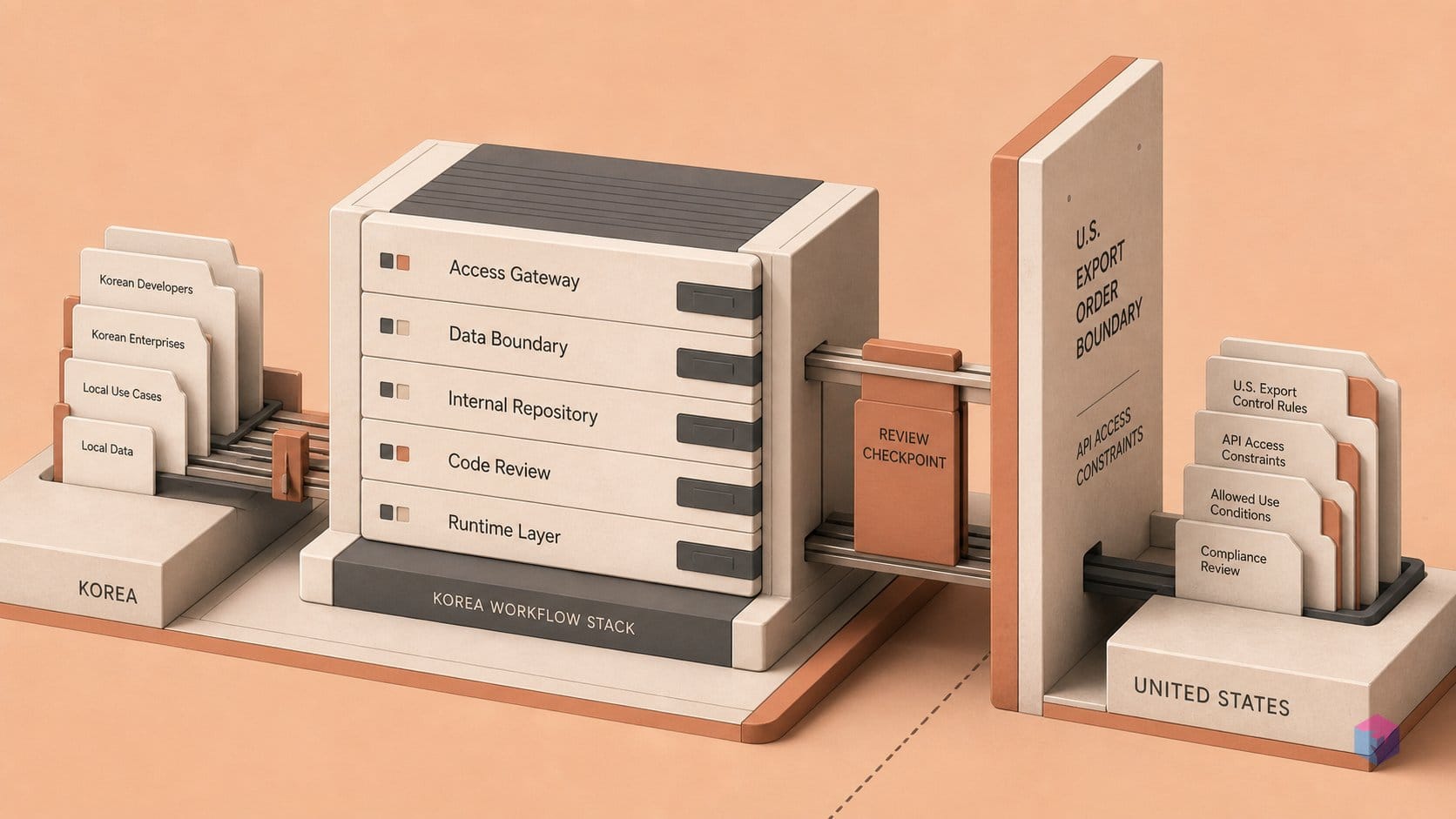
The freeze started thawing within two weeks. On June 26, 2026, U.S. Commerce Secretary Howard Lutnick's letter reportedly cleared Mythos 5 for roughly 100 U.S. institutions . A day later, NPR reported the Trump administration had partially lifted the ban, with Fable 5 — offline about 15 days — set to return . That matches the read Anthropic gave at the Seoul launch.
"We believe it will be resolved soon," said Chris Ciauri, International Managing Director at Anthropic, adding that he expected "no long-term impact."
For Korean builders, though, "resolved" is doing a lot of work. The public detail so far covers U.S. institutions and a global Fable 5 restoration — not whether Korean customers regain frontier access on the same timeline. Two specific gaps remain open:
- Timeline parity: there is no confirmation that Korean organizations come back online alongside U.S. ones, rather than on a slower track .
- Mythos 5 for Korea: Lutnick's clearance named U.S. institutions; the status of Mythos 5 for Korean entities — including those tied to the Project Glasswing cybersecurity work reportedly involving Samsung Electronics, SK Hynix and the Korea Internet & Security Agency — has not been disclosed .
The standard stack — Opus 4.8, Sonnet 4.6, Haiku 4.5 and Claude Code — was never touched and stays fully available . But the episode left a mark beyond the outage window. It sharpened a Korean debate about "AI sovereignty" — the risk of standardizing critical infrastructure on a U.S.-gated service that a single export directive can switch off, regardless of how deep local adoption runs .
The practical takeaway: the frontier tier is back in motion, but for Korean teams it has been demonstrated to be politically contingent. That changes the calculus for anyone weighing a hard dependency on Anthropic's most capable models versus keeping a fallback path open.
Looking ahead: academic tie-up, ministry MOU, and the geopolitical contingency debate
Most of Anthropic's Korea footprint sits below the frontier tier, and that footprint keeps growing regardless of export-control headlines. Anthropic signed an MOU with Korea's Ministry of Science and ICT covering AI-safety collaboration, Korean-language model-safety evaluation with the Korea AI Safety Institute, and information exchange on AI-enabled cyber threats . None of that depends on access to Opus-class or Fable-class models.
The same is true of the builder-facing programs. A National AI Research Lab (NAIRL) partnership gives free Claude access to up to roughly 60 researchers across KAIST, Korea University, Yonsei University and POSTECH . Claude for Startups is now live in Korea, layered on Meetups and Build Days that have drawn hundreds of local developers . These expand the ecosystem independently of frontier-tier status.
For regulated workloads, the practical hedge is path choice:
- Cloud marketplaces — AWS Bedrock or Google Cloud Vertex AI can offer more operationally predictable access and data-residency compliance, as Hanwha Solutions already does via Bedrock .
- First-party Claude API — required for startup credits via Claude Console, but the channel where a single export directive landed hardest .
The open question outlasts the June episode: whether frontier-tier access stays contingent on bilateral political conditions, or whether Anthropic's top models can be treated as a reliable infrastructure dependency. The partial lift — Commerce Secretary Howard Lutnick's June 26 letter and the June 27 NPR report of Fable 5 returning after roughly 15 days offline — eased the immediate pressure but did not settle the principle .
Concrete takeaway for Korean teams: build on the stable tier — Opus 4.8, Sonnet 4.6, Haiku 4.5 and Claude Code — where adoption is deep and access has held throughout. Treat the frontier tier as powerful but politically gated, and keep a marketplace or fallback path open until top-tier access proves itself a dependency you can plan around rather than a privilege that can be revoked.
Frequently asked questions
Does the Anthropic Seoul office mean cheaper API pricing for Korean developers?
No. Anthropic announced no Korea-specific rate card, won-denominated billing, or local cloud region at the Seoul launch . Korean builders pay standard global USD rates per million tokens (MTok): Opus 4.8 at $5 input / $25 output, Sonnet 4.6 at $3/$15, and Haiku 4.5 at $1/$5 . The office adds local enterprise support, startup credits, and event infrastructure — not discounted token economics.
What happened to Fable 5 and Mythos 5 access for Korean builders?
A U.S. export-control directive on June 12, 2026 led Anthropic to suspend both frontier models worldwide, since selective enforcement on shared cloud infrastructure was impractical . Korean institutional access tied to Project Glasswing research was revoked . By June 27 the Trump administration partially lifted the order, with Fable 5 — offline about 15 days — set to return . Mythos 5 access for Korean institutions remains unconfirmed.
Can Korean startups get Claude API credits through the Seoul office?
Yes. The Claude for Startups program is now live in Korea . Credits apply only to the first-party Claude API via Claude Console — not AWS Bedrock, Google Cloud Vertex AI, or other third-party platforms . That distinction matters when a startup chooses between building directly through Anthropic and going through a cloud marketplace, since credits do not transfer to the marketplace path.
Which Korean enterprises are deploying Claude right now?
Named at the Seoul launch: NAVER (Claude Code across its entire engineering organization), Samsung SDS (Claude, Claude Code and Claude Cowork across Samsung Electronics), LG CNS (thousands of employees, group-wide expansion planned), Nexon (live-service game development), and Channel Corp, which embeds Claude in Channel Talk, used by more than 230,000 companies across Korea, Japan and the U.S. . Hanwha Solutions (via AWS Bedrock), WRTN Technologies and Law&Company are also named .
Is Korean user data stored in Korea with the first-party Claude API?
Anthropic has not announced a Korea-specific cloud region or a data-residency guarantee on the first-party API . Hanwha Solutions works around this by running Claude via AWS Bedrock, which offers regional data-residency options . For regulated and public-sector Korean customers, residency remains an open compliance consideration to resolve at the platform level.