

In one month, a single Claude Code user reportedly ran up roughly $35,000 in compute against a $200 subscription. That gap — flat-rate plan versus metered reality — is why Anthropic capped everyone.
Why a $35K tab forced a weekly quota
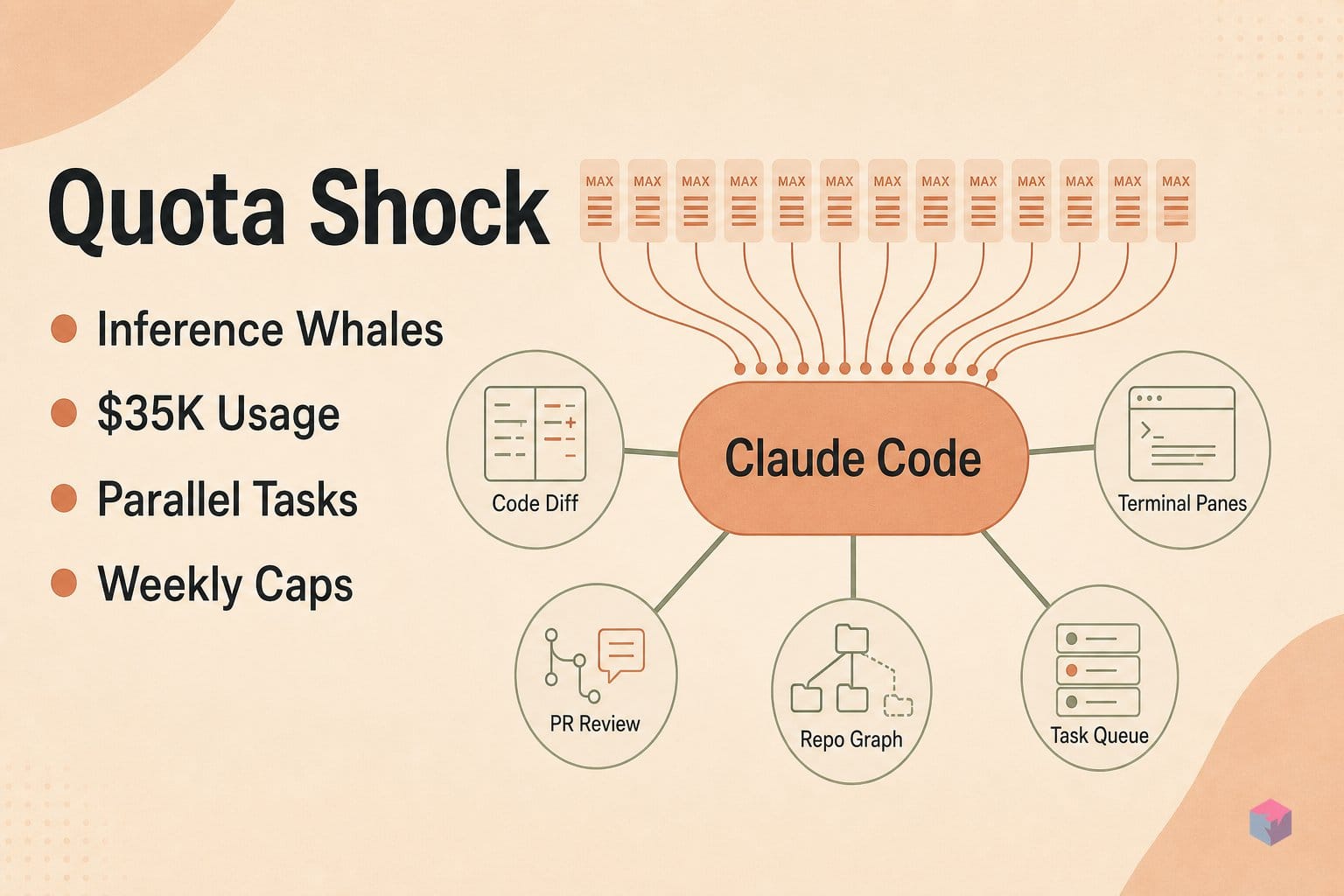
Weekly rate limits exist because a handful of agentic developers turned a flat consumer plan into an effectively metered one. Business Insider's reporting on "inference whales" surfaced one leaderboard user who consumed nearly 11 billion tokens — an estimated ~$35,000 of inference at API prices — on a $200/month Max plan . Named Swedish developer Albert Örwall described running three to four long-running Claude Code tasks in parallel, roughly $500/day of inference-equivalent usage under the same subscription .
Anthropic announced the new weekly limits on July 28, 2025, effective August 28, and estimated they would affect fewer than 5% of subscribers . TechCrunch reported the trigger: at least seven Claude Code outages in the prior month, driven by users running the agent 24/7 plus policy violations including credential sharing and reselling — with one cited case consuming tens of thousands of dollars on a $200 plan .
"Claude Code has seen unprecedented demand," said Amie Rotherham, Anthropic spokesperson, adding that most users won't notice a difference (source: TechCrunch).
The practical effect: for heavy agentic developers, the binding constraint moved. Pre-cap, the rolling five-hour session window was the bottleneck; post-cap, the shared seven-day pool is.
The rolling drain: how the 5-hour and 7-day bucket empties

Claude Code meters usage against two overlapping clocks that draw from one shared pool: a rolling five-hour session window and a weekly cap that resets every seven days at a fixed, account-assigned time . That single pool spans claude.ai chat, the desktop app, and the Claude Code terminal — switching surfaces does not reset it, and tokens spent in a browser chat come out of the same allowance as a long agentic debug run .
Max carries two weekly limits stacked together: one across all models and a second, tighter cap specific to the heaviest model . Max $200/mo is marketed as 20× Pro per-session usage — explicitly not unlimited . Anthropic's estimated weekly allowances at launch:
| Plan | Sonnet 4 / week | Opus 4 / week |
|---|---|---|
| Pro ($20/mo) | 40–80 hrs | — |
| Max ($100/mo) | 140–280 hrs | 15–35 hrs |
| Max ($200/mo, 20×) | 240–480 hrs | 24–40 hrs |
These are hour estimates, not message counts . Anthropic no longer publishes fixed messages-per-window figures, so the older "45 messages per 5 hours" number is stale — check current headroom with /status inside Claude Code . On paid plans, crossing the cap is not a hard block: overflow bills at standard API rates .
How to stay within the 7-day bucket
Staying inside the weekly cap is mostly a budgeting problem: every concurrent branch and every subagent draws from the same shared pool, so headroom disappears fastest when you fan out carelessly. A three-branch worktree setup burns roughly 3× a solo session, and plan-mode teammates can push consumption toward ~7× a single agent . Compounding that, every turn resends the accumulated conversation, project context, and file diffs, so a long debugging thread that keeps re-reading the same files inflates token cost turn over turn — the primary hidden multiplier.
Three habits keep the drain in check:
- Clear context between tasks. The per-turn re-send of prior file reads and diffs is what silently multiplies a session's cost; starting fresh between unrelated tasks stops old context from riding along on every new prompt .
- Match the model to the work. Anthropic's recommended ladder is Sonnet 4 for most coding, Haiku 4.5 for mechanical edits — priced at $1 input / $5 output per million tokens — and Opus 4 reserved for hard planning and debugging. The pattern is plan with Opus, then execute with Sonnet .
- Isolate parallel work with git worktrees. Built-in worktree support (reported in v2.1.49, around February 2026) lets you run
claude --worktree <name>or-wto spin isolated sessions, each on its own branch under.claude/worktrees/, with subagent isolation so parallel edits never collide .
Worktrees matter for the budget precisely because branched tasks finish sooner with no per-session surcharge — parallel sessions bill the same per token, they just wall-clock faster . The practical ceiling is human, not compute: the community reports comfortable orchestration tops out around 5–7 concurrent tasks before review bandwidth, not the rate limit, becomes the bottleneck .
ccflare, better-ccflare, and the TOS you're bypassing
The "13 in parallel" trick doesn't come from one account — it comes from a proxy that rotates several. ccflare is an open-source local proxy that load-balances Claude Code requests across multiple OAuth accounts; you point Claude Code at it with ANTHROPIC_BASE_URL=http://localhost:8080 and it routes traffic using five-hour sticky sessions plus health-check filtering that skips accounts already rate-limited, refreshing OAuth tokens automatically . Two security caveats matter: it stores OAuth tokens unencrypted and binds to 0.0.0.0 by default, so keep it on localhost .
An actively maintained fork, better-ccflare, extends this with multi-provider support — Claude OAuth, API console, Vertex AI, and Bedrock — plus a "LeastUsed" routing strategy and shorter cooldowns to avoid locking out the whole pool at once . Adjacent projects go further: ming86/claude-balancer does similar account rotation, and mixpeek/amux supervises "dozens" of parallel Claude Code, Codex, and Gemini tmux sessions from one dashboard, parking and resuming them around rate-limit prompts.
The economics are blunt: thirteen Max 20x subscriptions run $2,600/month before taxes, and spreading them across accounts multiplies included quota . But that's quota multiplication, not a sanctioned bypass. Anthropic's consumer terms prohibit sharing credentials, making an account available to others, and bypassing protective measures . The terms don't plainly address one person holding many separate accounts — but the stated goal, fair capacity allocation for the other 95%, leaves little ambiguity about how deliberate limit-defeat gets read.
What to do when your Max quota is exhausted
When your weekly cap runs dry, Anthropic now ships a sanctioned overflow instead of a hard wall. Usage credits let Pro, Max 5x, and Max 20x subscribers keep working past their included limits at standard API rates, billed separately from the subscription — with spend controls, auto-reload, and a $2,000 daily redemption ceiling, and no separate API credentials to wire up . It applies to both claude.ai conversations and the Claude Code terminal.
If you want per-token billing with no weekly stop at all, use a direct API key. Current published rates put Opus 4.8 at $5 input / $25 output per million tokens, Sonnet 5 at an introductory $2 / $10 through August 31, 2026, and Haiku 4.5 at $1 / $5 . For teams, Enterprise seat pools distribute capacity under different SLA guarantees — the right fit when one heavy subscriber is draining shared quota and blocking teammates.
The takeaway: pick the overflow that matches your risk tolerance. Credits for occasional spillover, an API key for uncapped agentic runs, seat pools when the constraint is a whole team — all three keep you inside the terms instead of gaming them.
Frequently asked questions
Does pausing Claude Code between tasks actually preserve my weekly quota?
Yes. Tokens are consumed only on active turns, so an idle session sitting between tasks costs nothing against the rolling five-hour window or the seven-day cap. The bigger win is clearing context between tasks: every turn resends prior conversation, project context, and file reads, so a long debugging session repeatedly re-sends accumulated diffs and inflates per-turn token cost . Running /clear before starting unrelated work resets that accumulation and keeps each turn lean.
What happens when I hit the weekly cap — does Claude Code stop entirely?
On paid Max plans the cap is not a hard block. Once you exhaust the included weekly allowance, usage overflows and bills at standard API rates rather than cutting you off mid-task . Because that overflow is billed separately, set spend controls before you reach the ceiling — usage credits support auto-reload and caps, with a $2,000 daily redemption limit . Check current status any time with /status.
Is using ccflare against Anthropic's terms of service?
Almost certainly, for the multi-account rotation use case. ccflare load-balances Claude Code requests across several OAuth accounts to dodge the shared usage pool , but Anthropic's consumer terms prohibit sharing login credentials, automated non-human access outside the API, and bypassing protective measures . Running separate accounts specifically to defeat per-account caps maps directly onto that clause, since the stated policy goal is fair capacity allocation. There's a security cost too: ccflare stores OAuth tokens unencrypted and binds to 0.0.0.0 by default.
Which model should I default to for long agentic tasks to preserve weekly headroom?
Follow Anthropic's own documented split: Sonnet for most coding, Haiku for cheap mechanical subtasks, and Opus reserved for hard planning and debugging only . The pattern is "plan with Opus, execute with Sonnet." The cost gap is stark — recent published API rates put Opus 4.8 at $5 input / $25 output per million tokens versus Sonnet 5 at an introductory $2 / $10 and Haiku 4.5 at $1 / $5 — so defaulting to Opus for routine edits drains the model-specific weekly cap fastest.
Can I add capacity to my Max plan without switching to the API entirely?
Yes. Usage credits let Pro, Max 5x, and Max 20x subscribers continue past their included limits at standard API rates, reloading up to $2,000 per day directly from claude.ai — no separate API key or plan change required . Credits apply to both Claude conversations and Claude Code terminal usage, and include spend controls and auto-reload. It's the lowest-friction overflow path for occasional spillover; a full API key or Enterprise seat pool makes more sense for sustained uncapped runs or whole-team capacity.
Enjoyed this article? Subscribe to get new stories by email whenever they're published.