

Claude Code can make interrupted work easier to recover, but a Max subscription limit is still a subscription limit. Treat fallbackModel as continuity plumbing, not extra quota.
Claude Code weekly limits now
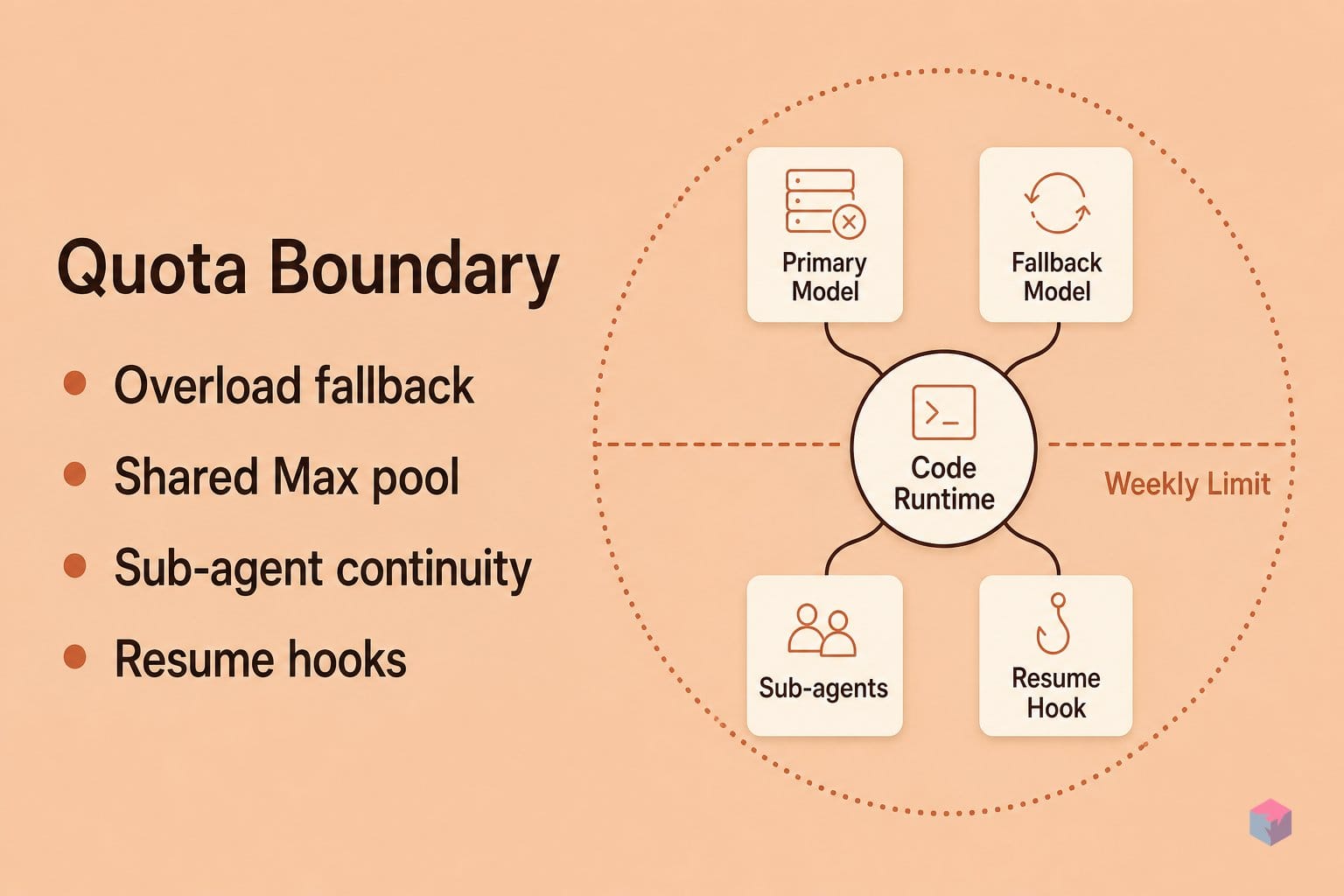
fallbackModel helps Claude Code continue when the primary model is overloaded, unavailable, or otherwise fails under supported server-side conditions; it does not bypass a shared Claude Max weekly limit. According to TechCrunch, Anthropic announced new weekly limits for Pro and Max users on July 28, 2025, effective August 28, 2025, and said fewer than 5% of subscribers were affected .
Quick Answer: fallbackModel can route around model overloads, but it cannot extend a Claude Max shared weekly usage pool. Anthropic’s weekly-limit rollout was announced on July 28, 2025 and reported as affecting fewer than 5% of subscribers .
The important distinction is quota class. Anthropic’s Claude Code error documentation separates overload and availability failures from session, weekly, and model-specific usage limits; a capacity error can be retried or routed to another model, while a weekly-limit message blocks subscription requests until the displayed reset time . That makes fallback useful for reliability, but not for entitlement expansion.
"You can use Claude Code with your Claude Pro or Max subscription," — Anthropic Support (source: Anthropic Support)
Max is sold in 5x and 20x tiers, starting at $100/month and $200/month respectively, and usage is shared across Claude web, desktop, mobile, and Claude Code rather than isolated per surface . In practice, a long Claude Code session can consume the same subscription allowance you expected to use in the web app later.
| Limit or feature | What it changes | What it does not change |
|---|---|---|
fallbackModel |
Routes supported model failures to a configured fallback model | Does not bypass shared Max weekly limits |
| Max 5x / Max 20x | Paid tiers start at $100/month and $200/month | Usage remains shared across Claude surfaces |
| Higher Claude Code limits | Anthropic said it doubled Claude Code five-hour limits on May 6, 2026 | Does not remove weekly/account/model caps documented for paid plans |
Before you rely on fallbackModel
fallbackModel is only useful after you identify the limiter that actually fired; it is not a general continuation switch for Claude Max. Claude Code distinguishes session limits, weekly limits, model-specific limits, overload, request-size, transport, authentication, and billing failures, and those buckets behave differently in the official error guidance .
Start with /usage before changing models. Anthropic says Claude Code usage on Pro and Max draws from the same allowance as Claude web, desktop, and mobile, so a busy browser session can reduce what remains for terminal work . The Max plan is sold as 5x and 20x tiers, with published prices starting at $100/month and $200/month respectively .
- If the error is a shared session or weekly limit, switching models will not reopen subscription access; Claude blocks further subscription requests until the displayed reset time or a billing path changes .
- If the error is model-specific exhaustion, another eligible model may still run, because that is a narrower cap than the shared Max pool .
- If the error is overload, such as a capacity-related
529, retrying or fallback can help because the failure is not counted as user quota consumption .
Configure fallback as a bounded chain, not an escape hatch. Claude Code supports fallbackModel in settings and --fallback-model on the command line, with up to 3 fallback models after duplicate removal and resolution through documented settings precedence . The changelog records v2.1.166 as the release that added fallbackModel and made --fallback-model apply to interactive sessions .
fallbackModel steps for overload, not weekly limits
fallbackModel is a recovery path for Claude Code when the selected model is overloaded, unavailable, or otherwise fails under qualifying server-side conditions; it is not a way to continue after a shared Max weekly limit is exhausted. The feature can be configured in settings or passed with --fallback-model, and Claude Code resolves fallback chains through its documented configuration precedence .
- Configure the fallback chain explicitly. Put
fallbackModelin your Claude Code settings, or pass--fallback-modelwhen starting an interactive session. Anthropic’s configuration docs describe fallback model selection as part of Claude Code’s model configuration, while the changelog recordsv2.1.166as the release that addedfallbackModeland made--fallback-modelwork for interactive sessions . Keep the chain short and intentional: Claude Code supports up to3fallback models after duplicate removal . - Test the right failure mode. A valid fallback test is a model-side problem, such as overload or temporary unavailability. Do not use a Max weekly-limit message, billing failure, authentication error, request-size failure, or transport failure as your test case. Anthropic’s error docs separate server capacity errors from usage-limit and account-state errors, which means only some failures are candidates for model fallback .
- Treat
529differently from a limit message. A529overloaded response is capacity-related and does not count against quota, so retrying later or moving to another available model can be reasonable . A message such as “You’ve hit your weekly limit” is different: it means the subscription allowance is exhausted until the displayed reset time, and switching models does not refill the shared Max pool . - Use
/model opusplanonly when allowance remains. If your problem is cost shaping rather than an exhausted account limit,/model opusplancan reserve Opus for planning and use Sonnet for implementation. That is useful when you still have shared plan capacity and want to spend the heavier model on architecture, debugging strategy, or review rather than every edit .
The practical rule is simple: configure fallback for resilience against model availability, then read limit messages literally. If Claude Code reports overload, fallback can keep the session productive. If Claude reports a Max weekly limit, the available paths are usage credits where available, a higher plan, API billing, or waiting for reset .
Subagents and resume hooks in long jobs
Subagents and resume hooks help long Claude Code jobs survive context pressure, approvals, restarts, and task fanout, but they do not bypass Max weekly limits. A subagent is a separate Claude instance with its own context window, tools, model, permission mode, effort setting, hooks, and optional background execution, according to Anthropic's sub-agent documentation.
The useful pattern is to split work by responsibility. A search subagent can inspect a large repository, a review subagent can audit a patch, and a test-repair subagent can focus on failures while the parent session receives compact summaries. That preserves the main conversation's context and makes long jobs easier to resume after compaction or interruption. It still consumes usage under the selected model, so a subagent fanout can make limits arrive sooner if you treat it as free parallel capacity.
| Mechanism | What it controls | Limit behavior |
|---|---|---|
| Subagent model selection | Model choice for delegated Claude Code work | Resolution follows environment variable, invocation parameter, subagent frontmatter, then parent model, using CLAUDE_CODE_SUBAGENT_MODEL for global steering. |
SessionStart hook |
Startup, resume, clear, and compact lifecycle events | Useful for injecting project context and restoring environment state, not for extending subscription entitlement. |
PreToolUse defer |
Tool approval in non-interactive claude -p runs |
A deferred pending tool call can be resumed later with claude -p --resume <session-id>, according to Anthropic's hooks documentation. |
"Subagents run in separate context windows," says Anthropic in the Claude Code documentation (source: Anthropic).
Model routing matters because subagents can silently change the cost profile of a job. Anthropic documents the resolution order as CLAUDE_CODE_SUBAGENT_MODEL, then an invocation parameter, then subagent frontmatter, then the parent model. That means a team can set a cheaper default globally, then override a specific research or planning agent when deeper reasoning is worth the spend.
Hooks are the other half of the long-job story. SessionStart can run on startup, resume, clear, and compact, while CLAUDE_ENV_FILE can persist environment variables across lifecycle events. In non-interactive mode, PreToolUse can return a defer decision so Claude Code exits with a pending tool call preserved; a later claude -p --resume <session-id> can replay that call after the external approval state changes.
The gotcha is accounting. Subagents, hooks, resumes, and background work make jobs more durable, not cheaper by definition. Anthropic's Claude Code limit docs distinguish usage limits from overload and model availability errors, and usage limits still stop the workflow until reset, credits, plan changes, or API billing apply. Community tools such as ccusage can help inspect local token patterns, but Anthropic's server-side accounting remains authoritative.
After Max plan weekly limits
After a shared Max plan weekly limit is exhausted, fallbackModel, subagents, and resume hooks cannot keep Claude Code running on subscription capacity. The legitimate paths are to wait until the displayed reset time, enable usage credits where available, move to a higher Max tier, or run heavy work through Claude Console/API pay-as-you-go billing .
Anthropic describes Max as shared across Claude surfaces, including Claude Code, web, desktop, and mobile use; the Max plan is sold in 5x and 20x tiers, with listed starting prices of $100/month and $200/month . That matters because a fallback chain only helps when the primary model is overloaded, unavailable, or otherwise fails under supported model-fallback conditions, not when the account has no remaining shared allowance .
- Use
/usageto inspect the current limit state before changing models or editing settings . - Use subagents to isolate research, test repair, and review work, but assume their tokens still count toward usage because subagents are separate Claude instances with their own context and model settings .
- Treat local dashboards as diagnostic tools, not billing truth. Community reporting around ccusage notes that subagent sidechain and tool-result structures can affect local accounting, while Anthropic’s server-side limit state remains authoritative .
The practical experiment is not “bypass the limit.” Keep Opus for architecture and planning, route mechanical edits or review passes to Sonnet where appropriate, and add hooks for approval durability, restart recovery, and unattended workflow control. Claude Code can make long jobs easier to resume; it cannot turn a spent Max weekly pool into more subscription capacity.
Frequently asked questions
Can fallbackModel bypass Claude Code weekly limits?
No. fallbackModel can route a Claude Code session around model overload or qualifying server-side failures, but it does not bypass shared Claude Max weekly limits. Anthropic’s Claude Code error docs distinguish overload conditions from usage-limit errors, and the usage limits support page says access resumes after the displayed reset time or after an eligible billing change.
Do Claude Code subagents have separate Max plan usage?
No. Claude Code subagents can run with separate context, tools, model settings, permission mode, hooks, and optional background execution, but their work still consumes usage under the user’s account. Anthropic’s subagents documentation describes subagents as separate Claude instances for task isolation, not as separate subscription pools.
When does switching models help in Claude Code?
Switching models can help when the problem is model-specific, such as an exhausted Opus allowance, a model overload, or a qualifying server failure. It does not help after the shared session or weekly Max pool is exhausted. The model configuration docs describe fallback model behavior, while Anthropic’s error docs explain that usage-limit errors are different from temporary capacity errors.
What is the practical use of resume hooks?
Resume hooks are useful for preserving lifecycle state, approvals, and pending tool calls across Claude Code restarts or non-interactive workflows. They are not a mechanism for extra subscription capacity. Anthropic’s hooks documentation describes events such as SessionStart, PreToolUse, Stop, and SubagentStop, including deferred tool approval flows that can be resumed later.
What should heavy Max users try next?
Heavy Claude Code users should inspect /usage, keep Opus for architecture and planning, route routine implementation or review work to cheaper models, reduce subagent fanout, and consider Claude Console or API pay-as-you-go billing for sustained automation. Max is offered as higher-usage tiers such as Max 5x and Max 20x , but those tiers still operate within Anthropic’s shared usage-limit system.
Enjoyed this article? Subscribe to get new stories by email whenever they're published.