
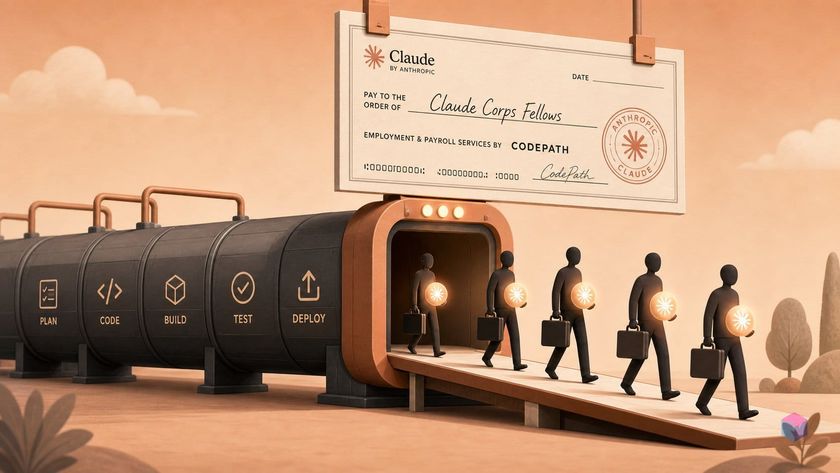
Anthropic is no longer just shipping models — it is shipping people. On June 11, 2026, the company announced a program that pays a thousand early-career workers to embed inside nonprofits and build with Claude.
What Claude Corps Is — and What It Is Not
Claude Corps is a 12-month, full-time workforce deployment program that pays early-career fellows to work on-site inside U.S. mission-driven organizations and build AI workflows with Claude . It is explicitly not a research residency, not a grant program, and not an internship. The design is operational: teach fellows to use Claude well, place them with a host, pay them to ship, and have them leave behind tools the host keeps.
Quick Answer: Claude Corps is Anthropic's $150M program, announced June 11, 2026, that pays 1,000 early-career fellows an $85K salary to embed full-time for 12 months inside U.S. nonprofits and build Claude-powered automations, agents, dashboards, and staff trainings — a deployment corps, not a research residency.
The scale is concrete: 1,000 fellows will embed inside mission-driven organizations and build practical systems — automations, agents, dashboards, internal tools, evaluation harnesses, and staff trainings . The work is implementation, not theory.
The money signals intent. Anthropic committed an initial $150 million to the fellowship, part of a broader economic-transition package of roughly $350 million that also includes a separate $200 million Economic Futures Research Fund .
The framing is an AI-transition initiative: Anthropic positions Claude Corps as a way to push productivity gains beyond the tech industry and into nonprofits, civic organizations, and public-interest groups, as part of its response to AI-driven labor-market disruption . Read plainly, it is both philanthropy and a distribution channel — a point worth keeping in view as the structure comes into focus.
Organizational Structure: Anthropic Funds, CodePath Employs, Social Finance Evaluates
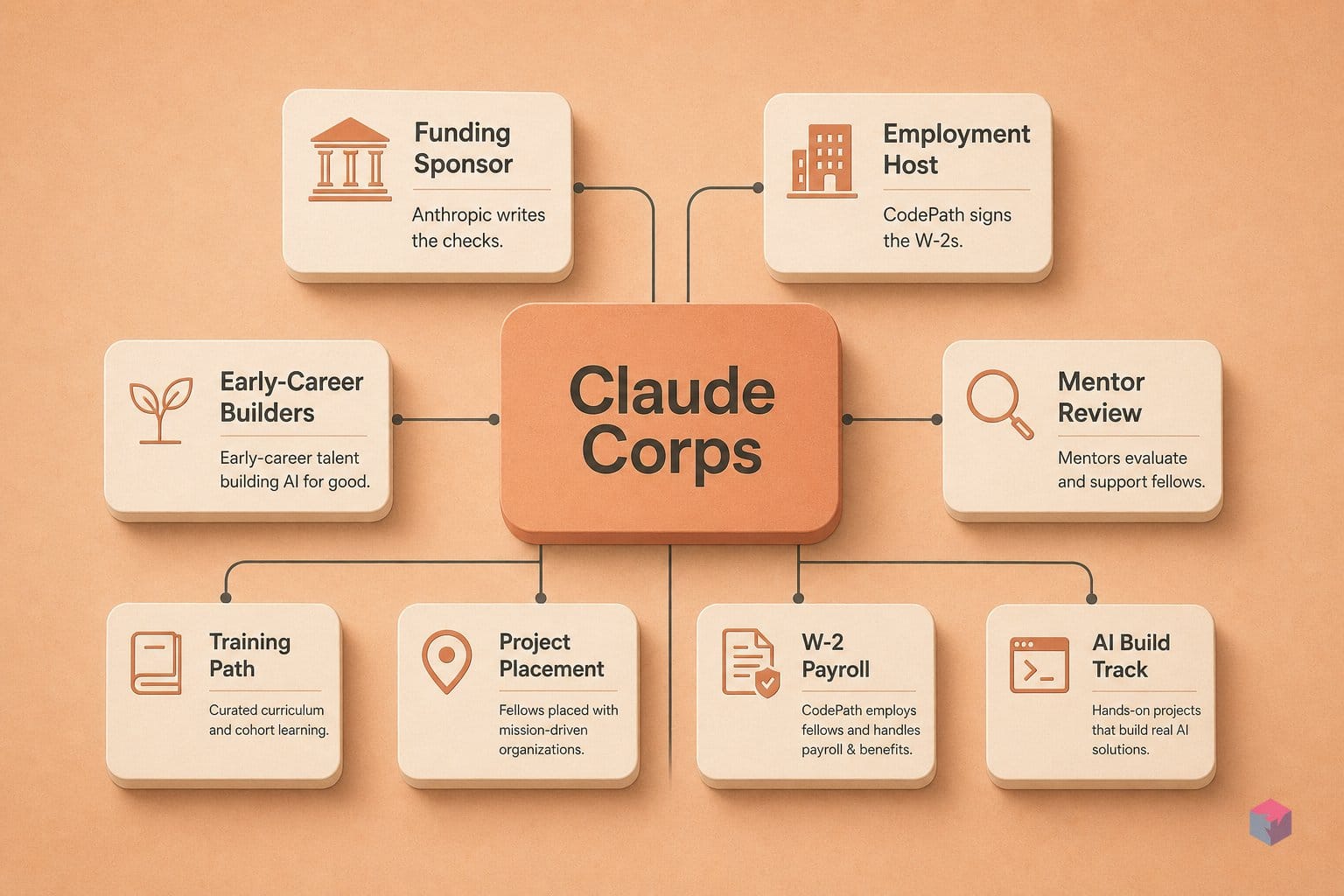
That dual nature is encoded directly in the org chart. Claude Corps runs on a three-way split where no single party does everything: Anthropic supplies the money and the model expertise, CodePath holds the employment relationship, and Social Finance handles the books and the scorecard. The design keeps Anthropic close to the product and the strategy while keeping its name off the W-2 — a deliberate separation of capital from employment liability.
Anthropic funds the program — an initial $150 million — leads overall strategy, and contributes Claude expertise [1]. In practice that means running Anthropic office hours and technical support on architecture, prompt development, and evaluation design, alongside the curriculum on the API and AI evals [3].
CodePath, a computer-science education nonprofit, is the program architect and the employer of record. It recruits, screens, trains on an AI-native curriculum, and employs fellows as full-time W-2 staff, assigning each one a dedicated mentor [1][3]. CodePath CEO Michael Ellison has framed the program around accessibility and the absence of any degree requirement, per an AP report.
Social Finance administers the philanthropic capital, leads independent measurement and evaluation, and is tasked with building a longer-term financial vehicle if the model proves out at scale [1][5].
| Party | Role | What it does |
|---|---|---|
| Anthropic | Funder & strategist | Provides capital, sets strategy, supplies Claude expertise and office hours |
| CodePath | Employer of record | Recruits, trains, employs fellows as W-2 staff, assigns mentors |
| Social Finance | Administrator & evaluator | Manages philanthropic capital, runs measurement, designs a scaling vehicle |
| Host org | Day-to-day supervisor | Directs fellow's work on-site; does not employ them |
The split matters most for the fellows themselves. They are legally employed by CodePath but supervised day-to-day by their host organization [3]. That arrangement gives hosts operational control without payroll, benefits, or termination exposure, and it insulates Anthropic from any direct employment obligation to the people deploying its product.
Eligibility: No Degree Required, but Visa Sponsorship Is Off the Table
Claude Corps drops the credential most fellowships start with: there is no college, technical, or computer-science degree requirement, and no coding prerequisite . The actual bar is demonstrated comfort using Claude or comparable tools to research, summarize, draft, revise, understand code with assistance, verify outputs, and iterate on prompts . Practical AI literacy, not a transcript, is what gets screened.
That said, the credential flexibility is paired with hard gates on career stage and circumstance. To qualify, applicants must meet all of the following:
- Be 18 or older with fewer than two years of full-time work experience .
- Already use AI tools in daily life or work .
- Show concrete action taken on a cause or community problem .
- Be willing to relocate, since Cohort 1 is in-person .
Current students are not excluded — they may apply as long as they can work full-time by October 19, 2026 and still fall under the experience limit .
The sharper constraint is work authorization. Visa sponsorship is not offered, so eligibility depends entirely on status you already hold. Anthropic states that authorization must be valid for the full 12 months and must not depend on employer sponsorship — which means F-1 OPT, STEM OPT, TN, and H-1B1-style statuses do not qualify . For non-citizen developers, that single rule will disqualify many otherwise-strong candidates regardless of their AI fluency.
One procedural detail is easy to miss: the application is gated before you can submit it. Anthropic's Greenhouse posting requires applicants to complete the AI Fluency and Claude 101 courses and upload proof of completion through the portal . It doubles as a filter and as onboarding — the program wants applicants who have already touched the toolchain before day one.
$85K Annual Salary, W-2 Benefits, and Claude Allowances
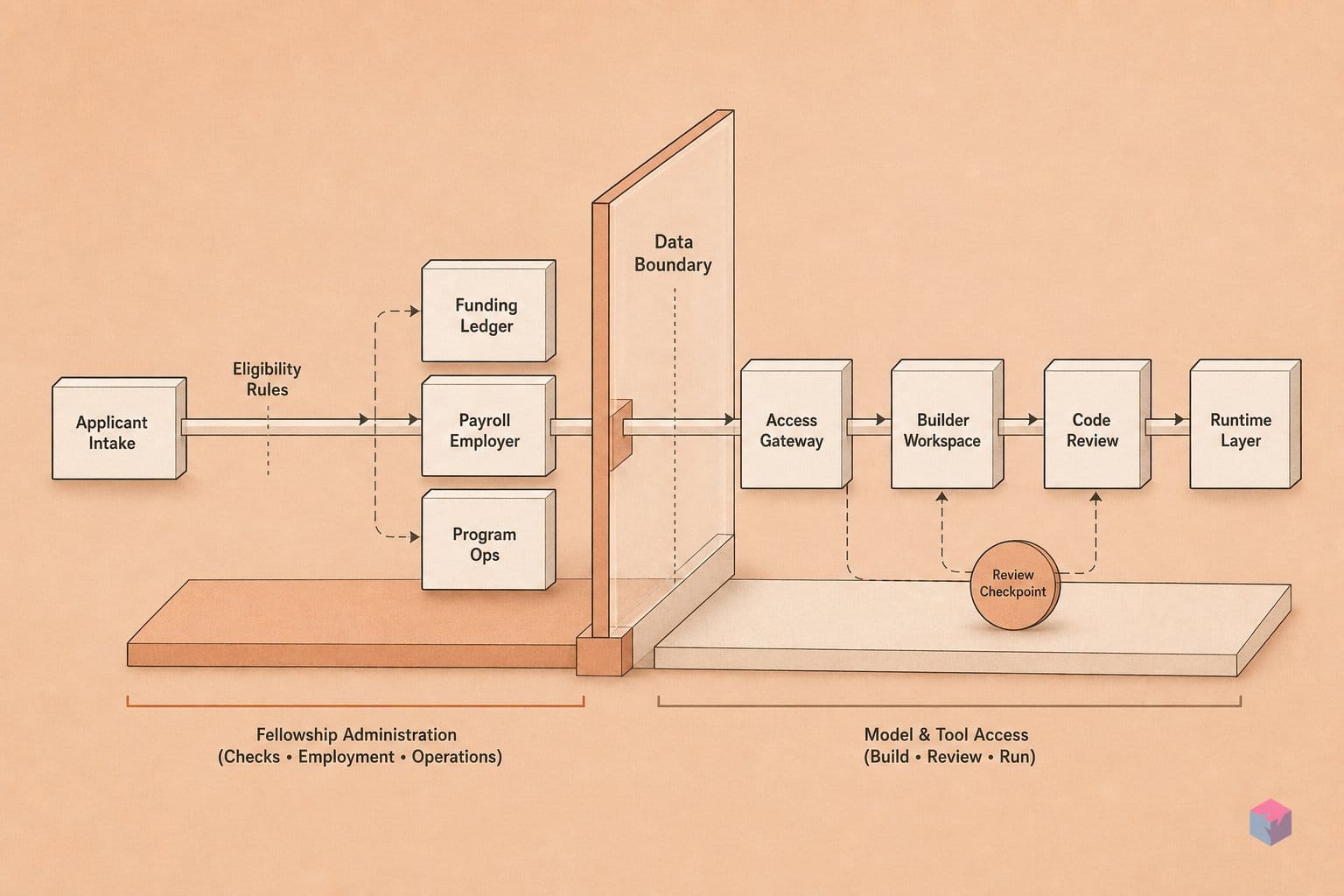
Once you clear that gate and a match, the offer is a salaried job, not a stipend. Fellows are full-time W-2 employees of CodePath earning $85,000 a year, paid twice monthly . That framing matters: it means tax withholding, payroll, and an employer relationship — with day-to-day supervision sitting at the host org, as covered earlier.
The compensation also carries a full benefits package rather than a contractor's bare rate. CodePath provides medical, dental, and vision insurance, a 401(k), paid holidays and flexible PTO, life and disability insurance, an FSA, an EAP, and pet insurance .
| Component | Detail |
|---|---|
| Base salary | $85,000/year, paid twice monthly |
| Employer (W-2) | CodePath |
| Health | Medical, dental, vision |
| Retirement | 401(k) |
| Time off | Paid holidays + flexible PTO |
| Other | Life/disability, FSA, EAP, pet insurance |
| Claude budget | Up to $2,500 per fellow in licenses/API credits |
| Relocation | Support when placed >100 miles from residence |
Beyond cash and benefits, each fellow gets up to $2,500 in Claude licenses and API credits for approved host projects . That budget is scoped to the work, not a personal allowance — it pays for the agents, evaluation harnesses, and integrations a fellow ships for the host.
Relocation support is the one line with a documented threshold. The Greenhouse posting ties it to placements more than 100 miles from a fellow's current residence, while Anthropic's fellow FAQ states more generally that support is available when fellows must move . Given Cohort 1 is in-person and opens with a mandatory San Francisco orientation, that detail is not academic for anyone applying from outside a host city.
What Hosts Get — and Give Up
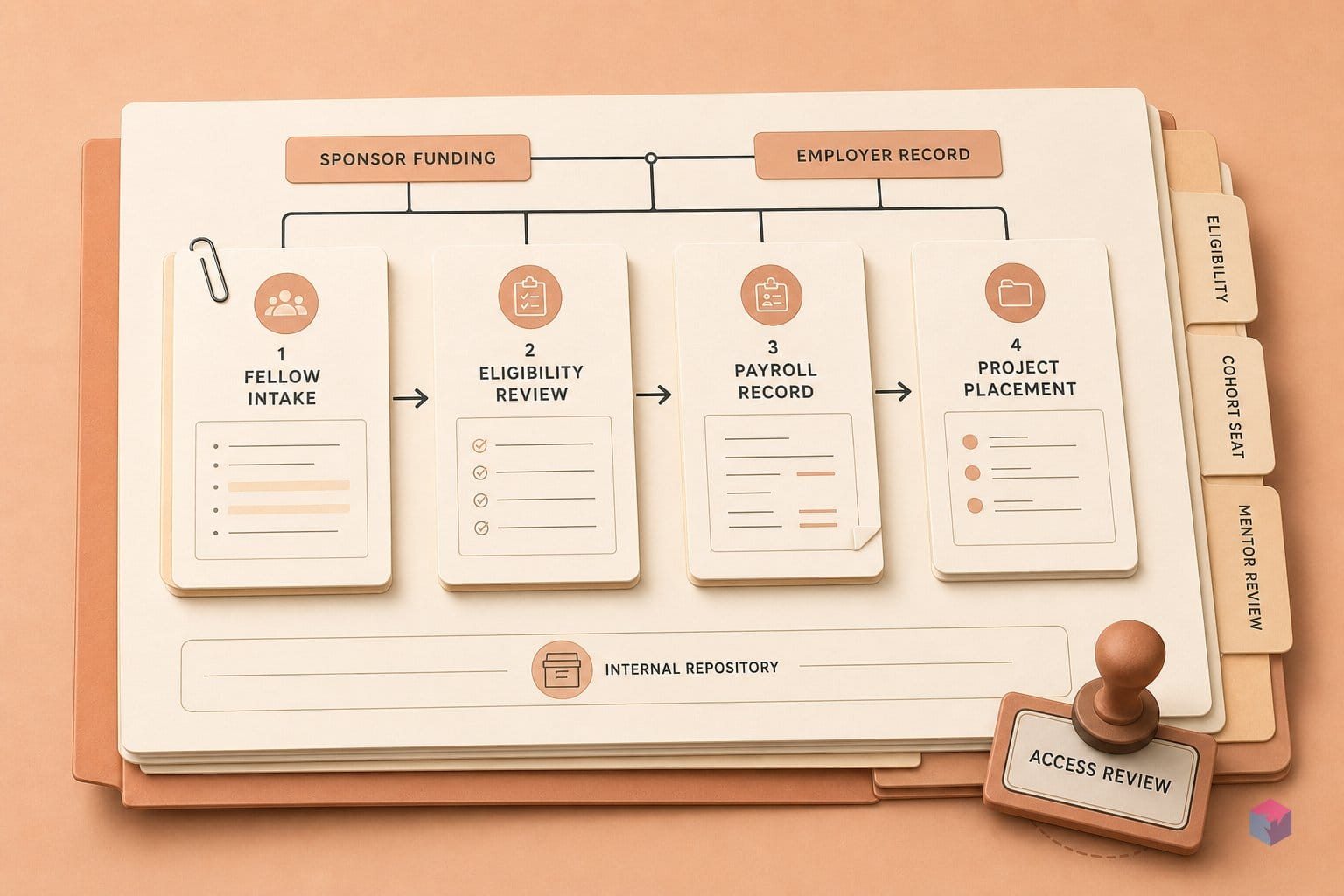
Host organizations get fully funded, embedded Claude capacity and keep everything their fellow builds — but Cohort 1 eligibility is narrow and the obligations are continuous. To qualify, a host must be a U.S.-based 501(c)(3) nonprofit and an active Claude for Nonprofits Team or Enterprise customer with an in-person or hybrid workplace . Fully remote organizations may apply only for the 2027 cohorts .
The funding stack is concrete, and the host pays no payroll. CodePath covers each fellow's salary and benefits. On top of that, every host receives a one-time $10,000 Host Implementation Grant administered by Social Finance, plus up to $2,500 in Claude allowances per fellow . Hosts can request up to four fellows, though Anthropic recommends at least two where feasible .
In exchange, hosts take on a defined set of obligations:
- Equipment and internal system access for the fellow
- A senior sponsor plus a day-to-day supervisor
- Monthly reporting and participation in quarterly convenings
- A full 12-month placement and a post-fellowship sustainability plan
The intellectual-property terms favor the host. Hosts own all tools, products, and code built during the fellowship, documented in a binding host MOU; neither Anthropic nor CodePath retains IP rights, per the host FAQ. For a nonprofit wary of building on infrastructure a vendor could later reclaim, that clause carries weight.
Anthropic says fellows will land across as many as 400+ organizations . The 18 named early hosts span civic, workforce, and relief work — among them Code for America, Goodwill Industries International, the International Rescue Committee, RAINN, Year Up United, and the YMCAs of Greater Charlotte and Greater Cincinnati . Cohort 1 host applications close at 11:59 p.m. PT on July 17, 2026, with selected hosts notified in late August .
The arrangement doubles as distribution: by requirement, every host is already a paying Claude customer, which makes the program a subsidized adoption channel as much as a staffing one. That tension drew pushback:
AI companies cannot be left to define their own public-interest obligations, argued Bella DeVaan of the Institute for Policy Studies (source: AP).
Cohort 1 Opens October 2026, Known Gaps, and Uncommitted Ambitions
The first cohort is small and front-loaded. Roughly 100 fellows start on October 19, 2026, and both fellow and host applications close July 17, 2026. The remaining ~900 fellows arrive in cohorts beginning January 2027 and August 2027 on rolling applications, with the split between the two left unspecified (source: Anthropic).
Selection is multi-stage and, notably, credential-blind. The pipeline runs:
- Application plus short written responses on community impact and learning from setbacks
- A practical, skills-based assessment
- A 25-minute conversation
- A final "Super Day" with two one-on-one conversations (source: Anthropic)
No degree or coding requirement gates any of those steps — the bar is demonstrated AI fluency and social-impact motivation, not pedigree.
One gap is worth flagging before you apply. The Greenhouse posting mentions government agencies and public-interest organizations, while the host FAQ currently restricts Cohort 1 placements to U.S. 501(c)(3) nonprofits only. If you are eyeing a civic or agency host, treat the broader language as aspirational until the FAQ catches up.
The timing also invites scrutiny. The Register noted the launch lands amid roughly 935 daily tech layoffs in 2026, up from 674 in 2025.
"The launch frames AI progress as 'exponential,' a characterization that independent observers find unsupported," wrote Thomas Claburn, reporter at The Register (source: The Register).
What to watch next: Anthropic says it will evaluate after year one and may scale past 1,000 fellows, open-source core infrastructure, and replicate the model abroad (source: Anthropic). Read those as ambitions, not commitments. The concrete takeaway for now: if you have under two years of experience and working AI habits, the July 17 deadline is the only date that matters — everything past Cohort 1 is conditional on a year-one review that has not happened yet.
Frequently asked questions
Does Claude Corps require a computer science or college degree?
No. Claude Corps has no college, technical, or coding degree requirement of any kind (source: Anthropic). Selection rests on demonstrated comfort with AI tools — using Claude to research, draft, revise, understand code with assistance, verify outputs, and refine prompts — plus fewer than two years of full-time work experience . Practical AI literacy counts; academic credentials do not.
Can applicants on F-1 OPT or similar visa statuses apply to Claude Corps?
No. Claude Corps does not offer visa sponsorship, and Anthropic explicitly excludes statuses that depend on employer sponsorship — F-1 OPT, STEM OPT, TN, and H-1B1 (source: Anthropic) . Applicants must hold valid, sponsor-independent work authorization that stays valid for the full 12-month fellowship.
Who is the actual employer for Claude Corps fellows — Anthropic or CodePath?
CodePath. Fellows are full-time W-2 employees of CodePath, a computer-science education nonprofit serving as employer of record that recruits, screens, trains, and pays them (source: Anthropic) . Anthropic funds the program and supplies Claude support, while day-to-day supervision comes from the host organization.
What is the deadline for Cohort 1 applications?
July 17, 2026, for both fellow and host applications, with Cohort 1 starting October 19, 2026 . The roughly 900 remaining fellows join later cohorts — one beginning January 2027 and one beginning August 2027 — which accept rolling applications (source: Anthropic) .
Do host organizations keep the tools and code that fellows build?
Yes, fully. The host MOU assigns all tools, products, and code built during the fellowship to the host organization, with Anthropic and CodePath retaining no IP rights (source: The Register) . The design intent is to leave durable AI capacity — agents, automations, dashboards, and evaluation harnesses — at the host after the placement ends.