
Anthropic shipped Claude Opus 4.8 on May 28, 2026, and the launch table tells a sharper story than the headline: on the coding and agentic rows that matter most to builders, 4.8 beats 4.7 on every Opus-vs-Opus comparison — but it does not lead every column.
Opus 4.8 vs 4.7 on Agentic Coding and Terminal Tasks
On agentic coding, Opus 4.8 posts a clear, measurable gain over Opus 4.7 while leading the rest of the field on the headline software-engineering row. SWE-bench Pro rises to 69.2% from 64.3% — a +4.9-point jump — and the same table shows GPT-5.5 at 58.6% and Gemini 3.1 Pro at 54.2%, so 4.8 leads this vertical outright . The gains are real but read as an incremental continuation of the coding line, not a step change.
Quick Answer: Claude Opus 4.8 (released May 28, 2026) beats Opus 4.7 on every Opus-vs-Opus benchmark row. The largest gain is Terminal-Bench 2.1 at 74.6% vs 66.1% (+8.5 pts), but GPT-5.5 leads that column at 78.2%. On SWE-bench Pro, 4.8 leads at 69.2% vs 64.3%.
The largest single improvement is terminal coding, and it is also the clearest case where a better 4.8 still does not lead. On Terminal-Bench 2.1, Opus 4.8 scores 74.6% against 66.1% for 4.7 — a +8.5-point gain — yet GPT-5.5 tops the column at 78.2% standard, and a footnote notes GPT-5.5 reaching 83.4% with the Codex CLI harness . So 4.8 is materially better than 4.7 here, but second, not first.
| Benchmark | Opus 4.8 | Opus 4.7 | Delta | Field note |
|---|---|---|---|---|
| SWE-bench Pro (agentic coding) | 69.2% | 64.3% | +4.9 | 4.8 leads; GPT-5.5 58.6%, Gemini 3.1 Pro 54.2% |
| Terminal-Bench 2.1 | 74.6% | 66.1% | +8.5 | GPT-5.5 leads at 78.2% (83.4% w/ Codex CLI) |
| OSWorld-Verified (computer-use) | 83.4% | 82.3–82.8% | +0.6 to +1.1 | Near saturation; method changed between runs |
| Online-Mind2Web (browser agent) | 84% | lower (not stated) | — | Vendor-cited jump; not yet public-reproducible |
Two numbers deserve caution. OSWorld-Verified is near saturation: 4.8 scores 83.4%, but the 4.7 baseline is given as 82.8% in the table image and restated to 82.3% in a footnote after an evaluation-method change, leaving an official delta of just +0.6 to +1.1 points depending on which 4.7 figure you anchor to . Anthropic also cites Online-Mind2Web at 84% as a meaningful jump over both 4.7 and GPT-5.5, but that result lives in a launch artifact and is not independently reproducible at publication . Treat the coding rows as the trustworthy signal and the computer-use rows as directional.
xhigh Became the Recommended Ceiling — Your 4.7 Baselines Are Stale
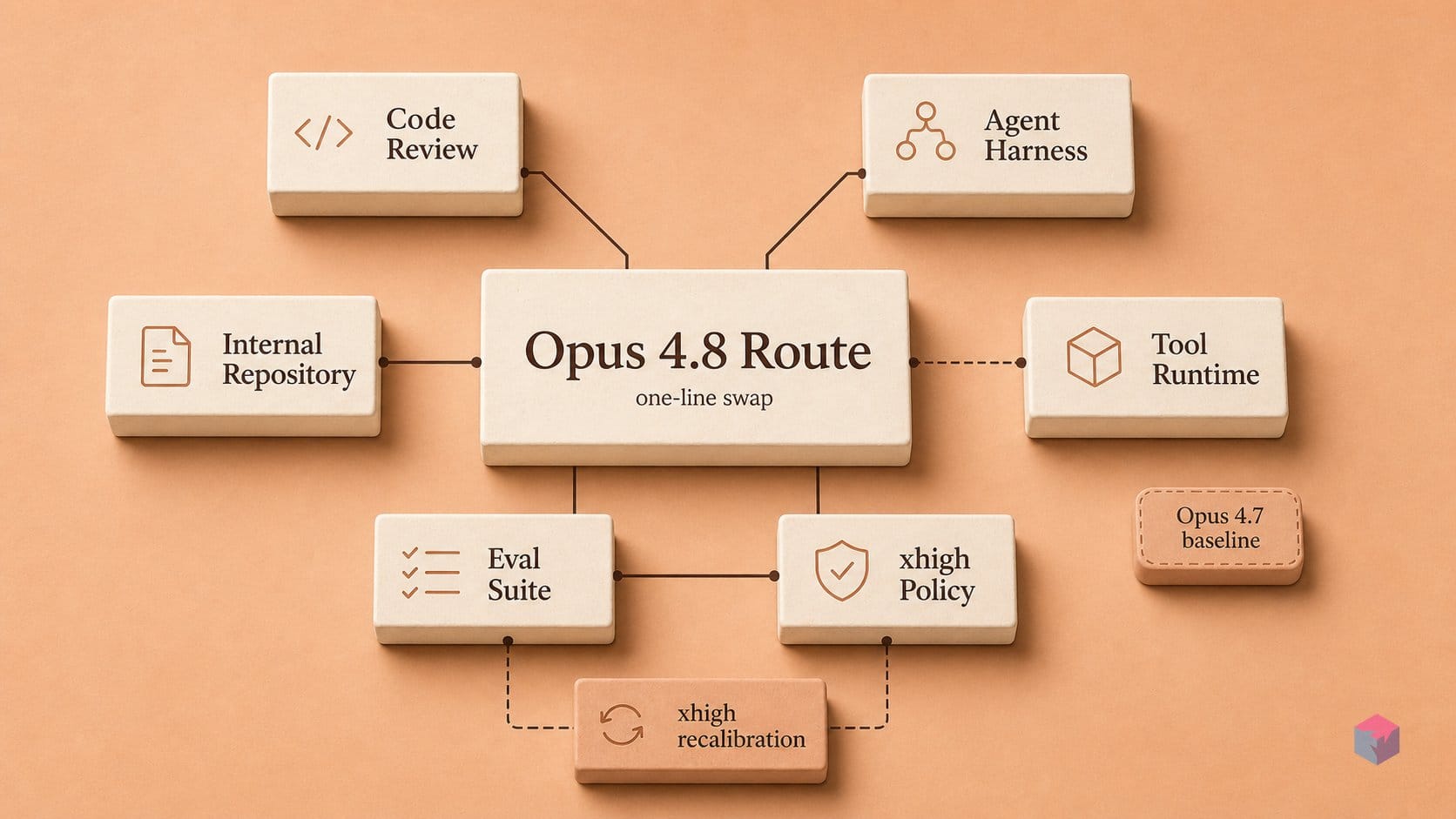
The default effort level moved to high across every surface — Claude API and Claude Code — and Anthropic now recommends xhigh for coding and high-autonomy work . That is a behavioral shift, not a relabeling. If you copy a 4.7 pipeline forward unchanged, you are not running the configuration Anthropic tuned 4.8 against, and your old latency and cost numbers no longer describe what the model does.
The tiers themselves were recalibrated between 4.7 and 4.8. On 4.8, medium draws more compute than 4.7's medium, high draws slightly less than 4.7's high, and xhigh draws substantially more . Same string, different thinking budget. A job pinned to high will quietly spend a bit less reasoning than it did on 4.7, while a switch to the recommended xhigh ceiling can move token spend and wall-clock time materially on multi-step autonomous runs.
The practical consequence for teams: benchmark both high and xhigh on 4.8 against your own task before committing a default. The delta is non-trivial for long-horizon agentic coding, exactly the workload Anthropic says 4.8 improves through better long-context handling, fewer compactions, and fewer missed required tool calls . Higher effort is where those gains concentrate, but so does the bill.
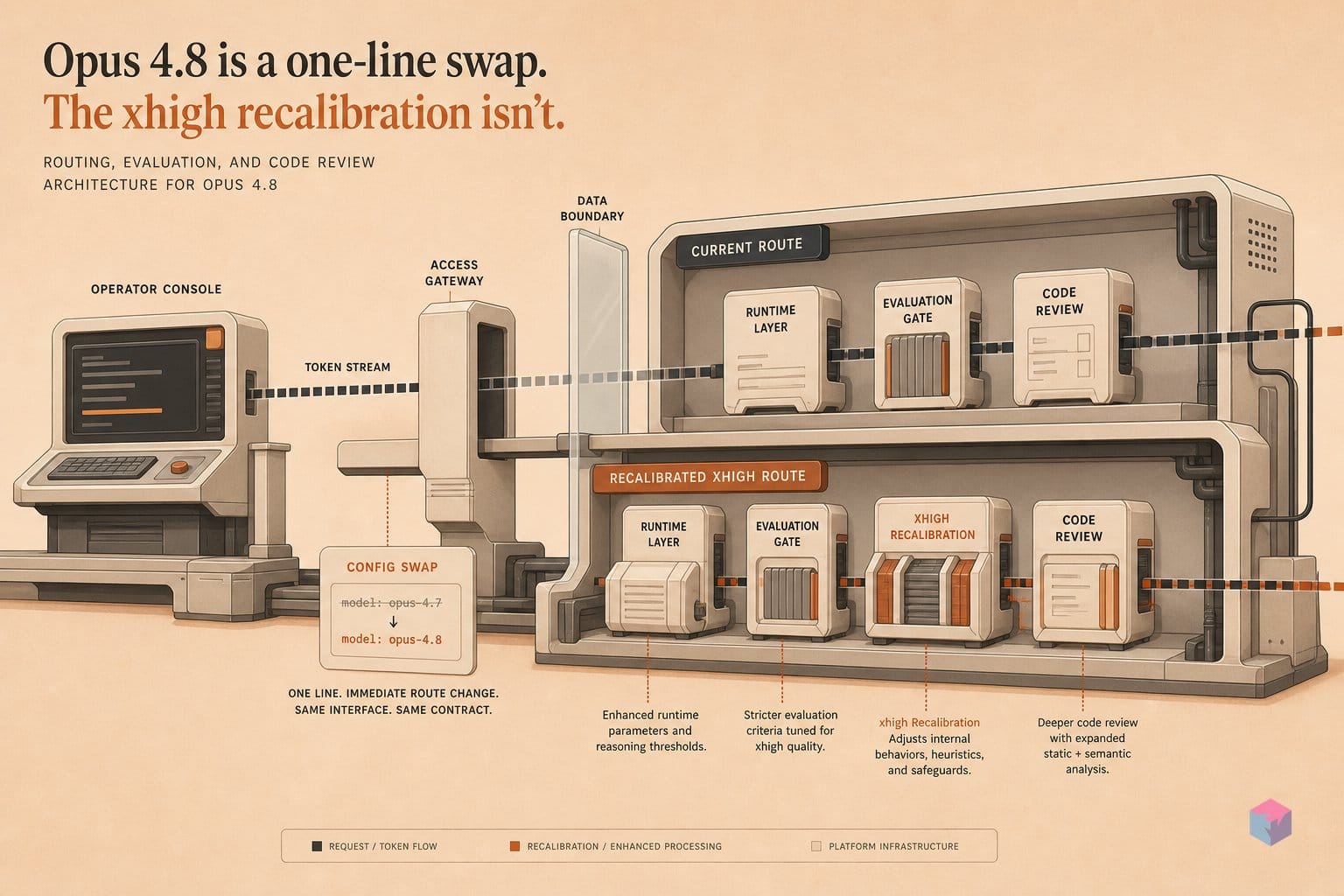
As Anthropic frames the migration in its developer docs: "updating the model string from claude-opus-4-7 to claude-opus-4-8 can be the entire change," but the same docs flag that effort levels were recalibrated and should be re-baselined for cost and latency — Anthropic, Models migration guide. Read the one-line swap and the re-tuning as two separate tasks.
One clarification before the next section: the separately priced fast mode at $10 per million input and $50 per million output tokens is its own tier, not a low-effort variant. Effort and the fast path are orthogonal knobs — we scope the fast path next.
Subagent Fleets in GA: The Bun Rewrite Demo and What It Unlocks
Dynamic workflows are now generally available in Claude Code, turning a single agent run into a fleet of tens to hundreds of subagents that verify their work before reporting back. The feature graduated from research preview to GA across the Claude Code CLI, Desktop, and VS Code, on paid plans, and through the API on Bedrock, Vertex, and Microsoft Foundry . The pitch is parallel coverage of work too large or too risky for one context window, with a verification pass baked in before any result surfaces.
Quick Answer: Dynamic workflows hit GA in Claude Code, spawning tens to hundreds of self-verifying subagents for codebase-wide bug hunts, large migrations, and double-checked critical work. The reference demo: a Zig-to-Rust rewrite of Bun, ~750,000 lines of Rust at a 99.8% test-suite pass rate, merged 11 days from first commit .
The headline demonstration is a rewrite of the Bun runtime from Zig to Rust: roughly 750,000 lines of Rust, a 99.8% pass rate against the existing test suite, and 11 days from first commit to merge . Read it as a capability demonstration, not a shipped product — the rewrite was not in production at the time of publication. It shows what a verify-before-report fleet can sustain across a large migration, not that you should retarget your own runtime tomorrow.
"Dynamic workflows run tens to hundreds of subagents that verify their results before reporting back," — Anthropic, Claude Code announcement (source: Introducing dynamic workflows).
Anthropic targets three jobs: codebase-wide bug hunts, large migrations, and critical work that warrants a second pass . The trade is token consumption — fleets burn substantially more than single-agent runs, so capacity-plan before enabling this on a team. Opus 4.8 is what makes the fleet hold together over long runs: improved compaction recovery, fewer missed required tool calls, and steadier continuation after long-context compaction events . Those reliability gains matter most precisely when dozens of subagents are running unattended for hours, where one dropped tool call or a botched compaction recovery used to derail the whole job.
The $10/M Fast Path: 2.5× Quicker and When to Choose It
Opus 4.8's pricing splits into two lanes. The standard path is unchanged from Opus 4.7 at $5 per million input tokens and $25 per million output tokens . A separately priced fast mode runs at $10 input and $50 output per million tokens — twice the per-token cost, but described as up to 2.5× faster and roughly three times cheaper than the fast-tier offerings from earlier model generations . The trade is throughput for reasoning depth, not a quality-free speedup.
| Dimension | Standard path | Fast path |
|---|---|---|
| Input / output per 1M tokens | $5 / $25 | $10 / $50 |
| Relative speed | Baseline | Up to 2.5× faster |
| Reasoning budget | Full (xhigh available) | Reduced for throughput |
| Context window | 1M (API, Bedrock, Vertex) | 1M (API, Bedrock, Vertex) |
Choose the fast path for latency-sensitive pipelines where you have already verified that standard-path output is sufficient for the task — interactive UI completions, classification, or high-volume transforms where the answer shape is well bounded. The depth reduction is acceptable precisely because the work does not lean on the model's full reasoning chain.
It is not a drop-in substitute for autonomous coding or high-stakes verification. Those jobs benefit from the full reasoning budget on the standard path with xhigh effort, where a single under-reasoned step can cascade across a long agentic run. There is no published context-window penalty for going fast: the full 1M-token window is served on both paths by default on the first-party API, Bedrock, and Vertex AI, with no beta header and no long-context premium . So the decision is purely speed-versus-depth per call, not a capacity cliff you have to design around.
Unremarked Flaws: The 4× Reduction and What It Implies
Opus 4.8 is described by Anthropic as roughly four times less likely than Opus 4.7 to let flaws in its own generated code pass without flagging them . This is a qualitative reliability claim, not a named benchmark — there is no public test artifact attached to the 4× figure, so treat it as a directional vendor statement rather than a reproducible result. In the same release, misaligned-behavior rates are stated to be substantially lower than 4.7 and comparable to the Claude Mythos Preview line , framing self-flagging as a safety-adjacent property and not merely a coding metric.
Independent post-release benchmarks add texture without settling the question. WorkBench Revisited ranks Opus 4.8 the top workplace agent at 89% task completion with unintended harmful actions on just 2.5%, against a GPT-4 (March 2024) baseline of 43% completion and 26% unintended harm . But the picture is domain-dependent:
- EpiBench: Opus 4.8 scores 39.0% versus GPT-5.5 at 45.0% — Opus 4.8 trails here .
- TxBench-PP: Opus 4.8 leads at 59.3% endpoint-pass versus GPT-5.5 at 55.3% .
No single vertical is decisive. The reliability story is credible — fewer unflagged flaws and lower misalignment are exactly what matters for high-autonomy runs — but the strongest evidence is Anthropic's own, and independent results vary by domain. Verify against your own task suite before trusting the 4× claim in production.
Swapping 4.7 for 4.8: What Requires Re-Testing
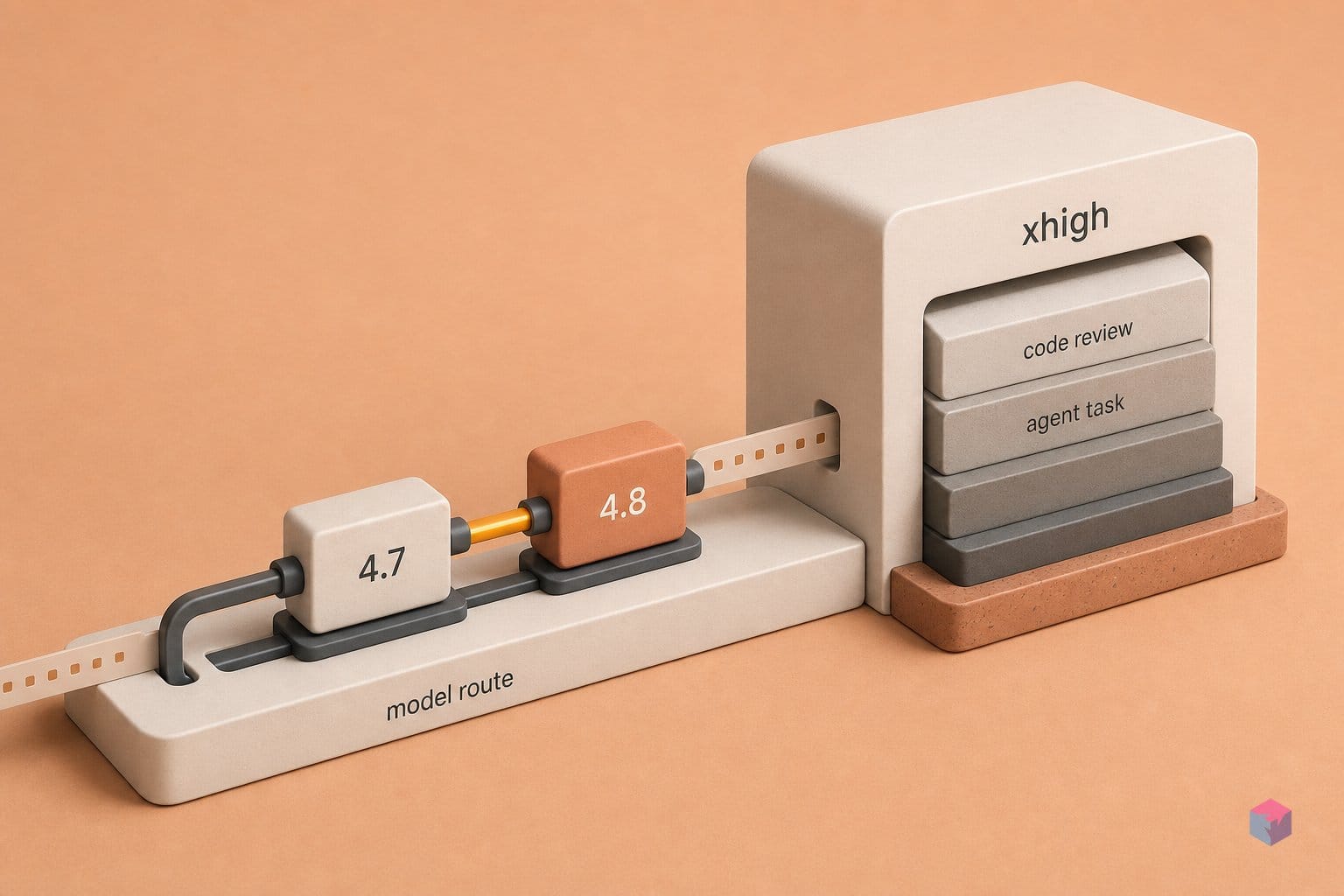
Migrating from Opus 4.7 to Opus 4.8 starts as a one-line change: swap the model string from claude-opus-4-7 to claude-opus-4-8. Anthropic states there are no breaking API changes , and the tokenizer is identical to 4.7, so your token-count estimates, prompt-cache logic, and budget math carry over unchanged . For many integrations, the string swap is the entire diff.
The constraints that tripped people on 4.7 still apply. Sampling parameters — temperature, top_p, top_k — are still rejected with a 400 error. Manual extended thinking remains unsupported, and prefill is still removed . If your 4.7 code already handles these, nothing new breaks here.
What does demand active re-baselining is effort behavior. Default effort is now high, not medium , so any code path that assumed medium as the implicit default will silently shift compute and cost. The tiers were also recalibrated against 4.7: medium on 4.8 draws more thinking than 4.7's medium, high slightly less, and xhigh substantially more . Re-run your own cost and latency benchmarks per tier before trusting old dashboards.
Two new capabilities are worth wiring in deliberately:
- Prompt caching now activates at 1,024 tokens, a lower minimum than before — short system prompts that previously couldn't be cached now can .
- The Messages API now accepts system entries mid-conversation, after a user turn, enabling conversation patterns — mid-session instruction injection, role re-grounding — that the older schema rejected .
Net: treat the model ID as drop-in, but treat effort tiers as a fresh calibration job. The API contract is stable; the compute behavior underneath it is not.
Opus 4.8 at $5/M: Where It Lands After the Lineup Reshuffled
Opus 4.8 shipped as Anthropic's flagship on May 28, 2026, and nine days later, on June 9, 2026, Claude Fable 5 arrived above it. That reshuffle repositioned Opus 4.8 within the broader lineup but did not supersede it inside its tier — it stays the top Opus-tier option, and it runs at roughly half the per-token cost of the model now above it .
That price gap is the decision lever. Standard pricing held at $5 per million input and $25 per million output tokens, unchanged from 4.7 . If your workload sits below Fable 5's capability ceiling, paying double for headroom you won't use is hard to justify.
Availability is global from launch: the Claude API, AWS Bedrock (anthropic.claude-opus-4-8), Vertex AI (claude-opus-4-8), and Microsoft Foundry. Foundry launched at 200k context; every other platform serves the full 1M-token window by default with no beta header or surcharge . Knowledge cutoff is January 2026; maximum output is 128k tokens standard, or 300k via the output-300k-2026-03-24 batch beta .
The takeaway: swap the model ID, re-baseline your effort tiers, and stay on Opus 4.8 unless a specific task proves it short of the ceiling — at $5/M, it's the cost-efficient default, not the consolation prize.
Frequently asked questions
Is migrating from Claude Opus 4.7 to 4.8 backward-compatible?
Yes. Updating the model string from claude-opus-4-7 to claude-opus-4-8 can be the entire change — Anthropic states there are no breaking API changes, and the Opus 4.7 tokenizer is retained . Two things still need attention. First, re-baseline your effort tiers: the default changed from medium to high, and medium/high behave differently than in 4.7 . Second, sampling parameters (temperature, top_p, top_k) still return a 400 error, manual extended thinking is unsupported, and prefill is removed .
What does xhigh effort actually do differently in Opus 4.8 vs 4.7?
xhigh in Opus 4.8 allocates substantially more thinking budget than 4.7's xhigh. Anthropic recalibrated effort across every level: medium now allows more thinking, high slightly less, and xhigh substantially more . The practical consequence is that the same label produces different cost and latency between versions, so a config tuned on 4.7 will not reproduce the same spend or response time on 4.8. Re-benchmark cost and latency at each tier before deploying — especially for coding and high-autonomy work, where xhigh is the recommended ceiling .
Are dynamic subagent fleets available on AWS Bedrock and Vertex AI?
Yes. Dynamic workflows are generally available across Claude Code CLI, Desktop, and VS Code, and through the API including Amazon Bedrock, Vertex AI, and Microsoft Foundry . The feature runs tens to hundreds of parallel subagents that verify before reporting, aimed at codebase-wide bug hunts and large migrations . Token consumption is substantially higher than single-agent runs, so size your rate limits and budget for fleet-width jobs before enabling them.
How does Opus 4.8 compare to GPT-5.5 on agentic coding benchmarks?
No single model dominates. Opus 4.8 leads on SWE-bench Pro at 69.2% versus GPT-5.5's 58.6%, and on TxBench-PP at 59.3% versus 55.3%. GPT-5.5 leads on Terminal-Bench 2.1 at 78.2% versus 74.6% (83.4% with the Codex CLI harness), and on EpiBench at 45.0% versus 39.0%. Pick per vertical, not per vendor.
Does the 1M-token context window require a beta header or extra cost on Opus 4.8?
No. The full 1M-token context window is served by default on the Claude API, Bedrock, and Vertex AI with no beta header and no long-context surcharge . The exception is Microsoft Foundry, which launched at 200k context . Maximum output is 128k tokens by default, or 300k via the output-300k-2026-03-24 batch beta header .