
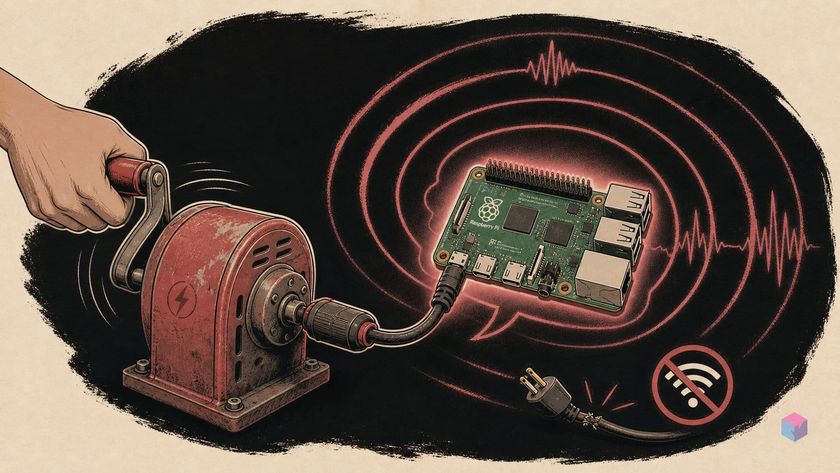
Turn a hand crank, speak, and a Raspberry Pi answers — no battery, no wall socket, no internet. That is the entire premise of CrankGPT, and the most interesting thing about it is what it refuses to be.
What CrankGPT Is (and Isn't)
CrankGPT is a fully offline, human-powered AI voice box from Squeez Labs — a proof-of-concept built by computer scientist Katrin Tomanek and Alex Kauffmann, a former technical project lead at Google's Advanced Technology and Projects (ATAP) group (The Outpost). The build pairs a stock Raspberry Pi 5 (8GB) with an off-the-shelf ~20W emergency hand-crank generator, running speech recognition, language modeling, and speech synthesis entirely on local CPU. It boots from first crank to a ready conversation in about 30 seconds .
Quick Answer: CrankGPT is a hand-powered, fully offline local-AI voice box from Squeez Labs, built on a Raspberry Pi 5 with 8GB RAM. It runs ASR, an LLM, and TTS on CPU with no battery, mains, or internet, reaching a ready conversation about 30 seconds after the first crank.
It is not a shipping product. The landing page offers a request-demo path with no posted price, no SKU, and no ship date, and lists three deliberately satirical power tiers — 20W "Synapse," 150W "Cortex," and 2000W+ "Singularity" . The project topped Hacker News and was covered by Hackaday, The Register, TechRadar, Boing Boing, and Gizmodo from June 11, 2026 onward — but all of it traces back to Squeez's own project page, with no independent benchmark replication yet.
The design goal is longevity, not throughput. As the creators put it:
"Provided the electronics are kept dry and at a reasonable temperature, there's no reason this thing won't still work in a hundred years, though you'll definitely need a fresh SD card." — Squeez Labs (source: Squeez Labs handcrank page).
The Custom Capacitor Board That Stabilizes the Crank Output
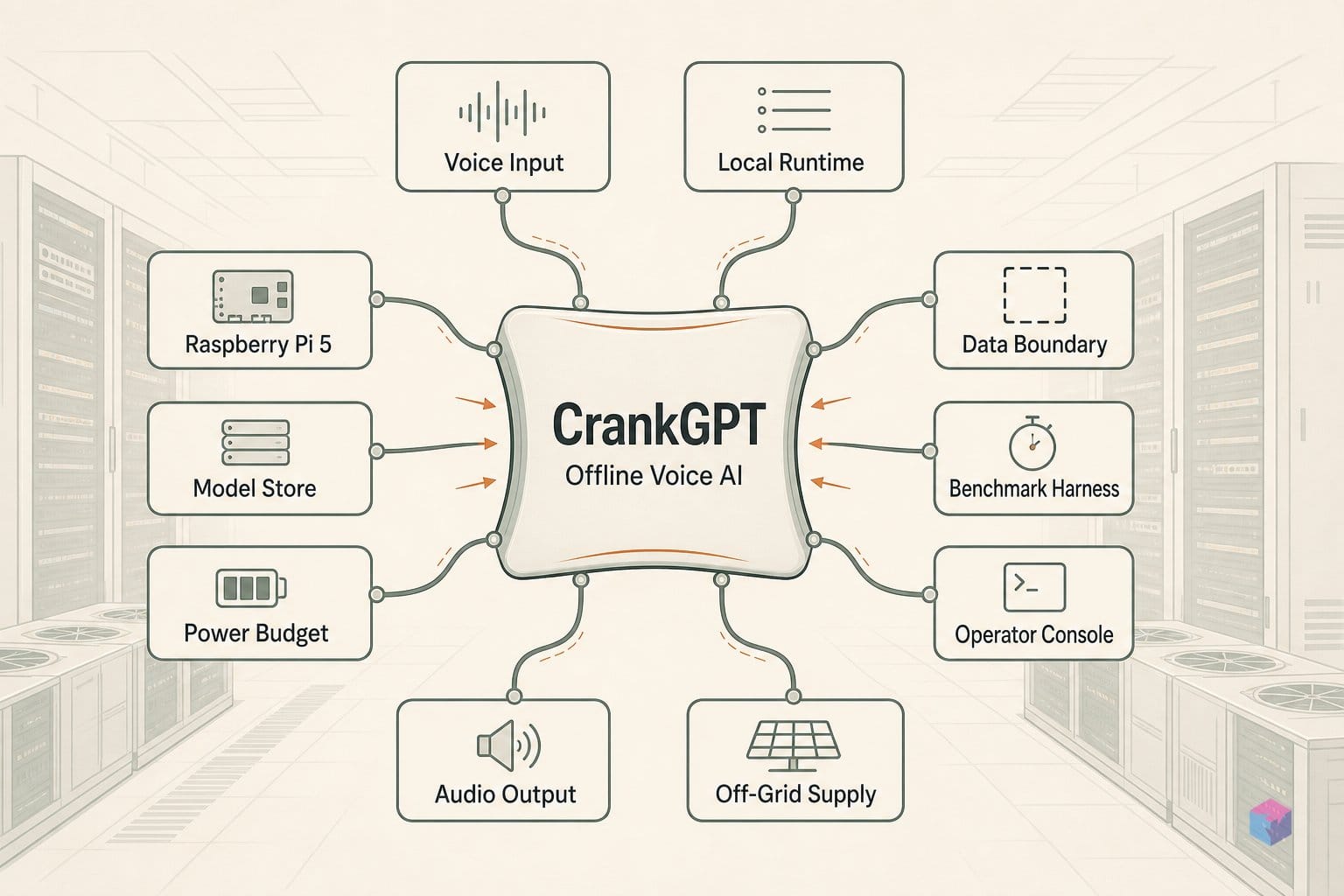
The hardest engineering problem in CrankGPT was not the model — it was keeping the Raspberry Pi 5 alive during inference. The off-the-shelf ~20W switchable-voltage emergency hand-crank generator cannot deliver clean power on its own. The Pi normally draws about 1.5A , but running speech recognition plus a language model plus text-to-speech triggers momentary spikes to roughly 5A, dragging supply voltage below the Pi's required 4.8V minimum and tripping overcurrent shutoffs . A raw crank-to-board connection browns out mid-sentence.
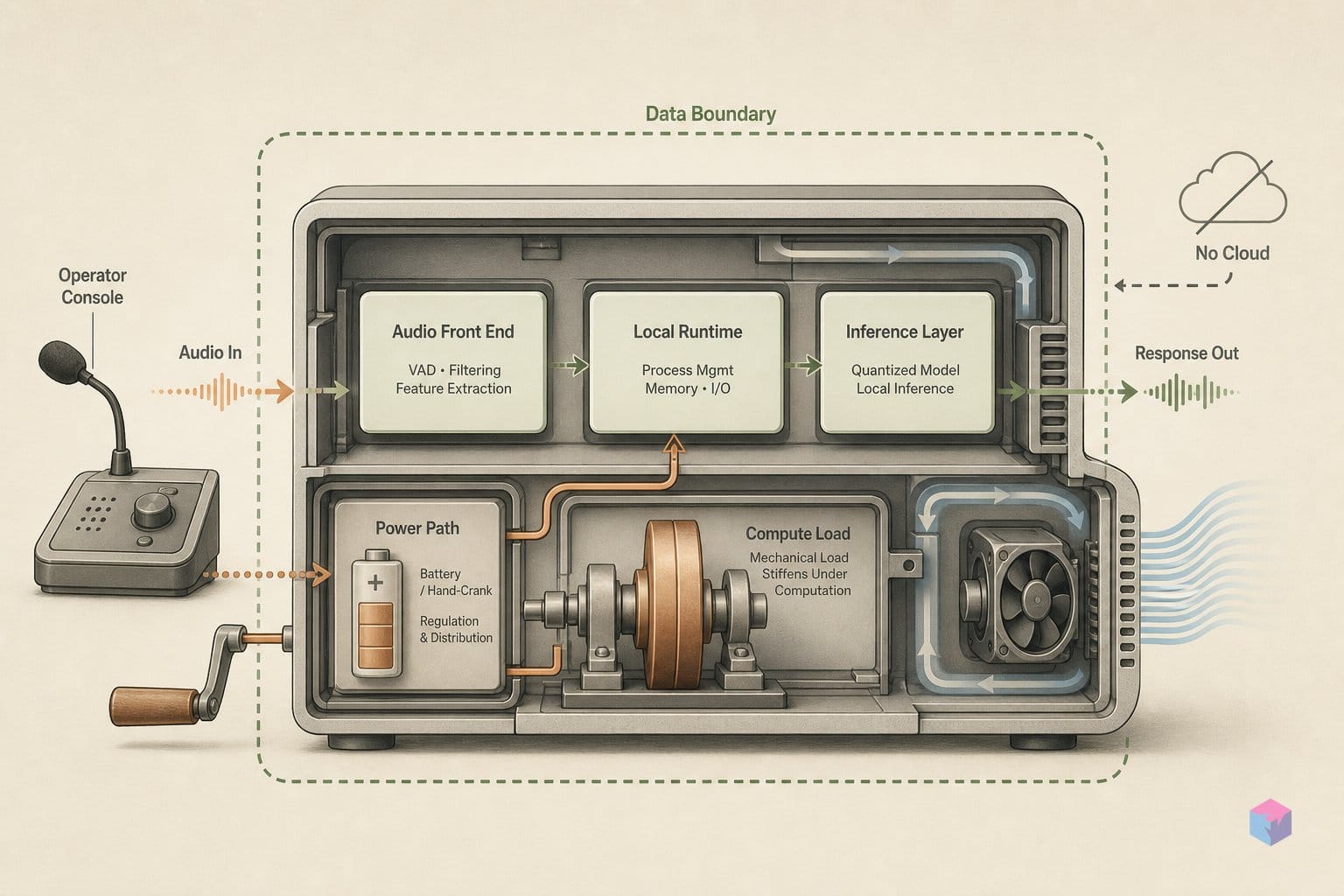
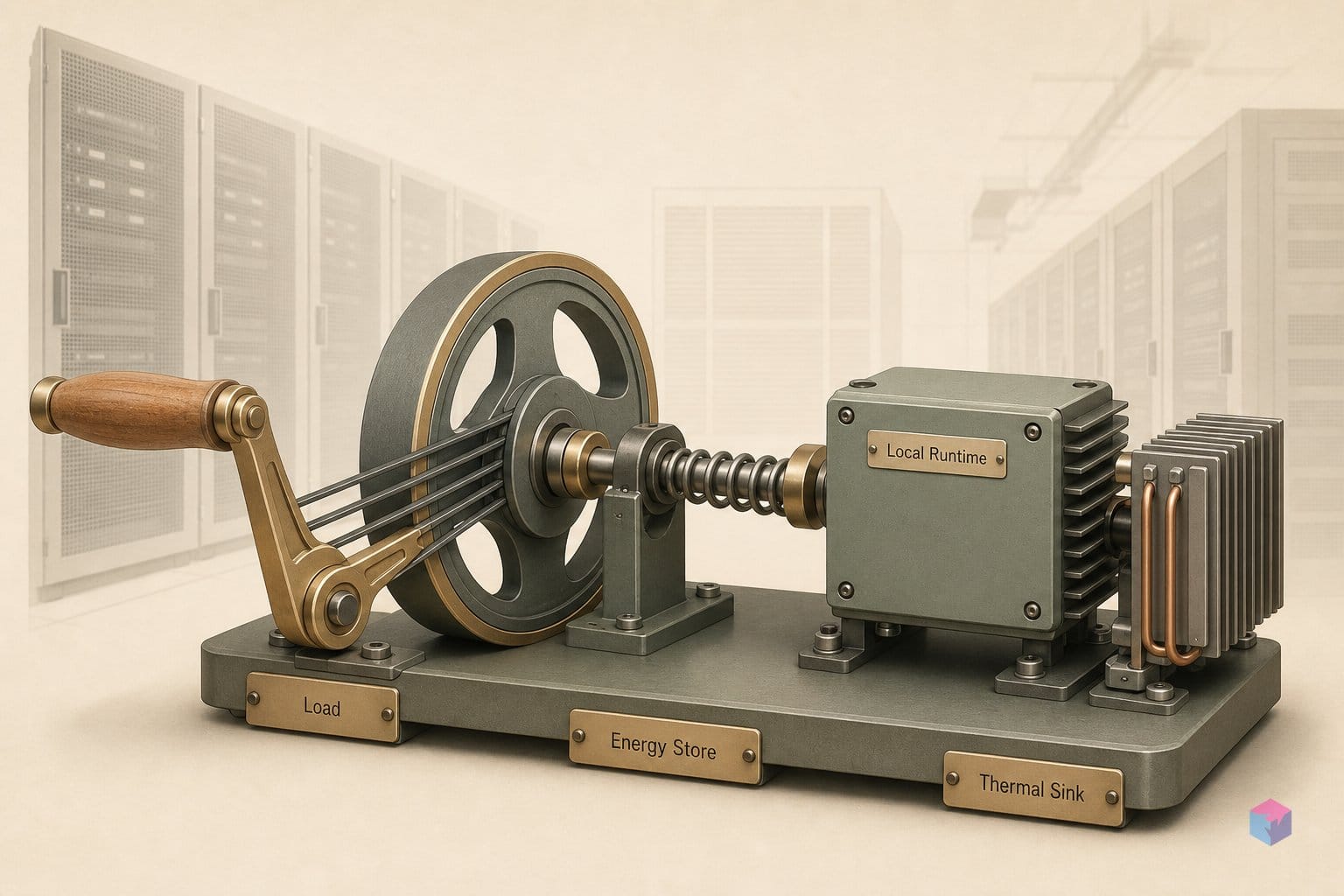
The fix is a custom capacitor board sitting between the generator and the Pi. It smooths the output and holds roughly 20 seconds of reserve charge, which is enough to absorb the spike at token generation and to let the operator stop cranking for a few seconds without killing the session . That reserve is the difference between a demo that survives a full reply and one that resets every time the model starts decoding.
The measured power profile shows why the buffer matters — draw more than doubles between idle and active inference:
| Mode | Power | Current @ 5V |
|---|---|---|
| Idle | ~4W | 0.8A |
| ASR (speech recognition) | ~8W | 1.6A |
| LLM inference + TTS | ~15W | 3A |
| Peak spike | — | ~5A |
These figures come from Squeez's own measurements . The most striking detail is that the load is tactile: the crank's mechanical resistance reportedly increases during token generation, so the operator physically feels compute demand rise and fall as the model decodes . The human is well within budget — Kauffmann estimates a good cyclist can sustain around 120W (The Outpost), an order of magnitude above the ~15W peak — but the generator's transient delivery, not the operator's stamina, is the bottleneck the capacitor board exists to solve. The Register's framing of the device as a "workout while you wait" is accurate on effort, but understates the harder problem: smoothing the current curve, not generating the watts.
DietPi and the 3-Second Userspace Boot
Once the power curve is stable, the next bottleneck is startup time — and on a hand-cranked machine, every boot second is muscle spent before a single token appears. Squeez runs CrankGPT on DietPi, a stripped-down Debian-based OS chosen over Raspberry Pi OS specifically because cold-start time matters when a person is generating the electricity. After disabling unnecessary radio services, the team reports reaching usable userspace in about 3 seconds .
That userspace figure is only one slice of the full path to a ready conversation. Boot-to-ready breaks down as roughly 10–15 seconds of Pi firmware and cold boot, the ~3 seconds of DietPi Linux init, then 10–15 seconds of agent startup and model loading — about 30 seconds total from the first crank to a usable assistant . The OS trim shaves the cheapest seconds; the model load is the part you cannot optimize away by deleting services.
The pipeline itself runs on Squeez's own open-source edge_voice_agent (ktomanek/edge_voice_agent, Apache 2.0), structured as ASR plus VAD, then LLM, then TTS — each stage pluggable . The backend matrix is deliberately broad: Moonshine, FasterWhisper, Nemo FastConformer, and Vosk for ASR; Piper and Kokoro for TTS; and any llama.cpp-hosted GGUF for the language model . That modularity is what lets the project pick the fastest option per stage — a choice that becomes concrete in the TTS layer, where the gap between candidates is large.
Why Piper Beats Kokoro on Pi 5 by 9x
On a CPU-only Pi 5, text-to-speech is the dominant UX variable, and Piper wins by a wide margin: it synthesizes a 20-word test utterance in about half a second, while Kokoro is roughly 9x slower and PocketTTS posts a real-time factor above 1.0 — meaning it generates audio slower than playback speed, producing audible stutter . When a person is hand-cranking the power, that latency is felt directly, so the slow options were non-starters.
Piper's speed comes partly from its execution path: CrankGPT runs it through ONNX Runtime rather than a Python-heavy stack, which trims overhead and keeps the memory footprint small enough to coexist with the LLM in 8GB . The same per-stage selection logic applies upstream at speech recognition. From the backend matrix — Moonshine, FasterWhisper, Nemo FastConformer, and Vosk — Squeez settled on Moonshine for ASR, citing the best speed-to-accuracy ratio on Pi-class boards without accelerators . Silero VAD sits in front of it to detect silence, so the box does not burn inference cycles transcribing dead air.
The result is a deliberately lean pipeline: Moonshine plus Silero VAD for listening, a llama.cpp-hosted small model for reasoning, and Piper on ONNX Runtime for speaking . Each stage is the fastest viable option for its job, which is what makes a sub-second response loop possible on human power.
350M to 1.2B: What Fits in 8GB at Q4_K_M?
The model that fits is small — and that is the point. CrankGPT runs three quantized small language models on the Pi 5's CPU, all at Q4_K_M, and the default voice agent uses Liquid AI's LFM2.5 350M, which generates 48.86 tokens/s with a 222.65 tok/s prefill while occupying just 354 MiB of RAM and returning a first byte in about 0.8 seconds . With 8GB on board, memory is never the binding limit; throughput and time-to-first-byte are. The bigger you go, the longer the person cranking waits.
Stepping up to LFM2.5 1.2B buys richer responses at a real cost: generation drops to 15.01 tok/s, prefill to 71.31 tok/s, RAM rises to 762 MiB, and TTFB climbs to roughly 1.5 seconds . Google's Gemma 3 1B carries the same 762 MiB footprint but is slower across the board — 14.31 tok/s generation, 46.12 tok/s prefill, and the worst TTFB in the tested set at about 2.9 seconds — which is why Squeez reserves it for translation rather than the general conversation loop .
| Model (Q4_K_M) | Generation (tok/s) | Prefill (tok/s) | RAM (MiB) | TTFB | Role |
|---|---|---|---|---|---|
| LFM2.5 350M | 48.86 | 222.65 | 354.48 | ~0.8 s | Default voice agent |
| LFM2.5 1.2B | 15.01 | 71.31 | 762.49 | ~1.5 s | Richer responses |
| Gemma 3 1B | 14.31 | 46.12 | 762.49 | ~2.9 s | Translation |
None of this is locked to the Pi 5. Squeez ran the same workload on an Orange Pi 5 Pro and saw generation run 29–58% faster, attributing the gain mainly to DDR5 versus the Pi 5's LPDDR4X memory bandwidth . For a CPU-bound, memory-bandwidth-limited inference loop, the board's RAM type matters more than its core count.
One licensing caveat is worth flagging before you reproduce this stack. The edge_voice_agent code is Apache 2.0, but the model weights are not. Liquid AI's LFM2 license grants free commercial use only to organizations under $10M in annual revenue, and Gemma 3 ships under Google's own custom terms . The code is open; the brains running on it come with strings.
The $300 BOM: Raspberry Pi 5, HATs, Crank, Capacitor
The hardware bill of materials lands at roughly $300 for a current build, up from about $150 for an earlier iteration . Squeez attributes most of that jump to a surge in RAM prices — the same memory-cost pressure that has made the device a talking point for the broader edge-AI economics conversation . Nothing here is exotic; the value is in the integration, not the parts.
The core stack is deliberately stock. A Raspberry Pi 5 with 8GB of RAM carries a cooling fan HAT, and audio I/O runs through a KEYESTUDIO ReSpeaker 2-Mic Pi HAT built on the WM8960 codec with a stereo MEMS mic array . Builders who would rather not use the HAT can swap in USB sound cards with external mics and speakers, which Squeez tested as a working alternative .
The power path pairs an off-the-shelf switchable-voltage ~20W emergency hand-crank generator with the custom capacitor smoothing board that keeps inference loads from browning out the Pi . Everything sits in a 3D-printed enclosure — a transparent variant exists — with a knob, a button, and a switch for mode selection .
A Pi 5 Handles Q&A. It Won't Handle Much More.
The honest framing is that a Raspberry Pi 5 at this power and parameter budget handles bounded conversational work and little else. Squeez is explicit that complex reasoning, long-context tasks, multimodal input, and high-quality code generation are out of reach on this hardware . The ceiling is set by an 8GB board running quantized sub-2B models on CPU with no accelerators — useful, not general-purpose.
What does fit is a narrow but real band of edge applications:
- Simple question answering on a small general model such as LFM2.5 350M, with sub-second time-to-first-byte .
- Translation, where Squeez uses Google's Gemma 3 1B specifically .
- Voice command routing and other tasks with short, bounded context.
Squeez's argument is that many genuine edge use cases land inside that band, not above it . The resilience and privacy case is the part that holds up under scrutiny: the box has no dependency on any external service, API, or power grid, which makes it relevant to off-grid, disaster-response, and air-gapped environments where cloud inference simply is not an option .
Even the satirical tier list maps the real constraint accurately. The 20W "Synapse" tier covers question answering, 150W "Cortex" is pitched at agentic coding and video generation, and 2000W+ "Singularity" covers swarms, training, and fine-tuning . The framing is tongue-in-cheek, but the power-to-capability mapping is honest: the hand-crank box lives firmly in the 20W band, and nothing about cranking harder moves it up a tier.
Reproducing CrankGPT: The Repo Is Out, Schematics Are Not
You can start cloning CrankGPT today, but you cannot fully reproduce it yet. The software half is live: Squeez's edge_voice_agent repository is published under Apache 2.0 and runs on any Pi-class board . The pipeline is ASR-plus-VAD, then LLM, then TTS, with swappable backends — Moonshine, FasterWhisper, Nemo FastConformer, or Vosk for ASR; Piper or Kokoro for TTS; and any llama.cpp-hosted model for the LLM . The hardware half is not. Full schematics and 3D-print files were described as "releasing in the coming days" as of mid-June 2026, so check the repo and squeezlabs.github.io before assuming you can rebuild the capacitor board and enclosure .
Two cautions before you ship anything built on it. First, the license trap: Apache 2.0 covers the code, not the weights. LFM2/LFM2.5 is free for commercial use only for organizations under $10M annual revenue, and Gemma 3 carries Google's custom model terms . Second, every latency and tokens-per-second figure here — the ~0.8s time-to-first-byte on LFM2.5 350M, the 48.86 generation tok/s — comes from Squeez's own llama-bench runs, with no independent replication .
Treat those numbers as directionally credible, not verified. The practical takeaway: clone the repo, run the voice agent on a Pi 5 you already own, and benchmark it yourself before betting an off-grid product on it.
Frequently asked questions
Can I replace the hand crank with a USB power bank?
Yes. The crank is a design statement, not a hard requirement — the whole point is that CrankGPT proves local voice inference works without mains power, but nothing stops you from feeding the Pi 5 from a battery instead. The board peaks at roughly 5A under combined LLM inference plus TTS load , so any USB-C PD bank rated 25W or higher covers it comfortably. Keep the capacitor board in the loop if your bank has aggressive overcurrent cutoffs: it holds about 20 seconds of reserve and absorbs the momentary spikes that trip a bank into shutting off mid-token.
What license covers the edge_voice_agent code?
The code is Apache 2.0. Squeez's open-source edge voice agent (GitHub: ktomanek/edge_voice_agent) ships under Apache 2.0, which permits commercial use . The model weights are a separate matter: LFM2/LFM2.5 is free for commercial use only for organizations under $10M annual revenue, and Gemma 3 carries Google's custom model terms . Code license and model license are independent — check both before you ship anything commercial, because an Apache 2.0 repo does not relicense the weights it loads.
Which model is the right starting point — LFM2.5 350M or 1.2B?
Start with LFM2.5 350M for lowest latency, and step up to 1.2B only when output quality justifies the cost. On a Pi 5, the 350M model returns about 0.8s time-to-first-byte at roughly 48.86 generation tokens/s using 354.48 MiB, while the 1.2B model runs ~1.5s TTFB at 15.01 tok/s using 762.49 MiB . Both fit easily in 8GB alongside DietPi and the agent stack , so the decision is purely latency versus richer responses, not a memory ceiling.
Is an Orange Pi 5 Pro worth using instead of the Pi 5?
On raw speed, yes — but you trade away hardware ecosystem support. Squeez measured the Orange Pi 5 Pro running 29–58% faster in generation, attributed mainly to its DDR5 memory bandwidth . The catch is HAT compatibility, community tooling, and GPIO ecosystem breadth: the Raspberry Pi 5 is far better supported for the hardware add-ons CrankGPT depends on, like the ReSpeaker 2-Mic Pi HAT . If your build leans on stacked HATs and documented GPIO wiring, stay on the Pi 5; if it's a headless inference box, the Orange Pi's bandwidth advantage is real.
When are the full schematics and 3D print files available?
No confirmed date exists as of publication. Squeez said full plans and schematics were releasing "in the coming days" as of mid-June 2026 , but the voice-agent code is already public while the hardware files were not yet posted. Check ktomanek/edge_voice_agent on GitHub and the Squeez project page for the latest, and verify the schematics are actually live before treating full reproducibility as confirmed .