
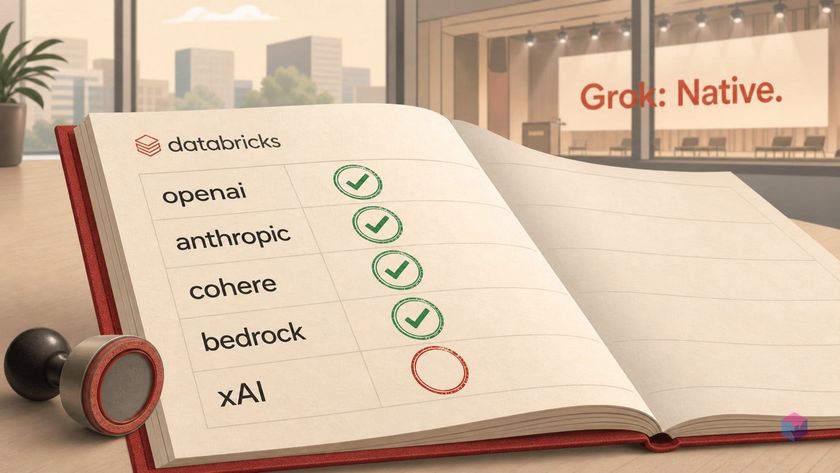
Databricks told a packed room at the Data + AI Summit that xAI's Grok is now a native model option inside Agent Bricks. Its own supplier registry, updated days later, still doesn't list xai anywhere.
The DAIS blog claim vs. the Databricks supplier registry
The native-Grok story rests on the DAIS 2026 engineering blog, not on Databricks' public docs. The blog frames a clean split: Databricks owns the data and governance layer (the Lakehouse plus Unity Catalog) while Grok supplies the reasoning model as a first-party Agent Bricks option . The pitch is tidy. The registry that would have to back it tells a different story.
Databricks' external-models page, updated May 18, 2026, enumerates exactly which suppliers it manages, and there is no xai entry. The Foundation Model API catalog, updated June 11, 2026, lists no Grok or xAI model either .
| Documented external supplier | Native Databricks connector? |
|---|---|
openai | Yes |
anthropic | Yes |
cohere | Yes |
amazon-bedrock | Yes |
google-cloud-vertex-ai | Yes |
databricks-model-serving | Yes |
custom | Bring-your-own endpoint |
xai | Absent from docs |
So what actually works today? The strongest doc-backed path is to configure xAI as a custom supplier using your own xAI credentials and endpoint via an OpenAI-compatible proxy route rather than a Databricks-managed connector . That's a meaningful distinction: "native" implies Databricks brokers the relationship, billing, and SLA; "custom" means you own all three.
One caveat in Databricks' favor: a private or limited-preview xAI connector not yet reflected in public docs can't be ruled out. Vendor docs lag launch announcements regularly. The practical read for developers: verify the integration path directly with Databricks before committing production workloads, and don't assume "native" means managed.
Unity AI Gateway: what it guards and what it logs
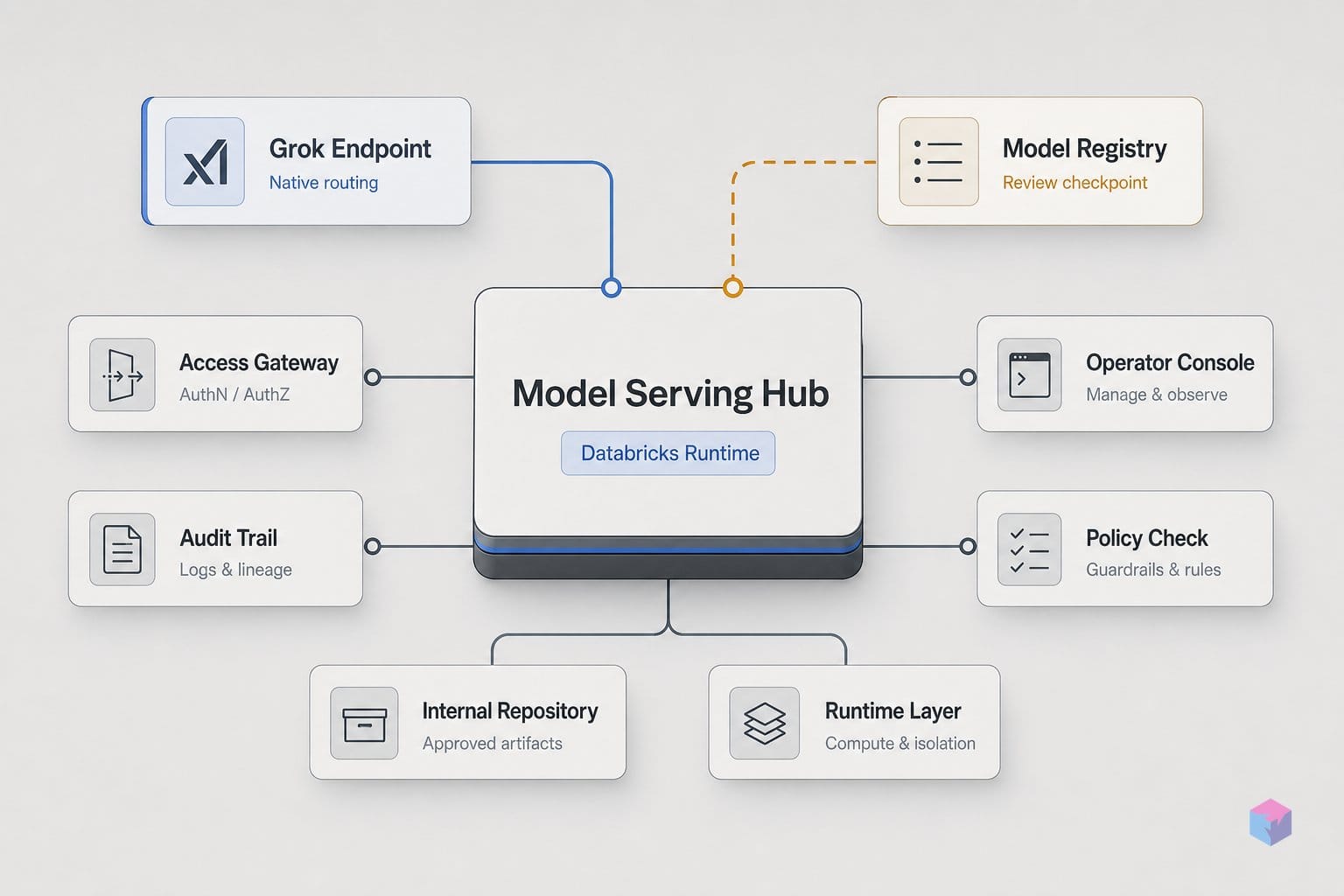
Unity AI Gateway is the documented substrate beneath Databricks' Grok pitch: a single control plane that sits in front of every LLM endpoint, agent, coding tool, and MCP server in an account . It is currently marked Beta in Databricks docs, and an account admin has to enable the preview before any team can route through it . That gate matters: this is opt-in plumbing, not a default.
What it guards is governance, applied centrally rather than per-notebook. The Gateway enforces:
- Fine-grained access controls per user and per group, with cost budgets, rate limits, and guardrails .
- Fallback chains and intelligent traffic routing across model providers, so a failed or throttled provider can hand off automatically .
- Usage logging to
system.ai_gateway.usagein Unity Catalog, plus inference tables for cost observability .
The core pitch for developers is provider portability: swap LLM suppliers "without application-code changes," routing Grok versus another model by configuration instead of re-platforming . Edmunds frames it the same way. "Databricks gives us a secure, governed foundation to run multiple models and switch providers as our needs evolve," said Gregory Rokita, VP of Technology at Edmunds (source: Databricks blog).
The caveat lands exactly where Grok would route today. Databricks notes that when you connect through the custom API path (the only currently available route for an xAI endpoint), token counting and streaming aggregation may be limited . So the same observability the Gateway sells as its headline feature degrades on the one path Grok can use right now. You get centralized access control and rate limits; you may not get clean per-token cost accounting.
Traffic splitting: up to 5 destinations, percentages must sum to 100%
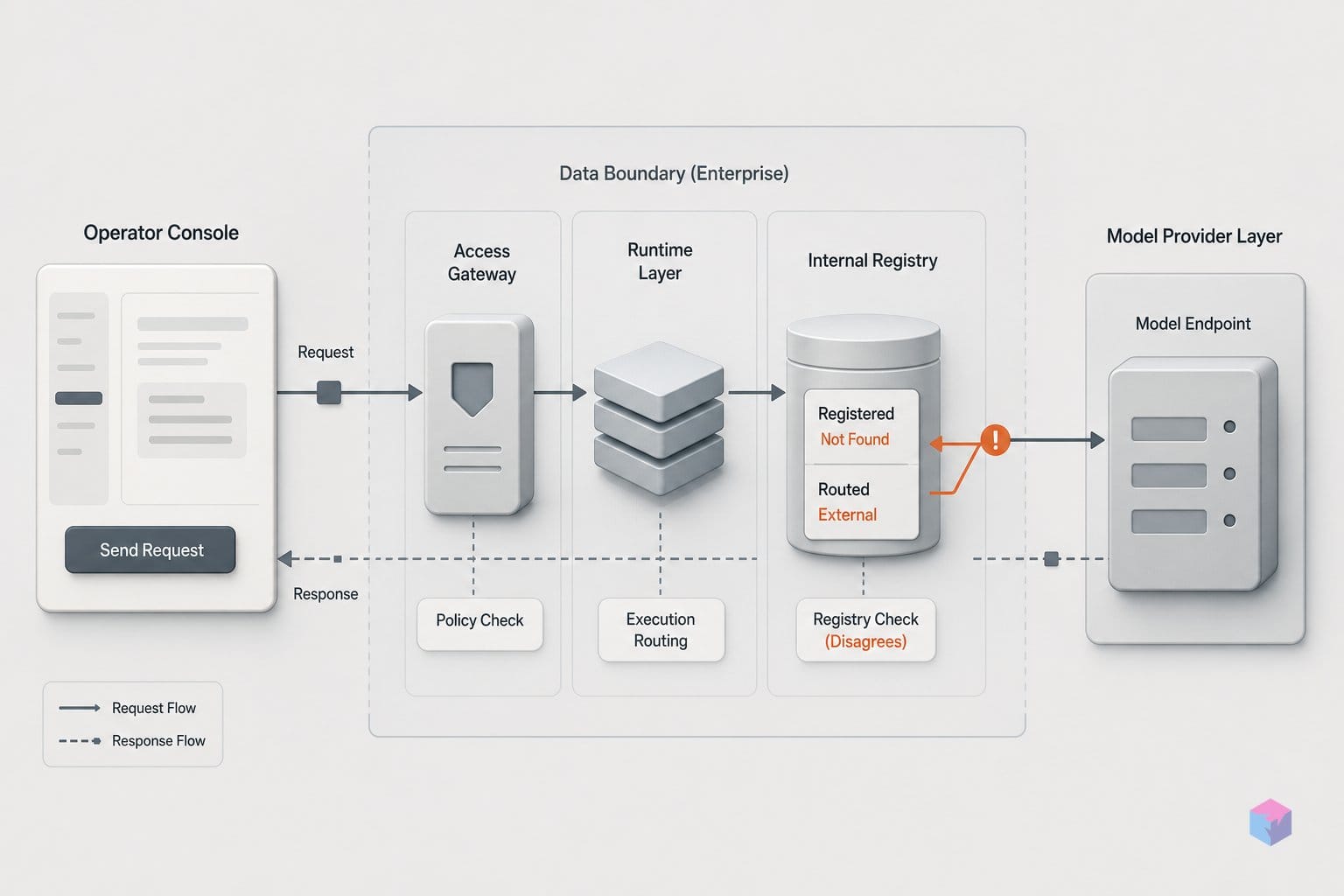
Where the Gateway does earn its keep is routing. A single endpoint can split traffic across up to 5 model destinations, with weights that must sum to exactly 100% . For a team weighing Grok against an incumbent, that is the mechanism that makes the "flex between models" pitch concrete.
In practice the percentages map onto three developer workflows:
- A/B tests: send 90% to a known-good model and 10% to Grok, compare quality and latency on live traffic before committing.
- Phased migration: ramp a new supplier from 10% to 50% to 100% over successive deploys instead of a hard cutover.
- Failover validation: confirm a fallback destination actually serves requests under partial load, not just in theory.
Every routing decision is logged to system.ai_gateway.usage , so the comparison is post-hoc and auditable rather than guesswork, assuming the custom-API caveats on token counting don't blunt the per-token side of that table for the Grok leg.
The asymmetry shows up at the query layer. Databricks documents native, provider-specific API surfaces for OpenAI Responses, Anthropic Messages, and Google Gemini, alongside an OpenAI-compatible unified API at /ai-gateway/mlflow/v1 . There is no xAI-specific variant in that list as of June 2026. So you can put Grok in a split, weight it, and log it, but you reach it through the generic OpenAI-compatible path, not a first-party connector. That gap is exactly what the "native" framing papers over, and it matters most when you want xAI-specific behavior to survive the round trip.
xAI's Grok-4.3 charges: $1.25/M input, Databricks markup undisclosed
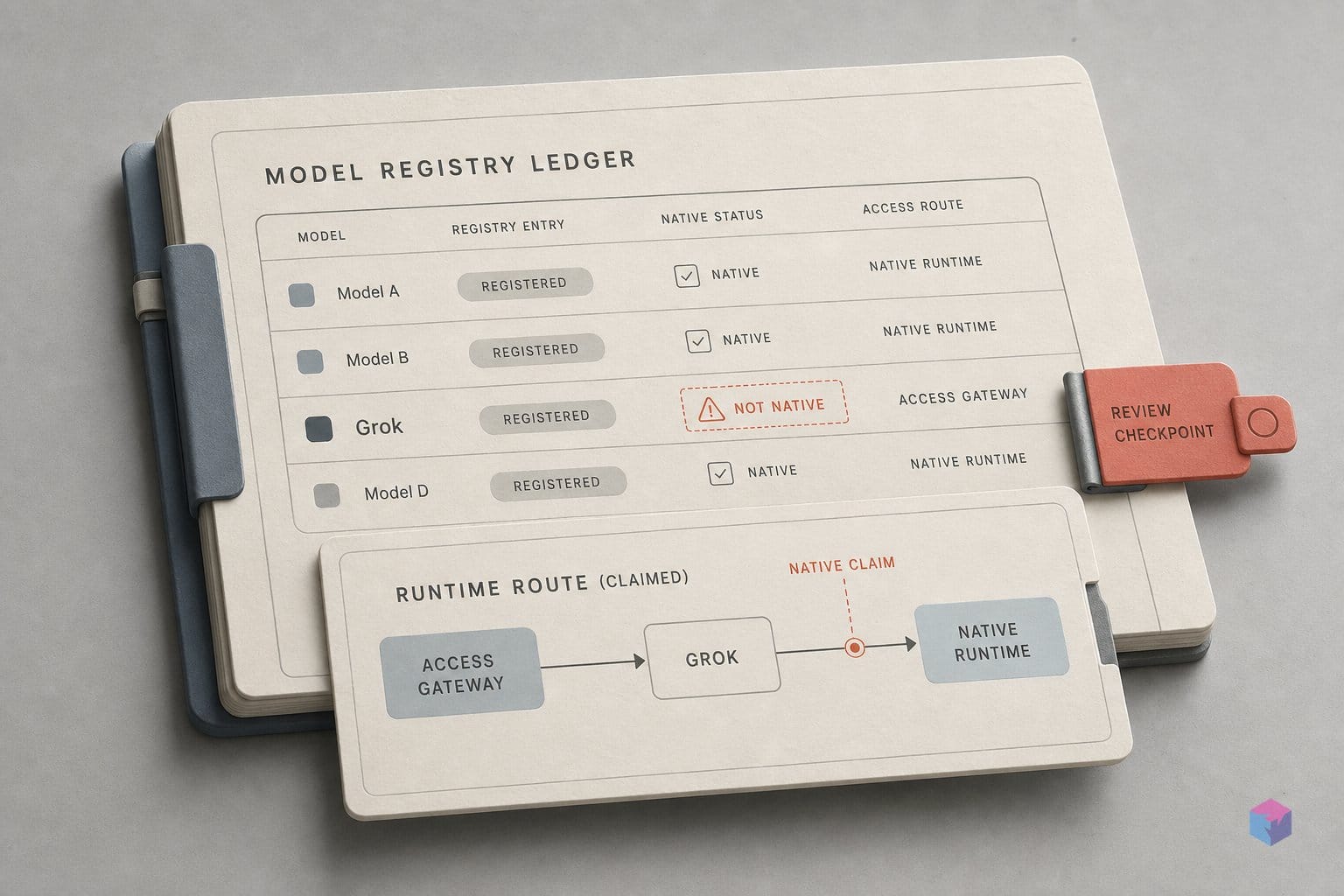
Once you reach Grok through the generic path, the prices you can verify are xAI's own, not Databricks'. xAI's recommended general model, grok-4.3, is a reasoning model with a 1,000,000-token context window and text plus image input, listed at $1.25 per 1M input tokens and $2.50 per 1M output tokens, with cached input at $0.20 per 1M tokens . Those are the direct-API numbers; what Databricks charges to route the same call is not published .
xAI also lists grok-build-0.1, a coding-focused model launched May 19, 2026, with a 256k context window at $1.00 per 1M input and $2.00 per 1M output tokens . Public reporting on Agent Bricks named only "xAI's latest models," so which Grok SKU is actually exposed is unconfirmed .
| Model | Context | Input /1M | Output /1M | Cached input /1M |
|---|---|---|---|---|
| grok-4.3 (general) | 1,000,000 | $1.25 | $2.50 | $0.20 |
| grok-build-0.1 (coding) | 256,000 | $1.00 | $2.00 | N/A |
The routing is plausible because xAI exposes an OpenAI-compatible client: point base_url at https://api.x.ai/v1 and set model="grok-4.3" . That maps cleanly onto Databricks' custom supplier path, which is explicitly positioned for OpenAI-compatible proxies .
Two open variables remain for anyone doing the math. Databricks has not stated whether it passes through xAI list prices or adds a margin for any Grok route through Agent Bricks . Databricks also warns that token counting and streaming aggregation can be limited for custom APIs, so your usage tables may not match xAI's billing exactly .
Until Databricks publishes a Grok price line, treat xAI's direct rates as the floor, not the bill.
The undocumented side: SLAs, markup, and feature parity
The contract terms are the biggest blind spot. No primary source publishes joint SLAs, billing commitments, support ownership, indemnity, data-retention terms, or regional data-processing controls for a Grok-through-Databricks path. The Databricks summit blog frames the partnership; it does not document who answers a 3 a.m. page when a Grok route fails, or whose data-residency policy governs the prompts logged to Unity Catalog .
The second gap is feature parity. xAI ships server-side capabilities (web and X search, tool calls, and reasoning controls) alongside its OpenAI-compatible endpoint at https://api.x.ai/v1 . There is no guarantee those xAI-specific fields survive a hop through Databricks' unified Gateway. A provider-agnostic proxy tends to normalize requests to a common shape, and anything outside that shape can be silently dropped.
Before you wire Grok into production through this path, check whether these still work end to end:
- Server-side web/X search and live tool calls: do they reach xAI intact?
- Reasoning controls and any future Responses-API fields: preserved or stripped?
- Streaming and token counts: accurate, given the documented custom-API caveats?
The multi-model offering is real, but it covers routing configuration, not feature parity. As Gregory Rokita, VP of Technology at Edmunds, put it: "Databricks gives us a secure, governed foundation to run multiple models and switch providers as our needs evolve" (source: Databricks).
The takeaway: until the external-models page (last updated May 18, 2026) adds an xai supplier entry, treat this as a custom-routed pattern under standard Gateway caveats, not a confirmed first-party integration . Pilot it, log everything, and confirm the terms with Databricks directly before you commit a workload.
Frequently asked questions
Is Grok officially listed as a supported supplier in Databricks' external-models API?
No, not as of June 2026 documentation. The external-models supported-supplier list is openai, anthropic, cohere, amazon-bedrock, google-cloud-vertex-ai, databricks-model-serving, and custom, with no xai entry . You can still wire Grok through the custom path using xAI's OpenAI-compatible endpoint (base_url="https://api.x.ai/v1") and your own credentials . That is self-supplied routing, not a Databricks-managed connector.
What is Unity AI Gateway, and is it generally available?
Unity AI Gateway is Databricks' central control plane for LLM traffic: access controls, per-user and per-group budgets, rate limits, guardrails, fallbacks, and logging to Unity Catalog across model providers, agents, and MCP servers . It is not generally available: the Gateway is marked Beta, and an account admin must enable the preview before teams can route through it .
How does traffic splitting across multiple LLM suppliers work in Databricks?
An endpoint supports up to 5 destinations, with weights that must sum to 100%, and every routing decision is logged to system.ai_gateway.usage . Because providers swap by configuration rather than application-code changes, the same mechanism covers A/B tests, phased migrations, and failover validation between suppliers .
What does grok-4.3 cost on xAI's API directly, and does Databricks add a markup?
On xAI's API, grok-4.3 is priced at $1.25 per 1M input tokens and $2.50 per 1M output tokens, with cached input at $0.20 per 1M tokens . Databricks has not disclosed whether it applies a markup for any Grok route through Agent Bricks . Treat xAI's list prices as a floor, not a ceiling, until Databricks publishes pass-through terms.