

A French streaming service just handed Spotify and Apple Music users a way to audit their own libraries for AI-generated tracks, without installing anything or holding a Deezer account. The detector that used to live inside Deezer's ingestion pipeline now reaches across the fence.
Deezer's ingestion filter now spans rival streaming libraries
On June 11, 2026, Deezer launched a free, browser-based AI Music Detector that scans playlists and saved libraries for fully AI-generated tracks across rival platforms, not just inside its own app . No Deezer subscription or account is required. It runs in 27 languages and can analyze up to 100 playlists per session .
The workflow is straightforward: a listener picks their streaming service, grants read access to the account, lets Deezer scan the playlists on its servers, then views and shares a report on how much of the collection looks machine-generated .
Secondary coverage names the supported services, though Deezer's own count is phrased loosely (its release cites "more than 20 of the most common platforms" ):
- Spotify
- Apple Music
- Tidal
- SoundCloud
- YouTube Music
What changed is the audience. The same detection model previously ran only on Deezer's ingestion pipeline (tagging AI albums and keeping them out of recommendations) and was licensed commercially to industry partners starting January 2026 . This is the first consumer-facing version.
The gap it targets is concrete. Deezer reports that 43% of users migrating from rival platforms already carried AI-generated tracks in their saved playlists . If other services do not adopt Deezer's filter at ingestion, listeners can now inspect what they imported themselves, which is precisely the point of pushing the tool past Deezer's own catalog.
Acoustic signatures, not metadata: what the fingerprinting method finds
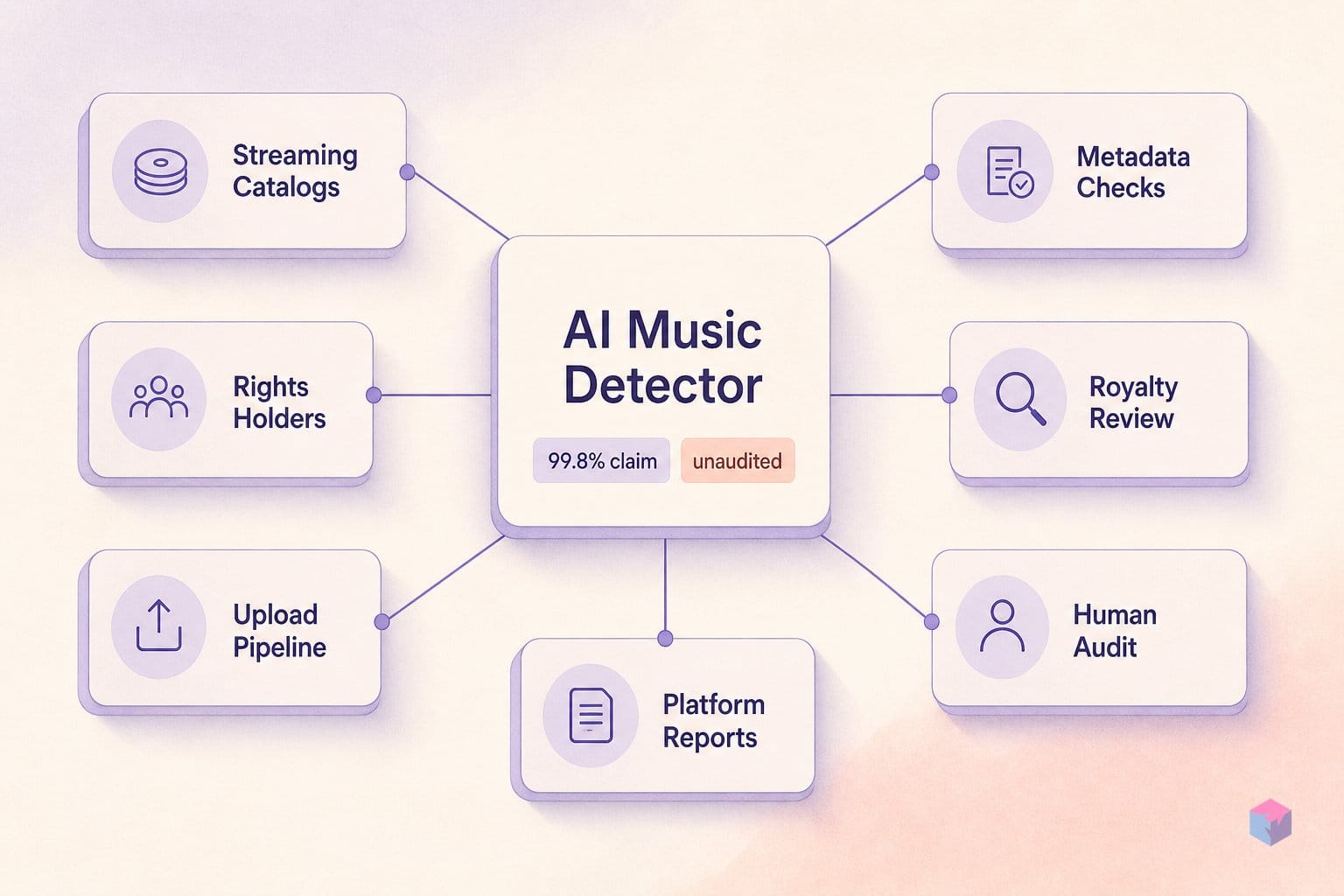
Deezer's detector works at the audio-signal level, not on labels. It analyzes the raw waveform for acoustic artifacts that generative models such as Suno and Udio embed in their output, subtle patterns that human listeners cannot perceive but that survive in the signal . The implication for developers: detection does not depend on a distributor declaring a track as synthetic.
That distinction matters. Metadata-based approaches trust whatever a distributor tags at upload; a self-declared label can be omitted, wrong, or gamed. Deezer's model ignores the tag and reads the signal directly, so a fully AI-generated track flagged by the audio classifier is identified regardless of how it was submitted or what it claims to be .
The technology has a paper trail. Deezer filed two patent applications in December 2024 covering distinct methods of identifying these synthetic signatures, and first deployed the detection tool internally on January 24, 2025 [5][6]. Until now that system ran only on Deezer's ingestion pipeline and was licensed to industry partners; the browser tool is its first consumer exposure.
Notably, the consumer-facing scanner is not a lightweight derivative. Deezer's disclosures describe no separate or stripped-down consumer variant: the public tool reuses the same underlying model that tags AI albums and tracks across Deezer's own catalog . So a Spotify or Tidal playlist gets scored by the production classifier, not a demo.
Deezer frames the method as a transparency play rather than a takedown mechanism. CEO Alexis Lanternier said that by detecting and tagging AI-generated music over the past year and a half, Deezer has been "at the forefront of transparency in music streaming" . The open question (addressed next) is what that signal-level confidence is actually worth without an independent benchmark.
An unaudited 99.8%: where the precision measurement stands
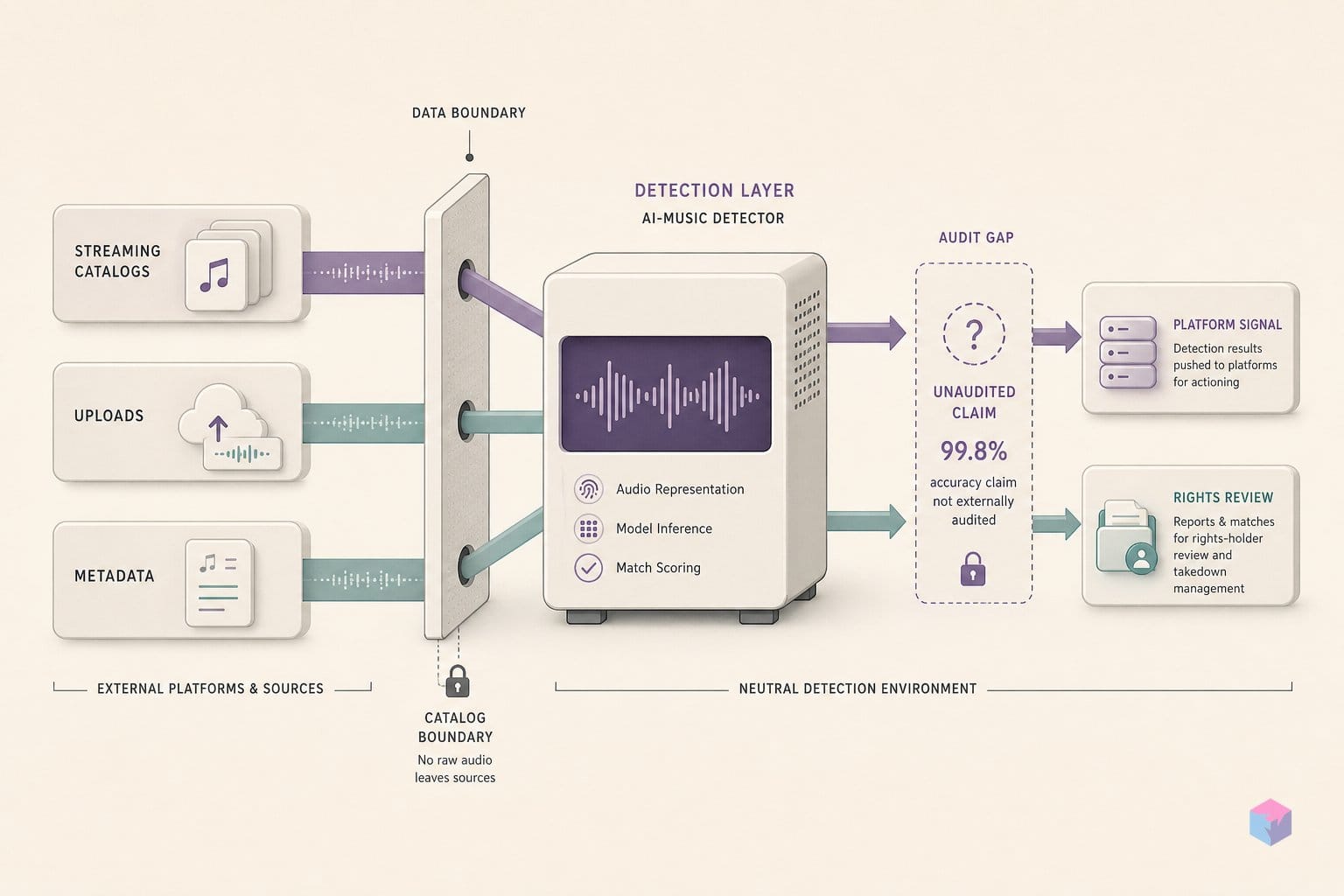
Deezer's headline number is 99.8% accuracy, and it comes entirely from Deezer. Its consumer FAQ translates that into roughly 2 missed AI tracks per 1,000 scanned and fewer than 1 false flag per 10,000 authentic songs . As of June 2026, no public benchmark dataset, third-party audit, or reproducible evaluation method backs those figures, so they remain a vendor claim, not a verified result.
That gap matters because the detector runs at the audio-signal level, where you cannot eyeball a misclassification the way you can with a bad metadata tag. Without a shared test set, there is no way to independently reproduce the precision number or stress it against adversarial inputs .
| Claimed metric (Deezer FAQ) | Stated figure | Verification status |
|---|---|---|
| Overall accuracy | 99.8% | Vendor-supplied, no audit |
| Missed AI tracks | ~2 per 1,000 scanned | Not independently tested |
| False positives | <1 per 10,000 authentic songs | Not independently tested |
The measurement is also scoped narrowly. Deezer describes the system mainly around fully (or 100%) AI-generated music, and its public materials do not clearly resolve how it handles AI-assisted production, voice cloning, heavy post-production, or hybrid human/AI workflows . Those edge cases are exactly where a developer would expect the false-positive rate to drift, and they sit outside the reported number.
There is a structural reason to read the percentage as a snapshot rather than a constant:
- Precision depends on artifact signatures left by specific generators such as Suno and Udio .
- Retraining those models to mask the artifacts would degrade detection without any change on Deezer's side.
- Holding the 99.8% figure steady therefore assumes a model update cadence Deezer has not committed to publicly.
The honest reading: the number is plausible and possibly conservative, but until someone publishes a reproducible benchmark, "99.8%" is a marketing input, not an engineering metric you can build trust decisions on.
Giving Deezer playlist-level authorization on Spotify and Tidal
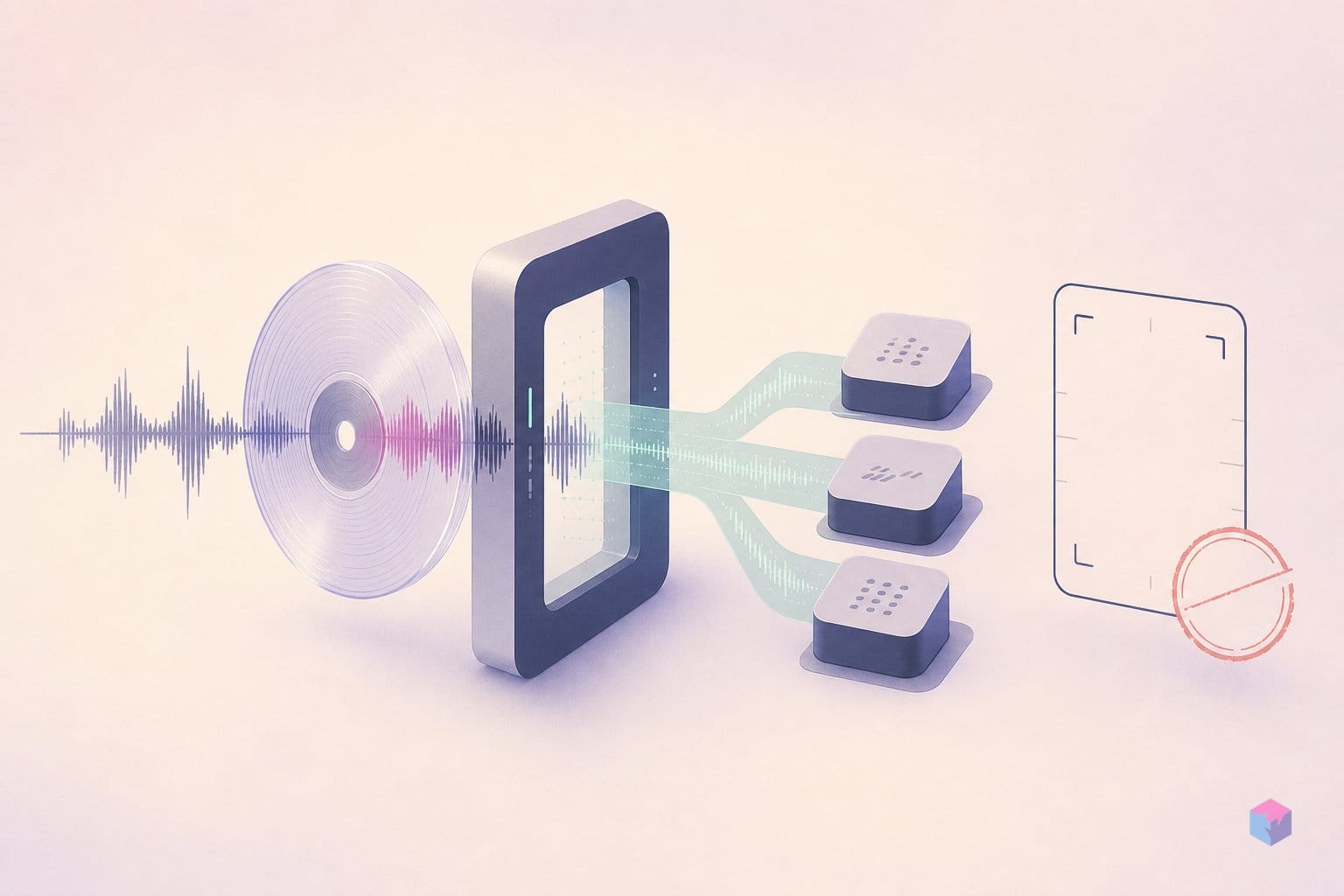
The flow is straightforward, and that is exactly where the friction hides. You pick your streaming service, grant read access to your playlists and saved library, let Deezer scan the audio on its own servers, and get back a shareable report showing how much of the collection appears fully AI-generated . No Deezer account or subscription is required. The tool runs in 27 languages and can analyze up to 100 playlists per scan .
What you are actually doing is handing a third party OAuth-style read permission over your library on a platform that has said nothing about it. That raises questions Deezer's own pages do not answer:
- How many platforms, exactly? Deezer's press release cites "20 of the most common platforms," while its consumer page uses broader wording ("compatible with every streaming service") and other Deezer posts say "more than 20." Secondary coverage names Spotify, Apple Music, Tidal, SoundCloud, and YouTube Music among them .
- Does anyone on the other side endorse this? There is no public statement from Spotify, Apple Music, or Tidal confirming integration or approval. Whether granting playlist-level access could collide with those services' API terms is unaddressed in Deezer's materials .
- What do you get back? Whether non-Deezer users receive track-level identifications or only a playlist-level percentage is not consistently documented across Deezer's pages, and coverage conflicts on the point .
For a developer, the read is simple: this is a cross-platform scan built on permissions Deezer controls and a target platform has not blessed. It works until a host service decides playlist read-access by a competitor's detector violates its terms, at which point the scope of what you can scan shrinks without warning.
Generative music and the fingerprint evasion problem
The pressure behind this rollout is volume. Fully AI-generated tracks reached roughly 44% of new daily uploads to Deezer (nearly 75,000 a day) by April to June 2026, up from about 10% of daily content in January 2025 . The curve is steep, and it explains why Deezer wants a detector running outside its own walls.
| Date | Fully AI-generated daily uploads | Share of daily content |
|---|---|---|
| Jan 2025 | ~10,000 | ~10% |
| Jun 2025 | ~20,000 | ~18% |
| Jan 2026 | ~60,000 | ~39% |
| Apr-Jun 2026 | ~75,000 | ~44% |
Source: Deezer newsroom figures .
The listening side tells a different story. Despite the upload flood, AI-generated music accounts for only 1 to 3% of actual streams on Deezer, and the company says up to 85% of those AI-track streams were bot-driven in 2025 and excluded from royalty calculations . The threat is dilution of the royalty pool, not listener demand.
Deezer's economic framing leans on a CISAC/PMP strategy study estimating that nearly 25% of creators' revenues (up to roughly €4 billion) could be at risk by 2028 . CEO Alexis Lanternier ties the consumer launch to that stake:
"By detecting and tagging AI-generated music over the past year and a half, Deezer has been "at the forefront of transparency in music streaming," Alexis Lanternier, CEO, Deezer (source: MacRumors).
Two open problems decide how long this lasts:
- Evasion. The detector reads acoustic artifacts that Suno and Udio embed today. If generators learn to suppress those signatures, the signal Deezer scans for degrades, and the unaudited 99.8% claim ages with it.
- Adoption leverage. If Spotify, Tidal, and others decline Deezer's commercial licensing (offered to the industry since January 2026 ), the consumer tool becomes indirect pressure: listeners surface AI content in those catalogs themselves and share the report.
The takeaway: Deezer has turned a backend filter into a public lever. Whether it holds depends less on the 99.8% number than on two things it does not control: what the generators do next, and whether rival platforms keep granting the playlist access the scan relies on.
Frequently asked questions
How does Deezer's AI Music Detector identify synthetic tracks without metadata labels?
It works at the audio-signal level. The model analyzes waveforms for acoustic artifacts that generative tools such as Suno and Udio embed in the signal but that humans cannot hear, rather than trusting distributor metadata or self-declared labels . Deezer filed two patent applications in December 2024 covering distinct methods for detecting these synthetic signatures .
Do Spotify or Apple Music officially support or endorse this scanning tool?
No. As of June 2026, neither Spotify nor Apple Music has issued a public endorsement or integration statement . The detector runs through standard playlist read access that a listener grants. Deezer's materials do not address whether that OAuth-style access could face API-terms friction with those platforms, which control the grant the scan depends on.
Can Deezer's detector identify AI-assisted music, or only fully AI-generated tracks?
It is scoped to fully (100%) AI-generated music only. Deezer's public documentation describes detection of machine-generated tracks but does not clearly resolve how the model handles AI-assisted production, voice cloning, heavy post-production, or hybrid human/AI workflows . Those edge cases sit outside what the tool currently claims to flag.
What happens to playlist data Deezer scans from rival services?
After a listener connects an account, Deezer processes the playlists on its own servers to produce a shareable report on how much of the collection appears machine-generated . The public disclosures do not detail data retention, anonymization, or any secondary use of the scanned library data.
Has the 99.8% precision figure been independently verified?
No. The 99.8% accuracy claim (roughly two missed AI tracks per 1,000) is a vendor figure from Deezer's own FAQ . As of June 2026, no public benchmark dataset, reproducible evaluation methodology, or third-party audit has been published, so real-world performance against future or adversarial generators remains unconfirmed .