
What DVD-JEPA actually offers: CPU-only JEPA with no label supervision
DVD-JEPA is a minimal, self-contained Joint-Embedding Predictive Architecture (JEPA) world model that learns the motion of a bouncing DVD logo directly from raw frames, with zero coordinate annotation, and reportedly trains in about 10 seconds on a CPU . It is attributed to independent developer Mandar Wagh, published around June 13, 2026 with a public repository and an interactive browser demo . One caveat up front: every figure here is self-reported — there is no peer review, independent benchmark, or third-party coverage yet.
Quick Answer: DVD-JEPA is a roughly 500-line, MIT-licensed PyTorch JEPA world model that learns a bouncing DVD logo's physics from raw frames with no labels, trains in about 10 seconds on a CPU, and runs inference client-side in a browser — no server or GPU required .
The pedagogical hook is that no supervision tells the model where the logo is. The input is stacked frames of shape 2·16·16, and the network compresses them into a 32-dimensional latent vector z that nonetheless encodes spatial position — location emerges from prediction alone . Training runs via a single command, python -m dvd_jepa.train, and the trained weights then run client-side at dvd-jepa.vercel.app with no GPU at inference time .
What makes it a clean teaching artifact is the "pure JEPA" path. The optional pixel decoder is explicitly not required: scripts/pure_jepa.py operates entirely on vectors, so the full loop — context encoder, EMA target encoder, and a predictor that forecasts the next embedding — stays legible in a few hundred lines . For engineers without GPU clusters, that lowers the barrier to reading and reproducing the JEPA recipe end to end.
Pure JEPA anatomy: EMA update, predictor, and collapse guard
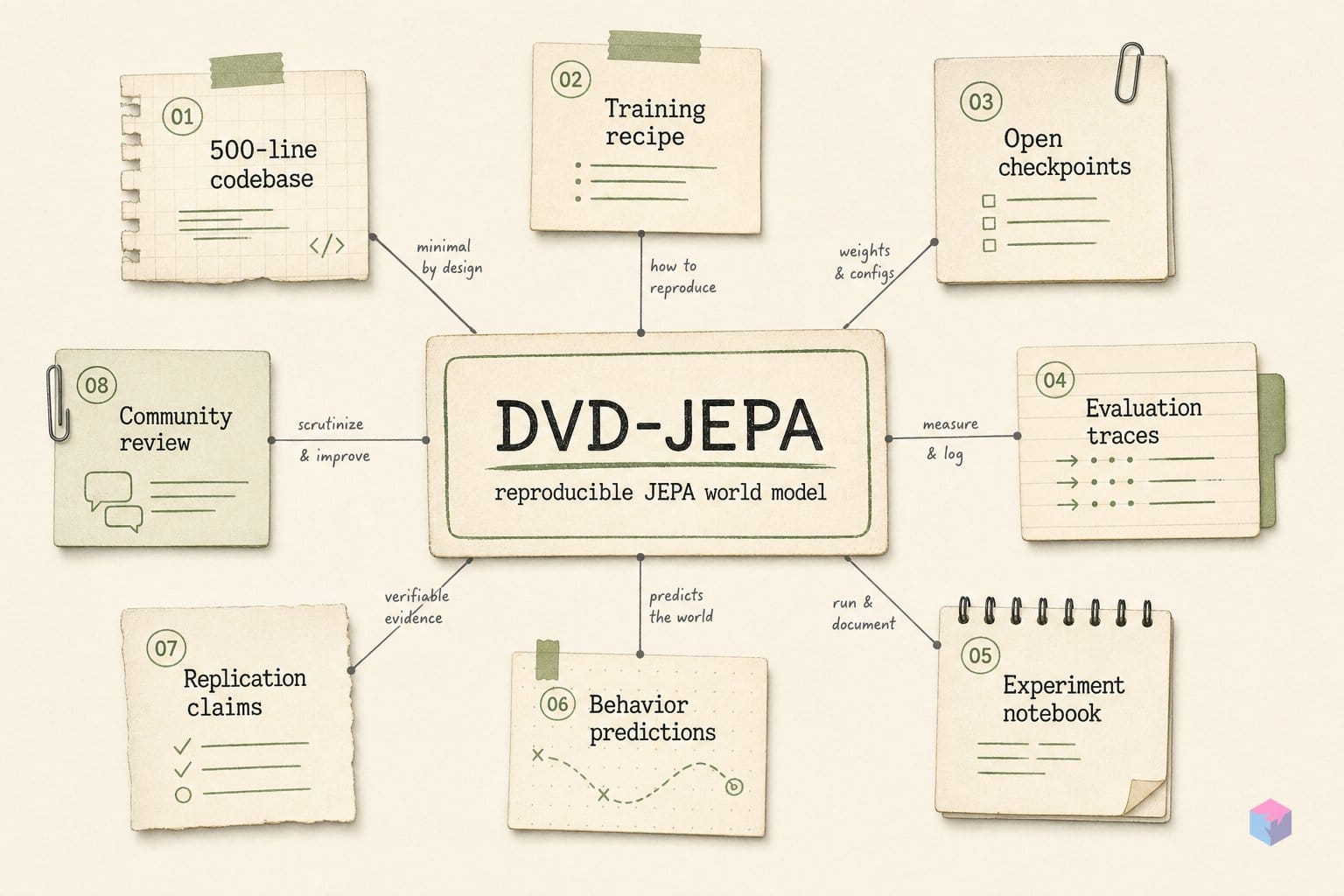
The pure JEPA loop is built from three small modules plus one regularizer: a context encoder that compresses frames to a latent vector, an EMA target encoder that supplies a stable prediction target, and a predictor that forecasts the next latent. A VICReg-style variance term keeps the representation from collapsing. In DVD-JEPA, each piece is a handful of linear layers, which is why the whole world model fits in a few hundred lines and trains on a CPU .
The context encoder takes stacked frames shaped (2·16·16) — two grayscale frames at 16×16 — and maps them through 256 → 128 → 32 to a 32-dimensional latent z. No pixel coordinates are fed in; the position of the bouncing logo has to be recovered by the network itself. The EMA target encoder is a shadow copy of the same architecture, updated at τ=0.99 per step rather than by gradient descent . That slow-moving copy is the point of contrast with Meta's larger line: it is the same EMA target trick used in I-JEPA and V-JEPA, just shrunk to laptop scale .
Why update the target by EMA instead of training it directly? If both encoders learned together, the predictor could drive them toward a trivial fixed point where every frame maps to the same vector — prediction error goes to zero, and the model has learned nothing. The EMA copy lags the live encoder, so the target signal stays stable while the context encoder moves, which is what makes the prediction objective meaningful rather than self-defeating.
The predictor (32 → 64 → 32) is the world-model head. It takes the current latent and forecasts the next frame's embedding — not its pixels. This is the defining JEPA choice: prediction happens in representation space, so the model never has to reconstruct texture it does not need, and an optional decoder for pixel readout is kept entirely separate .
| Module | Shape | Trained by | Role |
|---|---|---|---|
| Context encoder | (2·16·16) → 256 → 128 → 32 | Gradient descent | Frames → latent z |
| EMA target encoder | Same as context | EMA, τ=0.99/step | Stable prediction target |
| Predictor | 32 → 64 → 32 | Gradient descent | Forecast next embedding |
| Decoder (optional) | 32 → 64 → 256 → 256 | Gradient descent | Pixel readout, not required |
Collapse avoidance is handled explicitly. A VICReg-style variance term is appended to the latent prediction loss, pushing each embedding dimension to maintain spread across the batch. The reported embedding standard deviation of roughly 3.0 is the diagnostic that the guard is working — a value near zero would signal the trivial-solution collapse the EMA target alone cannot fully prevent . Seeing all four mechanisms — EMA target, latent-space predictor, variance regularizer, and the std readout that confirms it held — wired together in one readable file is the project's actual contribution.
The 0.73px RMSE and 88× anomaly gain: what they actually prove
The four headline numbers DVD-JEPA reports are evidence that the latent space z is doing real work, not proof of competitive performance. They show the JEPA loop functioning on a deterministic toy task: a linear probe recovers position to within 0.73 pixels , single-step latent forecasts land at 0.0005 MSE, prediction error flags out-of-distribution frames at 88× the baseline, and embedding standard deviation holds near 3.0. Every figure is self-reported with no independent replication, so read them as functional diagnostics rather than benchmarks.
The position RMSE is the most informative of the set. During pretraining the model never sees a coordinate label — it only predicts future embeddings of stacked frames. That a simple linear probe can then read the logo's x/y location to within 0.73 pixels means spatial position became linearly decodable from z as a byproduct of the predictive objective. This is the core JEPA claim in miniature: useful structure emerges from self-supervision, no supervision required.
The 0.0005 single-step forecast MSE is less surprising and should be discounted accordingly. A bouncing-logo trajectory is fully deterministic between wall collisions, so a competent predictor should anticipate the next-frame embedding almost exactly. The number confirms the predictor learned the dynamics; it says nothing about behavior under stochastic or high-dimensional inputs.
The 88× anomaly-detection sensitivity reuses prediction error as an out-of-distribution signal: when an injected frame violates the learned physics, the predictor's error spikes far above the in-distribution range, with no labeled anomalies involved. This is a clean demonstration of a general JEPA property — the same mechanism Meta frames around prediction error in its world-model work — but "88×" is meaningful only relative to this one toy distribution.
| Metric | Reported value | What it indicates |
|---|---|---|
| Linear-probe position RMSE | 0.73 px | z encodes spatial location without coordinate labels |
| Single-step forecast MSE | 0.0005 | Predictor models the deterministic dynamics |
| Anomaly sensitivity | 88× baseline | Prediction error flags OOD frames unsupervised |
| Embedding std | ≈ 3.0 | No representation collapse |
Taken together, these are indicative signals that the architecture works as designed — not benchmarked results. There is no peer review, no third-party leaderboard, and a single primary source behind all four figures . For a pedagogical artifact that is the right bar: the numbers prove the loop closes on a laptop, which is exactly what the project sets out to show.
Why the 'debut' label breaks: V-JEPA 2 came out in 2025
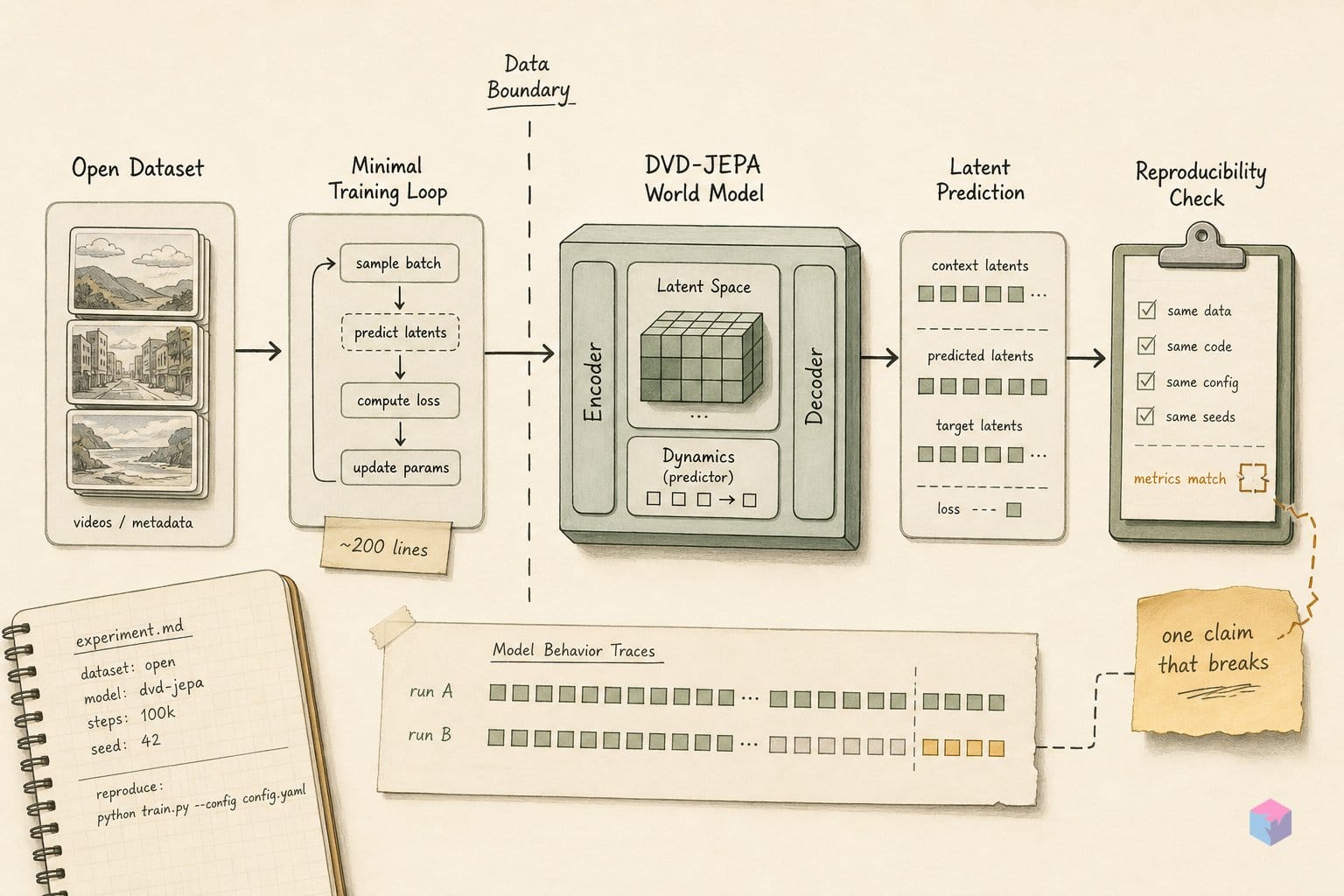
The "first open-source, fully reproducible JEPA world model" tag is the project's own positioning, not an established fact — and the timeline contradicts it. Meta published open JEPA world models well before June 2026: I-JEPA for images shipped with public code in 2023 , and the video line followed. Meta announced V-JEPA 2 on June 11, 2025 and recorded the code release at facebookresearch/vjepa2 on June 25, 2025, with V-JEPA 2.1 landing March 16, 2026 . So a JEPA world model with open code and checkpoints existed roughly a year before DVD-JEPA's June 13, 2026 demo .
The scale gap is the point. V-JEPA 2 is a 1.2-billion-parameter ViT-G/16 model pretrained on more than 1 million hours of internet video plus 1 million images, released under terms that permit commercial and research use . It reports 77.3% top-1 on Something-Something v2 and 39.7 Recall@5 on Epic-Kitchens-100, and — after post-training as an action-conditioned model on under 62 hours of unlabeled DROID robot video — zero-shot pick-and-place at 65–80% success in unseen environments .
"V-JEPA 2 is a 1.2-billion-parameter world model trained on over one million hours of video, released with code and checkpoints for commercial and research use," — Meta AI, V-JEPA 2 benchmarks announcement (source: ai.meta.com).
The line has kept moving. V-JEPA 2.1 (arXiv:2603.14482, submitted March 2026) scales up to a ViT-G/16 2B variant and targets dense video features, reporting 7.71 mAP on Ego4D, 40.8 Recall@5 on EPIC-KITCHENS, 77.7 on Something-Something-V2, and a 20-point real-robot grasping gain over V-JEPA 2-AC . None of that makes DVD-JEPA redundant — the two solve different problems. Meta's models are externally documented, peer-adjacent, and production-relevant; DVD-JEPA is a few-hundred-line teaching artifact. But it does mean "first" and "debut" do not survive contact with the record.
One caveat compounds the framing problem. An independent deep-research pass searching the exact strings "DVD-JEPA," "DVD JEPA," and combinations with "first open-source," "fully reproducible," and "world model" across GitHub, arXiv, and Hugging Face found no primary project page, paper, model card, or third-party announcement beyond the repo and demo themselves . There is no peer review and no independent benchmarking, so the single-source caveat applies to every figure in this article — including the toy-scale metrics from earlier sections. The defensible reading: DVD-JEPA is among the smallest and most self-contained reproducible JEPA demos, while Meta's V-JEPA 2 / 2.1 line is the open, documented, billion-parameter world model that actually came first.
The 2026 JEPA landscape: LeWorldModel, UWM-JEPA, and EB-JEPA
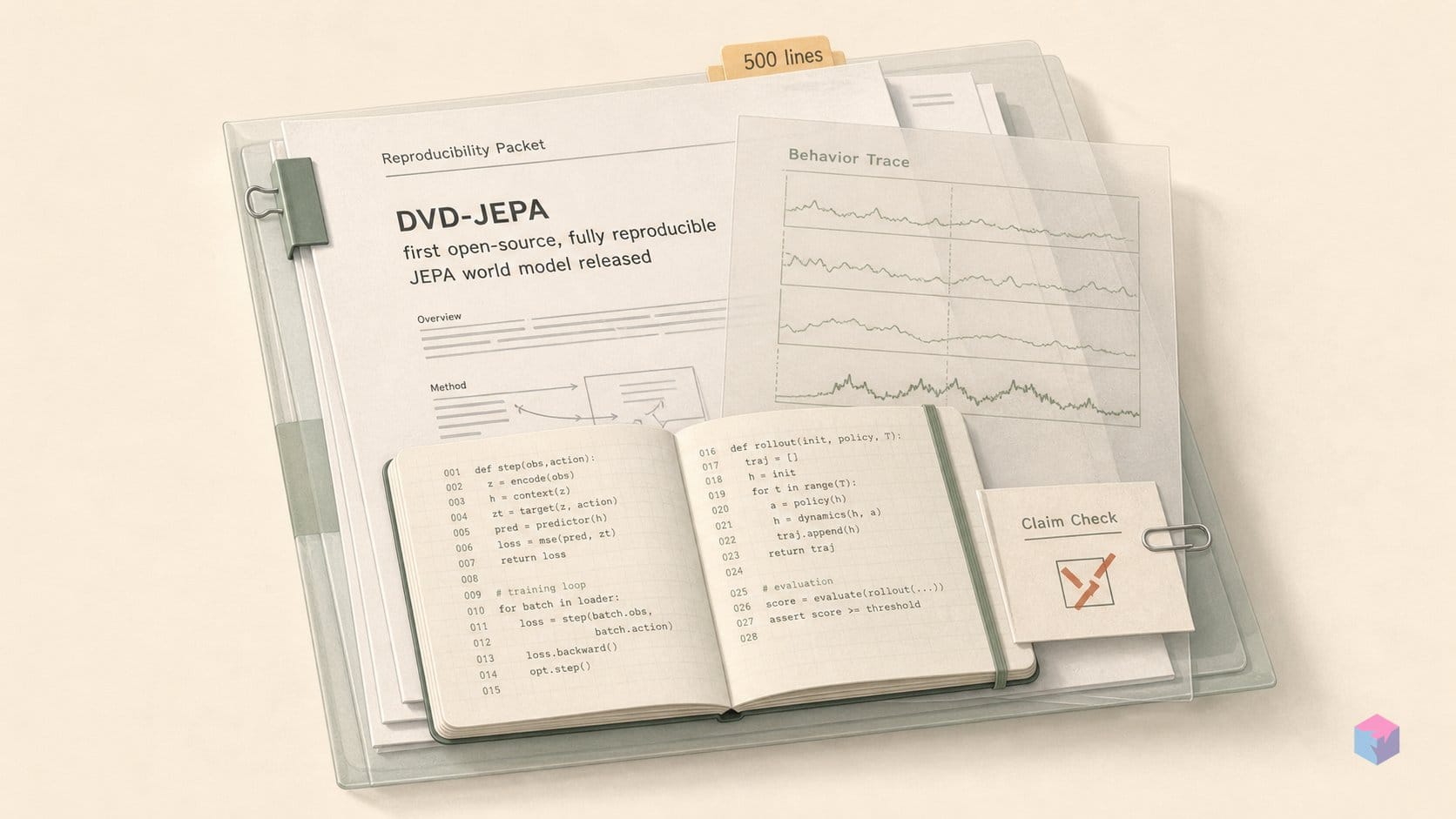
DVD-JEPA lands in a crowded 2026 research field where several teams are pushing JEPA world models in different directions — toward stable pixel-level training, exotic latent representations, and energy-based objectives. None of these targets DVD-JEPA's niche directly, but together they explain why the "first reproducible" framing does not survive contact with the literature. The relevant comparison is not whether DVD-JEPA is novel science, but where its tiny, CPU-only footprint fits among efforts that still assume a GPU.
The most direct rival to the "minimal end-to-end" pitch is LeWorldModel (arXiv:2603.19312, submitted March 2026). It claims to be the first JEPA that trains stably end-to-end from raw pixels using only two loss terms — cutting tunable loss hyperparameters from six to one — at roughly 15M parameters, with single-GPU training in a few hours and planning up to 48× faster than foundation-model-based world models.
"[The first JEPA to] train stably end-to-end from raw pixels using only two loss terms," — LeWorldModel authors, describing the method (source: arXiv:2603.19312).
The catch for anyone wanting to reproduce it: the arXiv page lists no GitHub link or open-source release as of writing, so its reproducibility claim is, like DVD-JEPA's metrics, currently unverifiable by a third party.
Two more entries round out the field:
- UWM-JEPA (arXiv:2605.25313, May 2026) proposes density-matrix latents with a learned unitary predictor, reporting 0.77 accuracy on a hidden-velocity task versus 0.53 for a parameter-matched LSTM-JEPA baseline (source: arXiv:2605.25313).
- Meta's EB-JEPA (arXiv:2602.03604) explores energy-based variants with public examples (facebookresearch/eb_jepa), and Causal-JEPA (arXiv:2602.11389) adds object-level latent-masking with partial public code (source: arXiv:2602.11389).
Against this backdrop, DVD-JEPA's defensible edge is narrow but real: it is the smallest footprint of the group, the fastest to clone-and-run, and the only one with no GPU barrier whatsoever — training on a CPU in roughly 10 seconds (source: mandarwagh9/dvd-jepa). LeWorldModel and UWM-JEPA aim at research contributions; EB-JEPA and Causal-JEPA explore alternative objectives. DVD-JEPA aims at comprehension. Read that way, it is a pedagogical artifact that makes the full JEPA loop legible on a laptop — not a production competitor to any model in this list.
Practical verdict: laptop learning vs. billion-param JEPA
Pick the tool by the job: DVD-JEPA is the right reach when you want to read a JEPA, and V-JEPA 2/2.1 is the right reach when you want to ship one. The two are not substitutes — one is a few-hundred-line teaching artifact that trains on a CPU in roughly 10 seconds , the other a 1.2-billion-parameter video world model pre-trained on more than 1 million hours of internet video . Choosing between them is a question of intent, not quality.
Reach for DVD-JEPA when:
- You want the complete loop — EMA target update, single-step predictor, and VICReg-style collapse guard — legible in one sitting, with the pure-vector variant in
scripts/pure_jepa.pystripping out even the optional decoder . - You need to teach the concept without GPU access — the trained weights run client-side in a browser with no server .
- You want to prototype out-of-distribution detection on a toy domain, using prediction error as the anomaly signal.
Reach for V-JEPA 2 or V-JEPA 2.1 when you need externally documented benchmarks (77.3% top-1 on Something-Something v2), ViT-scale checkpoints for fine-tuning — the repo lists ViT-L/16 300M through V-JEPA 2.1 ViT-G/16 2B variants — or a pretrained backbone for video understanding and robot action-conditioning, where V-JEPA 2-AC reached 65–80% zero-shot pick-and-place success .
Two caveats before you cite DVD-JEPA anywhere. First, the roughly 30 stars and 4 forks at capture reflect recency, not correctness — every metric is self-reported with no peer review or independent benchmarking, so audit the code before quoting the 0.73px RMSE or 88× anomaly figures. Second, mind the reproducibility gap that actually matters: DVD-JEPA is fully reproducible from scratch in seconds, while V-JEPA 2's open code and checkpoints make inference and fine-tuning accessible but leave the 1-million-hour pretraining run in an entirely different budget category .
The concrete takeaway: keep DVD-JEPA in your teaching folder and V-JEPA 2.1 in your production toolbox. Read the small one to understand the recipe, then fine-tune the large one when you need results someone else has already validated.
Frequently asked questions
Is DVD-JEPA really the first open-source JEPA world model?
No. The "first open-source, fully reproducible JEPA world model" line is the project's own positioning, not established fact. Meta open-sourced I-JEPA for images with public code , then released V-JEPA 2 — a 1.2-billion-parameter video world model — with code and checkpoints on June 11, 2025 . Both predate DVD-JEPA's June 13, 2026 demo . DVD-JEPA's defensible claim is narrower: among the smallest and fastest JEPA loops to reproduce from scratch with no GPU and no pretraining budget.
Can I reproduce DVD-JEPA on my own laptop?
Yes. DVD-JEPA is MIT-licensed and trains in roughly 10 seconds on a CPU via a one-line command, python -m dvd_jepa.train . The "pure JEPA" variant (scripts/pure_jepa.py) operates only on latent vectors and needs no pixel decoder, so the optional readout path is skippable . The trained weights also run in the browser demo client-side, with no server and no GPU required . Note that every reported figure is self-reported; there is no peer review or independent benchmarking yet.
How does DVD-JEPA's architecture differ from V-JEPA 2?
Same conceptual recipe, orders-of-magnitude different scale. Both use a context encoder, an EMA target encoder, and a predictor that forecasts the next embedding rather than pixels. DVD-JEPA compresses stacked frames down to a 32-dimensional latent in a toy bouncing-logo domain that runs CPU-only . V-JEPA 2 scales to ViT-g/16 at roughly 1 billion parameters, pretrained on more than 1 million hours of internet video plus 1 million images , with checkpoints up to ViT-G/16 2B in the V-JEPA 2.1 line .
What is the EMA target encoder and why does it matter?
The EMA (exponential moving average) target encoder is a slow-moving shadow copy of the context encoder, updated by averaging weights over time rather than by gradient descent. It matters because it keeps the prediction target from shifting too fast during training, which stabilizes learning and helps prevent representation collapse. This is the same self-distillation trick used in BYOL and across the JEPA family of self-supervised methods, including Meta's I-JEPA and V-JEPA 2 . DVD-JEPA pairs it with a VICReg-style variance term as a second collapse guard .
How does DVD-JEPA detect anomalies without labeled examples?
It treats the predictor's residual error as an out-of-distribution signal. Frames the world model cannot anticipate accumulate high prediction error, so no labeled anomalies are needed — the OOD score comes free from the JEPA training objective itself. DVD-JEPA reports anomaly-detection sensitivity at 88× baseline using this prediction-error approach , alongside a single-step forecast MSE of 0.0005 and an embedding standard deviation near 3.0 indicating no collapse . These are toy-scale, self-reported metrics, useful for understanding the mechanism rather than as production benchmarks.