
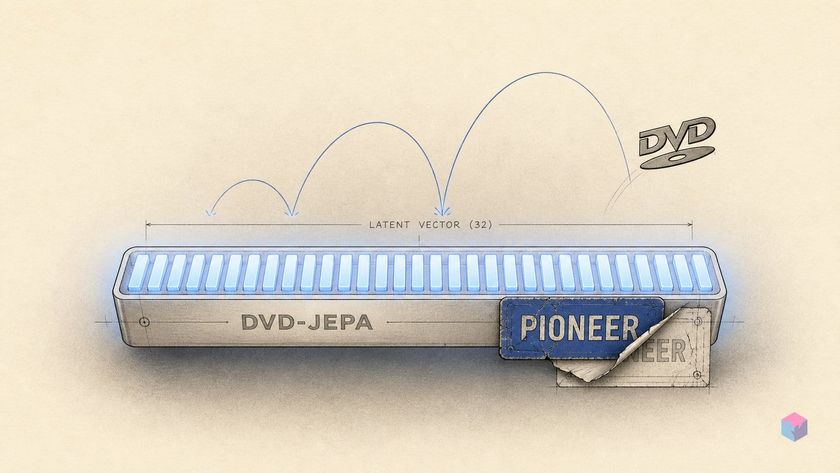
What DVD-JEPA Does: Latent Prediction Without Hardcoded Physics
DVD-JEPA is a small Joint-Embedding Predictive Architecture (JEPA) world model that learns the dynamics of the classic bouncing DVD-logo screensaver entirely in representation space — no explicit x/y coordinates, no hand-coded collision rules, and no pixel reconstruction in its loss . Instead of predicting where the logo will be in pixels, it predicts the embedding of the next state and uses that latent trajectory to anticipate motion. Its own page frames it as "a world model that dreams a bouncing logo" and "the rigorous sequel to DVD Dreamer" .
The model's entire understanding of the environment fits in a 32-dimensional latent space. Switch the optional decoder off — used only for visualization — and that understanding is exposed directly as 32 latent bars, since, as the page puts it, "a pure JEPA only speaks in vectors" . There is no frame buffer to reconstruct and no physics engine underneath; the dynamics live purely in the predicted vectors.
The runtime profile is the concrete novelty. DVD-JEPA reportedly trains in roughly 10 seconds on CPU and runs entirely client-side in the browser — no GPU, no server, no backend. You load the page, watch it train, and watch it predict . That makes it unusually cheap to inspect: the full training loop is observable in one tab on commodity hardware.
One caveat worth stating up front. At the time of writing, the project rests on a single primary artifact — dvd-jepa.vercel.app plus a referenced GitHub write-up — with no author name, license string, version tag, or release date visible on the page . The architecture is verifiable; the provenance is not yet, which matters once we test its "first" claim later.
The Minimal JEPA Recipe: What Each Component Does
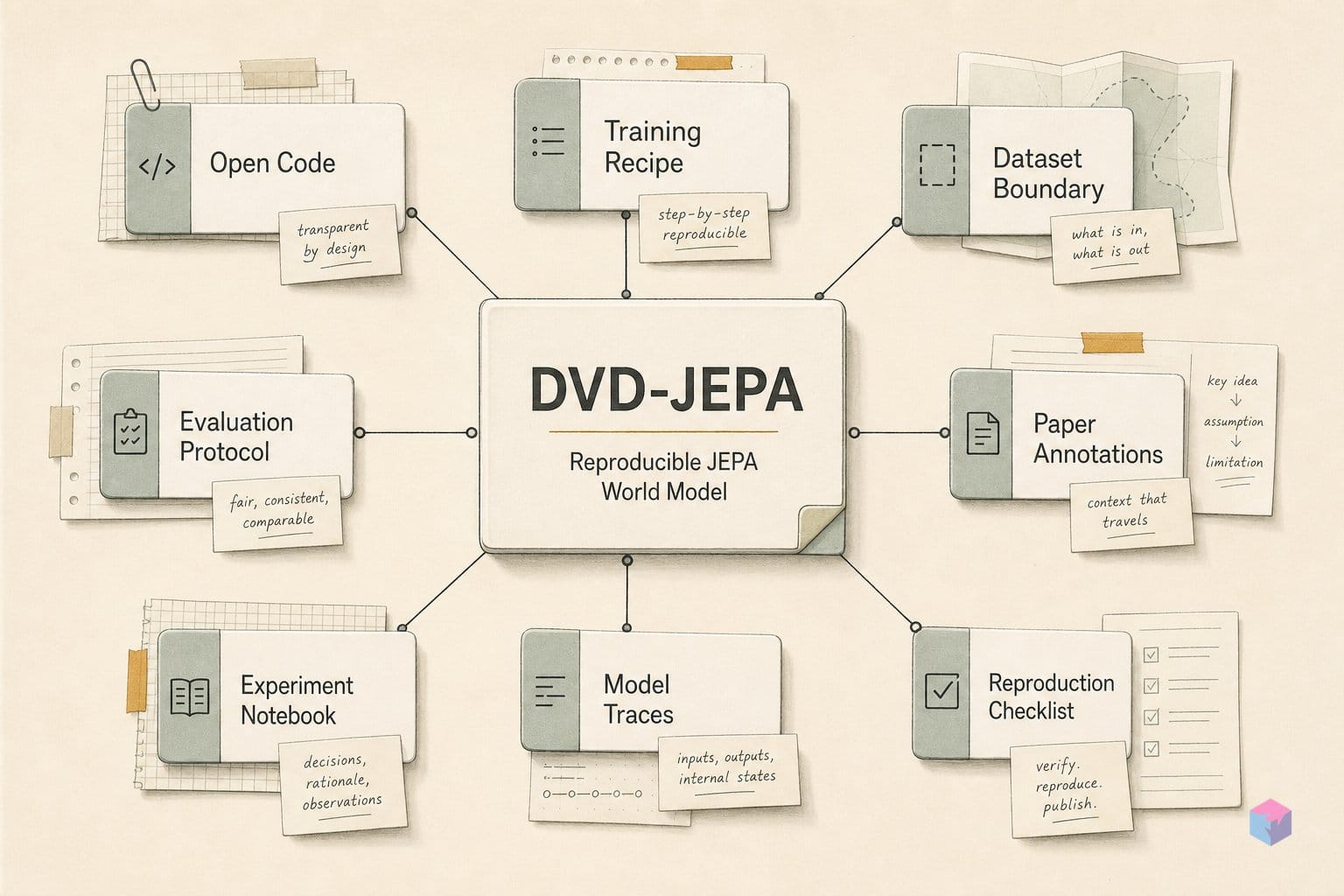
The minimal JEPA recipe is four parts: a context encoder, an EMA target encoder, a latent predictor, and an optional decoder. DVD-JEPA implements all four at miniature scale, learning the bouncing-logo dynamics in a 32-dimensional latent space with no explicit coordinates and no hand-coded physics . Each component has one job, and only three of the four ever touch the loss function.
- Context encoder. It maps the current frame — the current position of the logo — to a latent vector that becomes the predictor's input. This is the model's read of "what is happening now," expressed as embeddings rather than pixels .
- EMA target encoder. A momentum-updated copy of the context encoder, advanced by exponential moving average — the same mechanism used in BYOL and MoCo. It produces a stable but non-trivial prediction target and, critically, prevents representation collapse, the failure mode where the encoder maps everything to a constant vector .
- Latent predictor. It ingests the context embedding and predicts the next latent state entirely in embedding space. Pixel reconstruction never enters the loss; the predictor is scored on how close its imagined embedding is to the EMA target's embedding of the actual next frame .
- Optional decoder. Used only for visualization. With the decoder disabled, a pure JEPA loop still runs end to end, surfacing the 32 latent bars as its sole output — what the page calls a model that "only speaks in vectors" .
This is not a DVD-JEPA invention; it is the canonical stack Yann LeCun argued for. "The main idea is to learn to predict in representation space, not in input space," LeCun wrote in his 2022 position paper, the lineage DVD-JEPA cites alongside I-JEPA and V-JEPA . The contribution here is compression: the same context-encoder-plus-EMA-target-plus-predictor loop that drives Meta's open-sourced I-JEPA , shrunk until it trains in roughly 10 seconds on a CPU with zero infrastructure . The decoder-off mode is the pedagogical payoff: it forces you to read the model's understanding as raw embeddings, which is exactly what makes the next question — why predict in representation space at all — concrete.
Why JEPA Predicts in Representation Space, Not in Pixels
JEPA predicts in representation space because pixel-space prediction forces a model to reconstruct surface detail — exact texture, lighting variation, compression artifacts — that contributes nothing to understanding dynamics or planning. This is the core argument of Yann LeCun's 2022 JEPA position paper, which frames the choice as a budgeting problem: generative and diffusion-style models spend representational capacity reproducing per-pixel detail, while a Joint-Embedding Predictive Architecture predicts an abstract embedding of the next state and discards what does not matter for downstream reasoning .
DVD-JEPA makes that trade concrete at miniature scale. A pixel predictor for the bouncing-logo screensaver would have to hallucinate the logo's color and the exact RGB value of every background pixel each frame; the dynamics it actually needs to know are far simpler. In a 32-dimensional latent space, the model can encode "logo heading toward the top-right, about to hit an edge" without ever storing per-pixel color across frames . The same logic scales up: Meta's V-JEPA 2, pretrained on over one million hours of internet video, predicts in embedding space rather than reconstructing video frames .
Predicting embeddings introduces one failure mode the pixel objective does not have. If the predictor and target both collapse to a constant vector, prediction error drops to zero trivially — the model learns nothing while scoring perfectly. JEPA breaks this symmetry with an EMA (exponential moving average) target encoder, the same momentum-target trick used in BYOL: the target is a slowly-moving, stable, nonzero embedding the predictor must chase but can never freeze onto . That moving target is what keeps the latent space informative — and it is the component DVD-JEPA exposes directly when you watch its 32 latent bars move during training .
Prediction Error as an Anomaly Detector: No Labels Required
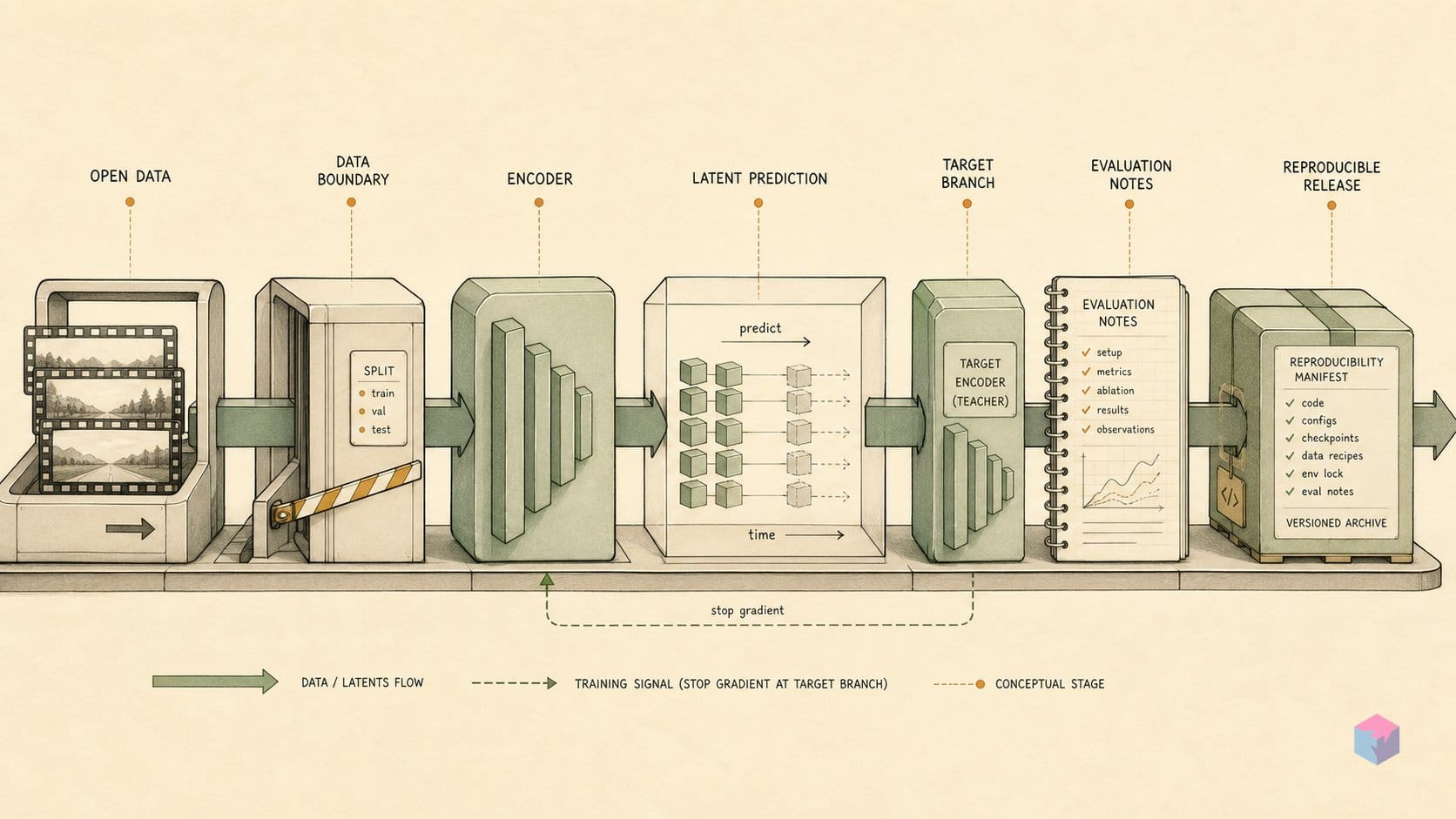
That same chase dynamic gives DVD-JEPA an anomaly detector for free. At inference, the predictor outputs an expected next latent state, and the distance between that prediction and the actual target-encoder embedding becomes a surprise score — high distance means reality diverged from what the model expected . No anomaly labels are involved; the only supervision is the stream of normal bouncing trajectories the model sees during its roughly 10-second CPU pass .
Once training converges, normal physics is cheap to predict, so the latent prediction error settles low. The interesting signal is in the spikes:
- Teleport — the logo jumps to a new position the predicted trajectory never reached, so the error climbs sharply .
- Color swap — an abrupt appearance change the encoder embeds far from the predicted latent.
- Direction reversal — a velocity flip the learned dynamics did not anticipate.
This is the same prediction-error principle that underpins self-supervised anomaly detection in larger world models, reduced to a form you can watch in one browser tab. The honest limitation: the threshold is calibrated to this deterministic toy environment. The mechanism — train on normal dynamics, flag high prediction error — generalizes to any deterministic domain, but the model carries no transferable physics. Point it at a different environment and you retrain from scratch, the same constraint that applies to DINO-WM and V-JEPA-2-AC style latent world models . The payoff is that the recipe for label-free anomaly detection is fully exposed, not hidden behind a benchmark number.
Prior Art: JEPA-WMs, I-JEPA, and EB-JEPA Predate the Superlative
DVD-JEPA's "first fully reproducible, open-source JEPA world model" framing does not survive contact with the public record. Open-source JEPA implementations with code and weights existed years before it, and the most direct counterexamples come from the same lab that originated the paradigm. Meta/FAIR's I-JEPA — the image-domain Joint-Embedding Predictive Architecture presented at CVPR 2023 — shipped public code and pretrained weights , predating DVD-JEPA by at least two years. Read literally, the superlative is unsupported as stated.
The most complete recent counterexample is JEPA-WMs, released alongside the paper "What Drives Success in Physical Planning with Joint-Embedding Predictive World Models?" (arXiv:2512.24497, dated December 2025) . It is an unusually complete reproducibility package: PyTorch code, reproduced baselines, evaluation code, and datasets in one repository , plus five pretrained checkpoints hosted under facebook/jepa-wms on Hugging Face . The paper reports the model outperforming DINO-WM and V-JEPA-2-AC on navigation and manipulation . DINO-WM itself (arXiv:2411.04983, November 2024) had already open-sourced a DINOv2-based visual world model with zero-shot planning across six environments .
For the specific niche of an educational, fork-and-learn JEPA library, EB-JEPA (arXiv:2602.03604, February 2026) is the closest peer — and it ships under a permissive Apache-2.0 license, reporting 91% CIFAR-10 probing accuracy and 97% planning success on the Two Rooms task , with code at facebookresearch/eb_jepa .
| Project | First public release | Code + weights | License |
|---|---|---|---|
| I-JEPA | CVPR 2023 | Yes (image JEPA) | Open-source |
| DINO-WM | Nov 2024 | Yes (DINOv2 world model) | Open-source |
| JEPA-WMs | Dec 2025 | Yes (5 checkpoints + datasets) | CC-BY-NC 4.0 (non-commercial) |
| EB-JEPA | Feb 2026 | Yes (educational library) | Apache-2.0 (permissive) |
| DVD-JEPA | 2026 (no exposed date) | Referenced, not retrievable | Not stated |
The charitable reading is that "first" means "first minimal, fully client-side, train-in-the-browser JEPA" — a real and defensible distinction, since none of the artifacts above run an end-to-end world model in a single browser tab with ~10-second CPU training . But the project page never spells that out, so the claim reads broader than the evidence supports. Treat the qualified version as the accurate one.
JEPA-WMs: The Most Complete JEPA Artifact — Non-Commercial Licensed
JEPA-WMs is the most complete public JEPA world-model release to date — a single repository bundling PyTorch code, pretrained weights, reproduced baselines, evaluation code, and datasets, tied to the paper "What Drives Success in Physical Planning with Joint-Embedding Predictive World Models?" (arXiv:2512.24497, 2025-12-30, by Basile Terver, Tsung-Yen Yang, Jean Ponce, Adrien Bardes, and Yann LeCun) . That completeness is exactly what DVD-JEPA's "first fully reproducible" framing has to contend with — but JEPA-WMs is not a drop-in for shipping products, and the reason is the license.
Hugging Face hosts five checkpoints under facebook/jepa-wms . They split cleanly by encoder and resolution: the DROID/RoboCasa checkpoint runs at 256×256 with a DINOv3 ViT-L/16 encoder and predictor depth 12, while Metaworld, Push-T, PointMaze, and Wall run at 224×224 with a DINOv2 ViT-S/14 encoder and predictor depth 6 .
| Checkpoint | Encoder | Resolution | Predictor depth |
|---|---|---|---|
| jepa_wm_droid (DROID/RoboCasa) | DINOv3 ViT-L/16 | 256×256 | 12 |
| jepa_wm_metaworld | DINOv2 ViT-S/14 | 224×224 | 6 |
| jepa_wm_pusht | DINOv2 ViT-S/14 | 224×224 | 6 |
| jepa_wm_pointmaze | DINOv2 ViT-S/14 | 224×224 | 6 |
| jepa_wm_wall | DINOv2 ViT-S/14 | 224×224 | 6 |
The dataset card totals 11.1 GB of included data — Metaworld's 42 tabletop tasks plus Franka Custom real-robot recordings from three camera views — with DROID offered as an optional separate download of 8.7 TB (stereo HD) or 5.6 TB (non-stereo HD) . For direct comparison against the paper's reported numbers, the repo also ships DINO-WM baselines and a V-JEPA-2-AC baseline (V-JEPA-2 ViT-G/16, predictor depth 24), and the paper reports its model outperforming both DINO-WM and V-JEPA-2-AC on navigation and manipulation .
The catch for builders is licensing. JEPA-WMs is released under CC-BY-NC 4.0 — explicitly non-commercial — and dataset access is gated behind agreeing to share contact information . That makes it an excellent reference and research baseline, but not something you can fold into a commercial pipeline without separate licensing. So the comparison with DVD-JEPA is two-sided: JEPA-WMs is far more complete and benchmarked, yet its terms restrict reuse in ways a minimal, permissively forkable teaching tool would not.
DVD-JEPA for What It Is: A Learner-Friendly Prototype
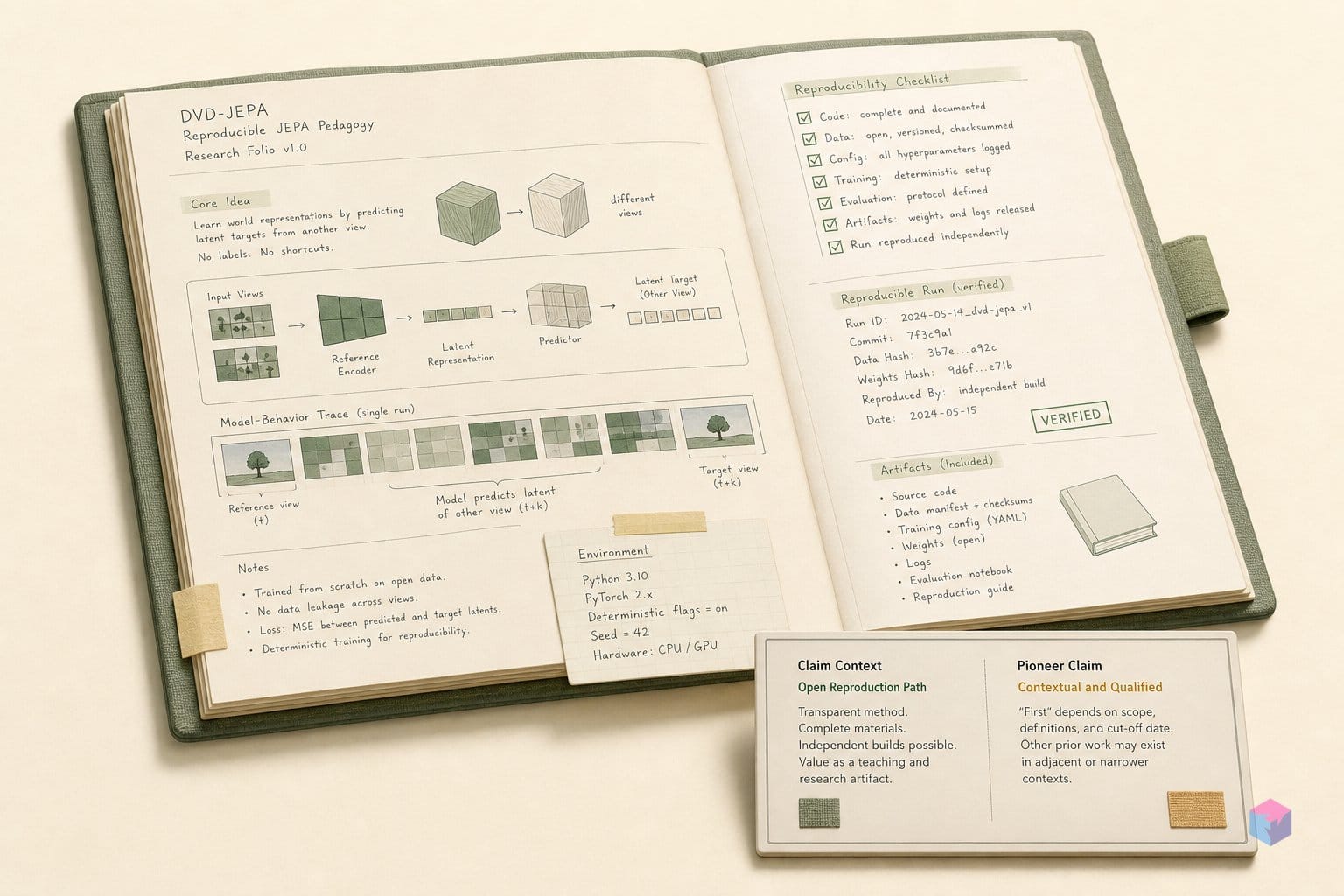
DVD-JEPA earns its keep as a teaching tool, not a benchmark contender. It is genuinely useful for three things: building intuition for why JEPA predicts in latent space rather than pixels, watching an EMA target encoder prevent representation collapse in a reproducible toy setting, and getting a full JEPA loop — context encoder, momentum target, latent predictor, anomaly detection — running in one browser tab with zero environment setup, training in roughly 10 seconds on CPU against a 32-dimensional latent . The project itself frames the lesson plainly:
"A pure JEPA only speaks in vectors." — DVD-JEPA project page (source: dvd-jepa.vercel.app)
What it is not: a substitute for benchmark-ready robot planning, a production anomaly detector, or a citation-ready "first" in the reproducibility literature. For planning workloads, JEPA-WMs is the documented baseline; for an audit-grade superlative, the page does not support one.
There is also a due-diligence gap. No author, version, license string, or release date is exposed on the project page , so inspect the GitHub repository before citing the work or forking it into anything. If you want comparable educational value with cleaner provenance, evaluate EB-JEPA (Apache-2.0, February 2026) in parallel — it reports 91% CIFAR-10 probing accuracy and a permissive license you can build on commercially . Treat DVD-JEPA as the fastest way to feel the JEPA recipe, and EB-JEPA as the version you can safely carry into a real project.
DVD-JEPA, EB-JEPA, JEPA-WMs: Comparison by Purpose and Scope
The right JEPA artifact depends entirely on what you are trying to do, and the four leading options sort cleanly by intent, license, and scale. None of them is a drop-in replacement for the others: DVD-JEPA is a browser demo, EB-JEPA is a Python library, JEPA-WMs is a research package, and V-JEPA 2 is a pre-trained foundation model. Match the tool to the job rather than to the loudest claim.
- Feel the JEPA recipe with zero setup, no Python environment, in one browser tab → DVD-JEPA. It trains in roughly 10 seconds on CPU with a 32-dimensional latent and runs entirely client-side . Inspect the GitHub repo for author, version, and license before you cite, fork, or derive anything from it.
- Integrate JEPA into a Python ML pipeline under a permissive license with quantified results → EB-JEPA. It is Apache-2.0, reports 91% CIFAR-10 probing accuracy, and ships as an educational library you can carry into commercial work .
- Reproduce or extend state-of-the-art robot-planning baselines in a research context → JEPA-WMs. It bundles PyTorch code, pretrained weights, baselines, and datasets, but is licensed CC-BY-NC 4.0 — non-commercial only .
- Pre-train at scale on video for downstream zero-shot planning → V-JEPA 2. It was pre-trained on over 1 million hours of internet video, and its action-conditioned variant reaches zero-shot Franka planning with fewer than 62 hours of unlabeled DROID data .
The concrete takeaway: use DVD-JEPA to build intuition this afternoon, but reach for EB-JEPA when the prototype needs a permissive license and reproducible numbers, JEPA-WMs when you are extending published baselines under non-commercial terms, and V-JEPA 2 when you need a real pre-trained world model. The "first fully reproducible" tag is the one part of DVD-JEPA's story to set aside until its repository, author, and license are independently verified.
Frequently asked questions
What is JEPA, and how does DVD-JEPA relate to Meta's I-JEPA and V-JEPA 2?
JEPA (Joint-Embedding Predictive Architecture) is a self-supervised design that predicts the next state in latent embedding space rather than reconstructing pixels. Meta/FAIR ships the large-scale implementations: I-JEPA shipped open source for images , and V-JEPA 2 is a billion-parameter video world model pretrained on over 1 million hours of internet video . DVD-JEPA uses the same four-component recipe — a context encoder, an EMA target encoder, a latent predictor, and an optional decoder — at a miniature 32-dimensional scale that trains in roughly 10 seconds on CPU inside a browser . It is an educational toy, not a competitor to Meta's research models.
Is DVD-JEPA actually the first open-source reproducible JEPA world model?
Not in any broad sense. I-JEPA published open code and weights back in 2023 . JEPA-WMs (arXiv:2512.24497, dated 2025-12-30) ships complete PyTorch code, five pretrained checkpoints, and reproduced baselines , and EB-JEPA (arXiv:2602.03604, 2026-02-03) is an Apache-2.0 educational library reporting 91% CIFAR-10 probing accuracy . The defensible reading is narrower: DVD-JEPA is plausibly the first fully client-side, train-in-the-browser JEPA — a genuinely meaningful distinction the project page does not state explicitly .
What does the EMA target encoder do, and why does JEPA need it?
The EMA (exponential moving average) target encoder is a momentum-updated copy of the context encoder — the same mechanism used in BYOL and MoCo . Without it, the predictor can collapse to a constant embedding, trivially achieving near-zero prediction error while learning nothing useful. The EMA target supplies a stable but slowly moving objective, so the predictor must track real structure in the data instead of converging on a degenerate shortcut. In DVD-JEPA this collapse-avoidance step is exposed directly, which is part of why it works as a reference implementation.
Can I use DVD-JEPA or JEPA-WMs in a commercial project?
Check the license before you ship. DVD-JEPA exposes no license string on its project page at the time of writing, so inspect its GitHub repository before any commercial use . JEPA-WMs is licensed CC-BY-NC 4.0 — explicitly non-commercial — and its dataset access is gated behind sharing contact information . EB-JEPA is Apache-2.0, which permits commercial use . For V-JEPA 2, verify the license in the facebookresearch/vjepa2 repository before integrating it .
How does DVD-JEPA detect anomalies without any labeled anomaly data?
It uses prediction error as the signal. After training only on normal bouncing dynamics, the predictor outputs an expected next latent state; at inference, the distance between that predicted embedding and the actual EMA target output measures surprise . Normal frames produce low error, while anomalous events — a teleport, an abrupt reversal, a color change — make the error spike. Because the method needs only normal training data and no labeled negative examples, it demonstrates unsupervised, prediction-error anomaly detection on commodity hardware in a single browser tab.