

You don't need a paid API key to run a coding agent anymore — a small category of GitHub directories now catalogs every inference provider with a genuinely free tier, complete with rate limits and drop-in configs. The seed for this piece is a walkthrough video, but the real substance lives in the repos themselves.
What cheahjs/free-llm-api-resources and the newer directories cover
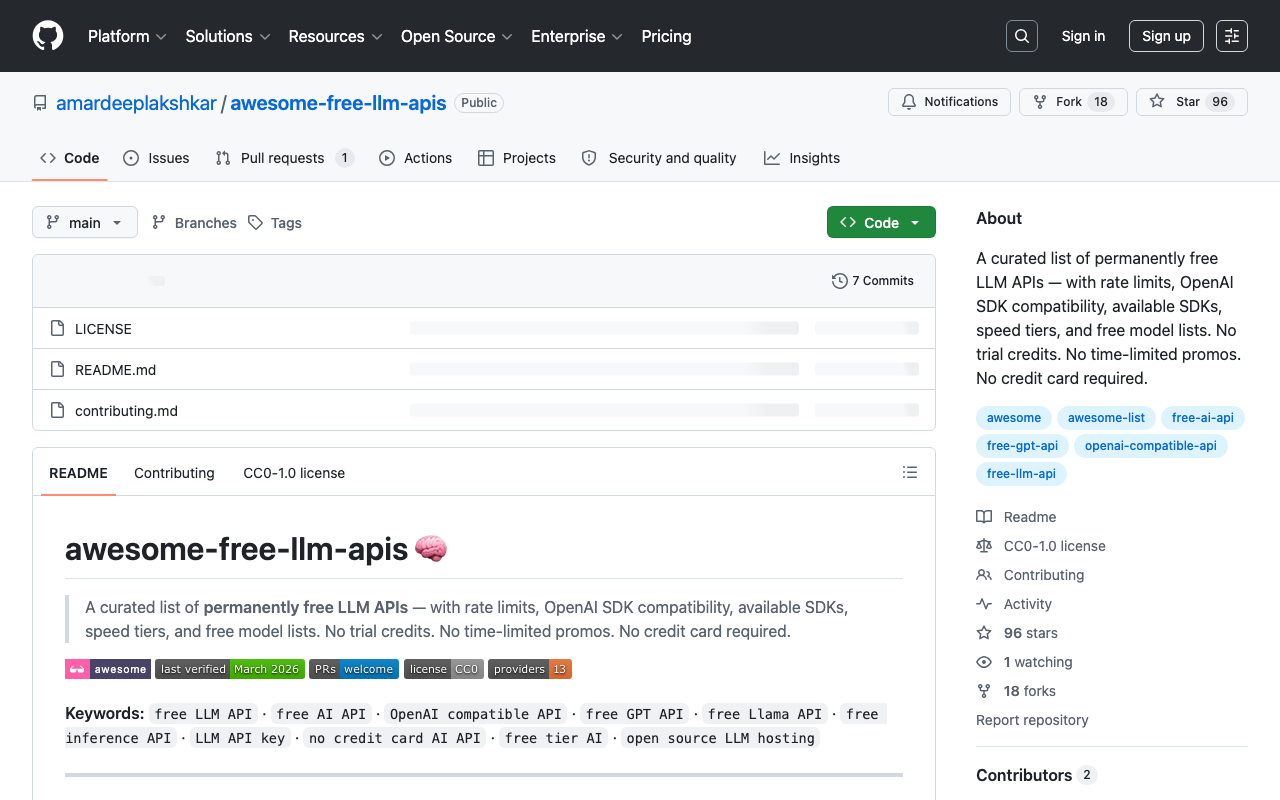
The anchor repo is cheahjs/free-llm-api-resources, an actively maintained, Python-based list carrying roughly 27.7k stars, 2.9k forks, and 423 commits. It is the practical index of where free LLM inference actually exists in 2026 — but its real taxonomy is smaller than the marketing suggests: about 13 permanent free-provider entries plus 13 trial-credit entries, not the headline "100+."
That "100+" figure is defensible only as a count of individual model endpoints. Multi-model aggregators — OpenRouter, Groq, GitHub Models, Cloudflare Workers AI — each expose dozens of model slugs, which inflates the total well past the number of distinct providers.
A newer companion sits alongside it: open-free-llm-api/awesome-freellm-apis claims 453 models across 30 providers, refreshed daily from freellm.net (806 stars, last updated 2026-07-22). The most useful forks filter specifically for permanent, no-card-required tiers. One caveat carries across all of them — cheahjs prepends the warning: "Please don't abuse these services, else we might lose them," and excludes reverse-engineered endpoints.
No-card permanent plans: exact rate limits by provider, July 2026 snapshot
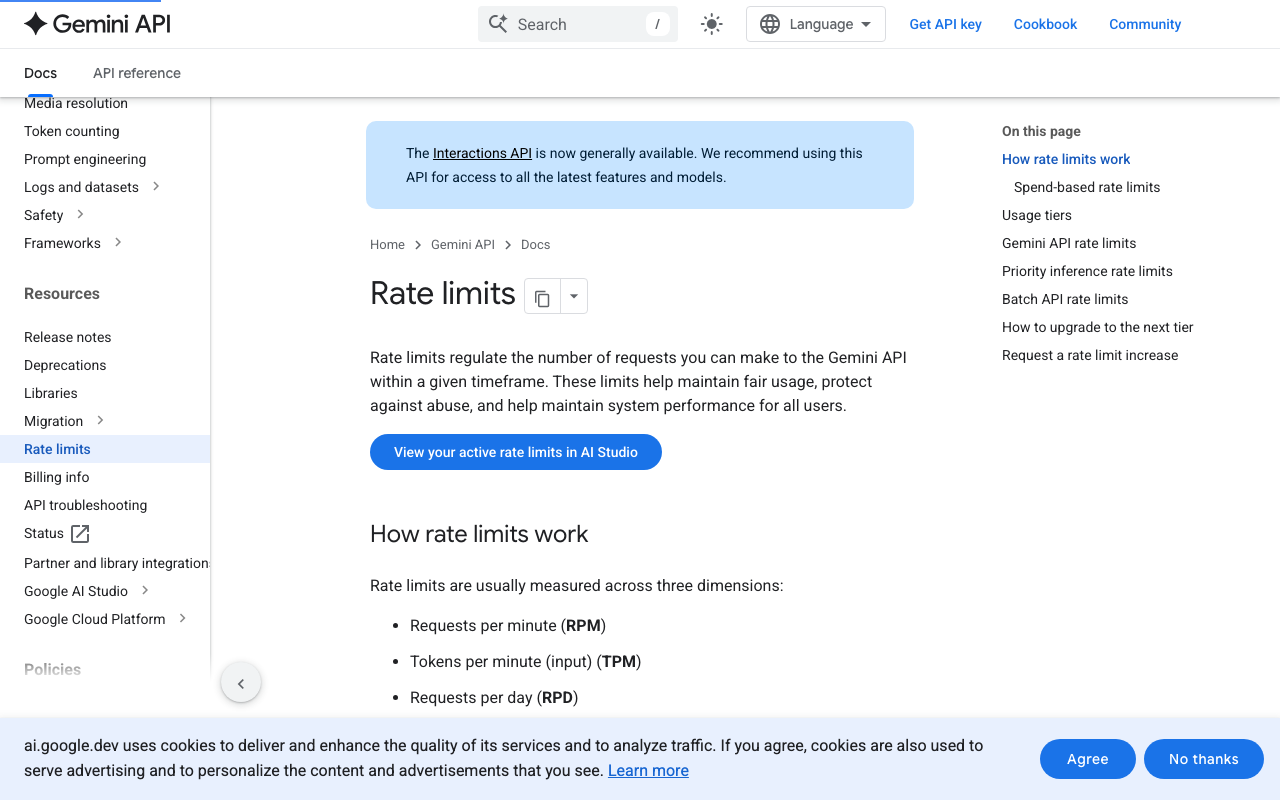
The durable no-card free tiers cluster around five gateways, each with a different bottleneck: Groq leads on throughput, Google AI Studio on token budget, Cloudflare Workers AI on edge model hosting, GitHub Models on frontier access, and Cohere on RAG primitives. The exact figures below are time-stamped snapshots — free tiers shrink without notice — but they map the real ceilings you hit when you plug a key into a coding agent or side project as of July 2026.
Groq publishes the most transparent official quota table of the group, quoted per model. Google's limits are per-project, reset daily at midnight Pacific for requests-per-day, and vary by model — viewable directly in AI Studio, with the rate-limit docs last updated 2026-07-21 [G]. Its draw is the 1M-token context window on Gemini Flash, the most generous long-context on-ramp on the free list.
| Provider | Model (example) | Free limits | Notable |
|---|---|---|---|
| Groq | llama-3.3-70b-versatile | 30 RPM / 1,000 RPD / 12k TPM / 100k TPD [Gr] | Throughput leader |
| Groq | llama-3.1-8b-instant | 30 RPM / 14,400 RPD / 6k TPM / 500k TPD [Gr] | Highest RPD/TPD |
| Google AI Studio | Gemini Flash | Per-project, resets midnight Pacific; 1M-token context [G] | Largest token budget |
| Cloudflare Workers AI | DeepSeek R1, Kimi | 10,000 Neurons/day (reset 00:00 UTC), then $0.011/1k Neurons [C] | Edge-hosted models |
| GitHub Models | Low-tier / DeepSeek-R1 | 15 RPM / 150 RPD low-tier; 10 RPM / 50 RPD high-tier; DeepSeek-R1 1 RPM / 8 RPD [GH] | Copilot-tier gated |
| Cohere | Chat / Rerank | 1,000 calls/month; 20 req/min chat, 10 req/min Rerank [Co] | Hardest cap; RAG primitives |
Cloudflare Workers AI gives 10,000 Neurons/day resetting at 00:00 UTC before billing $0.011 per 1,000 Neurons, and is one of the few hosts running DeepSeek R1 and Kimi at the edge [C]. GitHub Models exposes frontier models (GPT-4o, Claude, DeepSeek-R1, Llama 4) but gates them by Copilot tier, with DeepSeek-R1 hard-capped at 1 RPM / 8 RPD [GH]. Cohere holds the tightest ceiling — 1,000 API calls per month — which is thin for a daily driver but workable for building RAG primitives [Co]. The practical read: no single tier covers everything, which is why the repos push stacking.
Claude Code and Cursor with free provider keys: the env-var approach
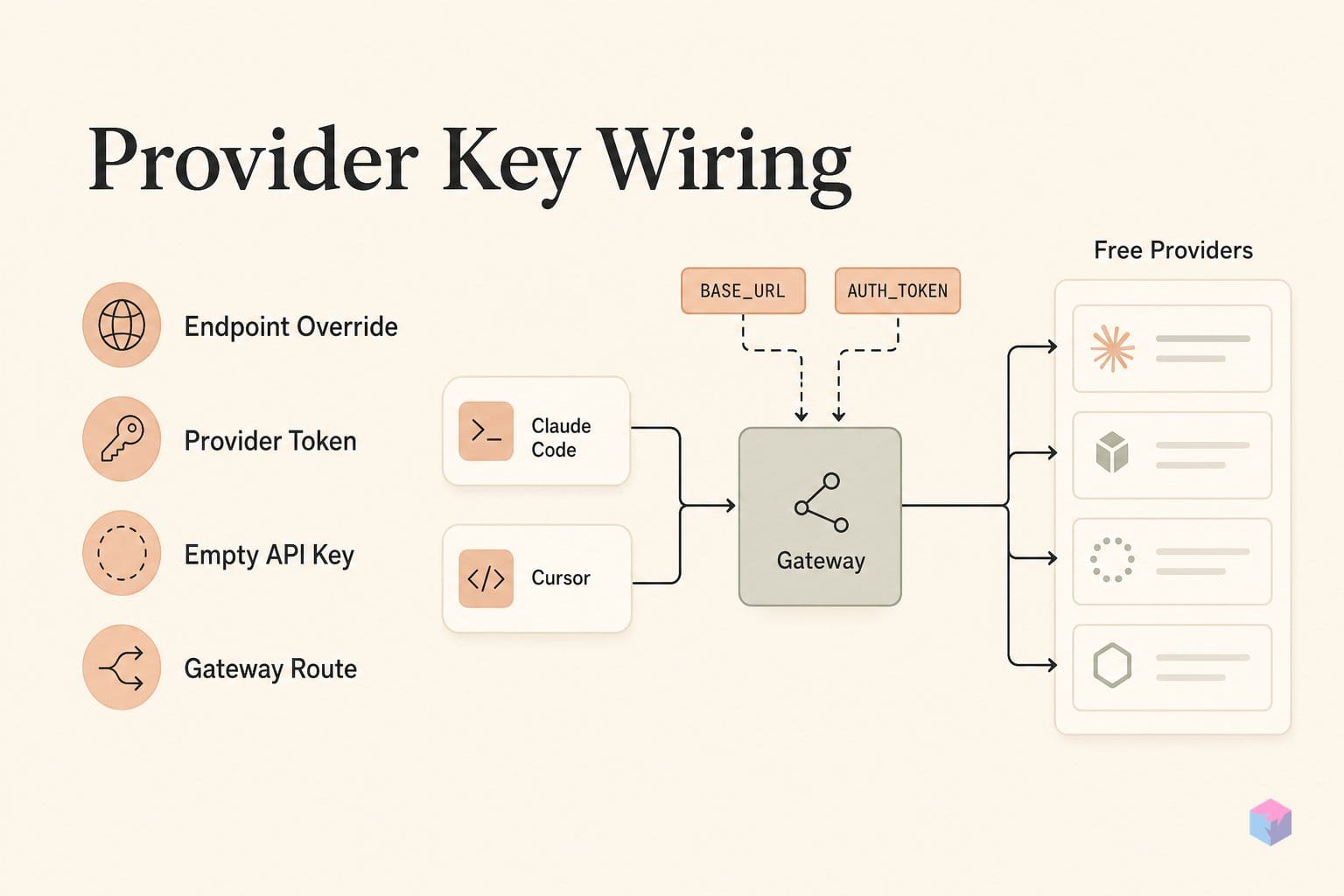
Pointing a coding agent at a free provider key takes two environment variables, but the exact wiring depends on which wire protocol the agent speaks. Claude Code talks to the Anthropic API format, not OpenAI's, so the documented method routes it through an OpenAI-compatible gateway using ANTHROPIC_BASE_URL to override the endpoint and ANTHROPIC_AUTH_TOKEN to carry your provider key — with ANTHROPIC_API_KEY left empty so the built-in Anthropic credential path stays out of the way. Both cheahjs/free-llm-api-resources and awesome-freellm-apis ship the same OpenRouter snippet, and Claude Code's own environment-variable docs confirm both overrides are supported:
export ANTHROPIC_BASE_URL="https://openrouter.ai/api"
export ANTHROPIC_AUTH_TOKEN="$OPENROUTER_API_KEY"
# leave ANTHROPIC_API_KEY unset
One caveat the repos flag: OpenRouter's Anthropic-format route requires a one-time $10 top-up, so "free Claude Code" via this path is not strictly zero-cost.
Cursor's bring-your-own-key support is narrower. Its docs list native direct support for OpenAI, Anthropic, Google, Azure OpenAI, and AWS Bedrock, and custom keys don't affect specialized features like tab completion, which still uses Cursor's built-ins. To reach OpenRouter you need a dedicated base URL — https://openrouter.ai/api/v1/cursor, not the generic /api/v1 — per OpenRouter's Cursor integration guide.
For Groq and other OpenAI-compatible providers, the friction largely disappears: agents like Aider and Cline accept a custom baseURL plus a model slug with no Anthropic-format adaptation needed. To avoid babysitting daily quotas, Claude Code Router (ccr) by @musistudio — MIT-licensed — automates fallback across configured providers, draining free tiers before touching paid credits, with claimed cost reductions of 70–85%.
"Please don't abuse these services, else we might lose them." — maintainer note, cheahjs/free-llm-api-resources
Three things the repos omit — and where to go from here
The catalogs are accurate snapshots, but three caveats rarely survive the copy-paste. First, "free Claude Code via OpenRouter" is not zero-cost. The Anthropic-format route requires a one-time top-up of at least $10 in credits; without it, free model variants are capped at 50 requests per day rather than the 1,000/day that spend unlocks . Budget for that floor before you wire an agent around it.
Second, Cerebras quietly changed. What several lists still describe as a permanent no-card tier now, in mid-2026, grants $5 in credits only after you add a verified payment method, and those credits expire 30 days after the grant . Treat any "no card required" label as a claim to re-verify against the provider's own console, not the directory.
Third, free tiers can carry a non-monetary cost. Unpaid Gemini API and AI Studio calls may be used to improve Google products and may be human-reviewed, while paid Vertex AI is handled differently . Check that clause before sending proprietary code through a free key.
Where to go from here: the mid-2026 consensus is to stack, not commit. Use Google AI Studio as the daily driver for its generous daily ceiling, Groq for latency-critical calls, and GitHub Models when you need frontier access . Then let a router enforce the order — Claude Code Router (ccr) by @musistudio or decolua's 9Router, both MIT-licensed — so free quotas drain before any paid request fires, with claimed savings of 70–85% . The takeaway: the directories are a starting map, not a contract — verify each tier at the source, keep proprietary code off free keys, and let a router do the quota bookkeeping.
Frequently asked questions
Is Claude Code actually free when routed through OpenRouter?
Not strictly. OpenRouter's free model variants are capped at 50 requests/day, but the Anthropic-format route that Claude Code needs requires a one-time top-up of at least $10 in credits, which raises the ceiling to 1,000 requests/day. So it is effectively pay-once, then draw down free-variant calls. The caveat matters for daily coding: 50 requests/day disappears in one debugging session, so real use assumes the $10 has been spent. Purists chasing zero cost should route Claude Code through a no-card gateway instead and accept the wire-protocol setup overhead.
Which no-card LLM plan has the highest throughput for solo development in 2026?
Groq's llama-3.1-8b-instant leads on raw request volume, with a documented free-plan ceiling of 14,400 requests/day — the highest RPD among permanent no-card tiers. But throughput is only one axis. Google AI Studio wins on token budget and context, offering 1M-token context on Gemini Flash, which matters more for large-codebase reasoning than request count. The tradeoff: Groq for latency- and volume-critical loops, Google AI Studio for long-context tasks, and GitHub Models when you need frontier capability. Most developers stack all three rather than pick one.
How often do the GitHub repo listings go stale?
It varies by repo, and none keeps pace with provider terms. awesome-freellm-apis refreshes daily from its upstream source (last updated 2026-07-22), while cheahjs/free-llm-api-resources is manually maintained. Even daily updates lag silent policy changes — Cerebras is the clearest 2026 example, having quietly moved to $5 in credits only after a payment method is added, rather than a permanent no-card tier. Treat every rate-limit figure in any repo as a dated snapshot and confirm it at the provider's own console before you build against it.
Does using a custom API key in Cursor affect tab completion?
No — and that surprises people. Cursor's docs confirm that bring-your-own-key credentials apply only to chat and agent model calls, not to specialized editor features. Tab completion and similar in-editor predictions keep using Cursor's built-in models regardless of which key you configure (BYOK does not cover tab completion). So plugging in a free OpenRouter or Groq key routes your explicit requests through that provider, but it does not make Cursor's autocomplete free or swappable. Budget for the Cursor subscription if tab completion is central to your workflow.
Are these free plans suitable for production services?
Not reliably. Free tiers are volatile and have been shrinking — Cerebras dropping its simple no-card plan in 2026 is the most recent illustration, and cheahjs flags the fragility directly with the README warning "Please don't abuse these services, else we might lose them" [README]. Rate caps, model inventories, and even the existence of a tier can change without notice, and unpaid Gemini traffic may be human-reviewed to improve Google products. Use these plans for development, prototyping, and personal projects; move to a paid, contracted tier before anything user-facing depends on it.
Enjoyed this article? Subscribe to get new stories by email whenever they're published.