
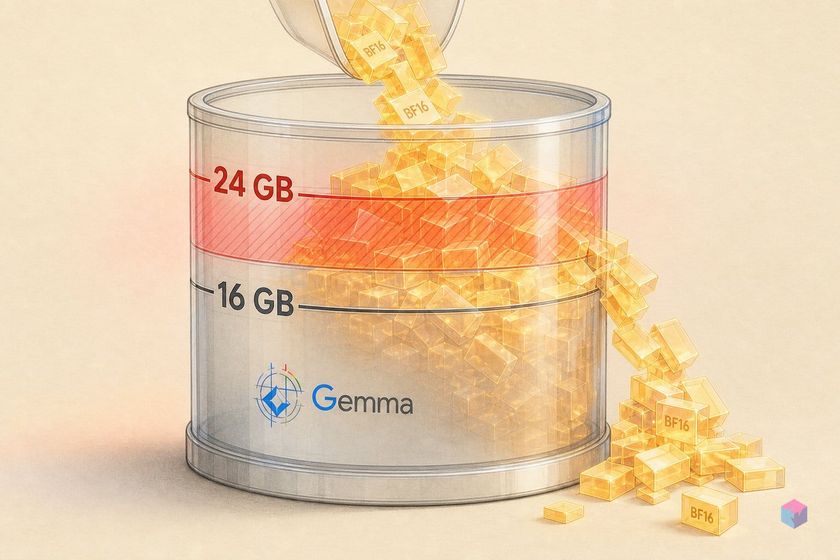
Google DeepMind's mid-sized open model now fits the machine on your desk — not a datacenter rack. Gemma 4 12B Unified is the family's answer to "state-of-the-art-class multimodal AI, but local."
What Is Gemma 4 12B Unified?
Gemma 4 12B Unified is a dense, multimodal open model from Google DeepMind that takes text, image, and audio as input and emits text only. It shipped on June 3, 2026 under the permissive Apache 2.0 license, with both pre-trained and instruction-tuned checkpoints available at launch. The official model card lists it at 11.95B parameters, 48 layers, and a 256K-token context window — built, Google says, on the same research base as Gemini 3.
Quick Answer: Gemma 4 12B Unified is Google DeepMind's 11.95B-parameter dense multimodal model, released June 3, 2026 under Apache 2.0. It accepts text, image, and audio (text-only output), runs a 256K context, and topped 1,005,883 Hugging Face downloads in its first month.
It sits in the middle of the Gemma 4 lineup: above the edge-class E4B variant — capped at a 128K context — and below the 26B mixture-of-experts model. The 256K window matches the larger family members, not the edge tier.
Feature-wise, the model carries the full Gemma 4 toolkit: native function calling, structured JSON output, variable-resolution image and video processing, and support for over 140 languages. Early adoption is a signal worth watching — beyond the million-plus downloads in the prior month, Google reports the broader Gemma family surpassed 400 million total downloads and 100,000 community variants by the Gemma 4 announcement. The rest of this piece unpacks what makes the 12B build technically distinct, starting with its encoder-free architecture.
The 35M Embedder That Replaced a 550M Encoder
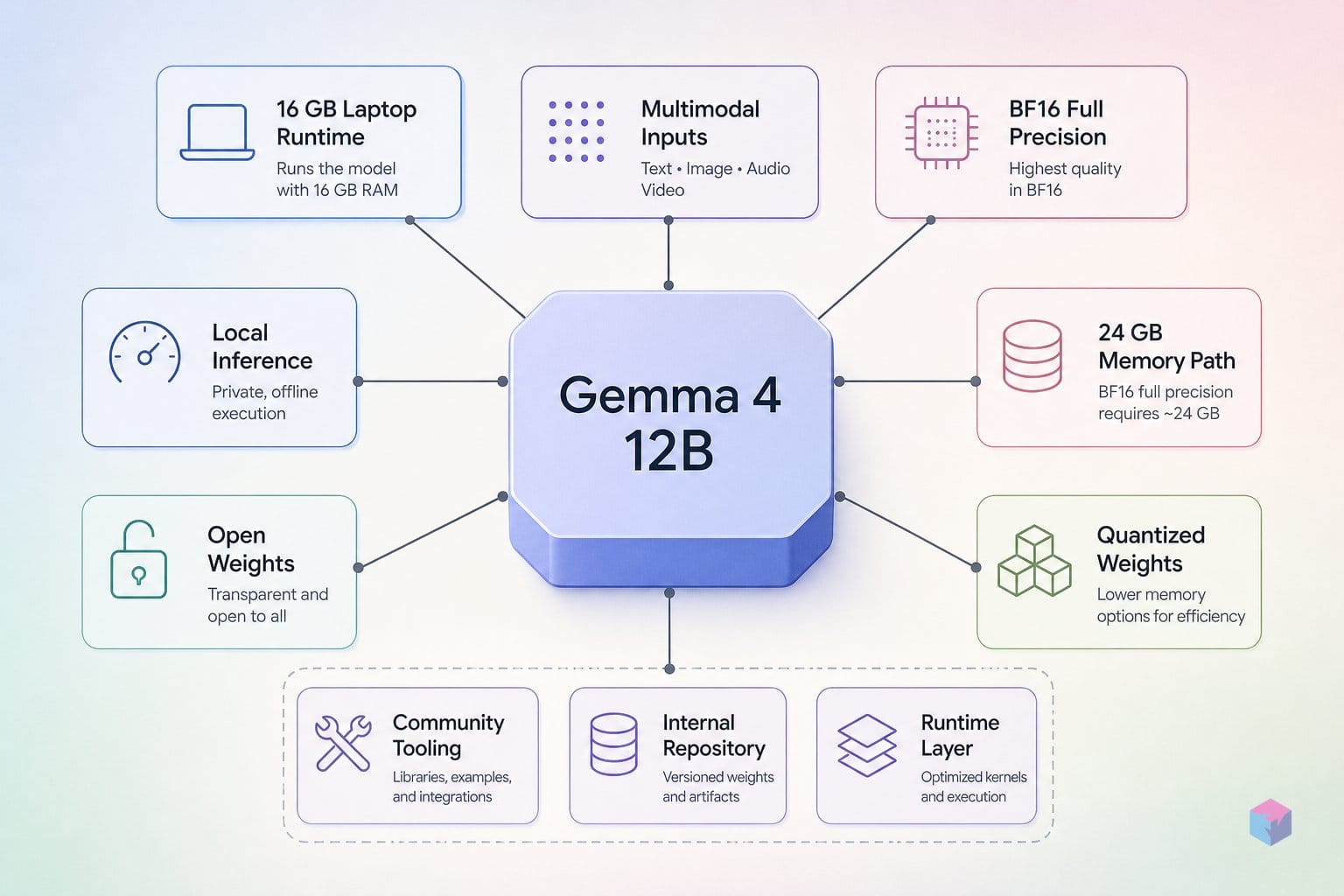
The encoder-free design is the defining technical change in Gemma 4 12B Unified. Standard Gemma 4 variants attach separate multimodal encoders — roughly 150M-parameter vision encoders at edge sizes, about 550M for medium models, and 300M audio encoders for the E2B/E4B edge tier . The 12B build removes those modules entirely, folding every modality directly into the language model rather than bolting perception on as a pre-processing stage.
On the vision pathway, there is no convolutional or transformer vision tower. Raw 48×48 pixel patches are projected into the LLM hidden dimension through a roughly 35M-parameter embedder, with spatial position encoded via factorized coordinate lookups rather than a learned 2D positional grid . That is more than a 15× reduction in dedicated parameters versus the 550M encoder it replaces, and the patches reach the decoder as plain embeddings.
Audio follows the same logic. The raw 16 kHz signal is sliced into 40 ms frames of 640 floats and linearly projected straight into the transformer input space — no dedicated audio encoder module sits in front of the model . Google describes this as its first mid-sized model with native audio input .
Vision, audio, and text then flow into a single decoder-only transformer, with the embedders trained jointly rather than frozen on top of a separate perception stack.
"Collapsing the encoders into lightweight embedders cuts multimodal latency and means a single fine-tuning pass updates the entire vision-audio-text loop — there is no frozen encoder to work around," — Google for Developers, What's new in Gemma 4 (video: Google for Developers).
For developers, the practical payoff is downstream tuning. With no frozen encoder gating the gradients, a LoRA adapter or a full fine-tune propagates through the whole multimodal path in one pass . The trade-off — how a 35M embedder compares with a purpose-built 550M encoder on hard vision tasks — surfaces in the benchmark numbers covered later, but the architectural bet is clear: fewer moving parts, one loss, one model to train.
24 GB at BF16, ~6–8 GB at Q4: The Memory Breakdown
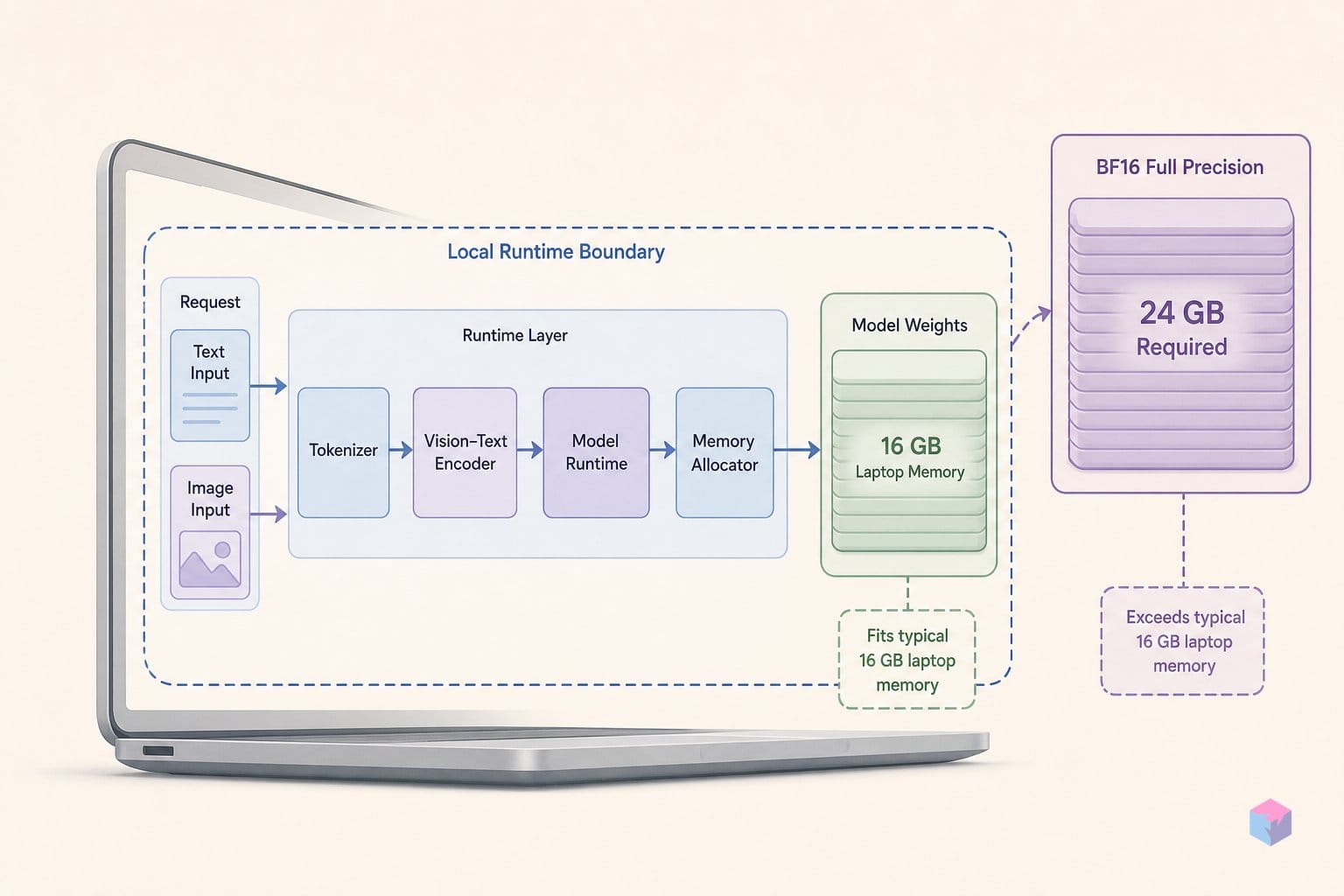
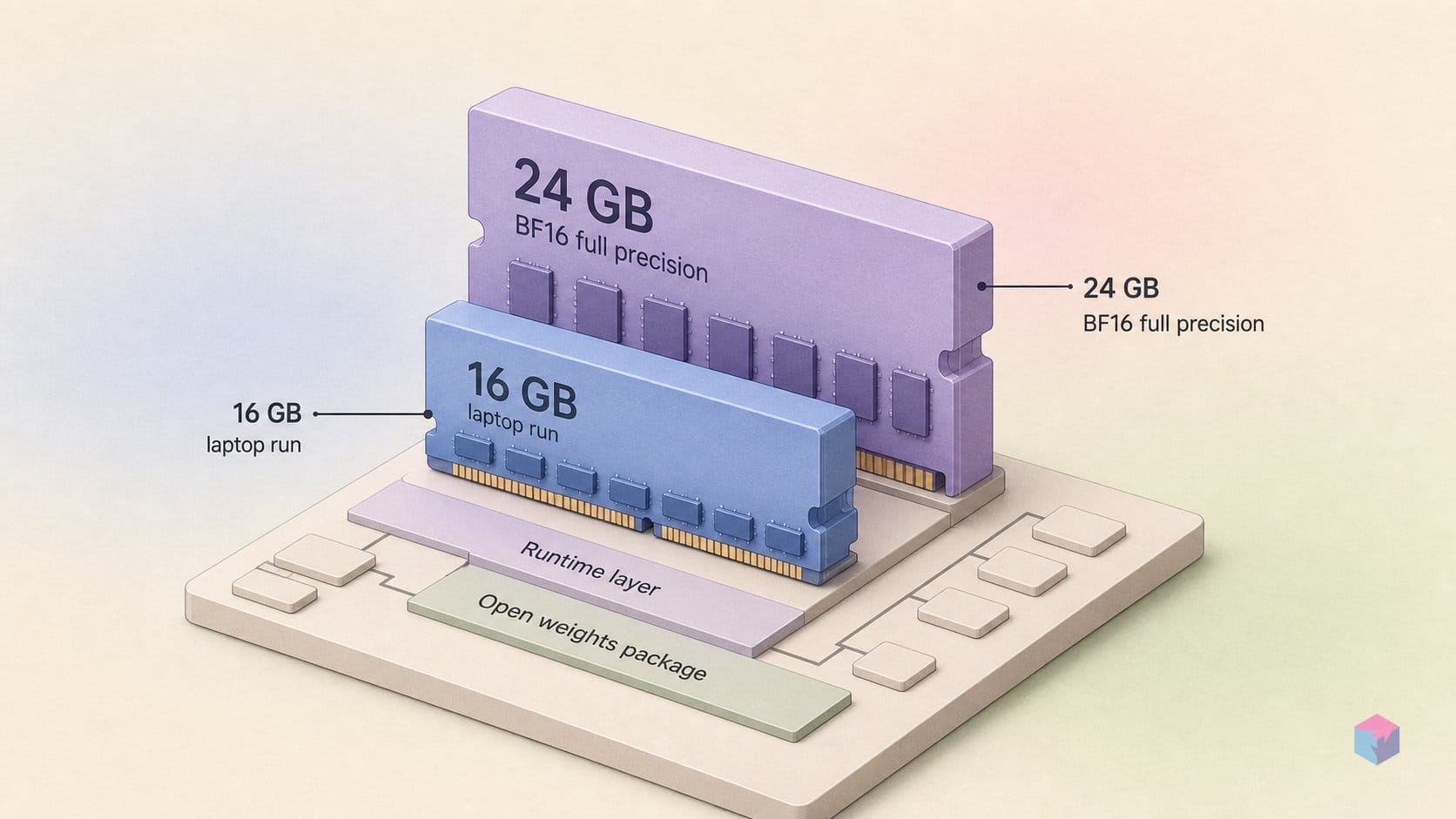
That "one model to train" simplicity does not translate into a small disk or memory footprint at full precision. The shipped Hugging Face checkpoint is BF16 at 11.95B parameters, which works out to roughly 24 GB for the weights alone — two bytes per parameter — before you account for the KV cache or any runtime overhead . So Google's "runs on a 16 GB laptop" framing is not a claim about raw BF16 inference; the developer guide narrows it to dedicated-GPU laptops with 16 GB of VRAM or unified memory, and getting there depends on quantization and an optimized runtime .
The quantization path is what closes the gap. At roughly 4-bit, the weight footprint drops to an estimated 6–8 GB . Google followed the June 3 launch with quantization-aware training (QAT) checkpoints on June 5, 2026, shipping Q4_0 and mobile-oriented formats . One caveat on the headline numbers: the widely-quoted 1 GB footprint is the E2B mobile pack, not the 12B — Google has not published an equivalent figure for this model .
| Configuration | Approx. weight footprint | Practical target |
|---|---|---|
| BF16 (full precision) | ~24 GB | 24 GB+ VRAM, before KV cache |
| Q4_0 / QAT (~4-bit) | ~6–8 GB | 16 GB VRAM or unified memory laptop |
It also helps to separate this from the 26B story. The 26B member is a mixture-of-experts model with only ~4B parameters active per forward pass, which is why it runs in ~16 GB despite its nominal scale — a sparsity efficiency, not the dense-plus-quantization efficiency at work here. Finally, hardware behavior differs by platform: Apple M-series unified memory pools CPU/GPU bandwidth differently than a discrete 16 GB VRAM card, and offload behavior varies by runtime. Test on your target hardware before committing to an inference plan rather than trusting a single footprint number.
Evals: 77.2% MMLU, 78.8% GPQA, 72.0% LiveCodeBench
On Google's own benchmarks, Gemma 4 12B Unified IT lands in state-of-the-art-class territory for a model this size: 77.2% on MMLU Pro, 77.5% on AIME 2026 with no tools, 78.8% on GPQA Diamond, and 72.0% on LiveCodeBench v6, with a 1659 Codeforces ELO . Two independent research briefs separately confirmed the 77.2% / 77.5% / 78.8% figures, which is a useful cross-check given how often single-source eval tables drift .
The multimodal and multilingual line items are where the unified architecture earns attention: 83.4% on MMMLU, 69.1% on MMMU Pro, 79.7% on MATH-Vision, 69.0% on Tau2, and 53.0% on BigBench Extra Hard . Reading these in context: the 12B clears the Gemma 3 27B no-thinking baseline on several reasoning and coding evals, yet trails the 26B A4B MoE on complex vision tasks and multi-step reasoning while staying close on agentic, coding, and multilingual metrics .
| Benchmark | Gemma 4 12B Unified IT | What it measures |
|---|---|---|
| MMLU Pro | 77.2% | General knowledge reasoning |
| AIME 2026 (no tools) | 77.5% | Competition math |
| GPQA Diamond | 78.8% | Graduate-level science Q&A |
| LiveCodeBench v6 | 72.0% | Code generation |
| Codeforces (ELO) | 1659 | Competitive programming |
| MMMLU | 83.4% | Multilingual knowledge |
| MMMU Pro | 69.1% | Multimodal understanding |
| MATH-Vision | 79.7% | Visual math reasoning |
Is it real? Treat vendor scores as a starting point, not a verdict. Google's Hugging Face write-up is candid that the 12B trades headline accuracy for portability against the larger A4B model rather than beating it across the board .
"On many headline reasoning and vision tasks the 12B trails the 26B A4B, but it is close on several agentic, coding, and multilingual metrics." — Google DeepMind, Gemma 4 model-card analysis (source: Hugging Face / Google)
One caveat to date-stamp: open-model leaderboards shift weekly, and per-model comparison tables sourced from third-party write-ups — exact 31B dense figures in particular — are provisional. Cross-check against Google's official model card at evaluation time, and scope any ranking to "open models" versus "all models" before quoting it .
Apache 2.0: MAU Restrictions Gone, Commercial Use Unrestricted
Gemma 4 12B Unified ships under the Apache 2.0 license — both the pre-trained and instruction-tuned checkpoints — which requires only attribution and imposes no usage caps, no acceptable-use policy, and no field-of-use limits on commercial products . That matters because earlier Gemma releases used a custom Google license that did the opposite: it attached monthly-active-user thresholds, an acceptable-use policy, and field-of-use restrictions that constrained how you could ship commercial products built on the weights.
The family moved to Apache 2.0 at the April Gemma 4 launch, and the 12B model inherits it unchanged . For builders, the practical effect is that scale stops being a legal question. There is no approval process, no MAU ceiling, and no enterprise carve-out: a privacy-sensitive deployment serving ten users and a consumer app serving ten million sit under identical terms. Commercial use is explicitly permitted .
The redistribution rights extend to your own work. Because both checkpoints carry the permissive license, fine-tuned derivatives — LoRA adapters or full fine-tunes — can be released and resold freely, provided you keep the attribution notice. That is the legal half of the end-to-end fine-tuning story the next section covers.
The contrast that frames this is Llama. Meta's Llama 4 still ships under a custom license rather than a standard open-source one, retaining a usage-cap clause that requires separate permission for products above 700 million monthly active users. Apache 2.0 removes that entire category of restriction, which is why teams that need clean, auditable licensing for at-scale commercial deployment treat Gemma 4 as the lower-friction option (video: Matthew Berman). For most developers the difference is invisible until you grow — and that is precisely when a custom-license carve-out becomes expensive to discover.
12B vs 26B: Where Gemma 4 Trades Accuracy for Portability
The choice between Gemma 4 12B Unified and the 26B A4B comes down to runtime complexity versus headroom, not raw parameter count. The 26B is a mixture-of-experts model that activates only ~4B parameters per forward pass, so it fits in roughly 16 GB despite its nominal size . The catch is that you need MoE-aware runtime support and you absorb sparse-attention overhead. The 12B dense model at ~4-bit quantization targets the same ~16 GB envelope but runs on far broader tooling with no MoE-specific tuning, and its encoder-free design keeps the multimodal path simpler to fine-tune .
On capability, the 26B leads on complex multi-step vision tasks, the harder reasoning benchmarks, and deep context utilization. The 12B holds close where it matters for many developers: it posts 72.0% on LiveCodeBench v6, a 1659 Codeforces ELO, and 83.4% on MMMLU, keeping coding and multilingual workloads competitive .
| Attribute | 12B Unified (dense) | 26B A4B (MoE) |
|---|---|---|
| Active params / pass | ~11.95B | ~4B of 26B |
| Q4 / MoE memory target | ~6–8 GB at Q4 (≤16 GB) | ~16 GB |
| Runtime requirement | Standard dense; wide coverage | MoE-aware runtime needed |
| Strength | Coding, multilingual, simple deploy | Hard reasoning, complex vision, long context |
A working heuristic: if you have 24 GB or more of unified memory or large discrete VRAM, test the 26B first and let its reasoning and vision headroom earn its keep. On a constrained budget, or for an edge or mobile pipeline, run the 12B quantized — you trade a few accuracy points for portability, simpler runtime support, and the encoder-free fine-tuning path covered earlier.
End-to-End Fine-Tuning: No Frozen Encoder to Work Around
The encoder-free design changes how you fine-tune. In a conventional multimodal stack, the vision or audio encoder is a separate module — Gemma 4's medium models otherwise carry roughly 550M-parameter vision encoders and 300M audio encoders — so adapting the model means either freezing that encoder or training it on a separate schedule. Either way the compute graph splits, and a LoRA adapter typically reaches only the LLM portion, leaving the perception front-end fixed. Gemma 4 12B removes that constraint: with a ~35M embedder projecting raw pixels and audio frames directly into the decoder, one LoRA or full fine-tune pass updates the vision, audio, and text pathways in a single gradient step .
That matters for anyone teaching the model a domain-specific modality — receipts, charts, dictated commands — because no frozen component caps how far adaptation can propagate. As Google's Gemma 4 developer guide frames it:
"The unified design lets downstream LoRA or full fine-tuning update the entire multimodal loop in one pass," — Google DeepMind, Gemma 4 developer documentation (source: blog.google).
Quantization-aware training widens the path further. The QAT checkpoints that shipped on June 5, 2026 — Q4_0 and mobile-oriented formats — let you fine-tune against the quantized representation rather than rebuilding from a float32 master and re-quantizing afterward . You keep the deployment footprint you actually ship while preserving more accuracy than naive post-training quantization. Tooling support is native: Unsloth and Hugging Face Transformers handle Gemma 4 12B without a custom fork (video: Google for Developers), and the model's native function calling and structured JSON output survive fine-tuning rather than needing to be re-bolted on .
The practical takeaway: an agentic or document-vision pipeline can be specialized end to end, on a single 16 GB-class machine, without the encoder-management overhead that older multimodal fine-tuning workflows assumed.
Where to Pull It: Hugging Face, Ollama, MLX, and QAT Packs
Gemma 4 12B Unified is distributed wherever you already pull open weights. The instruction-tuned checkpoint google/gemma-4-12B-it lives on Hugging Face, which lists over 1,005,883 downloads in the prior month , with the same weights mirrored on Kaggle, Google AI Studio, Vertex AI, the Google AI Edge Gallery, and Android Studio . For local serving, inference support spans Ollama, LM Studio, MLX on Apple Silicon, vLLM, SGLang, LiteRT-LM, and Unsloth . The dense 12B is simpler to host than the 26B MoE sibling, but confirm your runtime version handles the encoder-free input path before assuming feature parity.
Two operational details are easy to miss. First, the Multi-Token Prediction drafter ships ready for speculative decoding, which Google advertises as up to a 3× speedup without output-quality degradation — but it requires explicit enablement and is not turned on by default across every serving stack, so a stock launch leaves that gain on the table. Second, the multimodal ceilings are runtime-dependent: the model card lists a 30-second audio maximum and 60-second video maximum at 1 FPS, while the developer guide demonstrates a 5-minute clip processed as 313 extracted frames plus audio . Read your runtime's documentation, not just the model card.
If you want the smallest footprint, pull the quantization-aware-training packs released June 5, 2026 in Q4_0 and mobile formats . The concrete takeaway: grab the QAT Q4_0 build through Ollama or MLX for a fast offline start, then turn on the MTP drafter and verify your audio/video limits once latency matters.
Watch / Sources
- Google for Developers — What's new in Gemma 4
- David Ondrej — Google just destroyed all open-source models (Gemma 4)
- Matthew Berman — Google just dropped Gemma 4... (WOAH)
Frequently asked questions
Does Gemma 4 12B run on a 16 GB laptop without quantization?
No. The Hugging Face checkpoint is BF16 at 11.95B parameters , which implies roughly 24 GB for weights alone before KV cache and runtime overhead. The 16 GB story requires Q4 quantization, which drops the footprint to an estimated ~6–8 GB , plus an optimized runtime such as llama.cpp, MLX, or Ollama. Apple M-series unified memory behaves differently from discrete VRAM, so test on your specific machine before committing.
What does 'encoder-free' mean in practice for Gemma 4 12B?
Most multimodal models route inputs through separate vision and audio encoders — roughly 150–550M parameters for vision and 300M for audio in the rest of the Gemma 4 family . Gemma 4 12B removes them, using a ~35M-parameter embedder that projects raw 48×48 pixel patches and a direct linear projection of 40 ms, 16 kHz audio frames straight into the decoder . In practice this means a single decoder-only transformer handles all modalities, and one LoRA or full fine-tuning pass updates the entire multimodal loop together.
When should I choose the 26B A4B over the 12B Unified?
Choose the 26B A4B when you need its lead on complex vision and multi-step reasoning. It is a mixture-of-experts model with only ~4B parameters active, so it runs in roughly 16 GB despite its size . The 12B Unified wins on portability: more supported runtimes, simpler quantization, and no MoE routing overhead. If you have 24 GB or more of unified memory, test the 26B first; otherwise the Q4-quantized 12B is the practical default.
Is Gemma 4 12B Apache 2.0 for commercial use, including redistribution of fine-tunes?
Yes. Both the pre-trained and instruction-tuned checkpoints ship under Apache 2.0 , which removed the prior Gemma custom-license restrictions: no monthly-active-user thresholds, no acceptable-use policy, and no field-of-use limits . Commercial use is explicitly permitted, fine-tuned derivatives can be redistributed, and there is no approval process to clear first.
How does Multi-Token Prediction (MTP) work in Gemma 4 12B, and how fast is it?
Gemma 4 12B ships drafter-ready for Multi-Token Prediction, a speculative-decoding technique: a separate MTP head proposes several tokens at once and the main model verifies them in parallel. Google reports up to a 3× speedup without output-quality degradation . The gain is not automatic — your serving stack must explicitly support MTP, with vLLM and SGLang among the runtimes positioned for it .