
Is GLM-5.2 Really #1 in Frontend? What the Claim Covers
GLM-5.2 does hold a #1 frontend ranking, but only on one crowdsourced arena and only under a specific condition: stronger competitors are missing from the board. On Design Arena's Web Dev composite, Z.AI's open-weights model took outright #1 with an Elo of about 1,360, edging Anthropic's Fable 5 at roughly 1,350 among entries still in active rankings . That is a real result — and a narrower one than "world #1 frontend coding" suggests.
On LMArena's Code Arena (Frontend), the picture is more measured. GLM-5.2 (Max) ranked #2 overall — about +29 Elo over Claude Opus 4.7 (Thinking) — placing #2 in React and #4 in HTML, with only Fable 5 above it . The load-bearing detail is who isn't there: Fable 5 was pulled from usable comparisons and Mythos was never broadly released, so neither occupies an active arena slot . Remove that condition and the #1 framing softens considerably.
Z.AI's own claim is more disciplined than the headlines. The lab positions GLM-5.2 as the highest-ranked open-source model across FrontierSWE, PostTrainBench, and SWE-Marathon — not the top model overall, and not against the closed frontier . There is no first-party benchmark literally named "frontend coding" to validate a blanket title. What we have is arena Elo plus the temporary absence of two Anthropic models — enough to lead, not enough to settle the argument.
How GLM-5.2 Fared on the Crowdsourced Arenas
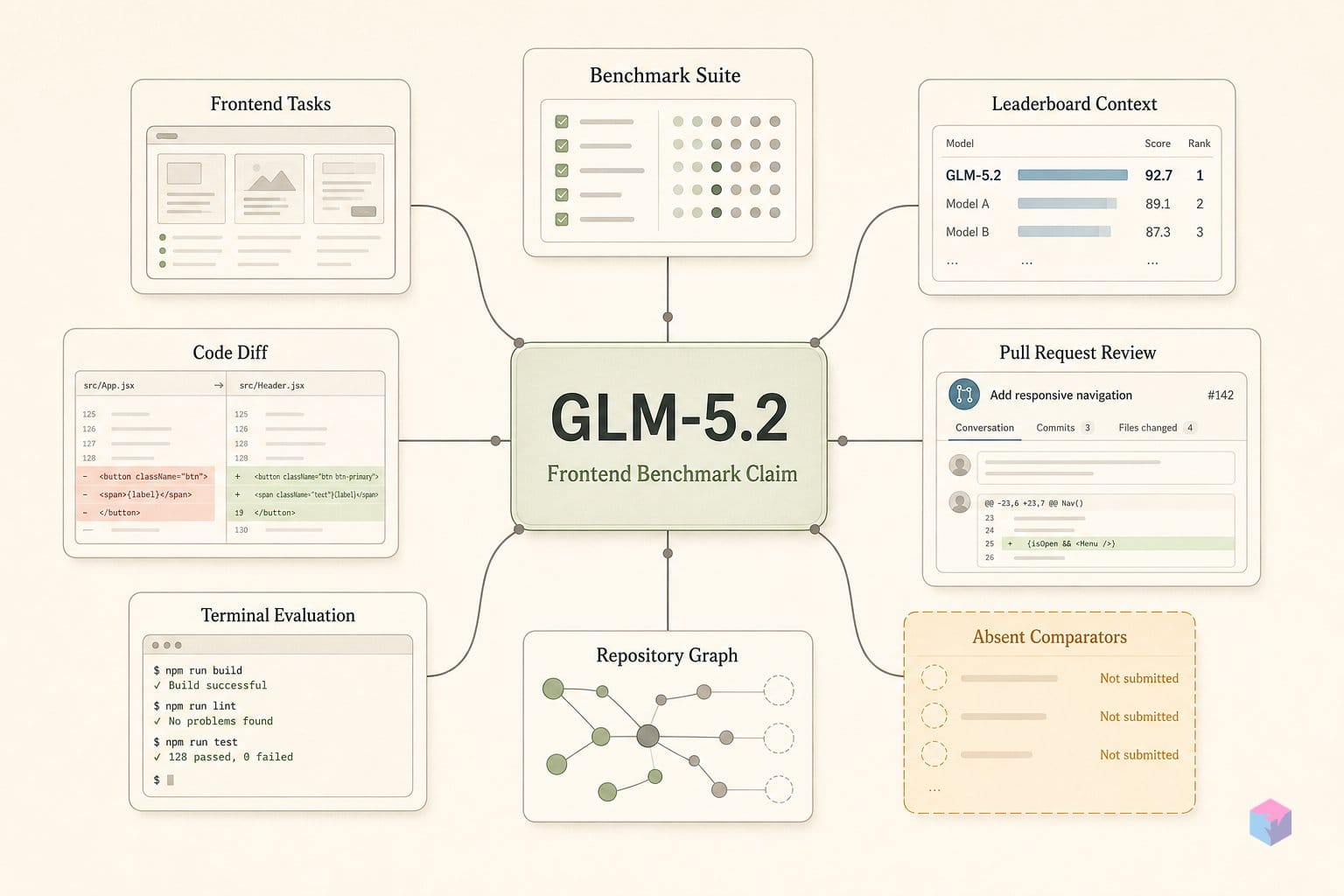
The arenas are where the frontend claim gets its strongest backing. On Design Arena's Web Dev composite, GLM-5.2 took outright #1 with an Elo of roughly 1,360, ahead of Anthropic's Fable 5 (~1,350) and the Claude Opus 4.6/4.7 stack . Unlike the SWE-style leaderboards, this is a head-to-head human-preference ranking that did include the broader Anthropic lineup — which is what makes the result hard to wave away.
Quick Answer: On crowdsourced arenas, GLM-5.2 ranks #1 on Design Arena's Web Dev composite (Elo ~1,360) and #2 on LMArena Code Arena (Frontend), trailing only Fable 5 — a model excluded from usable comparisons. On Agent Arena it sits around #10 overall, but #1 among open-weight entrants .
LMArena tells a more conditional story. On its Code Arena (Frontend) board, GLM-5.2 (Max) ranked #2 overall — about +29 points over Claude Opus 4.7 (Thinking) — placing #2 in React and #4 in HTML, with only Fable 5 scoring higher . The catch matters: Fable 5 was pulled and Mythos was never broadly released, so neither appears in usable rankings. With the strongest Anthropic competitor removed from the slot, GLM-5.2 becomes the top obtainable pick rather than the absolute best model ever benchmarked there.
| Arena | GLM-5.2 rank | What it measures |
|---|---|---|
| Design Arena — Web Dev composite | #1 (Elo ~1,360) | Human preference on web UI builds |
| LMArena — Code Arena (Frontend) | #2 overall (#2 React, #4 HTML) | Frontend code generation |
| Agent Arena | ~#10 overall (#1 open-weight) | Multi-step agentic tasks |
Step outside frontend and the lead narrows sharply. On the broader Agent Arena, GLM-5.2 placed only around #10 overall — though still #1 among open models — and reviewers flagged a "steerability tradeoff" on complex agentic work . As DeepLearning.AI's The Batch put it, GLM-5.2 is "the new top open model" — a framing that leads on open-weight terms without claiming the overall crown (source: The Batch, 2026-06).
The practical read: for frontend UI and React generation, GLM-5.2 is the strongest currently obtainable model by arena Elo — but that standing is conditional on who is competing. Treat it as a leading available option, not a permanent #1, and re-check the board whenever Fable 5 or Mythos return.
GLM-5.2 Against Proprietary Heavyweights: Row by Row
On standard coding benchmarks, GLM-5.2 is the strongest open-weight model on most rows but still trails the closed frontier on the majority of them. The clearest example is SWE-bench Pro, where GLM-5.2 scores 62.1 — first among publicly visible open-weight submissions, ahead of Kimi-K2.6 at 58.6 and GLM-5.1 at 58.4 — yet Z.AI's own comparison table lists Claude Opus 4.8 at 69.2 (source: VentureBeat, 2026-06). That seven-point gap matters once you scale production scaffolds, where small per-task failure rates compound across long agent runs.
Two rows are genuine #1 claims, and both come with asterisks. On PostTrainBench, GLM-5.2's 34.3 edged ahead only because Opus 4.8 Max dropped to 34.1% on 2026-06-17 — yet Z.AI's table still shows Opus 4.8 at 37.2, a live timing discrepancy worth monitoring rather than treating as settled (source: Z.AI blog, 2026-06). On FrontierSWE, its 74.4 currently sits at #3 on the live board — behind Fable 5 (90%) and Opus 4.8 (75%), ahead of GPT-5.5 (73%) and Opus 4.7 (63%) (source: FrontierSWE, 2026-06).
| Benchmark | GLM-5.2 | Closed-frontier leader |
|---|---|---|
| SWE-bench Pro | 62.1 | Opus 4.8 — 69.2 |
| FrontierSWE | 74.4 (#3) | Fable 5 — 90% / Opus 4.8 — 75% |
| PostTrainBench | 34.3 (#1, 06-17) | Opus 4.8 — 34.1–37.2 |
| Terminal-Bench 2.1 | 81.0–82.7 | Opus 4.8 — 85.0 |
| SWE-Marathon | 13.0 | Opus 4.8 (well ahead) |
| HLE (with tools) | 54.7 | Opus 4.8 — 57.9 |
Sources: Hugging Face model card, VentureBeat (2026-06).
Terminal-Bench 2.1 follows the same pattern: GLM-5.2 lands at 81.0–82.7 against Opus 4.8's 85.0, and SWE-Marathon at 13.0 shows the open model still trailing badly on the longest-horizon agentic task. Reasoning rows are more competitive — HLE-with-tools at 54.7 beats GPT-5.5's 52.2 (behind Opus 4.8's 57.9), with AIME 2026 at 99.2 and GPQA-Diamond at 91.2 (source: Hugging Face, 2026-06).
The honest summary: the closed frontier still leads on SWE-bench Pro, NL2Repo, ProgramBench, Terminal-Bench, FrontierSWE, SWE-Marathon, MCP-Atlas, and Tool-Decathlon. GLM-5.2's wins are real but narrow and, in the PostTrainBench case, possibly transient — early access testing corroborates that it edges past Opus on coding tasks without dominating across the board (video: AICodeKing). For decision-making, read the per-row gaps, not the headline.
IndexShare + MTP: How GLM-5.2 Handles Million-Range Queries
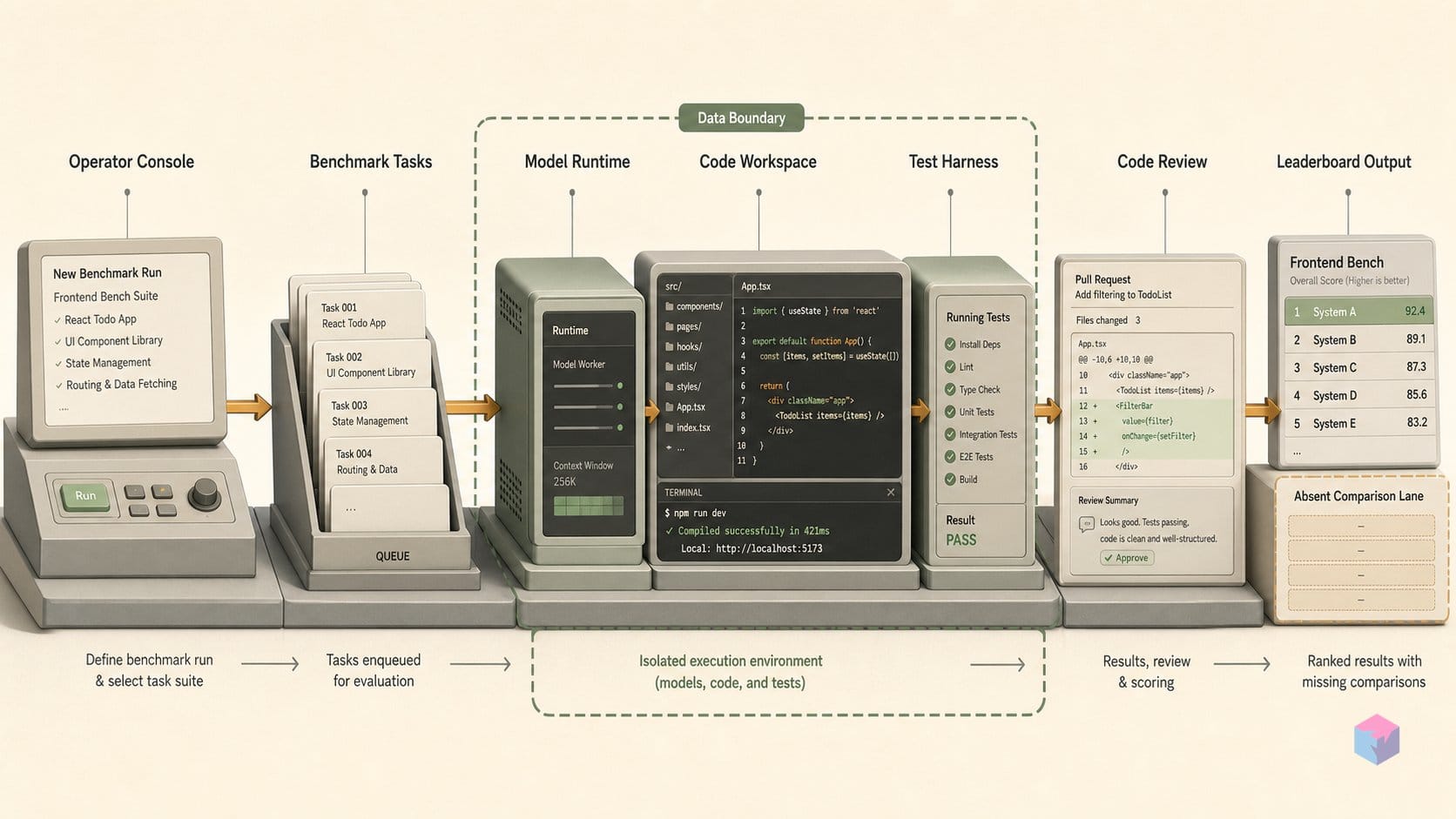
GLM-5.2's headline infrastructure change is a usable 1,000,000-token context window — roughly a 5× jump from GLM-5.1's 200K — paired with a 128K (131,072-token) maximum output per response . For builders, that combination is the practical difference between chunking a repository across many calls and indexing a full codebase in a single pass, then emitting a large refactor or generated module without truncation.
The window is affordable to serve because of IndexShare, the attention scheme Z.AI says reduces per-token FLOPs by 2.9× at 1M context . On the decode side, multi-token-prediction (MTP) speculative-decoding improvements yield up to ~20% longer acceptance length on long completions, which matters most exactly when you are streaming hundreds of thousands of output tokens . Note the distribution-page variance: Hugging Face lists 753B total parameters under an MIT license with no regional restrictions, while Ollama's hosted page lists 756B and a 976K context, so confirm the exact figures for the endpoint you actually call . Both build on the GLM-5 base as a Mixture-of-Experts model with roughly 40B active parameters per token .
Three control surfaces sit on top. Thinking effort has two tiers — High and Max, with Max the default for complex multi-step coding — and you can switch reasoning off entirely with enable_thinking=false; reasoning tokens are surfaced in the API response rather than hidden, which helps when you are debugging an agent's chain or budgeting tokens . The behavioral change most relevant to long agentic runs is new to the GLM line: mid-task clarifying questions. Instead of silently hallucinating a decision when a spec is ambiguous, GLM-5.2 can pause and ask . Over a million-token job, that single capability often determines whether the output is usable or quietly wrong.
Six Times Cheaper Than the Alternatives: Is the Quality There?
GLM-5.2's headline economics are real, but the "six times cheaper" figure is conditional, not universal. The API costs $1.40 per 1M input tokens, $0.26 per 1M cached input tokens, and $4.40 per 1M output tokens . VentureBeat pegs that at roughly one-sixth the cost of GPT-5.5 on equivalent long-horizon coding tasks — a ratio that holds on FLOPs-comparable, multi-step workloads and narrows on shorter loops.
If you would rather not meter raw tokens, the GLM Coding Plan starts at $18/month and exposes GLM-5.2 alongside GLM-5-Turbo and GLM-4.7 . The Lite, Pro, and Max tiers carry approximate quota pools of 80, 400, and 1,600 prompts per five hours respectively . One detail to budget around: GLM-5.2 and GLM-5-Turbo consume 3× quota during peak hours (14:00–18:00 UTC+8) and 2× off-peak, with a limited-time 1× off-peak benefit running through the end of September 2026 . Schedule heavy agent runs outside that window and the effective cost drops further.
The license is the quieter advantage. GLM-5.2 ships under MIT with no regional restrictions per the Hugging Face card — material for teams with permissive-license clauses in client contracts or open-source dependencies, where a closed API's terms are a non-starter.
On quality, DeepLearning.AI's The Batch calls GLM-5.2 "the new top open model" , and on long-horizon tasks the per-dollar value is hard to argue with. The caveat: on shorter agentic loops, Opus 4.8's steerability advantage matters most, and the practical cost gap shrinks because you spend fewer tokens recovering from missteps. Price the model on your own workload mix, not the leaderboard.
From HuggingFace to Cline: How to Adopt GLM-5.2 Now
Adopting GLM-5.2 takes one of two paths: pull the open weights and self-host, or hit a hosted endpoint and skip the GPUs entirely. The weights live at zai-org/GLM-5.2 on HuggingFace under an MIT license, shipped as transformers-compatible safetensors . The same checkpoint is mirrored on ModelScope and Ollama, so distribution is not a bottleneck.
One discrepancy is worth confirming before you provision hardware: the Ollama page lists 756B parameters and a 976K-token context, against HuggingFace's 753B and the 1,000,000-token figure Z.AI advertises . The gap is minor, but if your pipeline depends on the full million-token window, validate the actual usable context against your own inference harness rather than the model card.
For agentic workflows, GLM-5.2 was compatible with eight coding clients from day one, including Claude Code, Cline, OpenCode, and OpenClaw . Because Z.AI exposes an OpenAI-compatible endpoint, any client built to that spec should connect with only a base-URL and key swap. Reasoning effort is controlled by the enable_thinking parameter — High, Max, or off — and reasoning tokens are surfaced in the response object, which makes them usable for chain-of-thought logging or step auditing.
If the 1M context and MIT license are not your primary drivers, skip self-hosting altogether: Z.AI's chat, API, and every GLM Coding Plan tier expose GLM-5.2 directly . The hosted route gets you the same model with none of the GPU overhead.
Verdict: When GLM-5.2 Is the Right Choice — and When It Isn't
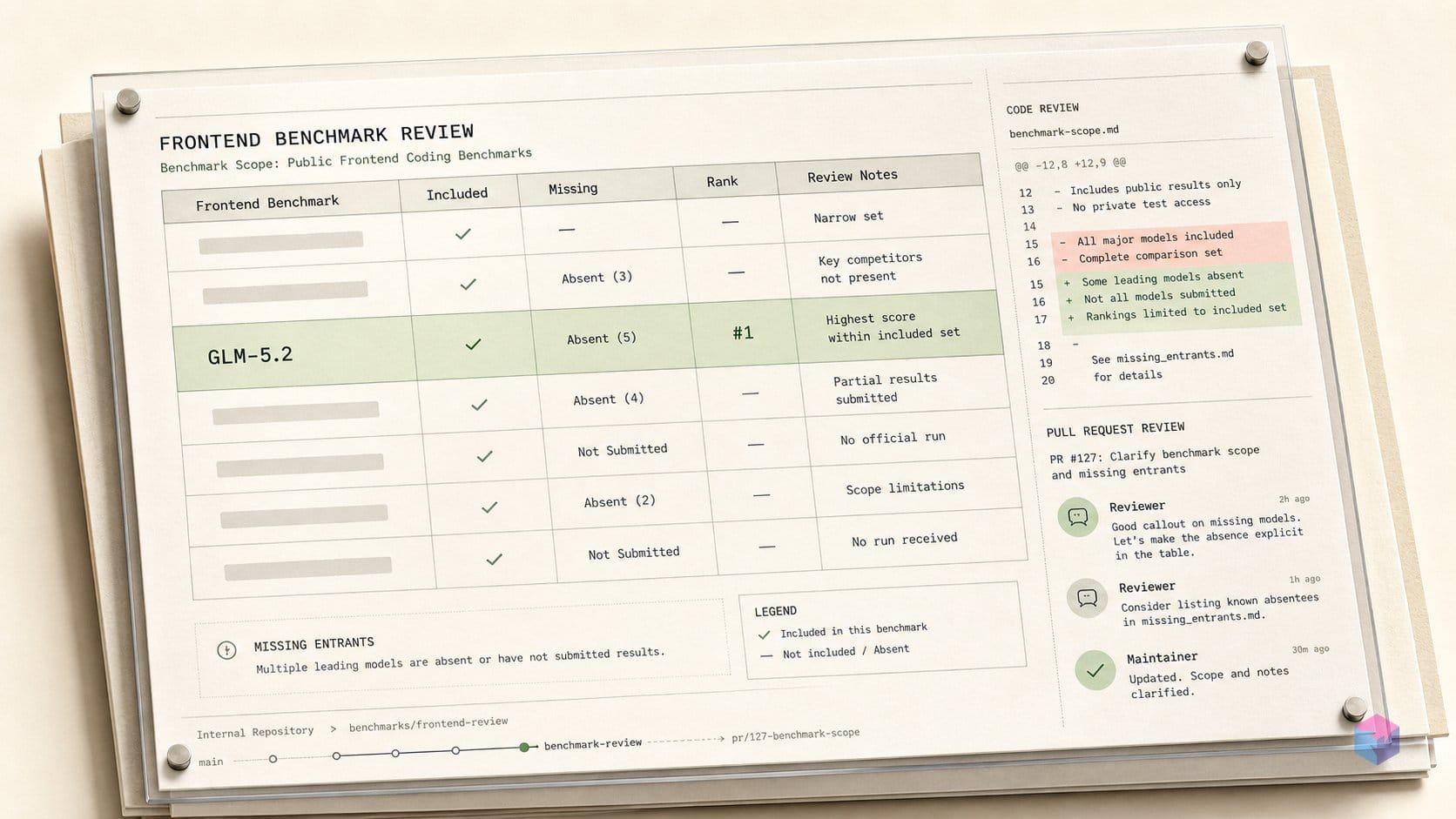
GLM-5.2 is the right choice when frontend output, full-repo context, and license freedom matter more than topping every coding leaderboard. It is the strongest open-weights model available, it holds outright #1 on Design Arena's Web Dev composite with an Elo of ~1,360 , and it ships an MIT license with no regional restrictions . Pick it for React/HTML UI generation, full-repo analysis that needs the 1M-token window, permissive-license requirements, and high-volume long-horizon coding where roughly one-sixth the per-token cost of GPT-5.5 changes the math .
It is not yet the pick for production agentic scaffolds that need top steerability — it placed only ~#10 overall on Agent Arena, with reviewers flagging a steerability tradeoff . For maximum SWE-bench Pro pass@1, Claude Opus 4.8 still leads at 69.2 versus GLM-5.2's 62.1, and Opus 4.8 also leads on Tool-Decathlon and MCP-Atlas coverage .
The arena #1 is real but conditional. Elo measures crowd preference on subjective outputs, not production pass@1, so validate frontend quality on your own workload before relying on the headline. The rankings are also live: PostTrainBench #1 is volatile as Opus 4.8 submissions update , and its FrontierSWE position currently sits at #3 behind Claude Fable 5 and Opus 4.8 . As one reviewer who tested early access put it, "it beats 4.6 Opus" on his runs — a meaningful result, but one tied to a specific harness and moment (video: AICodeKing). Re-check the boards before committing a long-running migration.
Concrete takeaway: default to GLM-5.2 for cost-sensitive frontend and large-context work, keep Opus 4.8 in reserve for agentic and pass@1-critical pipelines, and re-verify the leaderboards the week you commit.
Watch / Sources
- AICodeKing — GLM-5 (Fully Tested): I GOT EARLY ACCESS & YES, IT BEATS 4.6 OPUS!
- Ramanpal Singh — MiniMax 2.5 Benchmarks vs Reality - The Truth Exposed
- Alex Finn — The only Claude Code guide you'll ever need (Opus 4.5)
Frequently asked questions
Did GLM-5.2 actually beat Claude and GPT-5.5 in frontend coding?
It depends entirely on the metric and which models are competing. On Design Arena's Web Dev composite, GLM-5.2 took outright #1 with an Elo of roughly 1,360, ahead of Anthropic's Fable 5 at about 1,350 . On LMArena's Code Arena (Frontend), it ranked #2 — about +29 points over Claude Opus 4.7 (Thinking) — with only Fable 5 above it . But on hard SWE evaluations the closed frontier still leads: Claude Opus 4.8 scores 69.2 on SWE-bench Pro versus GLM-5.2's 62.1, and tops the FrontierSWE leaderboard at 75% . The "frontend #1" billing rests on arena Elo, not a first-party benchmark.
Why is Fable 5 absent from the Code Arena rankings?
Fable 5 was pulled from Code Arena's active comparison pool after its release, and Anthropic's Mythos was never broadly made available . That absence is the key condition behind GLM-5.2's #1 or near-#1 arena standing: stronger Anthropic entries exist but are not in the usable comparison set, so the ranking reflects who is currently competing rather than an absolute frontend ceiling. Re-check the leaderboards before relying on the headline.
What is GLM-5.2's context window and how does it affect real workloads?
GLM-5.2 ships a 1,000,000-token context window — roughly 5× GLM-5.1's 200K limit — with a maximum output of 128K (131,072) tokens per response . Z.AI's IndexShare architecture cuts per-token FLOPs by 2.9× at 1M context to keep latency practical . In practice, this means feeding an entire mid-size codebase into a single call rather than chunking it across requests — though you should validate quality at the long end on your own workload, since attention quality at 1M rarely matches the headline number.
Can I use GLM-5.2 with Claude Code or Cline today?
Yes. GLM-5.2 was confirmed compatible at launch with eight agentic coding clients, including Claude Code, Cline, OpenCode, and OpenClaw . The API is OpenAI-compatible, and the weights are published on Hugging Face under an MIT license with no regional restrictions . You can also reach it through Z.AI's API and chat, the GLM Coding Plan, ModelScope, and Ollama.
How does GLM-5.2's pricing compare to GPT-5.5 and Claude Opus 4.8?
API pricing is $1.40 per 1M input tokens and $4.40 per 1M output tokens, with cached input at $0.26 per 1M . VentureBeat's analysis puts that at roughly one-sixth the cost of GPT-5.5 on equivalent long-horizon coding tasks . For subscription access, the GLM Coding Plan starts at $18/month with quota pools by tier . The cost advantage is most pronounced on high-volume, long-context runs.