
Does an AI summary reduce clicks? Pew's 68,879-query answer.
Yes. An AI summary roughly halves the chance a user clicks a traditional result link. In the Pew Research Center study published July 22, 2025, when an AI summary appeared, users clicked a standard result just 8% of the time, versus 15% without, a 46.7% relative drop. To date, it is the most detailed independent measurement of how AI summaries affect click behavior.
Quick Answer: Pew analyzed 68,879 Google searches from 900 U.S. adults in March 2025. About 18% returned an AI summary, and when one appeared, traditional-result clicks fell from 15% to 8%, a 46.7% relative decline. Links inside the summary were clicked just 1% of the time.
The dataset is built from real browsing behavior, not survey recall: Pew analyzed 68,879 unique Google searches drawn from 900 U.S. adults, with browsing data collected March 1 to 31, 2025 and result pages scraped April 7 to 17 . The summary itself rarely recovered the lost click: source links embedded in the summary were clicked only 1% of the time, even though 88% of summaries cited three or more sources .
| Metric (Pew, March 2025) | AI summary shown | No AI summary |
|---|---|---|
| Clicked a traditional result link | 8% | 15% |
| Session ended with no outbound click | 26% | 16% |
| Clicked a link inside the summary | 1% | — |
Sessions ended outright 26% of the time after a page with an AI summary, versus 16% without . Pew's headline is direct:
"Google users are less likely to click on links when an AI summary appears in the results." — Pew Research Center (source: Pew Research Center, 2025-07)
One caveat for developers: Pew measured AI Overviews in classic Search, not AI Mode specifically. The direction holds regardless, because the longer, natural-language queries most likely to trigger Google's generative layer are exactly the ones that suppress clicks.
Query fan-out and the anatomy of an AI-powered answer
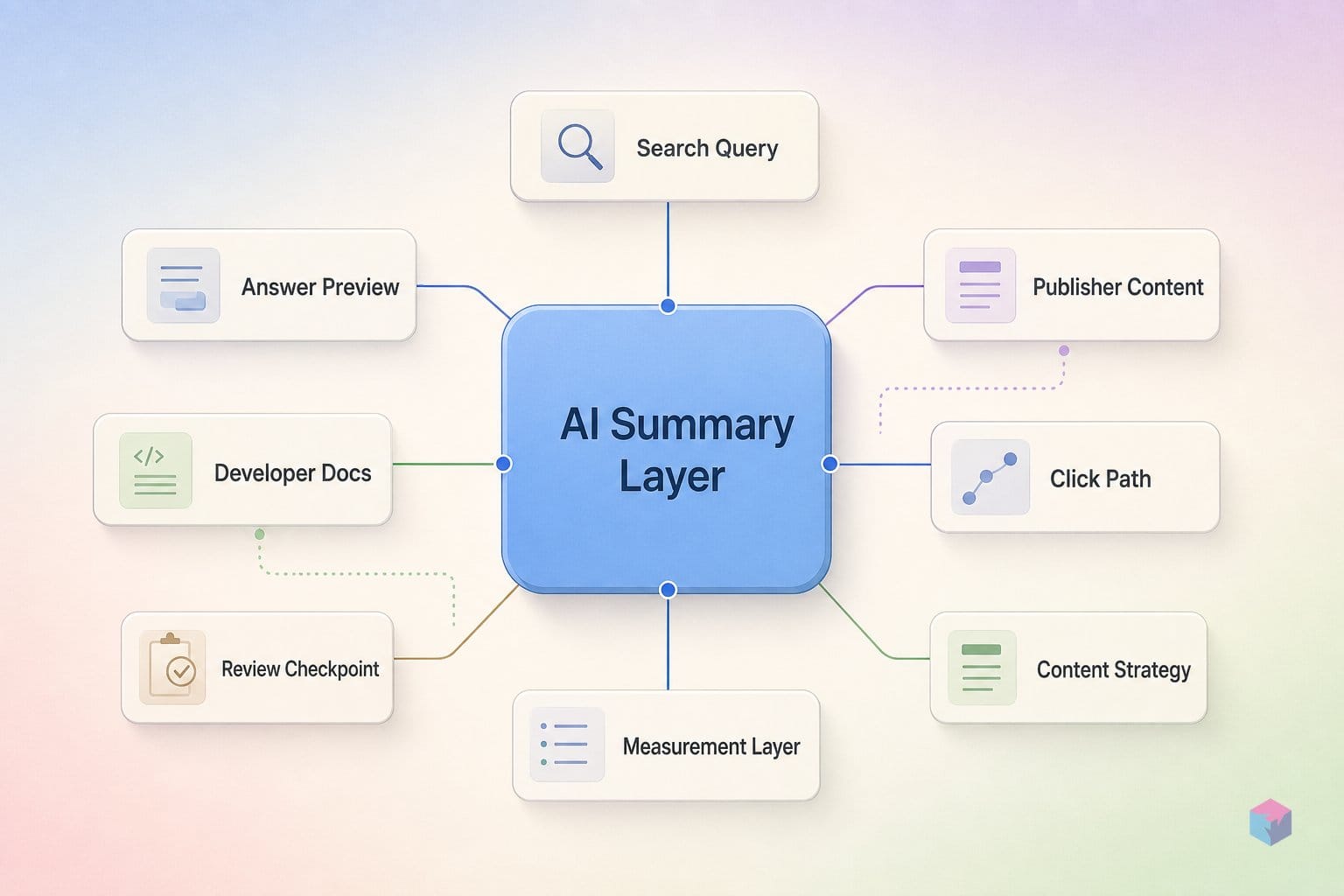
AI Mode is Google's conversational search surface that decomposes a single prompt into many concurrent sub-searches before synthesizing one answer with inline links. Google launched it as a Search Labs experiment on March 5, 2025, limited to Google One AI Premium subscribers in the U.S. and built on a custom Gemini 2.0 model . At I/O on May 20, 2025, Google moved it out of Labs for all U.S. users with no sign-up, added a dedicated AI Mode tab, and began swapping in a custom Gemini 2.5 model across both AI Mode and AI Overviews .
The mechanism Google calls "query fan-out" is what separates this from a keyword lookup. Instead of matching one string against the index, the system breaks a prompt into subtopics, issues multiple searches across those subtopics and data sources in parallel, then composes a single reasoned response with citations . That design is why a comparison or planning question that once took several manual searches can now resolve in one turn, and why longer, constrained, natural-language phrasing is the input the layer is built for.
The fan-out also extends past text. AI Mode accepts text, voice, and image input and supports follow-up conversational threads, so a query can be refined in place rather than restarted . Its Deep Search variant scales the same idea aggressively: Google says it can issue hundreds of sub-searches and return a cited report in minutes .
Adoption has tracked the design. Around its one-year mark, Google reported AI Mode had passed 1 billion monthly active users globally and that AI Mode queries had "more than doubled every quarter" since launch . That follows the Q2 2025 earnings figure of 100 million-plus AI Mode MAUs across the U.S. and India within weeks of the May graduation . The surface that suppressed clicks earlier is also the one reading multiple pages per answer.
Why queries tripled, and which intent categories grew fastest
The reason that surface re-reads so many pages is that the queries feeding it are longer and more constrained. By Google's own measurement, the average AI Mode query runs roughly three times the length of a traditional keyword search . That is a vendor-internal figure, not independently audited, so treat the multiple as directional rather than exact. The direction matters: users are typing full, conversational requests instead of iterating on two- and three-word fragments.
Input modality is shifting alongside length. Google reports that more than one in six U.S. searches now use voice or images, with image searches growing over 40% month over month . The visual channel is already at scale: Google Lens reported 1.5 billion monthly visual searches at I/O 2025 . For developer content, that reframes screenshots, diagrams, and error-state captures as retrievable assets rather than decoration.
The growth is uneven by intent, and the categories moving fastest are the ones that used to demand several separate searches. Google says two query classes are outrunning the platform average:
- Planning: grew 80% faster than AI Mode queries overall over the past six months .
- Brainstorming: grew 30% faster than the platform since launch .
The fastest-growing phrasings tell the same story: "where to," "where should I," and "ideas for" are climbing fastest . Each of those is an open-ended, constraint-laden request, the kind a user previously assembled through three or four keyword iterations, comparing partial results between each one. AI Mode collapses that loop into a single prompt, then resolves it with query fan-out behind the scenes.
For publishers, head terms now describe a search behavior that is shrinking relative to the whole. The growth is in scoped, multi-constraint intent: "how do I rotate refresh tokens in a local dev callback flow," not "OAuth tutorial." Content organized around a concrete task, its constraints, and its failure modes maps directly onto the query shapes Google says are expanding fastest, while generic head-term pages compete for the slice that is flattening.
No-click visits climbed from 56% to 69%: the Similarweb count
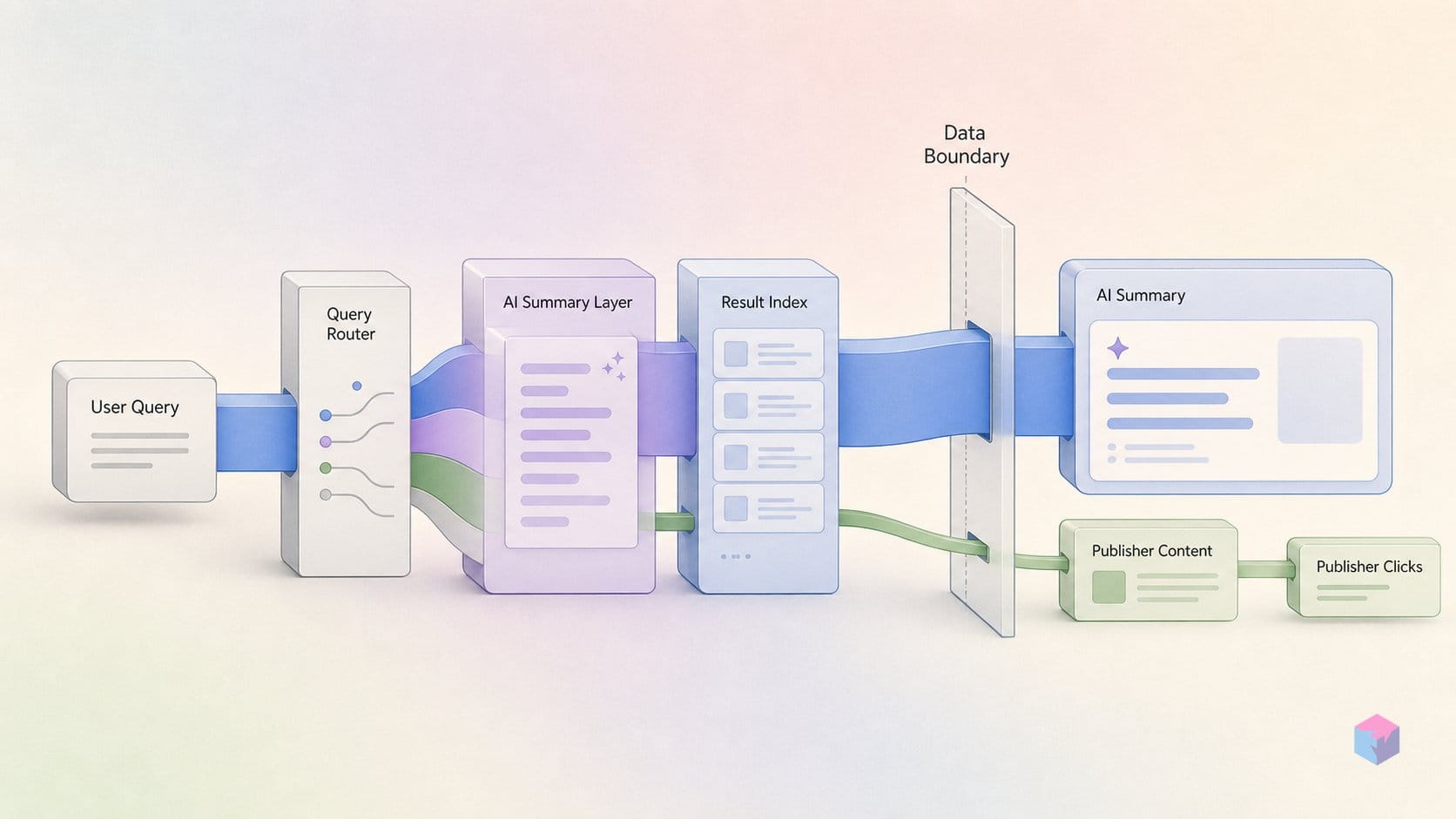
The no-click share is measurable and growing. Similarweb found that the share of all Google queries ending without a click to the open web rose from 56% to 69% between May 2024 and May 2025, a 13-point jump in twelve calendar months . That is the macro number to internalize: roughly two of every three searches now resolve inside the results page. For developers shipping docs and reference content, the open web is no longer the default destination of a search; it is the minority outcome.
The effect concentrates where AI is doing the answering. Semrush (data updated September 2025) reports that about 93% of AI Mode searches end with no click to any external site, and that across all Google searches only about 360 of every 1,000 still reach the open web . On the classic-Search side, Ahrefs measured a 34.5% drop in position-one CTR for informational keywords on queries that trigger an AI Overview. The rank-one slot keeps its position and loses its clicks .
Trigger rate is the other moving variable, and it does not only climb. Semrush's broader study (10M-plus keywords tracked January through October 2025) found AI Overviews peaked on nearly 25% of queries in July 2025 before settling to about 16% by November 2025 . Treat that as a noisy estimate, not a constant. Google is actively tuning where the generative layer fires.
| Signal | Measure | Source / period |
|---|---|---|
| No-click share, all Google queries | 56% → 69% | Similarweb, May 2024–May 2025 |
| AI Mode searches ending without external click | ~93% | Semrush, Sept 2025 |
| Total queries still reaching open web | ~360 / 1,000 | Semrush, Sept 2025 |
| Position-one CTR drop (informational + AI Overview) | −34.5% | Ahrefs |
| AI Overview trigger rate | ~25% (Jul) → ~16% (Nov) | Semrush, Jan–Oct 2025, 10M+ keywords |
These figures come from different vendor panels with different methodologies, so treat them as directional rather than precisely comparable. The direction is consistent: when the generative layer answers, the click rarely follows, and the trigger surface is wide enough to reshape baseline organic traffic.
Intent-matched pages vs. commodity content: what AI synthesis keeps
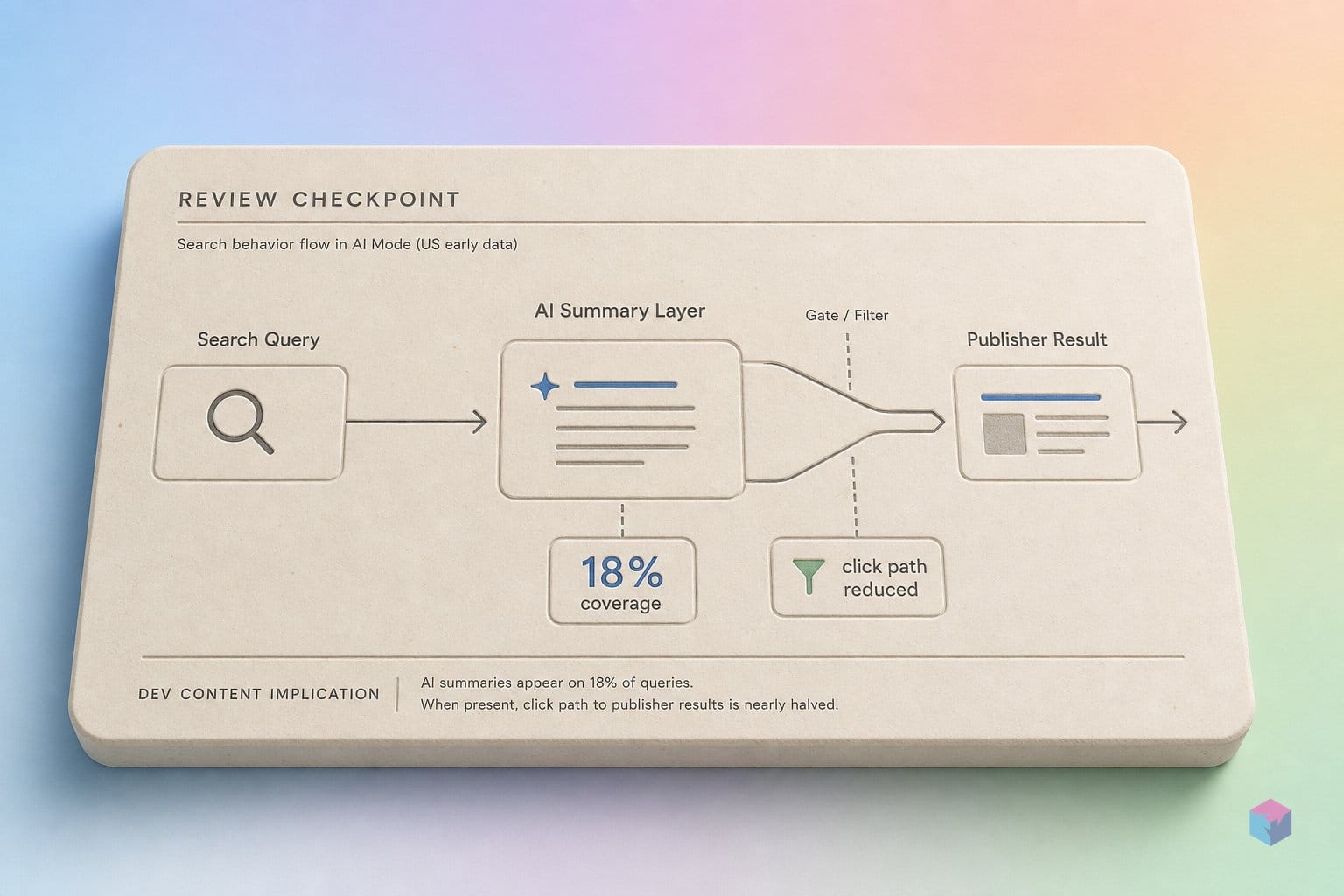
That reshaping does not hit all content equally. AI Mode answers common knowledge inline, so generic tutorials, thin how-tos, and rewritten docs get absorbed into the synthesized answer without earning either a citation or an outbound click. Google Search Central is explicit that the same SEO fundamentals apply and that there is no special markup to win placement; eligibility only requires being indexed and snippet-eligible . The payoff curve does change: when the model can reproduce a fact from memory, your page is redundant; when it must retrieve something specific and current, your page becomes a source.
The content that consistently earns a citation resolves a concrete implementation task rather than restating one. In practice that means:
- API references with current parameters, defaults, and error codes
- Migration notes that name versions and breaking changes
- Runnable, copy-pasteable examples
- Benchmark and compatibility tables
- Opinionated troubleshooting pages that document provider-specific failure modes
Google's own guidance points the same way, warning against generating pages for every query-fan-out variation and favoring unique, people-first material rooted in core ranking systems .
"If you're already following our guidance focused on creating helpful, reliable, people-first content, then you're already well on your way," — Google Search Central, on succeeding in AI search (source: Google Search Central).
Even a citation is not a stable position. Authoritas found that roughly 70% of AI-Overview-cited pages churned over a two-to-three-month window, independent of organic rank. The synthesized source set rotates faster than the underlying SERP . Being cited today is no guarantee of next quarter, so treat citation appearances as a data point rather than a stable channel.
Brand recognition is the one durable hedge. Amsive measured an 18% CTR increase on branded queries that surfaced an AI Overview, partially offsetting the summary-induced click drop seen on informational terms . For a developer-tools publisher, that argues for building name recall (a recognizable docs domain, a known SDK, a practitioner voice readers search for by name) so users still click through when the model already summarized the answer.
How to measure organic health while AI impression reporting rolls out
Build name recall, then measure the right signals, because raw organic clicks no longer describe how AI surfaces send value. On June 3, 2026, Google announced dedicated Search Generative AI performance reports in Search Console, exposing AI Overviews and AI Mode impressions, pages, countries, devices, and date granularity . The catch for developer teams: it rolls out to only a subset of sites, and per-surface click and CTR metrics remain under consideration . Until that lands, most teams cannot reliably attribute AI-Mode-referred traffic at all.
Until clean attribution is available, track these signals in parallel:
- Branded query volume in Search Console: the leading indicator that the citation-without-clicks pattern is still converting on your name. Amsive measured an 18% CTR increase on branded queries that surfaced an AI Overview, so brand demand is the metric AI surfaces least erode .
- Direct return visits: readers who bookmark a docs domain or SDK and come back without a search step.
- Docs-activation events: API key creation, signups, first successful call. These survive even when the answer was read inside the summary.
- Support ticket deflection: fewer tickets on a documented error mode means your page is doing its job in the generative layer.
Avoid judging AI-surface value by organic click count alone. Google's own framing is that AI Overview clicks drive materially more time on site, a quality claim rather than a quantity one, and not strictly contradicting Pew, which measured whether a click happens rather than what follows it . Treat single-vendor panel figures and volatile trigger rates as moving estimates, not constants.
Be the cited, canonical source for the implementation tasks your audience actually runs into, then grade yourself on impressions, branded search, activation, and deflection. When dedicated AI reporting reaches your property, you will already have the baselines to read it.
Last updated: 2026-06-21.
Frequently asked questions
Does the Pew CTR drop apply to AI Mode specifically, or only to AI Overviews in classic Search?
Pew measured AI Overviews in classic Search, not AI Mode. Its data was collected in March 2025 , before AI Mode left Labs for U.S. users at I/O on May 20, 2025 . The AI Mode-specific number comes from Semrush, which reports ~93% of AI Mode searches end without an external click . Both point the same direction (fewer outbound clicks) but the methodologies differ, so treat them as directionally consistent, not directly comparable.
Google says AI Overview clicks drive more time on site. Doesn't that contradict the Pew data?
Not strictly. Google describes engagement quality after a click happens; Pew measures whether a click happens at all . The two can both be true: fewer clicks overall, but higher session quality among the clicks that do occur. For publishers the exposure is volume, not per-visit value. Pew found a traditional link was clicked 8% of the time when a summary appeared versus 15% without, a 46.7% relative drop .
What dev content types are most likely to be cited in AI Mode answers?
Version-specific, authoritative pages that resolve a concrete implementation task: API references with current parameters and error modes, migration notes, runnable examples, benchmark and compatibility tables, and opinionated troubleshooting. Google's optimization guidance frames retrieval-augmented generation and query fan-out as pulling current pages from the Search index , which favors crawlable, task-resolving content. Commodity material (generic listicles, thin tutorials, rewritten docs) gets synthesized inline by the model and earns no citation or click .
When will Search Console show dedicated AI Mode impressions and CTR?
Google announced Search Generative AI performance reports on June 3, 2026, covering AI Overviews and AI Mode impressions, pages, countries, devices, and date granularity . At announcement the reports were rolling out to only a subset of sites, and per-AI-surface click and CTR metrics were still listed as under consideration. Until those reports broadly expose clicks and referral quality, treat impressions, branded search, and downstream activation as your interim signals.
Is special markup or schema required to appear in AI Mode answers?
No. Google Search Central states the same foundational SEO practices apply to AI Overviews and AI Mode, with no additional technical requirements or special schema . Eligibility simply requires being indexed and eligible for a standard Search snippet. The leverage is in content quality and task coverage, not a new structured-data format.