
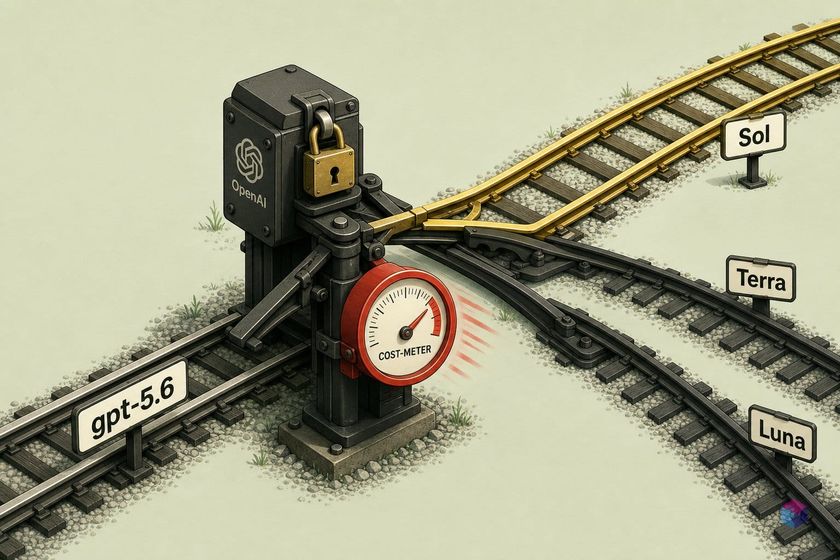
OpenAI shipped GPT-5.6 with a quiet default that can silently double your bill: the bare gpt-5.6 string is not a model — it's an alias, and it points at the most expensive tier in the family.
What gpt-5.6 resolves to — and why that doubles your expected bill
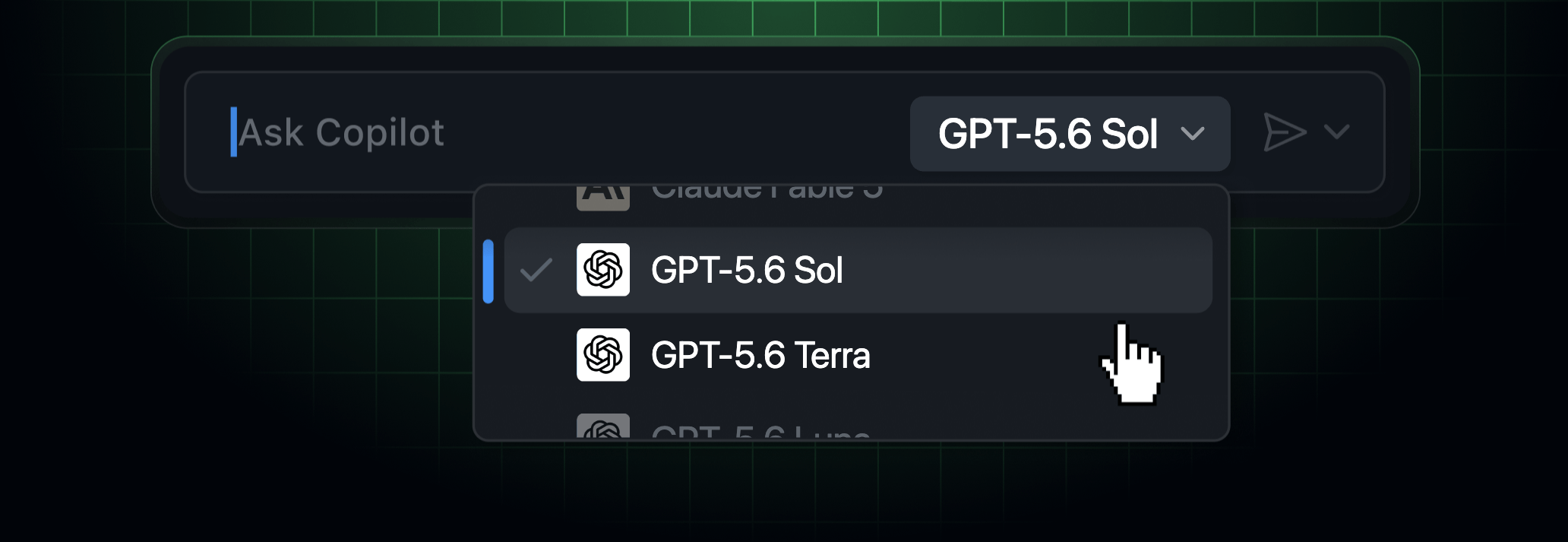
The gpt-5.6 alias routes to gpt-5.6-sol, the flagship tier — so any team that hasn't pinned a specific tier is already paying Sol rates, with nothing in the response payload to flag it . Sol costs $5 per 1M input tokens and $30 per 1M output, which makes a 1k-input/1k-output uncached call about $0.035 — against roughly $0.007 on the low-cost Luna tier, a 5× gap on identical payloads .
The number (5.6) marks the generation; the tier names — Sol (flagship), Terra (balanced), Luna (fast, cheap) — advance on their own cadence, so the default can shift under you across releases . GPT-5.6 reached general availability on July 9, 2026 across ChatGPT, Codex, GitHub Copilot, and the OpenAI API .
Sol, Terra, Luna: the $0.007–$0.035 band and 69–211 tok/s from Artificial Analysis
The three tiers are separated by a clean 2× price step and a matching speed inversion: the cheaper the tier, the faster it generates. Per 1M tokens, Sol costs $5 input / $30 output, Terra $2.50 / $15, and Luna $1 / $6 — a 5× span top-to-bottom . On a 1k-input/1k-output uncached call that is roughly $0.035 (Sol), $0.0175 (Terra), and $0.007 (Luna) . Scaled to 50M input + 10M output tokens per month, the tiers land near $550, $275, and $110 respectively .
| Tier | Input / Output (per 1M) | 1k/1k call | Artificial Analysis: tok/s (Intelligence Index, rank) |
|---|---|---|---|
| Sol | $5 / $30 | ~$0.035 | 69.3 tok/s (59, #2/188) |
| Terra | $2.50 / $15 | ~$0.0175 | 140.8 tok/s (55, #6/188) |
| Luna | $1 / $6 | ~$0.007 | 211.6 tok/s (51, #15/188) |
Throughput comes from the Artificial Analysis harness (output tokens/sec, not an API SLA): Sol measured 69.3 tok/s, Terra 140.8 tok/s, and Luna 211.6 tok/s . The inversion is intentional — Sol is the slowest because it spends far more output tokens reasoning, which is also the expensive half of the invoice .
Caching narrows the gap on repeated prefixes: cached input runs $0.50 (Sol), $0.25 (Terra), and $0.10 (Luna) per 1M, but cache writes bill at 1.25× the uncached input rate, and GPT-5.6 adds explicit cache breakpoints plus a 30-minute minimum cache life . What you do not route on is capacity: all three tiers share a 1,050,000-token context window, 128K max output, a February 16, 2026 knowledge cutoff, and identical Responses API tool access — web search, file search, code interpreter, computer use, and MCP . Capability, cost, latency, and risk are the axes — not context or modality.
Making the alias explicit: swapping in gpt-5.6-terra or gpt-5.6-luna
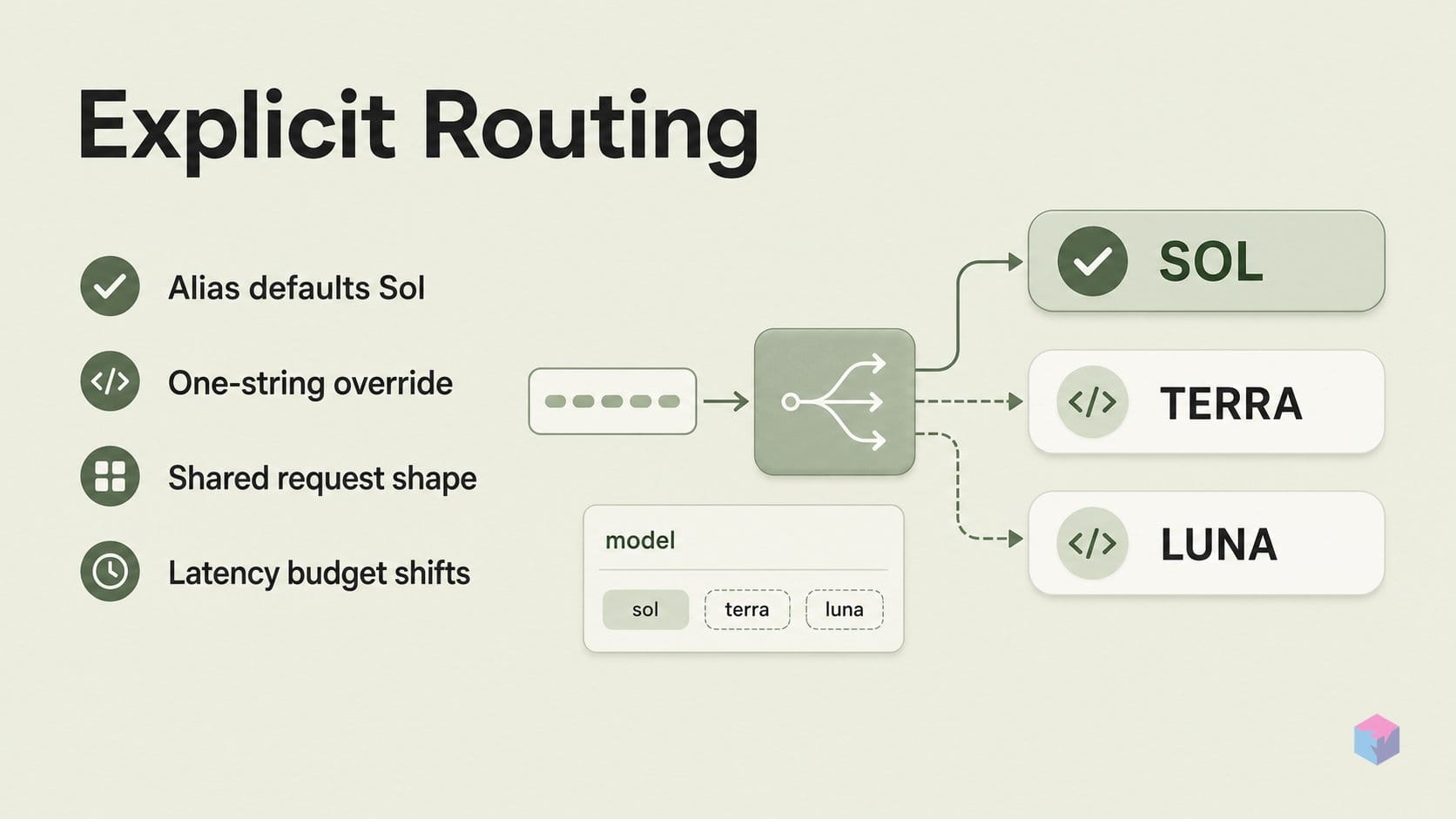
Overriding the default is a one-string change: pass gpt-5.6-terra or gpt-5.6-luna in the model field instead of the bare gpt-5.6 alias, which resolves to Sol . The tier name is the only thing that changes; the request shape, context window, and tool access are identical across all three. What changes is your bill and your latency profile.
Route gpt-5.6-luna to high-volume, latency-sensitive paths where a small quality loss is acceptable — classification, extraction, routing, summarization, guardrail pre-checks, search-query rewriting, and first-pass drafting . Do not send document-heavy synthesis through Luna: its MRCR long-context recall collapses to 41.3%, covered in the next section.
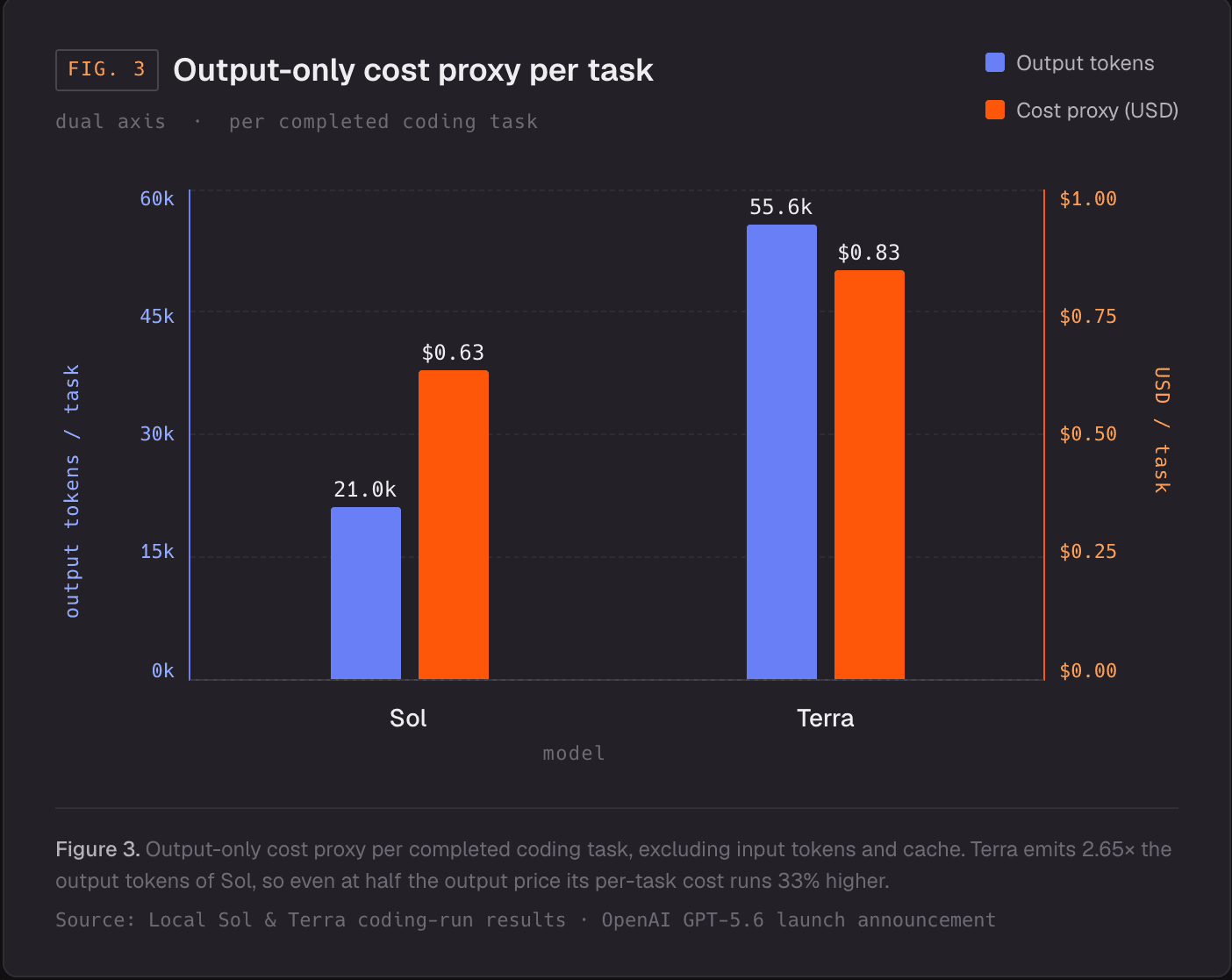
Make gpt-5.6-terra your general production default — agentic SaaS, routine coding, enterprise RAG document QA, and moderate-stakes support. On Agents' Last Exam, Terra scores 50.4% against Sol's 52.7%, landing within about two to three points at half the cost ($2.50 input / $15 output vs Sol's $5 / $30 per 1M tokens).
Two request-level levers stack on top of the tier choice. On user-facing routes, add service_tier="priority" for consistent low latency; it auto-downgrades to Standard when traffic exceeds 1M TPM with more than 50% arriving inside any 15-minute window. For offline evals, migrations, and bulk enrichment, route through the Batch API for 50% lower cost and 24-hour turnaround — pair it with Luna for the lowest possible per-request price.
"Output generation dominates latency — cutting output tokens by 50% may cut latency roughly 50%, while streaming is the single most effective way to bring perceived waiting to about a second," per OpenAI's latency guidance (source: Simon Willison, 2026-07).
Reserve gpt-5.6-sol — and the max and ultra reasoning levers only where correctness dominates cost — for deep coding agents, security analysis, computer use, and long-horizon research. Sol's Intelligence Index of 59 versus Terra's 55 is the quantified gap you are paying a 2x premium to buy.
Luna's MRCR at 41.3% and the Sol deep-thinking surcharge
Luna's per-token discount evaporates the moment a task needs long-context recall. On the MRCR benchmark, Luna scores just 41.3% against Sol's 91.5% and Terra's 89.6%. That is a hard ceiling, not a soft trade-off: any path that depends on information past roughly the 40th percentile of a long context — multi-document synthesis, deep RAG, long-transcript summarization — will silently drop facts. Route those to Terra or Sol regardless of Luna's headline price.
Luna also runs verbose. Artificial Analysis recorded it emitting 130M output tokens across the Intelligence Index versus a 60M baseline average — output is the expensive half of the bill, so uncapped completions can erase the $1/$6 advantage. Enforce output caps, strict structured-output schemas, and streaming before treating Luna as the cheap tier.
"The single biggest lever on both latency and cost is output length — cutting output tokens by 50% may cut latency by roughly 50%," — OpenAI latency guidance, summarized by Simon Willison (source: simonwillison.net, 2026-07).
At the top of the family, Sol's reasoning levers carry their own surcharge. max buys more thinking time; ultra fans work across parallel subagents — both multiply output tokens steeply. Sol Ultra can add roughly 3× the token cost of single-agent Sol for a few benchmark points, so reserve them for the highest-stakes correctness. And every tier shares one silent cliff: prompts over 272K input tokens bill the entire request at 2× input and 1.5× output — watch it on any long-document or deep-RAG call.
Ongoing monitoring: TTFT, success, and monthly invoice by tier
Routing is not a one-time decision, so instrument it. Track five signals per workload: task success rate, output-token count against a hard ceiling, time-to-first-token, wall-clock latency, and total monthly cost. Per-call price alone is misleading — it hides Luna's verbosity (Artificial Analysis measured 130M output tokens across the Intelligence Index versus a 60M average ) and Sol's reasoning overhead, both of which land on the expensive output side of the bill.
Escalate a workload up one tier only on evidence: when measured success drops below your acceptance floor, or when an error triggers human rework — not on a hunch. The Agents' Last Exam spread is just 2.3 points (Sol 52.7% vs Terra 50.4%) , which is why Terra is the correct default for most teams. Finally, prompt caching can cut input cost up to 90% on repeated prefixes, but size the net gain against the 1.25× cache-write surcharge and the 30-minute minimum cache life . The takeaway: default to Terra, pin the alias explicitly, and let per-workload evals — not the `gpt-5.6` default — decide where each request runs.
Frequently asked questions
Does migrating from gpt-5.5 to gpt-5.6 increase my bill automatically?
Only if you pass the bare gpt-5.6 alias, which resolves to gpt-5.6-sol at $5 input / $30 output per 1M tokens — about $0.035 for a 1k/1k call. Terra is the designed functional replacement for the GPT-5.5 generation at roughly half the cost ($2.50 / $15). Pass gpt-5.6-terra explicitly to stay close to cost-neutral.
When is Sol max or ultra worth the extra cost?
Reserve them for the highest-stakes correctness paths where a failure is expensive to fix — deep code review, security audits, and scientific evals. max gives Sol more time to reason; ultra fans work across parallel subagents and can add roughly 3× the token cost of single-agent Sol for a few benchmark points (Vellum). Never set either as a blanket default.
Why can Luna end up costing more than expected despite the lower per-token price?
Verbose completions offset the discount. Artificial Analysis measured Luna using 130M output tokens across the Intelligence Index versus a 60M average (Artificial Analysis). Since output is the expensive half of the bill, Luna's low $1 / $6 rate can be partly eaten by length. Enforce hard output-length caps, return strict structured schemas, and stream.
What exactly triggers the 272K-token billing cliff?
Any single request whose input exceeds 272K tokens is billed at 2× input and 1.5× output for the full request — not just the overage (OpenAI). It applies equally to Sol, Terra, and Luna, all of which share a 1,050,000-token context window. Watch for it in long-document RAG and deep-context agentic loops that accumulate history.
Is Terra good enough to replace Sol for general production use?
For most workloads, yes. On Agents' Last Exam the spread is tight — Sol 52.7% versus Terra 50.4% — which is the core argument for defaulting to Terra (OpenAI). Gaps widen on coding (80 versus 77.4 on the Coding Agent Index) and security (SEC-Bench Pro 71.2% versus 57.7%). Run evals on your actual workload before committing to Sol rates.
Enjoyed this article? Subscribe to get new stories by email whenever they're published.