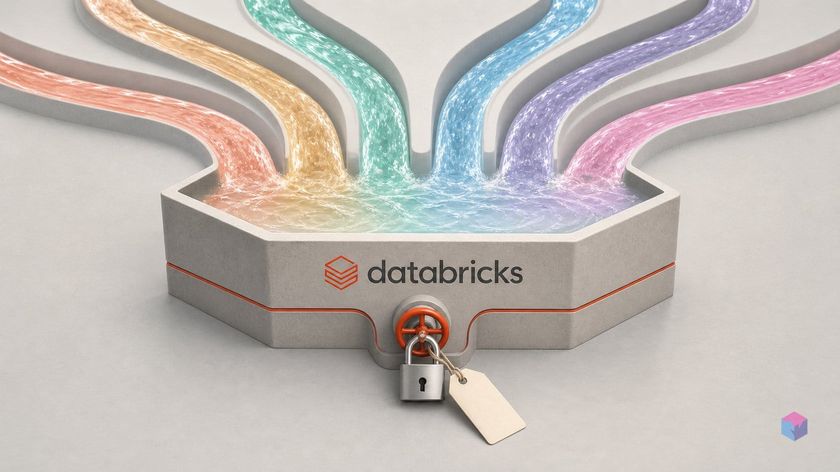
Databricks' Lineup Now Spans All Major AI Families
Databricks just turned Agent Bricks into a multi-model meeting point — and at its 2026 Data + AI Summit it added two more families, including Elon Musk's Grok.
At DAIS 2026 (June 16–18), Databricks added Kimi (Moonshot) and xAI's Grok to Agent Bricks, its platform for building and governing enterprise AI agents . The supported roster now spans OpenAI, Anthropic, Google Gemini, Qwen, Kimi, and Grok, alongside custom fine-tuned and RL-trained models . The point is breadth: developers can route a single agent across frontier and open-source models inside one governed boundary.
Quick Answer: At DAIS 2026 (June 16–18), Databricks added xAI's Grok and Moonshot's Kimi to Agent Bricks, bringing the supported roster to OpenAI, Anthropic, Google Gemini, Qwen, Kimi, and Grok. Databricks reports more than 100,000 agents built and over 1 quadrillion agent tokens processed per year.
Databricks frames the value as choice: model families keep leapfrogging each other on behavior, latency, and cost, so it wants developers picking per task rather than locking into one vendor . The scale claims are its own: more than 100,000 agents built on Agent Bricks, processing over 1 quadrillion agent tokens per year . Named production deployments cited at DAIS include AstraZeneca, 7-Eleven, Fox Corporation, and Block .
One caveat for builders: Databricks has not published its own billing rates for these models. The table below pairs each family with public direct-API references where available — useful for ballpark planning, not for Databricks pass-through pricing.
| AI family | Status in Agent Bricks | Public direct-API reference |
|---|---|---|
| OpenAI | Supported | Vendor API (Databricks rates unpublished) |
| Anthropic | Supported | Vendor API (Databricks rates unpublished) |
| Google Gemini | Supported | Vendor API (Databricks rates unpublished) |
| Qwen | Supported (open-source) | Open weights / vendor API |
| Kimi (Moonshot) | Newly added at DAIS 2026 | Vendor API (Databricks rates unpublished) |
| Grok (xAI) | Newly added at DAIS 2026 | grok-4.3: 1M-token context, $1.25/1M input, $2.50/1M output |
The plural "Grok models" appears in both the xAI and Databricks posts, but neither lists exact Databricks model IDs, regions, or pricing . Treat the roster as confirmed and the SKU-level detail as still pending official release notes.
Keeping Sensitive Queries Within the Perimeter
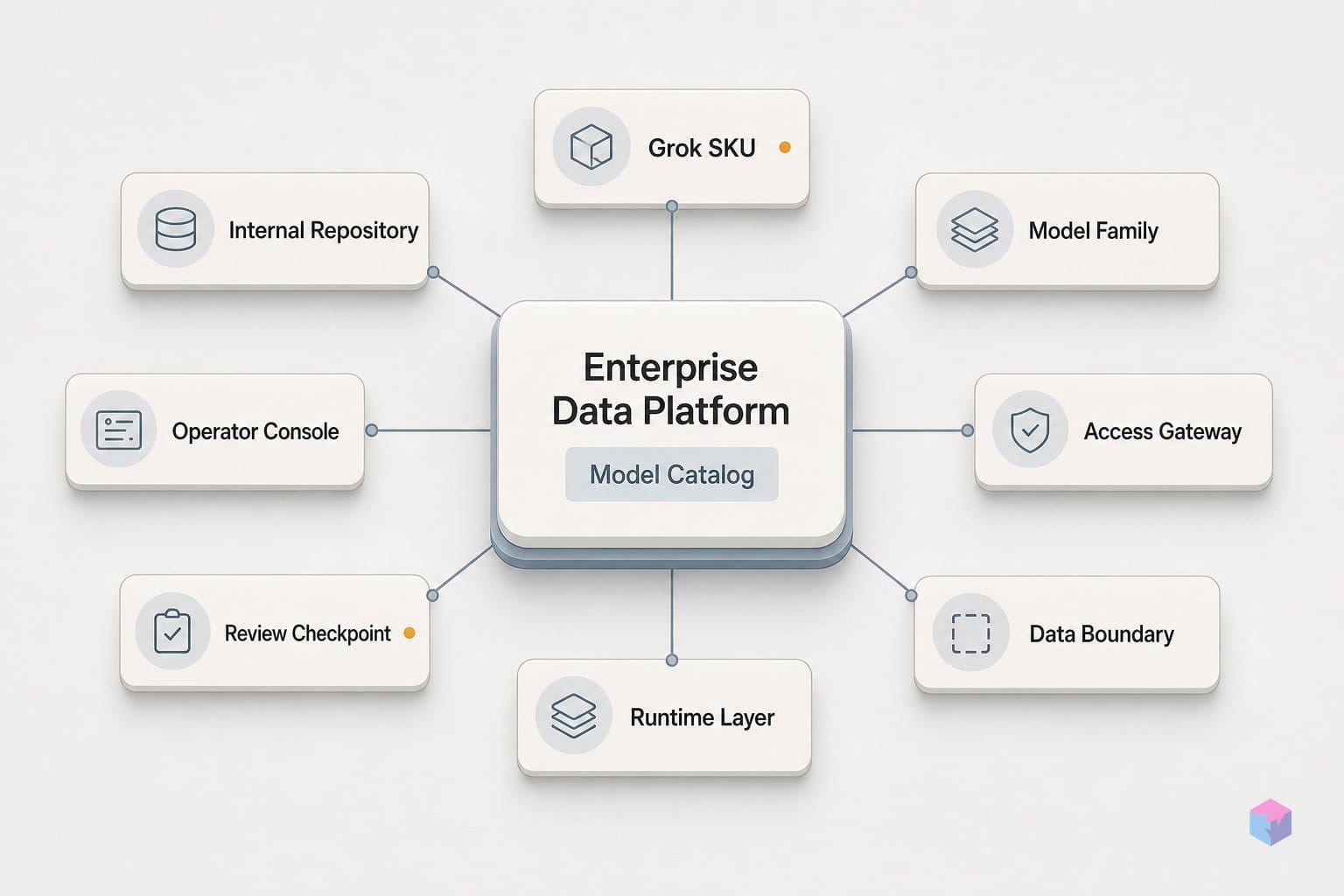
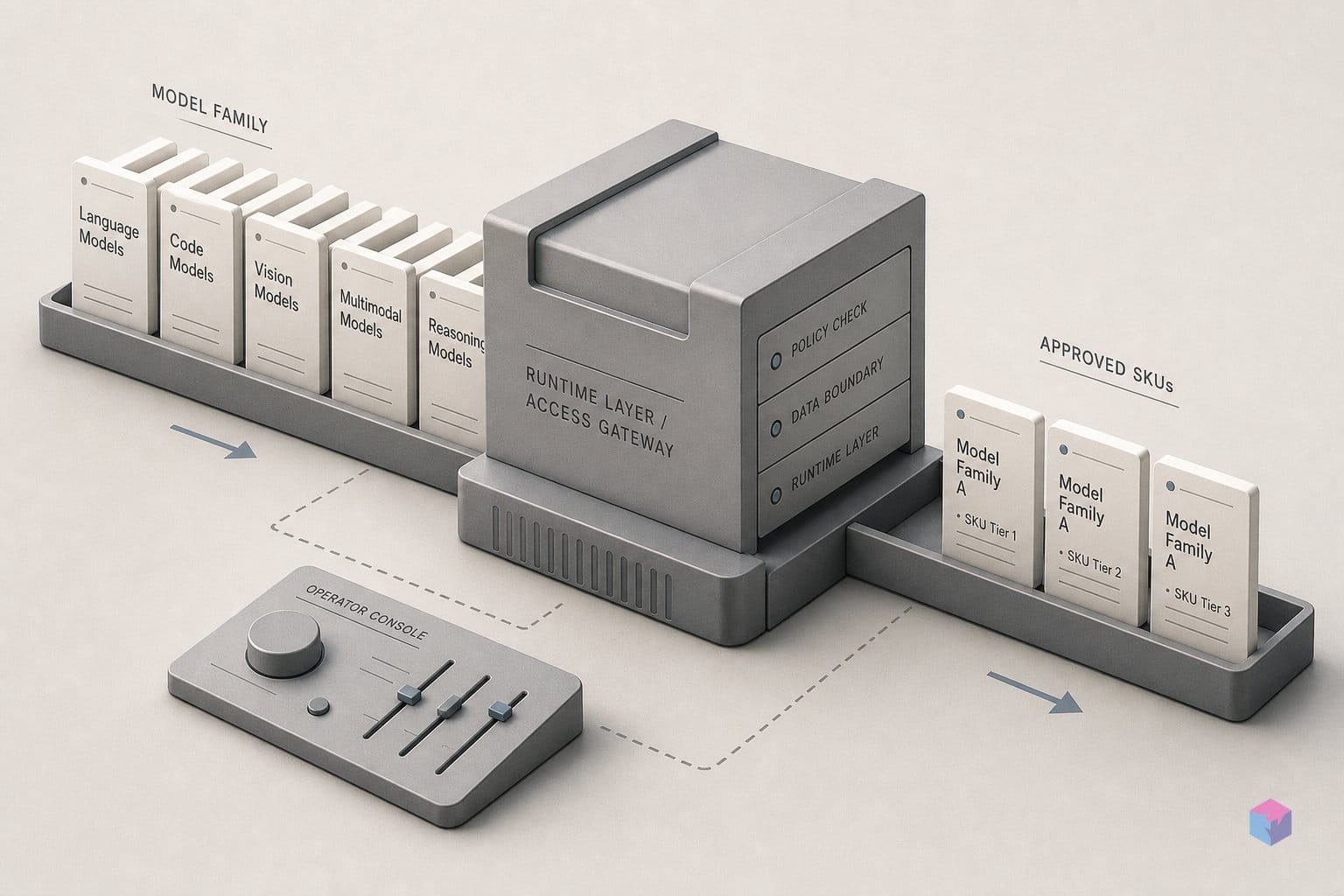
Native availability means Grok inference runs inside Databricks' own security boundary, so a customer's corporate corpus never exits to an external pipeline. Agents built in Agent Bricks reason over Lakehouse data in place, rather than shipping it to xAI's public API. That is the substantive difference for builders — model choice that keeps governance and data residency where the data already lives .
Inside that perimeter, Agent Bricks wires agents to both structured and unstructured Lakehouse data through several connectors:
- MCP support in Unity Catalog for tool and external-source access
- Genie Ontology for semantic grounding over enterprise tables
- Managed memory backed by Lakebase
- Document Intelligence for unstructured content
- Sandboxed execution for agent-run code
This is what removes the need for custom ETL. Without it, a team would have to build pipelines to ferry sensitive records into an external model endpoint and back. Here, queries execute against the Lakehouse natively, inside the governed boundary, against the same Unity Catalog permissions that already gate the data .
On retention, the reporting is specific. The relevant endpoints are described as zero-data-retention, model partners including xAI do not retain data submitted through these features, and Databricks states it does not train foundation models on customer data submitted to its AI assistive features . For a regulated team — the kind running pharma or financial workloads — that is the contractual line that makes a frontier model usable on real data.
One caveat worth flagging: these are the stated platform-level data-handling terms. Exactly how Databricks' own governance policies interact with xAI-hosted inference is among the details still pending official release notes . Treat the perimeter guarantees as confirmed at the platform level, and the operator-plane mechanics — covered next — as where the enforcement actually happens.
The 'Any-Family' Philosophy and Why Choice Is the Value Prop
Databricks frames Agent Bricks around three pillars — Choice (any model), Context (enterprise data access), and Control (governance) — and Grok's arrival extends the Choice pillar rather than signaling a product endorsement . Read that way, the news is not "Databricks thinks Grok is best." It is Databricks widening the menu so customers can pick per task and swap later.
The argument behind Choice is structural. Databricks says model families keep leapfrogging one another with each release, forcing trade-offs across behavior, latency, and cost . No single family leads on every workload, so committing an agent stack to one provider is a bet against that churn. The roster now spans frontier proprietary and open families — OpenAI, Anthropic, Google's Gemini, Qwen, Kimi, and Grok — plus custom fine-tuned and RL-trained models .
What broad choice buys a builder, in practice:
- Task-fit routing — match a model to a job instead of forcing one family across reasoning, extraction, and coding workloads.
- Cost control — move spend toward cheaper models when quality allows, without re-platforming.
- Churn insurance — when a rival ships a better release, switching is a config change, not a migration.
That trade-off is exactly what one named customer describes. Gregory Rokita, VP of Technology at Edmunds, said the platform lets his team "run multiple models and switch providers as our needs evolve, all while keeping costs in check" (source: Databricks, 2026-06).
The honest reading of Grok's addition, then, is that Databricks is hedging against model-performance churn on behalf of its customers — not crowning a winner. Notably, the Databricks post cites no benchmark scores for Grok or any other family, which is consistent with a choice-neutral stance . The value proposition is optionality inside one governed plane. Whether that optionality holds depends on the operator controls that enforce it.
How Unity's New Operator Plane Sets Limits and Traces Calls
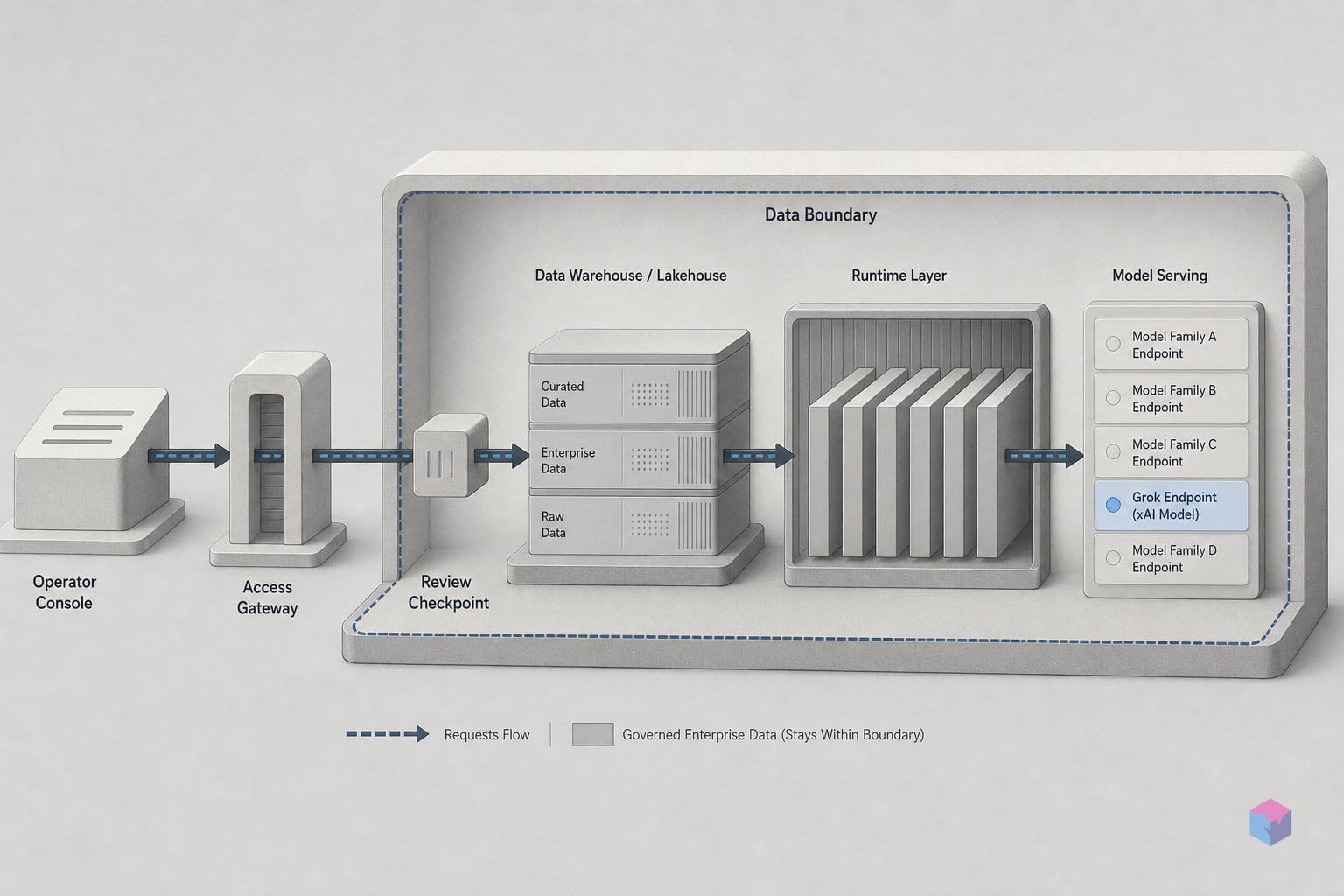
The operator controls live in the Unity AI Gateway, a governance layer Databricks detailed on June 16, 2026. It is designed to let teams "use any model, agent, or tool" while centrally governing access, actions, cost, and monitoring across every family in the roster (source: Databricks, 2026-06). For developers, this is the plane that turns multi-model optionality into something an organization can actually budget and audit.
Cost visibility is the headline addition. The gateway surfaces unified AI spend across all tools and models, granular cost attribution per team or project, and hard spend caps that stop runaway usage before the invoice does (source: basenor, 2026-06). For finance and platform owners, that means Grok, Gemini, Kimi, and Qwen calls roll into one ledger instead of separate vendor dashboards.
The new capabilities break down as follows:
- Smart routing — directs requests by task complexity, quality, and cost, so cheaper tasks land on lower-cost families automatically, with no per-request branching in application code .
- Contextual runtime policies — guardrails authored in SQL, with Python support described as "coming soon," letting teams enforce rules in a structured language rather than custom middleware .
- End-to-end traces — full visibility into model calls and MCP activity, so operators can reconstruct what an agent did and which tools it touched .
- Extended Unity Catalog governance — registration and access control now reach MCP services, registered skills, and agent definitions, not just tables and models .
The practical implication for builders: switching a workload from one family to another becomes a routing and policy decision rather than a code rewrite. The same SQL guardrail and the same trace pipeline apply whether the call hits Grok or an open-source model. That uniformity is what makes the "any-family" pitch operationally credible — and it is the layer to watch as the specific Grok SKUs and their pass-through pricing get pinned down.
How Musk's AI Firm Chose Clouds Over Its Own Portal
Grok's Databricks debut is the latest step in a year-long distribution strategy: xAI has spent twelve months placing its models inside enterprise clouds rather than relying on Grok.com, X, or its direct API. The arc runs from Oracle Cloud Infrastructure in June 2025 , through Microsoft Azure AI Foundry in September 2025, to Amazon Bedrock and Databricks within a single week in June 2026 .
| Cloud surface | Announced | Integration type |
|---|---|---|
| Oracle Cloud Infrastructure | June 17, 2025 | Managed Grok models on OCI |
| Microsoft Azure AI Foundry | September 2025 | Model catalog availability |
| Amazon Bedrock | June 17, 2026 | Grok 4.3 generally available |
| Databricks Agent Bricks | June 18, 2026 | Native model in governed agent platform |
Grok 4.3 is the likely reference SKU. xAI's Bedrock listing cites a 1 million-token context window and configurable reasoning effort, plus vendor-reported top rankings on Artificial Analysis Omniscience, Tau2 Telecom, and Vals AI Case Law and Corporate Finance . Treat those scores as xAI's own claims until independent leaderboards confirm them — the Databricks post itself publishes no benchmark figures.
Pricing is the open question. xAI's public API list rates put grok-4.3 at $1.25 per 1M input tokens and $2.50 per 1M output , and the coding-focused grok-build-0.1 at $1.00 input and $2.00 output over a 256k context, with web and X-search tool calls billed at $5 per 1,000 invocations . None of these are confirmed Databricks pass-through rates.
The throughline is strategic, not technical: xAI is meeting enterprise buyers where their data and governance already live. For developers, that means Grok arrives pre-wired into the same procurement, security, and billing surfaces as competing families — and the choice of provider becomes a platform decision rather than a separate vendor contract.
Billing and SKU Specifics That Remain Unstated
The biggest gap is precision: neither official post names a single Databricks model ID. Both xAI's announcement and the Agent Bricks post describe only "Grok models" in the plural . As of June 18, 2026, there is no published list of which SKUs are exposed, no preview-vs-GA flag, no cloud-region matrix, and no stated SLA .
Pricing is the other blank. xAI's API list rates put grok-4.3 at $1.25 per 1M input tokens and $2.50 per 1M output tokens , but those are direct-API prices, not Databricks pass-through or billing terms. The Databricks posts publish no Grok-on-Databricks rate, so cost-conscious teams cannot yet model spend against the Unity AI Gateway's hard caps and cost-attribution features.
For builders, the most consequential unknown is tooling. xAI's distinguishing capability is live retrieval — Web Search and X Search, listed at $5 per 1,000 calls on xAI's own pricing . Neither post addresses whether those tools are reachable through Agent Bricks.
Open questions worth tracking in the release notes:
- Exact Grok SKUs and model IDs surfaced in Agent Bricks
- Databricks billing rates versus xAI's direct API list prices
- Preview vs. GA status, region availability, and SLA
- Whether Grok's web/X-search tools work inside the governed perimeter
The takeaway: the strategic story — Grok inside a governed, multi-model control plane — is real, but the operational fine print developers need to commit a workload is not on the page yet. Until Databricks ships concrete SKU, pricing, and tool-support details, treat Grok-on-Databricks as confirmed availability with terms to be verified, not a spec you can architect against today.
Frequently asked questions
What is Databricks Agent Bricks?
Agent Bricks is Databricks' unified environment for building, testing, deploying, and governing AI agents against enterprise data. It connects agents to Lakehouse data through MCP support in Unity Catalog, managed memory backed by Lakebase, Genie Ontology, and Document Intelligence. Databricks repositioned it from an experiment into a core platform at the 2026 Data + AI Summit, reporting more than 100,000 agents built and over 1 quadrillion agent tokens processed per year, with customers including AstraZeneca, 7-Eleven, Fox Corporation, and Block.
Which specific Grok models are available in Databricks Agent Bricks?
The exact SKUs are not yet specified. Both xAI and Databricks refer only to "Grok models" without listing Databricks model IDs, as of June 18, 2026. On xAI's public API, the flagship is grok-4.3 with a 1 million-token context window, while the coding-focused grok-build-0.1 carries a 256k context window. Whether either or both appear in Agent Bricks is unstated.
How is native Grok access in Databricks different from calling the xAI API directly?
The Databricks integration routes inference through Unity Catalog's security and governance boundary, so corporate structured and unstructured Lakehouse data stays inside the governed perimeter instead of leaving via external API pipelines (source: xAI, 2026-06). Reporting states the relevant endpoints are zero-data-retention, and partners including xAI do not retain submitted data. Databricks centrally handles authentication, spend caps, cost attribution, and runtime policy enforcement — work you manage yourself when hitting xAI's API directly.
What does the Unity AI Gateway add for governing Grok calls?
The Unity AI Gateway is the control plane for multi-model governance. It adds unified AI spend visibility across tools and models, hard spend caps, granular cost attribution per team or project, and smart routing based on task complexity, quality, and cost (source: Databricks, 2026-06). Contextual runtime policies are authored in SQL, with Python support described as coming soon, and the gateway captures end-to-end traces for model and MCP activity (source: Basenor, 2026-06).
Are Grok's web search and X search tools available inside Agent Bricks?
This is not specified in either official announcement as of June 18, 2026. On xAI's direct API, Web Search and X Search tool invocations are priced at $5 per 1,000 calls. Because these search tools are a defining differentiator of xAI's offering, whether Agent Bricks exposes them — and under what billing — is an open question developers should confirm in forthcoming release notes.
Last updated: 2026-06-25. Reviewed against xAI and Databricks announcements from the 2026 Data + AI Summit; SKU, pricing, and tool-support details remain pending official release notes.