
1.5 in 60 words: in-pass sound, 1080p, narrowed to still-photo animation
Grok Imagine Video 1.5 is xAI's image-to-video model: you supply a source image, that image becomes frame 1, and a text prompt drives the motion . The two concrete additions over the base grok-imagine-video slug are synchronized audio — dialogue, sound effects, and music generated in the same pass rather than as a separate stage — and a new 1080p resolution tier the older model lacks .
It surfaces in the API under three identifiers :
grok-imagine-video-1.5— the stable aliasgrok-imagine-video-1.5-preview— still listed on the model pagegrok-imagine-video-1.5-2026-05-30— the dated snapshot
xAI documents a 1 request/second rate limit on the model page . Launch write-ups in mid-June 2026 framed 1.5 as fully released, though the persisting -preview alias muddies that "out of preview" claim — the doc slug itself does not say so .
The 60–100% premium for 1.5 over the original animation slug
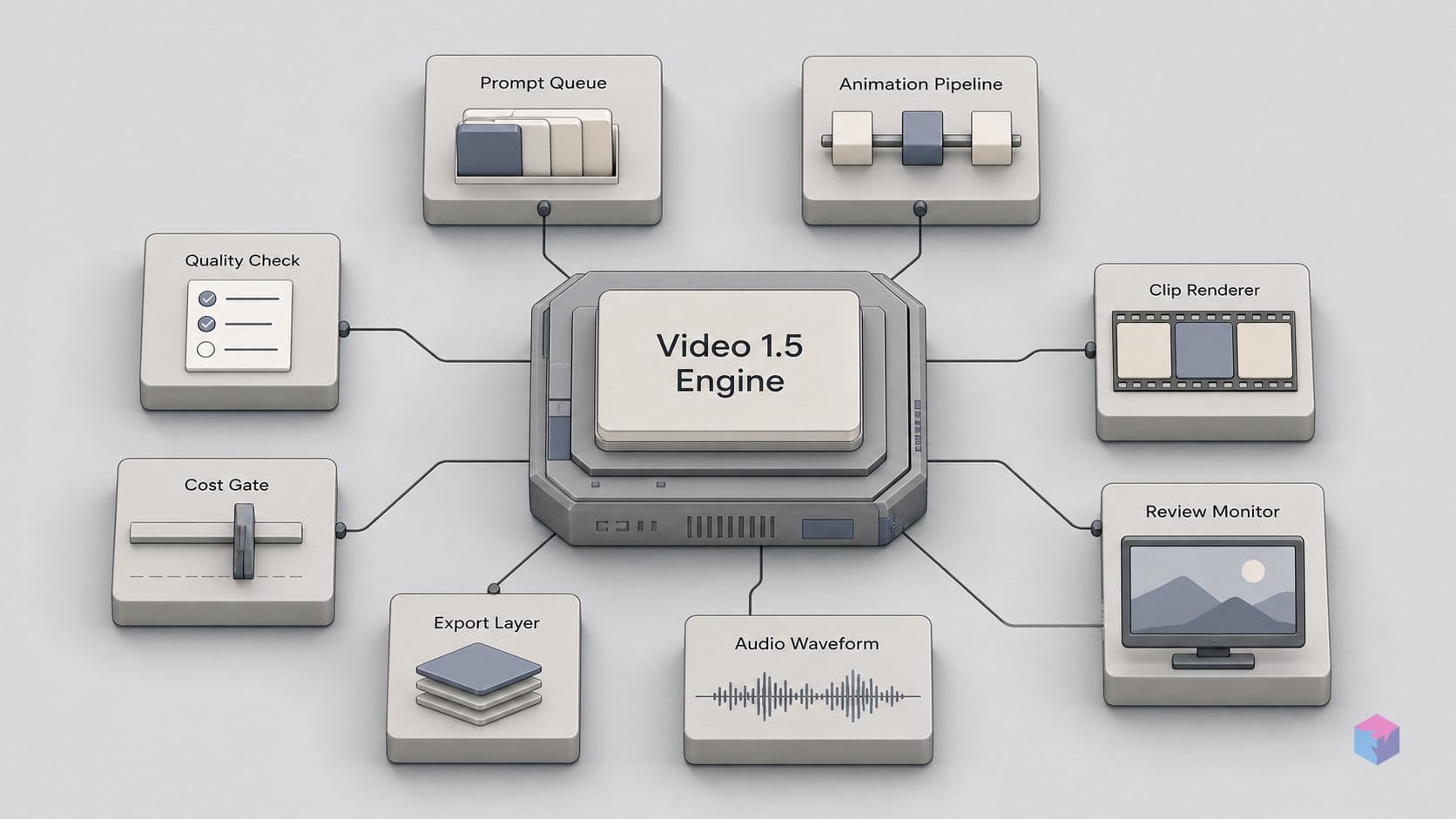
The upgrade has a fixed, documented price. xAI lists grok-imagine-video-1.5 at $0.08/sec (480p), $0.14/sec (720p), and $0.25/sec (1080p), plus $0.01 per input image . The original grok-imagine-video slug runs cheaper: $0.05/sec (480p) and $0.07/sec (720p), with $0.002 per image and $0.01/sec for video input .
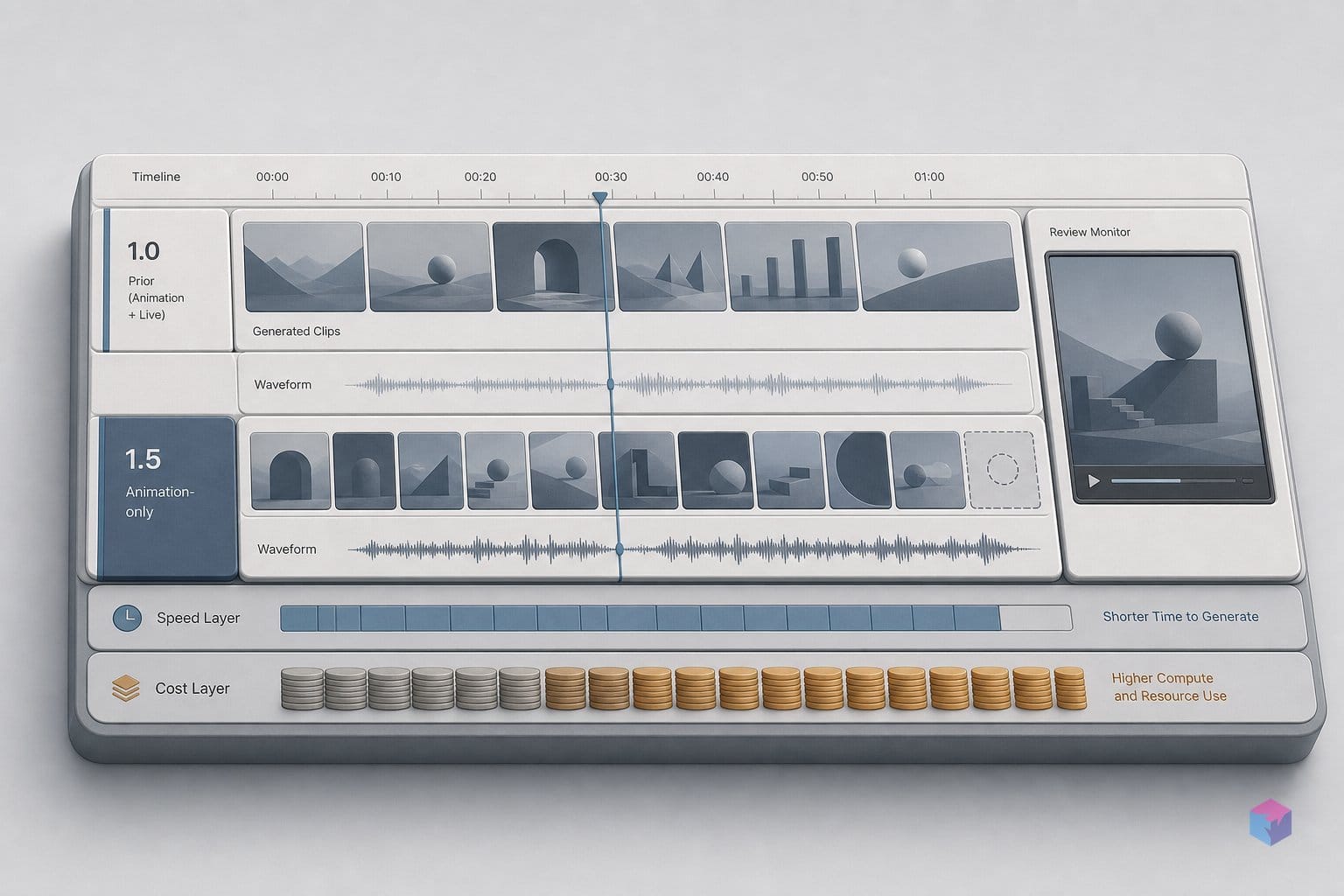
That puts 1.5 at roughly a 60% premium at 480p and 100% at 720p — and 1.5 is the only slug that unlocks a 1080p tier the base model does not offer .
| Tier | grok-imagine-video-1.5 | grok-imagine-video (base) | Premium |
|---|---|---|---|
| 480p / sec | $0.08 | $0.05 | ~60% |
| 720p / sec | $0.14 | $0.07 | ~100% |
| 1080p / sec | $0.25 | n/a | 1.5 only |
| Image input | $0.01 | $0.002 | — |
For capacity planning, the per-second model is easy to project. A 10-second render on 1.5 costs $0.80 (480p), $1.40 (720p), or $2.50 (1080p) before image input . A 15-second 720p clip lands near $2.10 output plus $0.01 image, or $2.11 total . If your workflow does not need 1080p or in-pass audio, the base slug remains the cheaper path.
The 25-second headline: third-party write-up, not a reproducible async measurement
The speed story is softer than the pricing story. Launch coverage reports that the consumer "Video 1.5 Fast" variant renders a 6-second, 720p clip in about 25 seconds, down from 40-plus seconds on the prior model — a roughly 40% reduction . That figure comes from a write-up, not an official xAI benchmark, so treat it as directional.
xAI's own API documentation tells a different timing story. It describes video generation as asynchronous and says it "typically takes up to several minutes," varying with prompt complexity, duration, resolution, and editing overhead . The SDK polling examples default to a 100ms interval and a 10-minute timeout — not an architecture built around a sub-30-second assumption .
The cleanest reconciliation: "25 seconds" describes the latency-optimized Fast variant on grok.com, while "several minutes" describes the standard async API job — same model, two surfaces. As independent reporting cautions, vendor speed numbers are measured under controlled conditions, "not necessarily reflective of real-world performance," per TechJack Solutions.
No official xAI benchmark compares 1.5 against the prior model on identical prompt, duration, resolution, queue state, and region. Until one exists, plan API capacity around the documented "several minutes," not the headline.
In-pass sound synchronization: the one concrete addition in 1.5
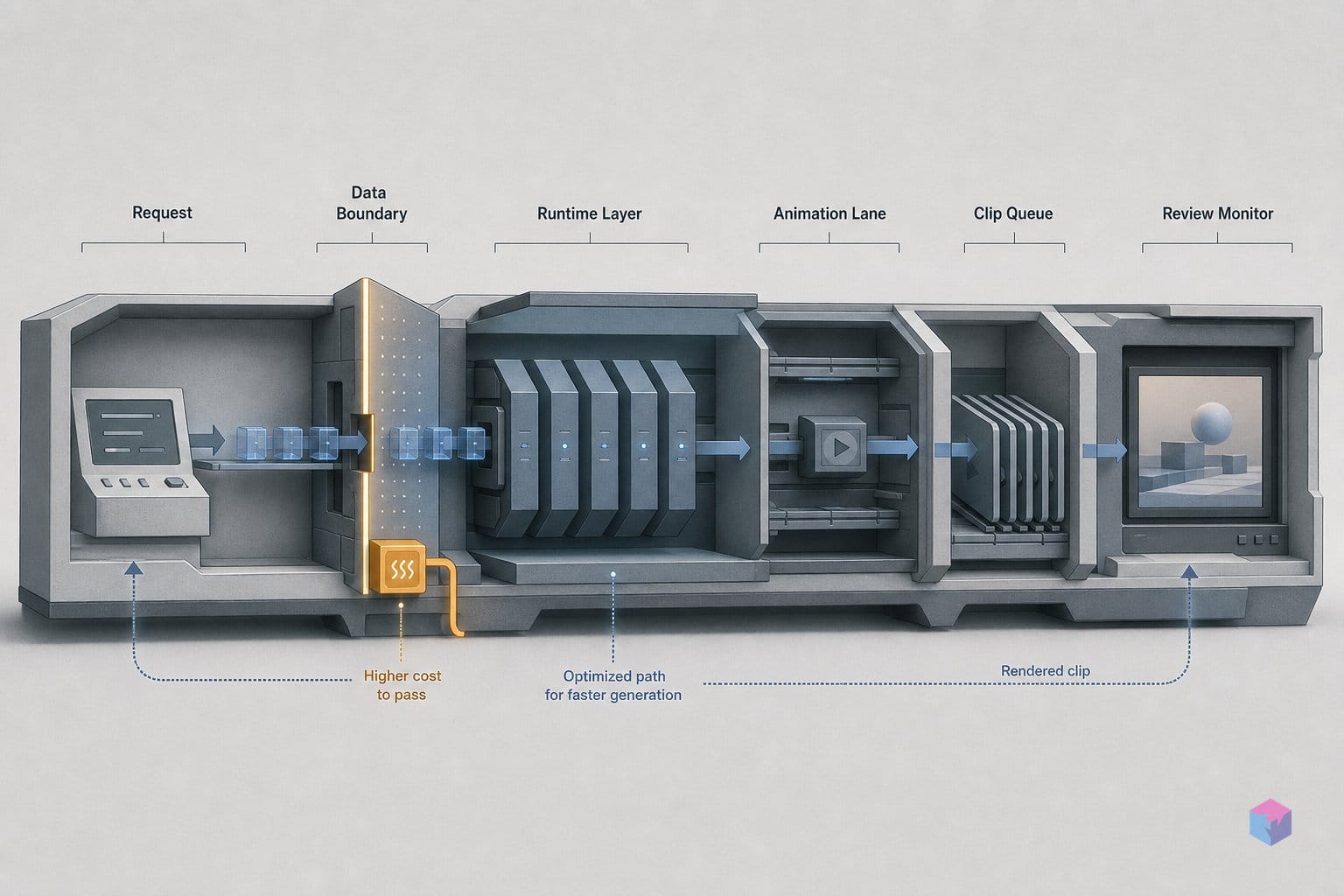
The clearest functional upgrade in 1.5 is native synchronized audio. Per xAI's launch materials, dialogue, sound effects, ambient sound, and background music are generated in the same rendering pass as the video, not bolted on as a separate post-process stage . That single-pass design is what distinguishes 1.5 from the prior animation slug at the feature level, independent of the speed and pricing claims.
xAI pairs this with softer, unquantified claims:
- Improved lip-sync and speech clarity
- Better physics and motion plausibility
- Stronger motion coherence across longer clips
None of these carry a number or test methodology in the official docs . One practitioner guide notes a mode-independent limit: fine-detail consistency on complex brand elements, product packaging, and multi-feature subjects "shows drift during camera movement" . Treat the audio feature as confirmed; treat the quality claims as vendor assertions, since xAI has published no 1.5 technical report, training-data disclosure, or safety evaluation to check them against .
Arena Elo scores and the limits of blind-test ranking
Launch coverage reported that Video 1.5 took the #1 spot on an Image-to-Video Arena leaderboard, ranking above Sora 2, Google Veo 3.1, Seedance 2.0, and Kling in blind testing , with separate write-ups echoing the leaderboard win . Read that as a directional signal, not a settled verdict.
Arena ranking rests on blind human preference votes over randomly paired outputs. Prompts, durations, and resolutions are not standardized across comparisons, and the cited Elo figures vary by source — each reflecting leaderboard state at a single moment. Scores shift as new model submissions arrive, so today's #1 is provisional.
"Vendor speed and ranking numbers are measured under controlled conditions" — independent reporting on the 1.5 launch (source: TechJack Solutions).
No independent reproduction under controlled conditions exists, and xAI has published no standardized public benchmark to check the arena result against . Treat the ranking as a snapshot of perceived visual quality, not a definitive ordering.
Functions excluded from 1.5: text-prompt, reference, and editing
Grok Imagine Video 1.5 accepts exactly one input shape: a still image plus a text prompt, where the source image becomes the first frame. Text-to-video, reference-to-video, and video editing or extension are not supported. This is documented as a standing constraint in xAI's model page, not a temporary preview gap or an API quirk .
So the routing decision is explicit. If you need any of the following, you drop back to the broader grok-imagine-video slug:
- Prompt-only generation with no source image (text-to-video)
- Reference-to-video conditioning
- Extending or editing an existing clip
That base model carries the wider input surface 1.5 trades away .
The narrowing matters for trust-and-safety teams too. In January 2026, the Internet Watch Foundation cited dark-web claims of sexualized imagery of minors made with Grok Imagine, after which xAI restricted image generation mainly to paying subscribers . Faster, lower-friction animation raises the abuse-at-scale surface for any platform ingesting user-generated video.
Async polling, 1-rps cap, and the Priority Processing ambiguity
Integrating 1.5 means building around its delivery model, not just its price. Submission is asynchronous: you send a job and poll for completion through the xAI SDK, which defaults to a 100ms poll interval and a 10-minute timeout. The model page lists a 1 request/second rate limit, so any concurrent workload needs your own queue logic — there is no built-in batching to lean on.
Two gaps deserve caution before you commit:
- Priority Processing is unclear. xAI's docs are inconsistent on whether paid Priority Processing covers video endpoints; do not assume it applies to 1.5 jobs without confirming.
- Throughput at scale is undocumented. No official latency figures exist for this slug under concurrent load, so plan capacity from your own load tests, not vendor numbers.
The takeaway: 1.5 buys you in-pass audio and a 1080p tier at a 60–100% premium, but you inherit a 1-rps async pipeline with unverified priority and undisclosed scaling behavior. Prototype against your real queue before betting production on it.
Frequently asked questions
Can I use grok-imagine-video-1.5 to generate video from a text prompt alone?
No. The grok-imagine-video-1.5 slug is image-to-video only — you must supply a still image, which becomes the first frame, plus a text prompt to drive motion . Prompt-only generation, reference-to-video, and editing or extension are not supported on 1.5; those workflows still require the broader grok-imagine-video base model .
How does grok-imagine-video-1.5 pricing compare to the base model?
It is meaningfully pricier. List pricing for 1.5 is $0.08/sec at 480p and $0.14/sec at 720p, versus $0.05 and $0.07/sec on the base grok-imagine-video model — roughly 60% more at 480p and 100% more at 720p . The one exclusive feature you pay for is the 1080p tier at $0.25/sec, which the base model does not offer .
How long does a grok-imagine-video-1.5 job actually take via the API?
Official docs are vague: generation is asynchronous and "typically takes up to several minutes," varying with prompt complexity, duration, and resolution . The widely-quoted figure of about 25 seconds for a 6-second 720p clip refers to the consumer-surface "Video 1.5 Fast" variant on grok.com, not a standard async API render . Treat the two as different surfaces, and load-test before sizing capacity.
Does Priority Processing apply to grok-imagine-video-1.5 jobs?
Unclear. xAI's documentation does not consistently confirm that paid Priority Processing covers video endpoints, so it is unsafe to assume priority scheduling reliably applies to 1.5 jobs . Verify the current behavior directly against the API before building any latency assumptions or SLAs around it.
Is the #1 Image-to-Video Arena ranking independently verified?
No. The reported #1 placement — ahead of Sora 2, Google Veo 3.1, Seedance 2.0, and Kling — comes from blind human preference voting on an arena leaderboard, not standardized prompts or fixed test conditions . Cited Elo figures vary by source and shift as new models are submitted, so the claim should be read as leaderboard-aligned rather than a reproducible benchmark .