
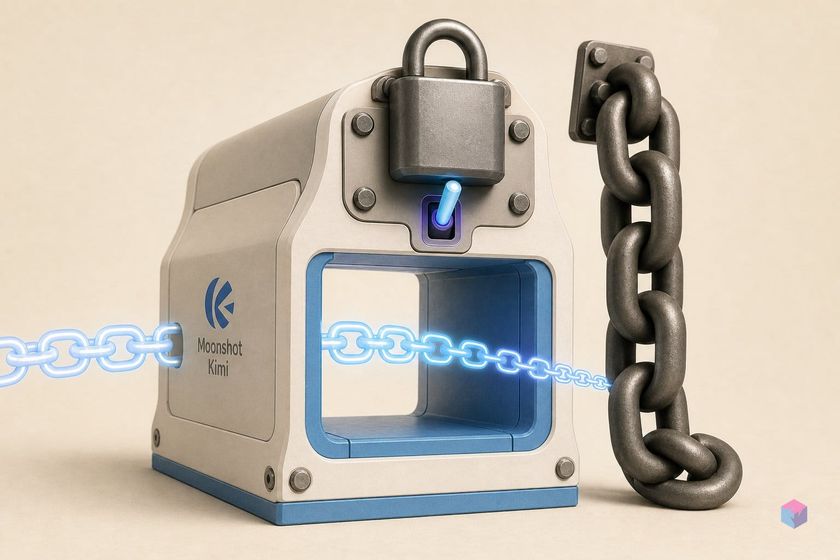
Moonshot's Kimi line just split coding off from chat: K2.7 Code is a model built to plan, edit files, run shell commands, and debug across many steps — and it ships with one constraint you can't toggle off.
K2.7 Code: 180 t/s, Multimodal, and Mandatory Chain-of-Thought
Kimi K2.7 Code is Moonshot AI's coding-specialized successor to K2.6, shipped June 12, 2026 and tuned for agentic, long-horizon software engineering rather than general chat. Its headline pitch is efficiency: Moonshot claims roughly 30% fewer reasoning tokens than K2.6 at comparable quality.
Quick Answer: K2.7 Code is Moonshot AI's coding model (shipped June 12, 2026) with a 256K-token context, multimodal input, and a vendor-claimed ~30% reasoning-token reduction over K2.6. Chain-of-thought is always on — disabling it returns a hard API error.
On June 15, 2026 Moonshot added a HighSpeed variant, exposed as model ID kimi-k2.7-code-highspeed — the same model running faster, about 180 tokens/s output, up to ~260 tokens/s on short prompts. Both variants expose a 256K (262,144) token context window and are multimodal: images (png/jpeg/webp/gif, ≤4096×2160) and video (mp4/mov/webm and more, ≤2048×1080), passed as base64 data URLs or ms://<file_id> references .
Treat the benchmarks as vendor claims. The figure both reports agree on is MCP Mark Verified +11.4% over K2.6; larger numbers like SWE Marathon +76.2% appear in only one source and are self-reported, and the HighSpeed update skipped independent benchmark submission at launch. One thing isn't negotiable: temperature is fixed at 1.0, top_p at 0.95, tool_choice accepts only "auto" or "none", and thinking mode is always on — attempting to disable chain-of-thought returns an API error, with no opt-out .
Before You Auth: Kimi CLI or Moonshot's Pay-as-you-go
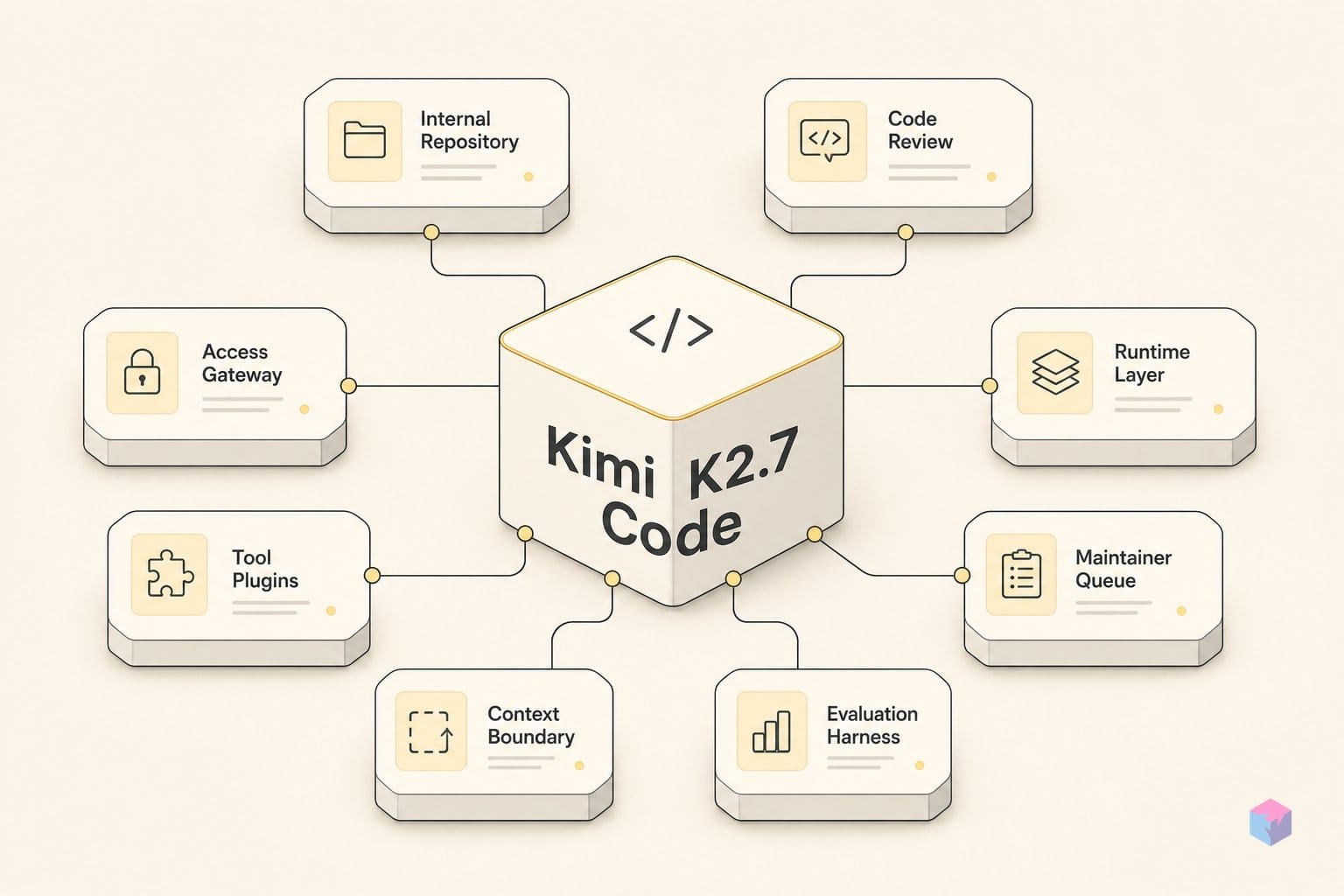
Pick your access route before you write any code, because keys, billing, and model IDs all diverge. There are two: Kimi Code is a membership-quota product for terminal, IDE, and third-party agent workflows, billed by request volume rather than tokens; the Moonshot Platform is pay-as-you-go per-token API access for application integration. Kimi Code refreshes quota every 7 days from your subscription date with no rollover, advertising roughly 300–1,200 requests per 5-hour window and up to 30 concurrent requests, shared across all devices and keys on the account . The Platform needs a $1 minimum recharge to unlock, then bills per million tokens .
The model IDs differ too. Kimi Code's stable alias kimi-for-coding always maps to the latest backend, so you never reconfigure on upgrades; the Platform uses versioned IDs kimi-k2.7-code / kimi-k2.7-code-highspeed .
Keys are not interchangeable. Platform keys come from platform.kimi.ai; Kimi Code keys come from the Kimi Code Console — max 5 per account, with each full key shown exactly once, so copy it immediately .
| Route | Base URL | Model ID | Billing | Quota notes |
|---|---|---|---|---|
| Kimi Code (membership) | https://api.kimi.com/coding/v1 | kimi-for-coding | Subscription quota | ~300–1,200 req / 5-hr, 7-day cycle, no rollover |
| Moonshot Platform (PAYG) | https://api.moonshot.ai/v1 | kimi-k2.7-code / -highspeed | $0.19 cached · $0.95 input · $4.00 output per 1M | $1 minimum recharge to unlock |
Kimi CLI Quickstart: From curl to Pair Programmer
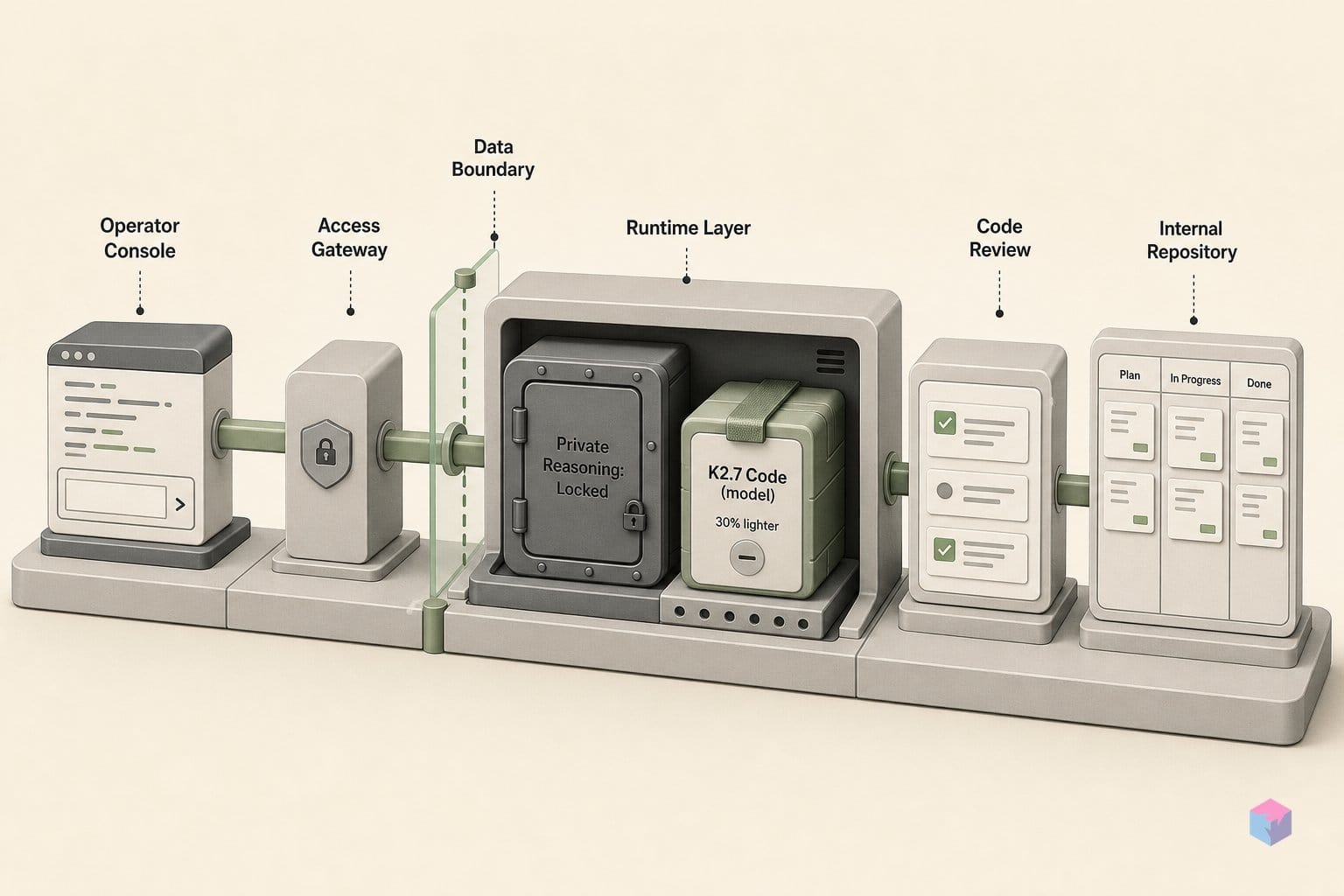
The fastest way to drive K2.7 Code is Moonshot's official CLI, kimi — an interactive terminal agent that ships with its own bundled runtime, so a one-line installer is all you need. On macOS or Linux, run the install script; on Windows, use the PowerShell equivalent :
# macOS / Linux
curl -fsSL https://code.kimi.com/kimi-code/install.sh | bash

# Windows (PowerShell)
irm https://code.kimi.com/kimi-code/install.ps1 | iex
Prefer npm? The CLI is TypeScript-distributed, but that route needs Node.js 22.19.0 or newer . Once installed, cd into a project, run kimi, type /login, and paste a Kimi Code key. Confirm the active backend with /model — it should report the stable ID kimi-for-coding , which maps to the latest backend so you never reconfigure on upgrades.
The agent has controlled shell and file access. Read-only and search actions run automatically, while file modifications and shell commands pause for confirmation by default . Scope your first run to a bounded task — one bug plus its tests, or a repository orientation pass — before pointing it at a large codebase. "Refactor the whole project" is the prompt most likely to burn quota and confidence.
A few session commands worth knowing on day one:
/help— list all commands/new— start a fresh conversation/fork— branch the current session/compact— shrink context to reclaim window spacekimi -p 'explain this file'— run a one-shot prompt without entering the TUIkimi -C— resume the previous session
Moonshot recommends a true-color, ligature-capable terminal such as Kitty or Ghostty for the cleanest diffs . Config, logs, sessions, and the update cache all live under ~/.kimi-code/, which you can relocate by setting the KIMI_CODE_HOME environment variable — handy for keeping work and personal accounts separate.
Where K2.7 Code Goes Wrong
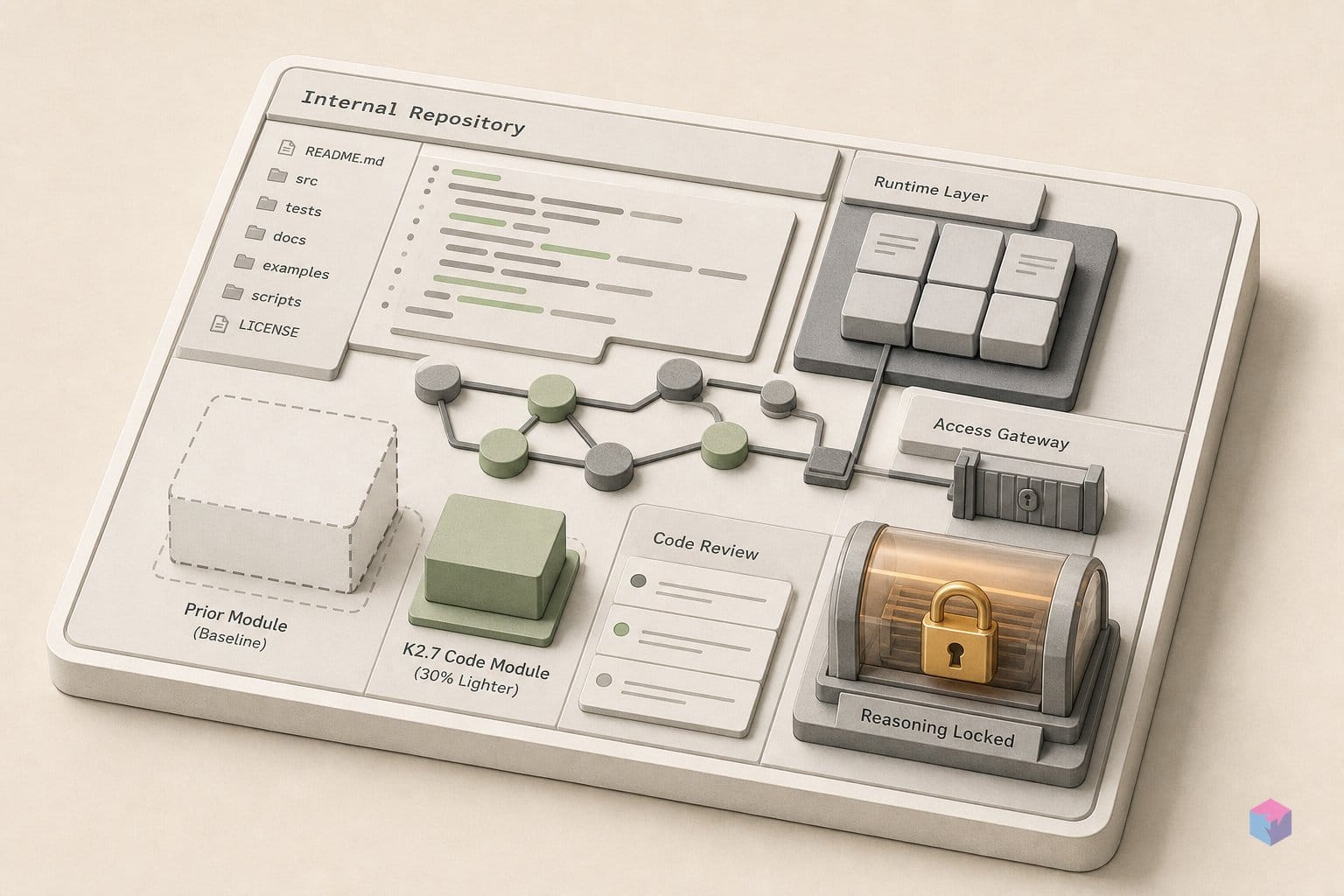
Most early failures come from carrying K2.6 habits into K2.7 Code. The model rejects sampling overrides: temperature is fixed at 1.0 and top_p at 0.95, so any request that passes other values returns an error . Strip both from your migration code before the first call. tool_choice is similarly narrow — only "auto" or "none" are accepted, and anything else fails .
The quietest trap is in multi-turn agent loops: you must echo the assistant message's reasoning_content back into context every turn. Drop it and chain quality degrades silently — no exception, just worse decisions over a long horizon .
Treat the headline numbers as vendor claims. Only the MCP Mark Verified +11.4% gain over K2.6 appears in two independent sources; SWE Marathon and Kimi Code Bench v2 figures are Moonshot-internal, and HighSpeed Mode shipped on June 15, 2026 with no third-party evaluation at all .
"Kimi K2.7 Code adds HighSpeed Mode — but skips independent benchmark submission," reported TechTimes, flagging that the speed update arrived without external verification (source: TechTimes, 2026-06).
Finally, watch your quota model. Kimi Code membership refreshes every 7 days from your subscription date with no rollover, shared across all devices and API keys on the account, and capped at roughly 300–1,200 requests per 5-hour window — so batch-heavy jobs hit the wall fast . Platform accounts are throttled under cluster load regardless of tier, and rate limits scale with cumulative recharge amount, not subscription level .
K2.7 Code: Where to Go After the CLI Quickstart
Once the CLI feels familiar, wire K2.7 Code into your editor. In Roo Code, pick the OpenAI Compatible provider, set the base URL to https://api.kimi.com/coding/v1, model kimi-for-coding, max output 32768, context 262144, streaming on, image on, reasoning effort Medium aimadetools. For Claude Code via Kimi Code membership, set ANTHROPIC_BASE_URL=https://api.kimi.com/coding/, ANTHROPIC_API_KEY=<kimi-code-key>, and CLAUDE_CODE_AUTO_COMPACT_WINDOW=262144 — then enable Thinking with Option+T (macOS) or Alt+T (Windows/Linux), or requests silently fall back to K2.6 aimadetools.
Two Platform habits pay off at scale. Before a large multimodal or long-context call, POST /v1/tokenizers/estimate-token-count (it accepts both K2.7 model IDs) to validate your budget before you commit. And upload reusable assets once via /v1/files — purposes file-extract, image, video, with limits of 100 MB per file, 10 GB total, and 1,000 files per account — then reference them with ms://<file_id> instead of inlining base64 on every call Kimi Platform docs. The takeaway: start in the CLI, graduate to your editor, and lean on token estimation and file references to keep long agent sessions cheap and predictable.
Frequently asked questions
What is the difference between kimi-k2.7-code and kimi-for-coding?
kimi-k2.7-code is the versioned model ID on Moonshot's pay-as-you-go Platform — you select it explicitly against the base URL https://api.moonshot.ai/v1 and are billed per token. kimi-for-coding is a stable alias used by the Kimi Code membership route for third-party integrations; it always resolves to the latest backend, so tools like Roo Code keep working across upgrades without reconfiguration . Pick the versioned ID when you need a pinned, reproducible target; pick the alias when you want hands-off upgrades.
Can I disable chain-of-thought in K2.7 Code?
No. Internal chain-of-thought is always on, and attempting to disable it returns a hard error . Two related sampling parameters are also locked by the API rather than left to you: temperature is fixed at 1.0 and top_p at 0.95, and tool_choice accepts only "auto" or "none" . During multi-step tool calls you also have to preserve each assistant message's reasoning_content in context.
How does Kimi Code membership pricing compare to the Moonshot Platform?
They use different billing models. Kimi Code membership is quota-based: roughly 300–1,200 requests per 5-hour window, reset every 7 days from your subscription date, with no rollover and one shared quota across all devices and API keys . The Moonshot Platform charges per token — $0.95 per 1M input (cache-miss), $0.19 per 1M cached, and $4.00 per 1M output, with a $1 minimum recharge to unlock API access . Steady high-volume agent loops favor the membership; bursty or production traffic favors metered tokens.
Is K2.7 Code's 30% efficiency improvement independently verified?
Only partially. The ~30% reasoning-token reduction and the MCP Mark Verified +11.4% gain over K2.6 appear consistently across multiple write-ups . The larger figures — SWE Marathon +76.2% and Kimi Code Bench v2 +21.8% — are self-reported on Moonshot's own benchmarks and surface in only one source, so reproduce them before citing. The HighSpeed Mode update on June 15, 2026 shipped with no independent benchmark submission at all . Treat the numbers as vendor claims.
How do I wire K2.7 Code into Roo Code or Claude Code?
Both go through the Kimi Code membership route with model kimi-for-coding. For Roo Code, choose OpenAI Compatible, set the base URL to https://api.kimi.com/coding/v1, turn on streaming, and set max output 32768 and context 262144. For Claude Code, set ANTHROPIC_BASE_URL=https://api.kimi.com/coding/, set ANTHROPIC_API_KEY to your Kimi Code key, and explicitly enable Thinking mode (Option+T on macOS, Alt+T on Windows/Linux) — without it, requests silently fall back to K2.6 . If you prefer the metered Platform instead, swap in a Moonshot key with model kimi-k2.7-code and base https://api.moonshot.ai/v1.