

Checkpointing looks easy in a toy agent: write state somewhere, restart, and continue. The failure appears when the loop has to prove which step already happened, which tool result is authoritative, and whether a human approved the next action.
Why checkpointing fails in while-loop agents
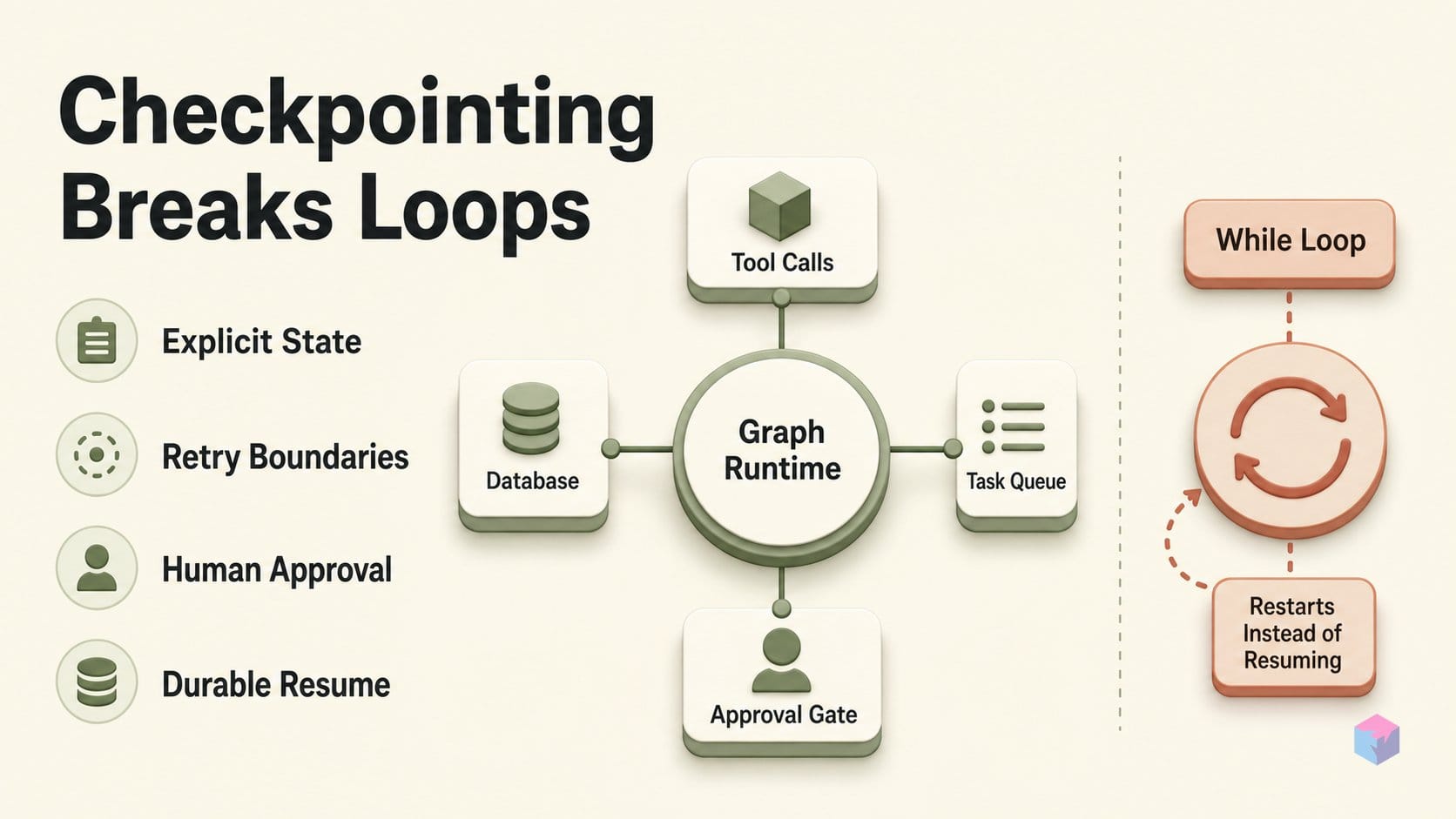
A plain while-loop agent is fine until the process must pause, survive a restart, wait for a reviewer, or resume the right state after a failed tool call. Once the agent has external side effects, checkpointing becomes a runtime concern, not a line of file I/O; LangGraph was introduced for cyclical agent graphs on January 17, 2024 , and LangChain later positioned LangGraph as the lower-level runtime for durable, long-running agents in LangChain 1.0 on October 22, 2025 .
Quick Answer: While-loop agents break at checkpointing because they usually restart control flow instead of resuming an explicit state machine. LangChain reported 65M+ monthly LangGraph downloads in July 2026 , which signals that durable graph runtimes are now a mainstream agent pattern.
The July 2026 source video is useful as the editorial prompt for this comparison , but implementation decisions should lean on primary runtime documentation. LangGraph’s own overview describes it as orchestration for long-running, stateful agents, while its persistence docs define checkpoints as saved graph state organized by thread .
"LangGraph provides durable execution, human-in-the-loop, persistence, and memory," — LangChain documentation (source: LangGraph Overview)
The practical shift is from loop engineering to explicit graph engineering. In a loop, the model call, tool execution, retry, approval pause, and final response often live inside one control structure. In a graph, those become named nodes and conditional edges, so the checkpoint says more than "some JSON was written"; it tells the runtime where the agent is allowed to resume.
Before touching LangGraph
Before touching LangGraph, define the agent as a state machine: a typed state object that carries messages, proposed_action, approved, tool_result, error metadata, retry counters, and audit fields. LangGraph is designed for stateful, long-running agents with durable execution, persistence, streaming, and human-in-the-loop control, while LangChain agents use LangGraph underneath for those runtime capabilities LangGraph Overview.
The design step is to name the workflow phases before writing code. A practical graph might use plan_or_call_model, route_tool_or_finish, request_approval, execute_tool, handle_rejection, and finalize. That naming matters because checkpoints are tied to graph state, not just a serialized variable dump LangGraph Persistence.
| State or node | Why it belongs outside the loop |
|---|---|
messages |
Preserves conversation and tool context across checkpointed runs. |
proposed_action and approved |
Makes review decisions explicit before side effects happen. |
error and retry counters |
Lets the runtime retry or route failures without restarting the whole agent. |
audit fields |
Records who approved, rejected, edited, or resumed a run. |
Any run that needs memory, pause/resume, or checkpoint lookup should pass a stable configurable.thread_id; otherwise the runtime cannot reliably retrieve the right checkpoint lineage LangGraph Persistence. LangGraph was introduced as a library for cyclical agent graphs in 2024 , and LangChain’s 1.0 announcement in 2025 positioned LangGraph as the lower-level runtime for custom production agents .
Use InMemorySaver only for tests and prototypes; its reference page describes it as appropriate for debugging and testing, not production InMemorySaver reference. For deployed agents, start with persistent checkpointing such as Postgres or AsyncPostgresSaver, especially when human approval can pause execution across processes LangChain human-in-the-loop docs.
Numbered runnable path for LangGraph
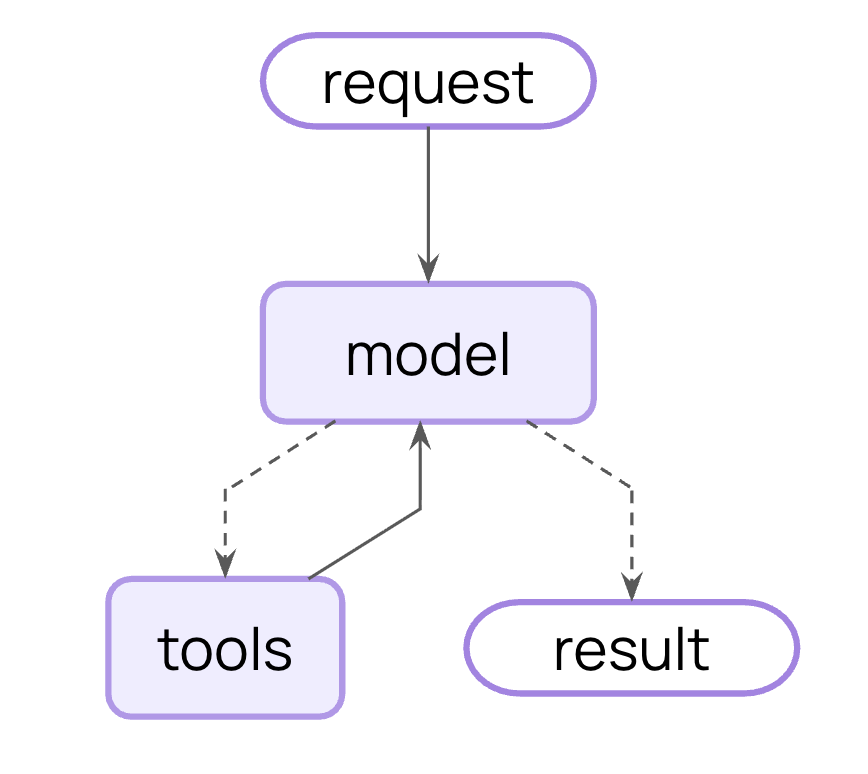
A runnable LangGraph agent starts as an explicit state machine: define the state, name the nodes, draw the edges, then add persistence and review gates. LangGraph is the lower-level runtime under LangChain agents for durable execution, streaming, human-in-the-loop control, persistence, and memory .
- Sketch the state before writing graph code. Treat the old while loop as a set of named transitions. A practical state object might carry
messages,proposed_action,approved,tool_result,error, retry metadata, and audit fields. Name nodes such asplan_or_call_model,route_tool_or_finish,request_approval,execute_tool,handle_rejection, andfinalize. This makes the loop boundary visible instead of hiding it inside one function. - Add conditional edges for every exit path. The routing node should choose between final response, safe tool execution, human review, rejection handling, retry, and terminal error. LangGraph’s model is built around nodes and edges, where nodes can be deterministic code, LLM calls, tool calls, or subagents . The useful test is simple: if a branch changes operational behavior, make it an edge.
- Wire checkpointing before you need resume. Compile the graph with a checkpointer and invoke it with the same stable
configurable.thread_idwhenever continuity matters. LangGraph persistence stores graph state as checkpoints grouped by thread, enabling pause and resume, conversation memory, fault recovery, and time-travel debugging . Use InMemorySaver for local testing, then move durable runs to a persistent checkpointer. - Put human review at the action boundary. At the LangGraph level, call
interrupt()from a review node and resume withCommand(resume=...)using the samethread_id. At the LangChain agent level, HumanInTheLoopMiddleware can interrupt selected tool calls and let a reviewer approve, edit, or reject them . - Attach retries to flaky nodes. Use
RetryPolicyon model calls, remote APIs, databases, or tools instead of wrapping the whole run in one broad exception handler. LangGraph’s documented retry defaults includemax_attempts=3,initial_interval=0.5seconds,backoff_factor=2.0,max_interval=128.0seconds, andjitter=True. Node-level retries preserve the graph’s audit trail and keep recovery tied to the failed operation.
Retries belong on nodes
Node-level retry is the practical boundary for LangGraph agents because it retries the failed model call, API request, database operation, or tool node without hiding where the failure happened. The documented RetryPolicy defaults are max_attempts=3, initial_interval=0.5 seconds, backoff_factor=2.0, max_interval=128.0 seconds, and jitter=True with default_retry_on .
That boundary matters operationally. A broad try/except around the whole agent can only say “the run failed.” A retry policy attached to execute_tool, call_model, or write_to_db says which unit failed, how often it retried, and what state was available when it stopped. For expensive remote calls, repeating only the failed node is cheaper and easier to inspect than replaying a full conversation loop.
"LangGraph provides a built-in retry mechanism for handling transient errors that can occur during graph execution," — LangChain documentation (source: LangGraph fault tolerance)
There is one current caveat: the same fault-tolerance material says per-node timeouts and node-level error handlers require langgraph>=1.2, are documented as alpha, and are Python-only in the cited docs . Treat those as useful but still-moving runtime controls, especially if your production stack also includes TypeScript agents.
Checkpointing also changes what “retry” means after partial success. LangGraph persistence can record pending writes from successful nodes in a failed superstep, so a resumed run can keep completed parallel work instead of rerunning every branch from scratch . That is the piece plain while loops usually lack: not just another attempt, but a resumable record of which node already produced usable state.
Where to go after a plain loop
A plain loop is still the right starting point when the agent is a demo, a local prototype, a short-lived task, or a reversible operation. The LangChain create_agent reference describes the familiar cycle: call the model, execute tool calls, return tool messages, then call the model again until the run is finished.
Move to LangGraph when the agent has to survive the shape of real work: long pauses, human review, external side effects, state inspection, replay, recovery, or audit records. That is the practical line between “loop engineering” and graph engineering. LangGraph was introduced publicly as a library for cyclical agent graphs in January 2024 , and LangChain’s own positioning now treats it as the lower-level runtime for durable, stateful agents.
Before promoting a loop into production, check these boundaries:
- Use stable
thread_idvalues whenever a run must resume the correct checkpoint lineage, as described in LangGraph persistence. - Make tool calls idempotent with external operation IDs, because replay after a checkpoint can repeat LLM calls, API requests, or interrupts.
- Interrupt only consequential actions. LangChain’s human-in-the-loop middleware supports reviewer decisions such as approve, edit, or reject.
- Set retention rules for checkpoint history, especially in long conversations and frequently resumed workflows.
The concrete takeaway: keep the loop while losing state is acceptable; switch to LangGraph when pause, retry, review, and recovery become product requirements.
Frequently asked questions
Does LangGraph replace a while-loop agent?
No. LangGraph does not replace the basic agent loop so much as make it explicit: state, nodes, edges, conditional routing, persistence, and recovery become part of the runtime instead of hidden inside one loop body. A plain loop is still fine for short-lived demos and reversible tasks; LangGraph is the better fit when the agent needs durable state, pause/resume behavior, review gates, or failure recovery.
Why does human-in-the-loop review require checkpointing?
Human-in-the-loop review requires checkpointing because the agent has to stop before a consequential action, persist its current state, wait for a reviewer decision, and then resume from the same thread lineage. LangGraph’s interrupt flow is designed around that pause-and-resume model, while LangChain’s HumanInTheLoopMiddleware also requires checkpointing so tool calls can be approved, edited, or rejected before execution.
When is InMemorySaver enough?
InMemorySaver is enough for local debugging, tests, and prototypes where losing state after process exit is acceptable. Production agents should use persistent checkpoint storage because checkpoint data must survive restarts, reviewer delays, and long-running workflows. LangGraph’s persistence docs describe checkpoints as per-thread saved graph state used for memory, recovery, time travel, and human review.
Where should retries live in a LangGraph agent?
Retries should live on the failure-prone node itself, not around the whole graph run. In LangGraph, model calls, remote APIs, databases, and external tools can get node-level retry policies, which keeps recovery scoped to the operation that failed. The official fault-tolerance docs describe retry policies with defaults such as max_attempts=3 and exponential backoff .
Enjoyed this article? Subscribe to get new stories by email whenever they're published.