
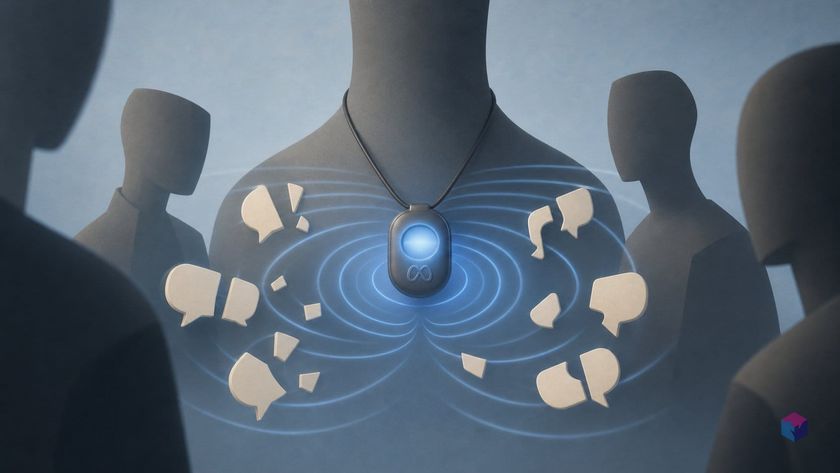
Meta is reportedly building a neck-worn AI pendant that listens to the room around you — but before the "always-listening" headlines run away with the story, it's worth reading what the source document actually claims, and what it doesn't.
What the Himel memo actually says
This is a leaked roadmap, not a product launch. The Information reported on an internal memo authored by Alex Himel, Meta's VP of Wearables, describing plans to test a neck-worn "ambient" AI pendant within the next year . There is no confirmed product name, price, or ship date — Meta has made no official announcement, so every spec should be treated as provisional .
The defining trait is that the pendant is ambient: it hangs around the neck or clips to clothing and the user does not actively invoke it. Per the reporting, it passively captures ambient audio, generates real-time transcripts, and builds a searchable log of daily conversations, surfacing reminders and summaries when relevant .
The memo sets aggressive distribution targets. Himel reportedly wants to ship 10 million wearable devices in the second half of 2026 and reach roughly 6.8 million monthly active wearable users by year-end, driven by new products and country expansion .
The pendant is one item on a crowded slate. Engadget's reading of the same memo says Meta aims to release up to four more smart-glasses models before the end of 2026, plus two further prototypes :
- Modelo, Luna, RBM2 Refresh, Mojito VIP — reported codenames for additional glasses models targeted before end of 2026.
- Artemis — a named future prototype.
- SSG — described as "supersensing" glasses.
So the signal is direction, not a finished device: Meta is widening its wearables portfolio from camera glasses into passive audio capture, and the pendant is the most scrutiny-attracting piece of that plan.
Limitless: the shipped product Meta absorbed
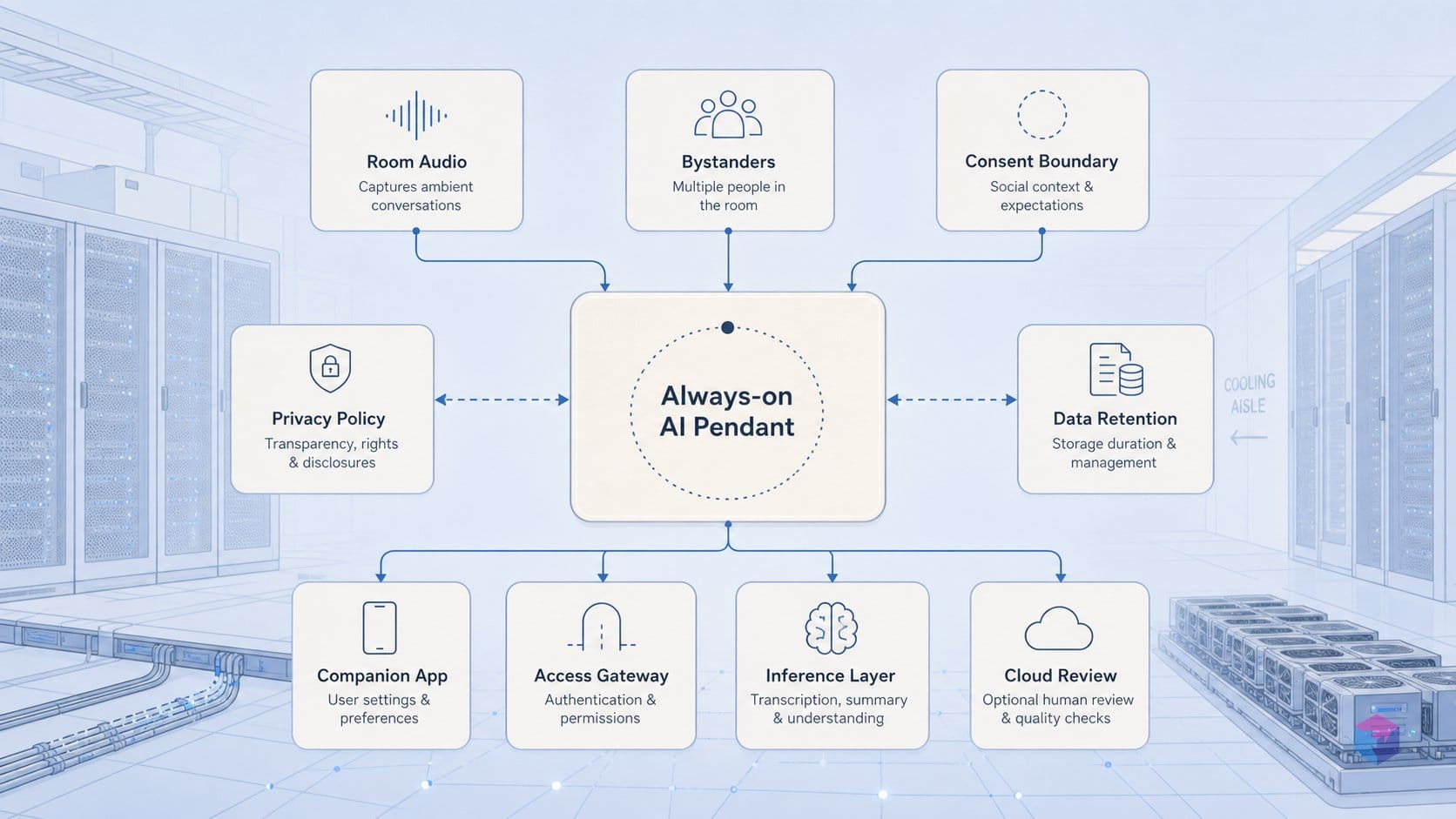
Meta did not start from a whiteboard — it bought a working device. Meta acquired Limitless, an AI-recorder startup, in a deal announced December 5, 2025. Limitless already shipped a pendant-style recorder worn as a necklace or clipped to a shirt that captures and transcribes real-world conversations, so the pendant in Himel's memo builds on a product with documented specs, not a concept.
The hardware Meta absorbed is a wearable microphone that syncs with iOS 18/iPadOS 18 or Android 13 and later, records continuously with pause and stop controls, and is designed to last a full day of recording . It is IP54 water-resistant rather than waterproof, and its free tier included 1,200 transcription minutes — 20 hours — per month . A white recording LED stays on and cannot be dimmed or switched off — a deliberate, if minimal, disclosure mechanism.
| Limitless Pendant spec | Detail (pre-Meta) |
|---|---|
| Companion OS | iOS 18 / iPadOS 18 or Android 13+ |
| Recording | Continuous, with pause/stop |
| Battery | Full day of continuous recording |
| Water resistance | IP54 (not waterproof) |
| Free transcription tier | 1,200 minutes / month |
| Recording indicator | White LED, cannot be disabled |
The post-acquisition cleanup is the clearest signal here. Limitless stopped selling new Pendants on December 5, 2025, and is supporting existing customers throughout 2026 with the Unlimited Plan provided free . More telling for builders weighing regulatory exposure: Limitless simultaneously ended service in the EU, UK, Brazil, China, South Korea, Israel, and Turkey, giving affected users until December 19, 2025 to export their data before deletion . That exit list maps closely to stricter privacy jurisdictions a Meta-branded successor may struggle to reach.
The privacy terms explain why. Limitless's policy states that non-wearers' voice, audio, transcripts, summaries, and sometimes speaker-recognition data may be captured, and that information may be used to improve services and train AI or large language models provided by third parties, including affiliates . Retention depends mainly on the recording user's choices — meaning the person being recorded has little say. None of these are confirmed terms for Meta's prototype, but they describe the stack Meta is folding into its roadmap.
The consent problem is structural, not cosmetic
That detail — retention tied to the wearer, not the room — is where the form factor stops being a convenience and becomes a policy question. Camera glasses record what you point them at, and a capture LED signals intent to anyone in frame . A neck-worn microphone records everyone within earshot — bystanders, coworkers, patients, students — with no opt-in gesture from any of them. The shift from visual capture to ambient audio is the substantive change, not a cosmetic one.
Limitless tried to handle this with a notify-first rule. Its policy states that wearers must tell people and obtain consent before recording, and that non-wearers' voice, transcript, summary, and sometimes speaker-recognition data may be captured anyway .
"The wearer is responsible for notifying you and obtaining your consent before recording," — Limitless, on what to expect when talking to a Pendant wearer (source: Limitless Help Center).
Meta's implementation is unconfirmed and may diverge at scale. Two factors raise the stakes for a Meta-branded version:
- Existing litigation. Meta's camera glasses have already drawn lawsuits over how captured footage is handled, and always-on audio widens that exposure .
- Regulatory frameworks. Continuous ambient capture of third parties implicates GDPR, CCPA, and HIPAA — consent, data minimization, and patient-confidentiality rules that a single wearer cannot waive on a room's behalf.
The clearest signal about where regulators draw the line is what Limitless did to its own footprint. It ended service in the EU, UK, Brazil, China, Israel, South Korea, and Turkey as of December 5, 2025, giving affected users until December 19, 2025 to export their data . That is eight markets exited at once — most of them strict-privacy jurisdictions. Meta has not stated whether its pendant will re-enter any of them, and the prudent reading is that it absorbed a product that had already retreated from the regions most likely to challenge ambient recording .
Wearables for Work: what enterprise targeting means for builders
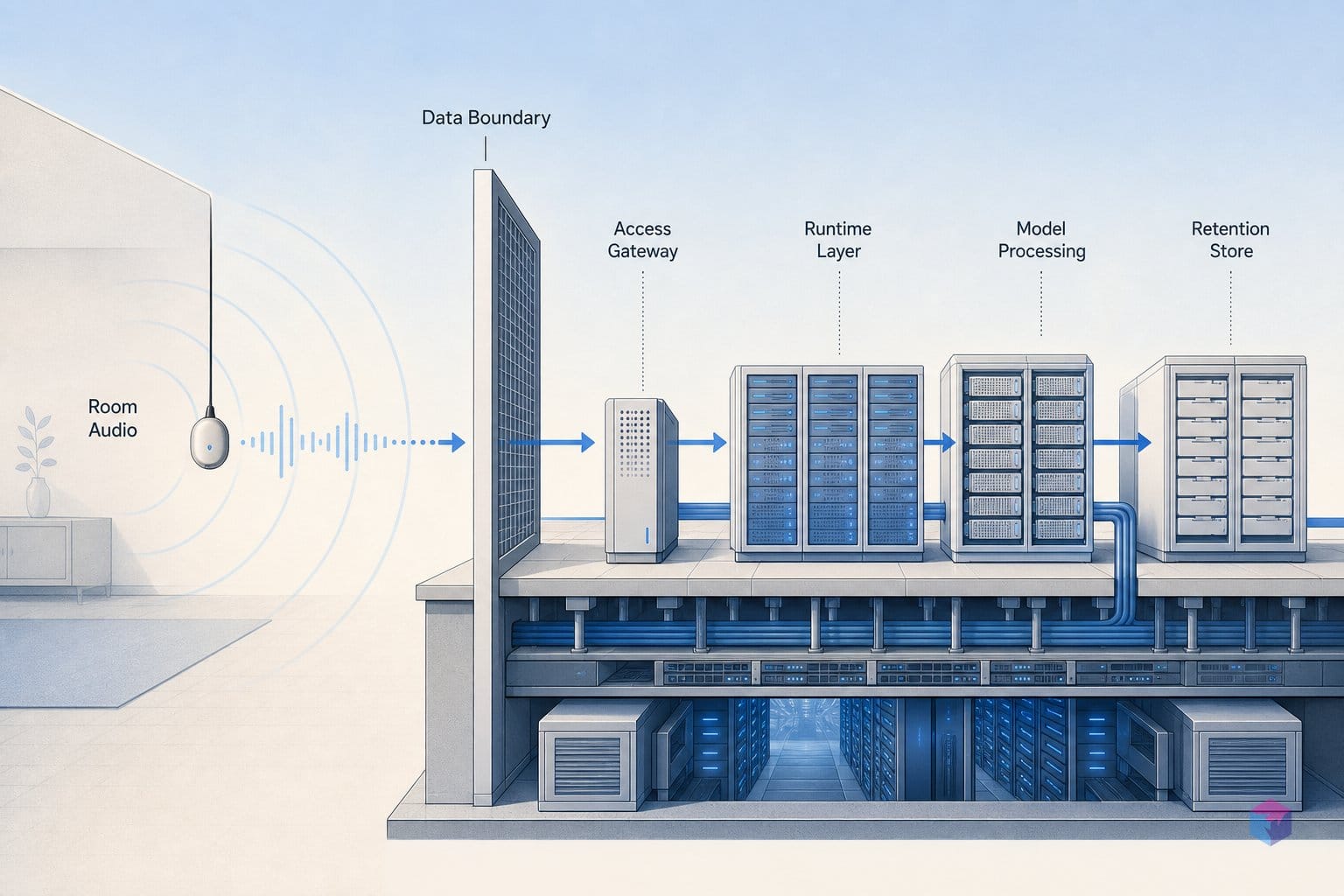
Enterprise is not an afterthought in the memo — it is a named product line. Himel outlines a subscription tier called "Wearables for Work" aimed at commercial customers paying for vertical-specific capabilities such as meeting transcription and workplace-platform integration . For developers, that phrasing matters more than the pendant itself: a paid commercial tier with platform integrations implies an SDK or integration surface is on the roadmap, not just a consumer gadget.
The targets are specific enough to read as a go-to-market plan. The memo sets goals of securing pilots with at least 10 companies and reaching deployments in at least two larger organizations of 100 devices each . Fleet deployments of that size do not happen without provisioning, admin controls, and integration hooks — the connective tissue builders are usually asked to fill.
The transcription and summarization stack absorbed from Limitless is the most likely raw material. Folded into Meta's roadmap, it points toward API or webhook surfaces that push transcripts and summaries into the systems where work already happens. Expect integration pressure around:
- Calendar and meetings — auto-attached transcripts and action items per event.
- CRM — call and conversation summaries written back to contact and deal records.
- Productivity platforms — the "workplace-platform integration" the memo names directly .
Himel is explicit about why this tier exists. He framed the strategic imperative as monetizing the software experiences that differentiate Meta's devices — building a business beyond thin hardware margins.
"We need to monetize the software experiences that differentiate our devices and build a business beyond hardware margins," — Alex Himel, VP of Wearables at Meta, per the internal memo first reported by The Information.
What is missing is exactly what an enterprise buyer would gate on. The memo confirms none of the controls that determine whether this is deployable: admin retention policies, whether captured recordings train Meta models by default, and data-residency options for regulated industries . Given that Limitless's terms allowed using captured data to train third-party models, the default posture is the open question builders should watch before committing to an integration.
Reality Labs losses give the wearable push its financial logic
The pendant exists because Meta needs its hardware bets to start paying back the AI infrastructure spend behind them. Reality Labs reported just $402 million in revenue against a $4.028 billion operating loss for the quarter ended March 31, 2026, even as Meta overall generated $56.311 billion . A pendant cannot close that gap on device margins alone.
That is the point of the broader memo math. Meta raised its 2026 capital-expenditure guidance to $125 billion–$145 billion, driven by AI infrastructure . Recouping that requires recurring software revenue and platform lock-in — transcription, summaries, and the "Wearables for Work" subscription — not hardware average selling price. The Limitless stack gives Meta a shipped, proven AI layer to monetize rather than a research prototype.
The pendant also has to slot into an existing price ladder. Meta's glasses already define the consumer rungs:
| Device | Starting price | Launched | Defining feature |
|---|---|---|---|
| Ray-Ban Meta Gen 2 | $379 | Sep 17, 2025 | 3K video, ~8h use, 48h charging case |
| Meta Ray-Ban Display | $799 | Sep 30, 2025 | In-lens display + Neural Band |
Ray-Ban Meta Gen 2 starts at $379 and launched September 17, 2025 . Meta Ray-Ban Display starts at $799 and launched in the US on September 30, 2025, adding an in-lens display and the Meta Neural Band . A neck-worn pendant likely sits below the glasses, sold partly as an accessory feeding the same AI subscription.
What separates Meta from the ambient-AI graveyard is distribution, not novelty. Recent standalone devices failed on their own: the Humane AI Pin was discontinued, and the $199 Rabbit R1 was widely panned . Meta's edge is a large existing glasses user base, retail reach, and the Limitless transcription pipeline it already owns — the hard parts those startups never solved.
Competitive context: Apple, Amazon Bee, and the OpenAI/Ive device
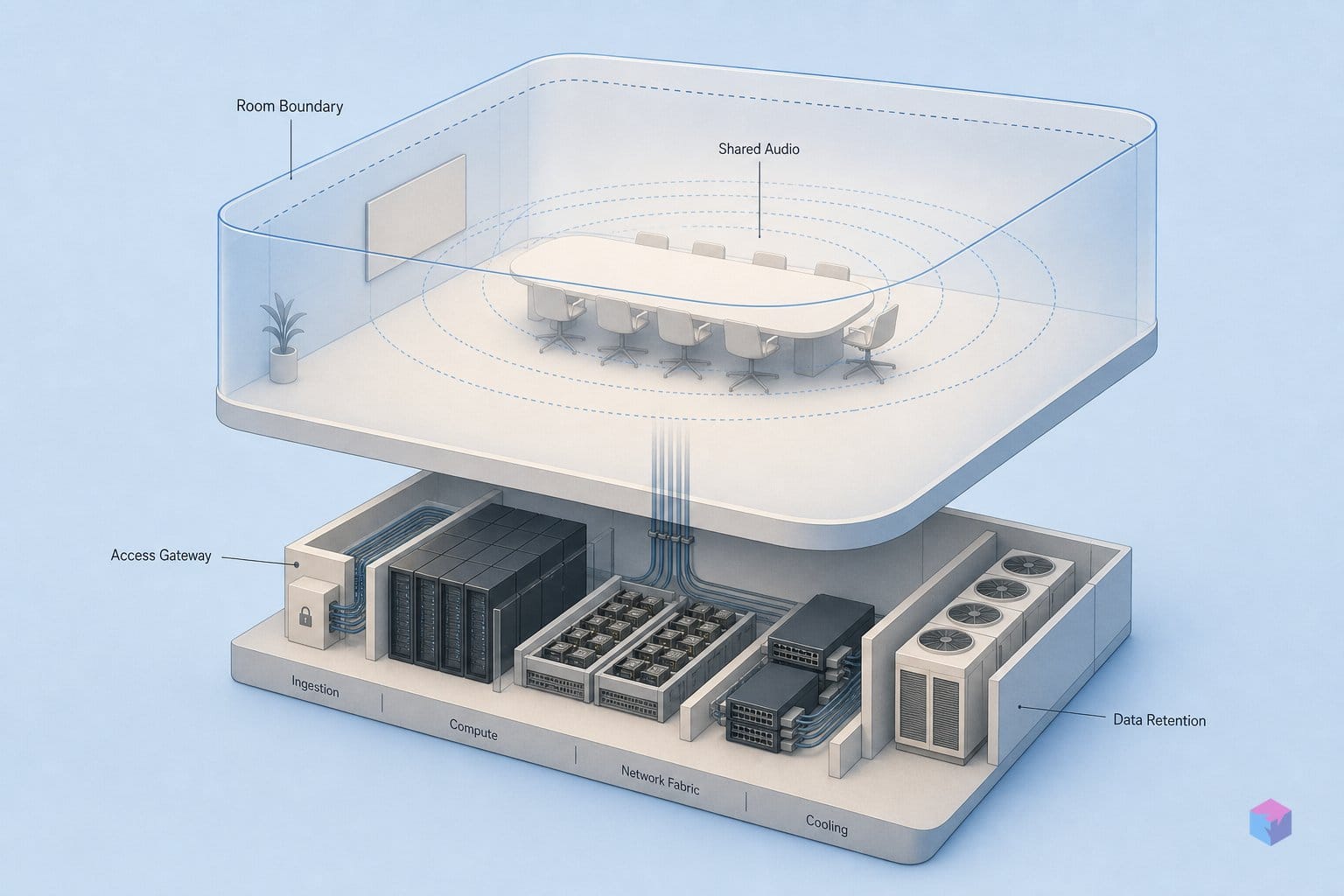
Meta is not alone in chasing the always-on audio niche. Amazon's "Bee" ambient recorder targets the same use case — passively capturing conversation and surfacing summaries — while OpenAI's device with Jony Ive is in reported development, and Apple has wearable-AI research signals but no announced pendant . The category is crowding fast, and each entrant brings a different structural advantage.
Meta's strongest card is distribution. It already ships hardware at scale — Ray-Ban Meta is described as the world's No. 1 selling AI-glasses line, with millions of units sold . It also controls a social graph that could make conversation summaries more useful across contacts, and it owns the Limitless transcription pipeline rather than rebuilding one. That combination is exactly what the Humane and Rabbit standalone devices lacked.
"We need to monetize the software experiences that differentiate our devices," — Alex Himel, VP of Wearables at Meta, framing the push beyond thin hardware margins (source: TechCrunch).
The disadvantages are just as concrete:
- Versus Apple: no trusted privacy brand. Apple sells on-device processing and data minimization; Meta carries the opposite reputation into a product built on capturing other people's voices.
- Versus Amazon: no consumer ambient-AI track record yet. Bee is purpose-built for the recorder niche, while Meta is extending a glasses business sideways.
- Versus OpenAI/Ive: an unproven form factor against a design-led entrant with no legacy hardware baggage.
The pendant's real differentiator from glasses is also its liability: it is less conspicuous for recording. There is no camera capture LED in your eyeline, no obvious gesture . Removing the visual cue raises the ethical bar rather than lowering it — and that is precisely where Apple's privacy positioning, not Meta's scale, may decide the category.
Open questions before this is a real product
None of the decisions that determine whether this pendant is benign or hostile have been made public. Meta's own framing is a roadmap, not a spec — internal plans point to testing within the next year , but the implementation details are exactly the ones that carry the most risk. Four questions stand out for anyone tracking this category:
- Continuous or on-command? The acquired Limitless Pendant recorded continuously with manual pause/stop, targeting a full day of capture . Meta has not confirmed whether its device inherits that always-on default or moves to explicit invocation.
- Camera or audio-only? Reporting describes an audio-first, ambient device , but nothing rules out later visual capture — and there is no in-eyeline LED equivalent for a microphone.
- Where do recordings live, and for how long? Limitless says captured information may be used to improve services and train third-party LLMs, with retention driven mainly by the recording user's choices . Whether a Meta opt-out genuinely excludes model training is unknown.
- EU and UK re-entry? Limitless ended service in the EU, UK, South Korea, and four other markets as of December 5, 2025 . GDPR ambient-audio consent likely demands architectural change — on-device processing, bystander handling — not a policy rewrite.
The concrete takeaway: treat every spec as provisional. Until Meta publishes a recording model, a retention policy, and a list of supported regions, the pendant is a hiring-and-acquisition signal, not a product you can build against or trust in a room.
Frequently asked questions
What is the Meta AI pendant and when does it ship?
The Meta AI pendant is a neck-worn ambient recorder described in a leaked internal memo by Alex Himel, Meta's VP of Wearables — it would clip to clothing or hang around the neck, passively capture audio, and build searchable transcripts and summaries. Meta targets internal testing within one year . There is no confirmed ship date, price, or product name. Treat every spec as provisional until Meta announces it.
How is this different from Meta's Ray-Ban smart glasses?
The difference is the consent surface. Ray-Ban Meta glasses capture what you point them at — visual plus audio — and use a capture LED to signal others when the camera is recording . The pendant is audio-only and ambient: it listens passively to everyone in earshot without the wearer actively aiming it . That shifts the privacy question from pointed visual capture to continuous, undirected recording of bystanders.
What happened to Limitless after Meta acquired it?
Limitless, the pendant-recorder startup whose acquisition was announced December 5, 2025, stopped selling new Pendants that same day and is supporting existing customers throughout 2026 with the Unlimited Plan provided free . Limitless simultaneously ended service in the EU, UK, Brazil, China, South Korea, Israel, and Turkey, giving affected users until December 19, 2025 to download their data before account deletion .
What is 'Wearables for Work' and does it have a developer integration surface?
'Wearables for Work' is a planned enterprise subscription tier outlined in the memo, aimed at commercial customers paying for vertical capabilities like meeting transcription and workplace-platform integration, with stated goals of pilots at 10 companies and deployments at two larger organizations of 100 devices each . No SDK is announced. But folding Limitless's transcription stack into an enterprise tier with workplace integrations strongly implies an API or webhook surface is coming.
Why did Limitless exit the EU and several other markets?
Limitless ended service on December 5, 2025 in the EU, UK, Brazil, China, South Korea, Israel, and Turkey, with no official reason stated . GDPR-style ambient-audio consent rules are the most likely factor, since an always-listening device captures non-consenting bystanders. Meta has not said whether a Meta-branded pendant could return to these stricter privacy regions — making supported-region clarity one of the open product questions.