
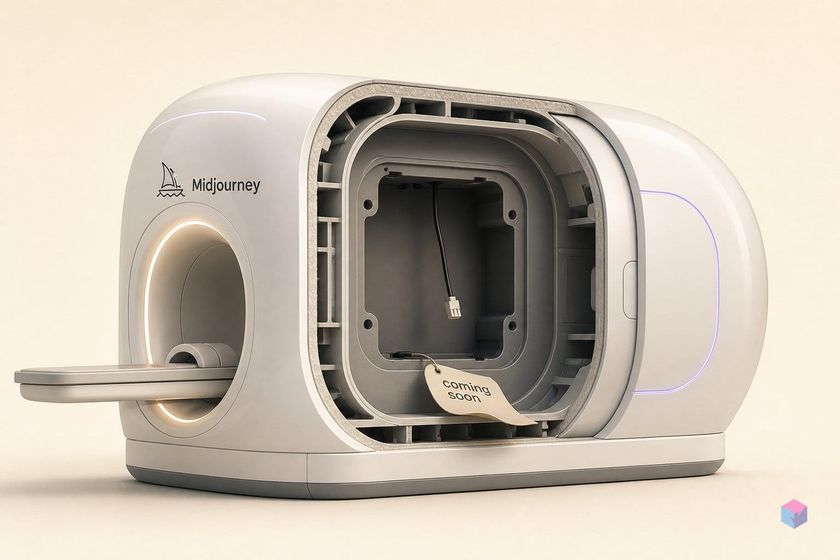
Midjourney spent four years generating images that look real. Its newest product scans the real thing — and, by the CEO's own admission, there's no AI inside it yet.
What the USCT Body Scanner Does
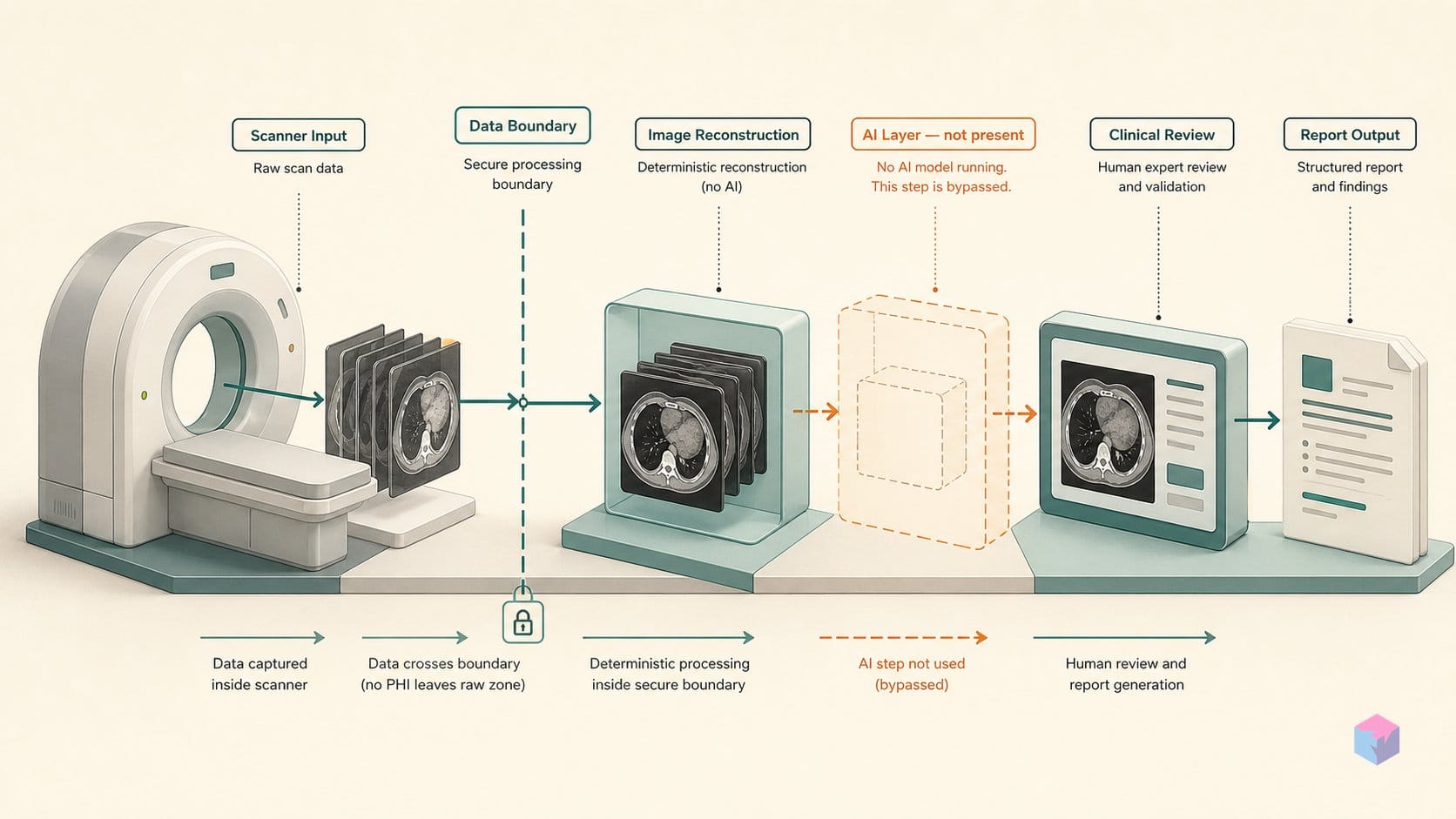
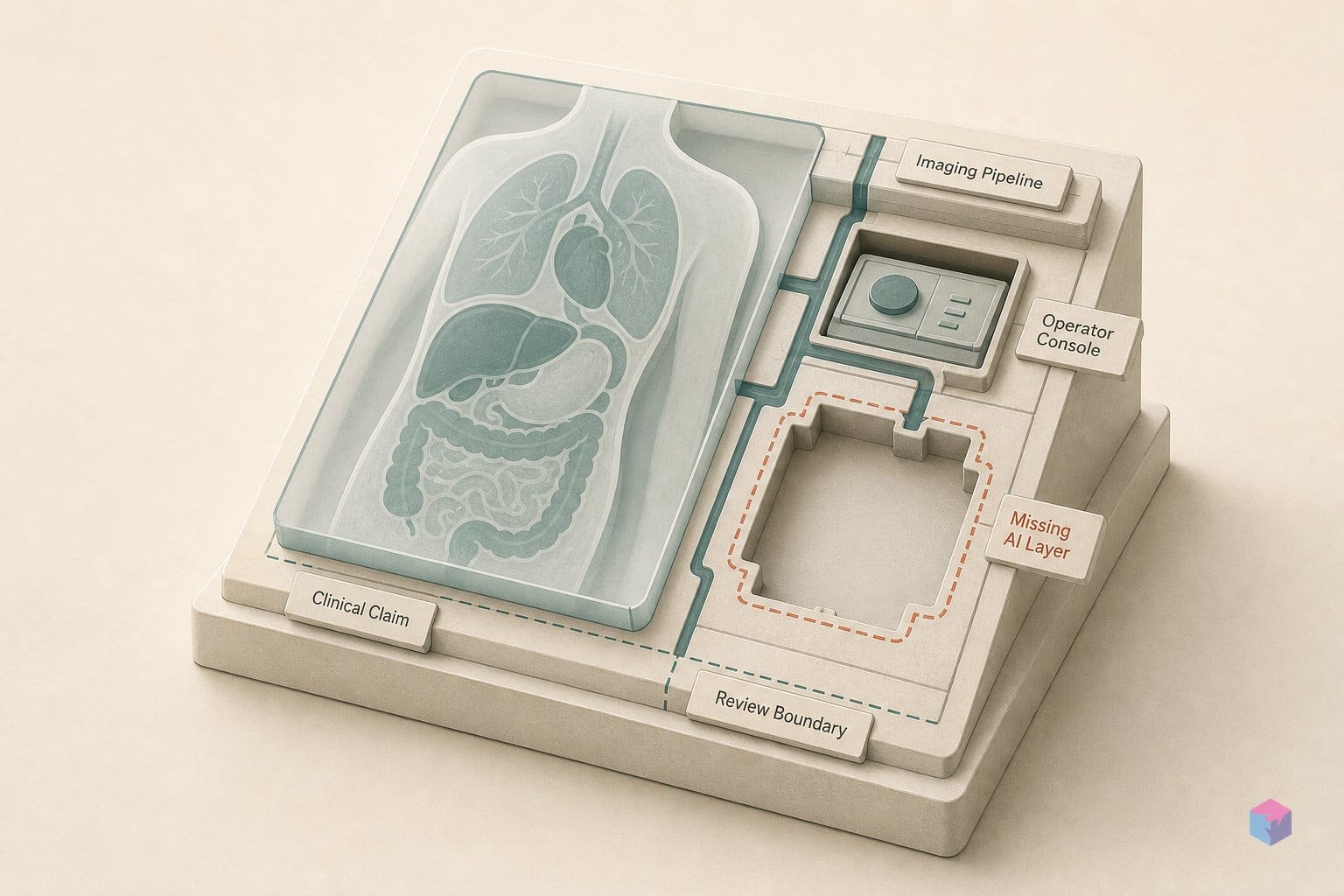
Midjourney Medical's full-body scanner has no AI in its current form. Founder David Holz confirmed this in post-announcement interviews, telling reporters the device is not using AI today, though the company hopes to add it later . What Midjourney unveiled on June 17–18, 2026 is a computational ultrasound instrument — branded "Ultrasonic CT" (USCT) — not a deployed diagnostic AI . The present workflow is ultrasound acquisition plus computational reconstruction; AI segmentation appears in the demo gallery, but no live AI diagnostic runs during a scan.
The headline spec is speed. Midjourney targets a roughly 60-second full-body scan, against the typical 60–90 minutes for a full-body MRI . The Register cites about 0.5 mm tissue resolution, which it frames as comparable to standard clinical MRI though below advanced designs — a figure no reviewed source has independently replicated .
Crucially, there is no FDA clearance for the device in any reviewed source. Midjourney positions it as a wellness product that will "start by just giving you detailed body composition maps," not cleared diagnostics, and says it will submit results to the FDA to seek expanded capabilities over time .
The most concrete, verifiable element is the supply chain. The scanner runs on Butterfly Network's Ultrasound-on-Chip modules under a co-development and licensing agreement Butterfly disclosed in a Form 8-K on November 17, 2025 — up to $74 million over a five-year term, contingent on development and commercial milestones . The hardware is real and contractual; the diagnostic AI is, for now, a roadmap item.
The Scanning Method: Transducer Array, Water Immersion, 3D Reconstruction
The scanner works by surrounding the body with sound. A person stands on a platform and is lowered at roughly 2 inches (≈5 cm) per second into a shallow pool, passing through a ring of about 500,000 tiny transducer elements that fire ultrasound through the body from every angle . The water is not theatrical staging — it is an acoustic coupling medium. Air reflects almost all incident ultrasound, so impedance matching between the transducers and tissue requires the body to be immersed; the "golden light" tank is engineering necessity dressed as spa .
The data volume is the hard part. Midjourney says the array records terabytes of multi-angle ultrasound per second — which it frames as roughly 500 hours of HD video for every second of acquisition . That raw acoustic data is not an image; a compute cluster runs full-waveform inversion (FWI), an iterative reconstruction that solves for the speed-of-sound and density field consistent with the recorded waveforms, to build 3D cross-sectional maps of muscle, fat, bone, organ density, and tissue stiffness. The Verge reported about two petaflops of processing per system to do this .
| Component | Specification (per prototype) |
|---|---|
| Transducer elements | ~500,000 in a ring array |
| Immersion speed | ~2 in / 5 cm per second |
| Data rate | Terabytes/sec (≈500 hrs HD video/sec) |
| Reconstruction | Full-waveform inversion, ~2 petaflops/system |
| People scanned at reveal | ~12 (June 2026) |
The published scan gallery shows raw reconstructed slices, AI segmentation overlays, swept torso and leg volumes, and side-by-side USCT-versus-MRI comparisons . It is demonstrative output, not a clinical validation dataset — no sensitivity, specificity, or reader-study figures accompany it. As of the June 2026 reveal, only about a dozen people had been scanned, a sample far too small to characterize how reconstruction behaves across diverse body types .
Butterfly Network, whose Ultrasound-on-Chip modules drive the array, frames the throughput differently. CEO Joseph DeVivo called the system "a potentially meaningful commercial opportunity" designed for "weekly use" — a cadence that only works if a single scan stays near the targeted ~60 seconds and the compute pipeline keeps pace with the acquisition rate .
Butterfly Had to Clarify the Deal Midjourney Omitted
The most verifiable part of the entire announcement is the part Midjourney left out: its hardware depends on Butterfly Network. Midjourney's own blog post did not credit Butterfly, so Butterfly issued a standalone press release to confirm the partnership . For a launch built around a novel imaging claim, the omission of the supplier whose chips make the array work is a meaningful signal about how the reveal was managed — and a reason to read Butterfly's filings rather than Midjourney's marketing for the load-bearing facts.
Those facts are on the public record. Butterfly disclosed the arrangement in a Form 8-K dated November 17, 2025, specifying up to $74 million in expected payments over a five-year term, contingent on development and commercial milestones . The chips arrive through Butterfly Embedded — formerly Octiv — which licenses Butterfly's Ultrasound-on-Chip modules. Each current prototype uses 40 of those modules, and The Verge reported roughly two petaflops of processing per system, with about a dozen people scanned as of the reveal .
Butterfly's framing is commercially optimistic but conditional. As CEO Joseph DeVivo put it:
"A potentially meaningful commercial opportunity," — Joseph DeVivo, CEO at Butterfly Network, on the scanner designed for "weekly use" (source: Butterfly Network)
The market read the clarification as good news for the supplier: BFLY shares rose after Butterfly's release . That asymmetry is worth noting for anyone tracking who carries the risk here — Butterfly books licensing revenue against milestones, while Midjourney owns the unproven clinical and regulatory bet. Staffing reinforces the hardware-first posture: Midjourney's consumer hardware division is led by Ahmad Abbas, formerly of Apple's Vision Pro team . The talent signals serious intent to build a device; it says nothing yet about whether that device can clear the evidence bar a medical product faces.
USCT Physics: Established Prior Art, Unsolved Challenges
The physics under the scanner is real but not new to Midjourney. Ultrasound computational tomography (USCT) and full-waveform inversion (FWI) — the reconstruction approach that fits a wave-propagation model to recorded soundwaves — are established techniques with foundational academic work, including research from Caltech and others . Midjourney is applying and scaling existing physics rather than inventing a new imaging modality, which is a useful frame for evaluating its claims: the open questions are engineering, validation, and regulation — not whether sound can image tissue.
FWI is hard in well-documented ways, and the literature treats its limitations as open problems rather than solved ones. The reconstruction is computationally intensive, mathematically nonconvex (the optimization has many local minima), sensitive to its starting estimate, and prone to artifacts when the model and the measured data diverge . That is why Midjourney pairs each prototype with roughly two petaflops of compute per system — the math is expensive, and poor initialization can converge on a wrong answer that still looks plausible.
Validation is the second gap. Much USCT work to date leans on phantoms (physical test objects) and simulation rather than broad in-vivo data, and Midjourney's published scan gallery is demonstrative — raw slices, segmentation overlays, and USCT-vs-MRI comparisons — not a peer-reviewed validation dataset . Generalizing from controlled phantoms to diverse human anatomy across body habitus — different sizes, fat distribution, and organ positions — is a substantially harder problem than the gallery implies, and the job postings seeking ML-reconstruction talent suggest that work is ahead, not behind .
On resolution, the headline number is credible but unremarkable. The Register cites roughly 0.5 mm tissue resolution, comparable to standard clinical MRI though below advanced MRI designs . No independent replication of Midjourney's resolution or accuracy claims appears in any reviewed source as of publication. For developers used to checking a benchmark against an independent leaderboard, the equivalent here would be a third-party reader study or published sensitivity figures — and none exist yet.
Midjourney Medical Has No AI in Its Scanner
Despite Midjourney's identity as an AI image lab, its body scanner does not currently run AI. In post-announcement reporting, Business Insider quoted founder David Holz saying the scanner is not using AI today, and that pricing and data policies remain unfinalized, though Midjourney hopes to add AI later to improve the system . That admission came from the company's own leadership, not a buried footnote — which matters for anyone reading the "AI organ scanning" framing literally.
"It's not currently using AI, but we hope to add AI later to make it better," — David Holz, founder of Midjourney, as reported by Business Insider, 2026-06.
The published scan gallery does show AI segmentation overlays on reconstructed slices and phantom data . But these are demonstrative renderings, not outputs of a live diagnostic model inferring on patient scans in production. The gallery is illustrative material, not a peer-reviewed validation set, and an overlay in a marketing gallery is not evidence of a deployed inference pipeline.
What actually runs today is a two-stage pipeline: ultrasound data acquisition through the Butterfly-supplied transducer array, followed by deterministic computational reconstruction into 3D cross-sections. There is no diagnostic model in the loop and no live inference step between acquisition and the body-composition maps Midjourney says it will "start by just giving you" .
The ML signals are forward-looking. Midjourney's careers page lists machine-learning reconstruction roles , which is a hiring signal of future intent, not proof of shipped capability. For developers, the distinction is precise and consequential: as of mid-2026, Midjourney Medical is a data-acquisition and computed-imaging company, not a deployed medical-AI company. Treating it as the latter — reading roadmap ambition as current product — is exactly the kind of claim this site exists to flag.
FDA Pathway for USCT: Lessons from SoftVue's PMA Package
The clearest benchmark for what Midjourney Medical must eventually produce already exists. The only FDA-cleared ultrasound tomography device is Delphinus Medical Technologies' SoftVue, approved under premarket approval PMA P200040 on October 6, 2021 — and even then only as an adjunct to mammography for asymptomatic women with dense breasts, not a standalone screening replacement. A USCT device cleared after a multi-year program reached the market with a narrow, evidence-gated indication, which sets a realistic ceiling on how quickly a 60-second whole-body scanner moves from "spa experience" to "diagnostic."
SoftVue's approval rested on a multi-center clinical package: 6 U.S. sites, 7,439 asymptomatic volunteers, and a 140-case reader study (36 cancers, 104 non-cancers) interpreted by 32 MQSA-qualified radiologist readers, reported with sensitivity, specificity, and AUC figures . That is the shape of a PMA: prospective enrollment, controlled reader studies, and quantified diagnostic performance — not a demonstrative gallery.
| Evidence element | SoftVue (PMA P200040) | Midjourney Medical (mid-2026) |
|---|---|---|
| FDA status | Approved adjunct, dense-breast indication | None disclosed; wellness positioning |
| Clinical sites | 6 U.S. sites | None disclosed |
| Study population | 7,439 asymptomatic volunteers | ~12 people scanned at reveal |
| Reader study | 140 cases (36 cancers, 104 non-cancers) | None |
| Radiologist readers | 32 MQSA-qualified | None disclosed |
| Performance data | Sensitivity, specificity, AUC reported | None published |
Midjourney has disclosed no comparable sensitivity, specificity, AUC, reader-study, adverse-event, or prospective-outcome data. The distance between a published scan gallery and a PMA package is not a formatting gap; it is years of enrollment, blinded reads, and statistical endpoints. The company's stated path is to start with body composition maps and later submit test results to the FDA to seek expanded diagnostic capabilities The Verge reports — but no indication, primary endpoint, trial design, or timeline has been named.
Whole-body screening of asymptomatic people also carries its own evidentiary burden, independent of the hardware. The FDA's guidance on full-body CT states it knows of no scientific evidence that scanning asymptomatic individuals yields more benefit than harm, warning that incidental findings drive unnecessary follow-up testing according to FDA . The AAFP's Choosing Wisely guidance echoes this, citing low tumor-detection yields and false-positive risk that triggers cascades of unwarranted procedures. For a developer evaluating the claims, the lesson is concrete: regulatory clearance for USCT has historically meant a narrow indication backed by thousands of enrolled subjects and dozens of credentialed readers — none of which Midjourney has yet shown.
From 12 Scans to 1 Billion: What Midjourney Medical Has to Prove
Between today's prototype and Midjourney Medical's stated ambition sits a five-order-of-magnitude gap. Roughly a dozen people had been scanned as of the reveal , the first San Francisco site is targeted for end of 2027 with 10 scanners , and the 2031 roadmap calls for more than 50,000 scanners worldwide handling roughly 1 billion scans per month . Closing that gap depends on evidence and infrastructure Midjourney has not yet produced.
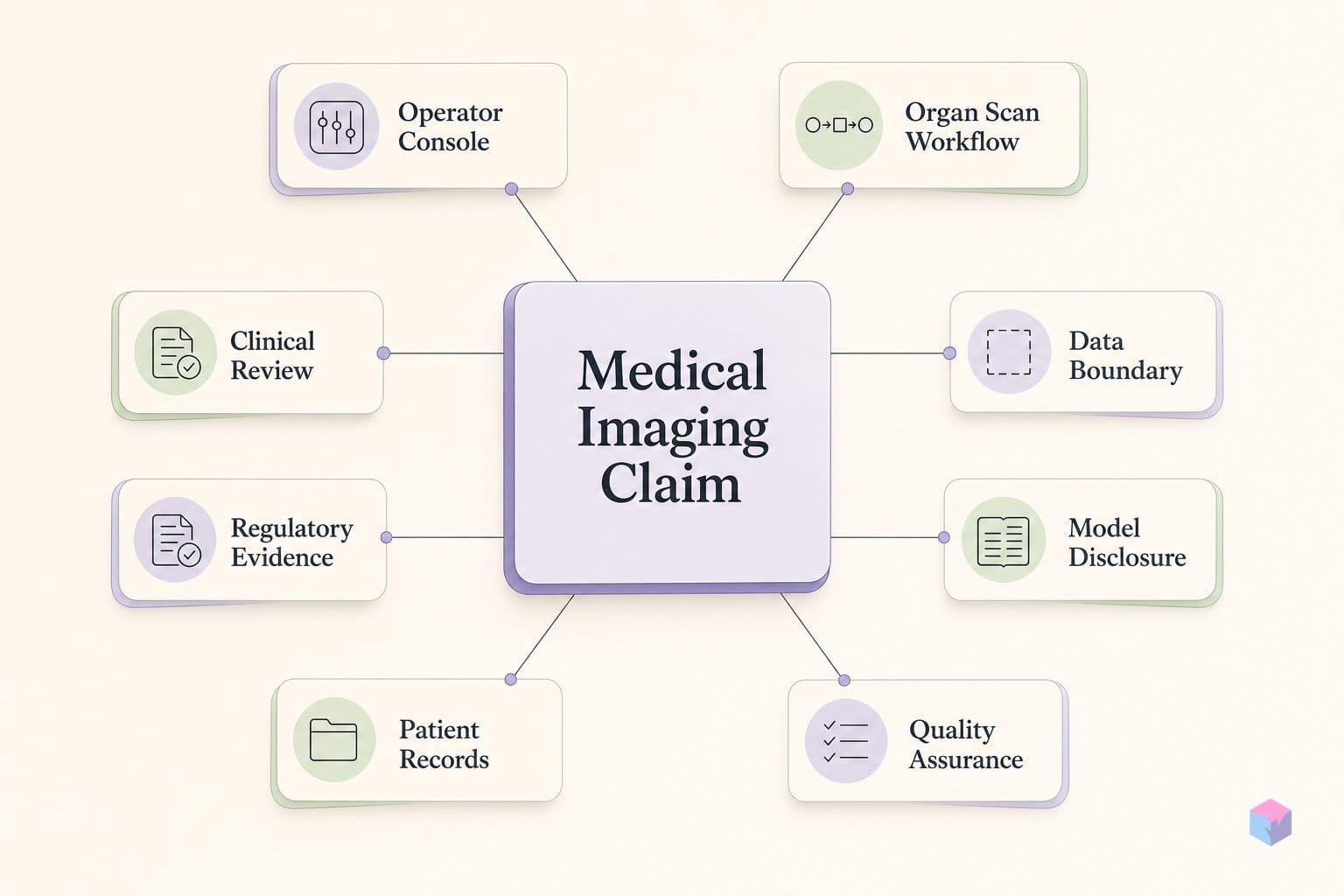
Three unresolved items define the risk surface for anyone tracking this:
- Data governance. No HIPAA policy, no disclosed data-security architecture, and no clarity on whether scans will train proprietary models. Holz said pricing and data policies are not finalized — material gaps for a company that built its name on training generative models.
- FDA indication scope. This is the gating factor. A cleared body-composition-only indication and a diagnostic oncology indication demand fundamentally different evidence packages and trial infrastructure. Butterfly's own release warns regulatory approval may not arrive "on the anticipated timeline or at all" .
- False-positive management. Whole-body scanning routinely surfaces incidental findings that drive unnecessary downstream testing, a hazard the FDA has flagged for whole-body imaging generally . No management protocol has been disclosed.
For developers watching this space, the meaningful inflection point is neither the spa opening nor the published scan gallery. It is two concrete artifacts: the first FDA submission filing, which fixes the indication scope and therefore the evidence bar, and the first peer-reviewed validation paper reporting sensitivity and specificity on real patients. Until those exist, Midjourney Medical is a hardware-and-reconstruction pipeline with a wellness positioning and a roadmap — engineering worth following, but not yet a validated diagnostic claim. Watch the regulatory docket and the literature, not the marketing.
Frequently asked questions
Does Midjourney Medical's USCT scanner have FDA clearance?
No. As of June 2026 there is no FDA clearance for the Midjourney Medical scanner in any reviewed source . The device is positioned as a wellness product that delivers body-composition maps, not cleared diagnostics. Midjourney says it will submit test results to the FDA over time to seek expanded diagnostic capabilities, but no timeline or specific indication has been disclosed, and Butterfly's release warns that approval may not arrive "on the anticipated timeline or at all" .
Is Midjourney's body scanner using AI?
Not currently. Founder David Holz acknowledged the scanner is not using AI at this time, with AI integration framed as a future goal to improve the system . The present workflow is ultrasound acquisition plus computational reconstruction — full-waveform-style inversion of acoustic data into 3D cross-sections. The segmentation overlays in Midjourney's published scan gallery are demonstrative, not a live AI diagnostic pipeline .
What is Butterfly Network's role in the Midjourney Medical scanner?
Butterfly Network supplies the Ultrasound-on-Chip modules that capture the raw acoustic data, provided through Butterfly Embedded under a co-development and licensing agreement disclosed in a Form 8-K on November 17, 2025, specifying up to $74 million over a five-year term contingent on milestones . Each current prototype uses 40 Butterfly modules . Midjourney's own announcement did not credit Butterfly, which prompted Butterfly to issue a standalone clarifying release.
How does USCT compare to MRI on the physics level?
Both produce 3D soft-tissue maps, but the mechanism differs. USCT uses no ionizing radiation and no magnetic fields; it fires soundwaves through the body and reconstructs images via acoustic full-waveform inversion, whereas MRI relies on magnetic resonance. Midjourney targets roughly 60-second scans versus the typical 60–90 minutes for a full-body MRI . The Register cites about 0.5 mm tissue resolution, comparable to standard clinical MRI though below advanced designs . USCT has not been independently validated for diagnostic use at whole-body scale.
What evidence standard would Midjourney Medical need for a diagnostic FDA clearance?
The closest cleared comparator is SoftVue ultrasound tomography, whose PMA P200040 was approved October 6, 2021, backed by a multi-center package of 7,439 asymptomatic volunteers across 6 U.S. sites and a reader study with 32 MQSA-qualified radiologists reporting sensitivity, specificity and AUC data . Even that clearance covers only a narrow mammography-adjunct indication for women with dense breasts, not a screening replacement . A broader diagnostic claim such as whole-body oncology screening would require a substantially larger and more complex evidence package, and Midjourney has published no comparable data to date.