

What M3 and GLM-5.2 Actually Do
MiniMax M3 and Z.ai's GLM-5.2 are open-weight models tuned for long-horizon coding agents — systems that hold repository-scale context, call tools in a loop, run for hours, and recover from failed attempts, rather than emitting a single completion. MiniMax (Shanghai) shipped M3 on 2026-06-01; Z.ai/Zhipu followed with GLM-5.2, with full open weights live on Hugging Face on 2026-06-17. Both undercut closed-API pricing by roughly 5–20×, and both claim to match or exceed frontier closed models (GPT-5.5, Gemini 3.1 Pro, Claude Opus 4.8) on SWE-bench-class tasks — on vendor-reported numbers, with scaffolding caveats this guide returns to below.
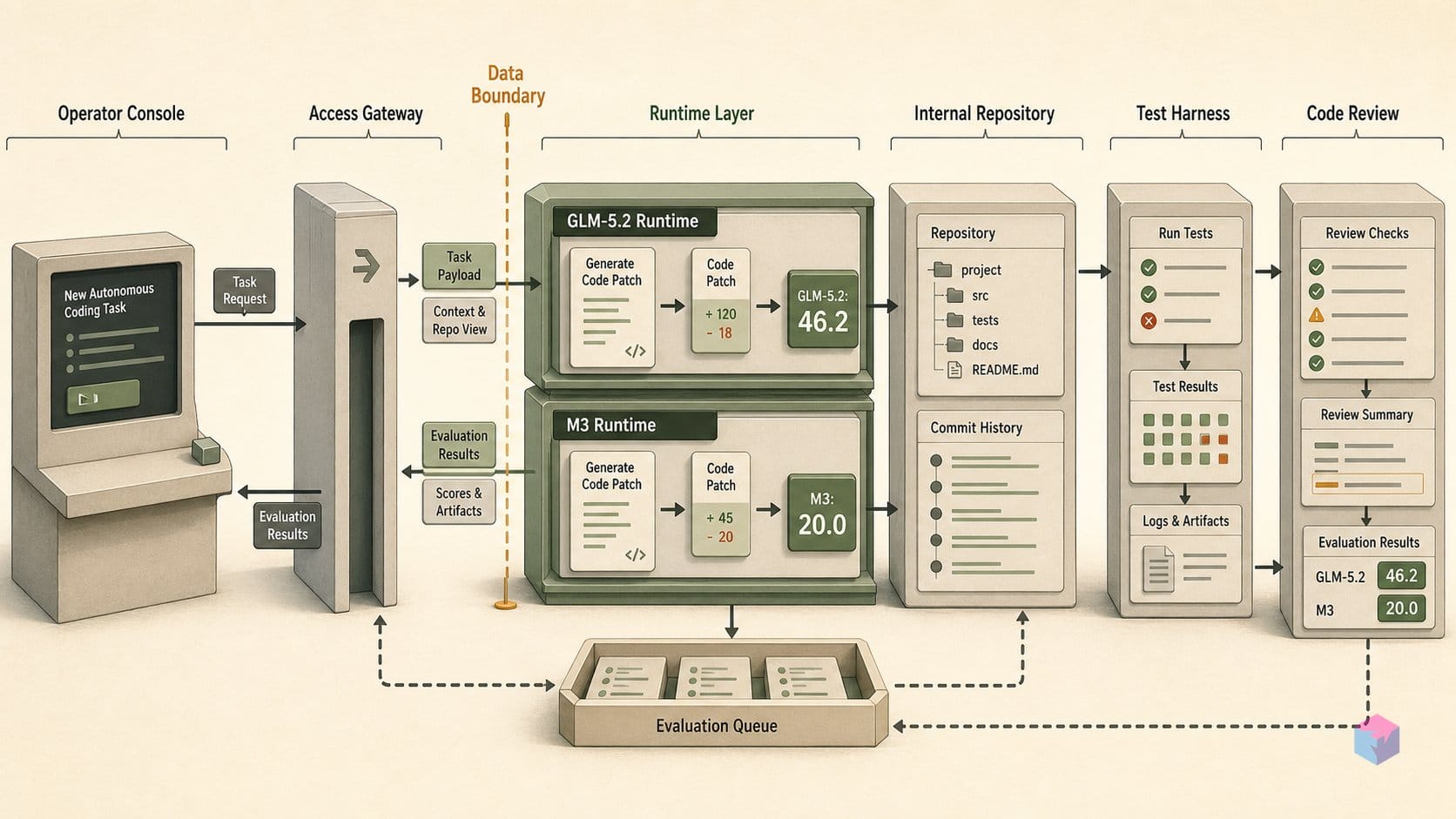
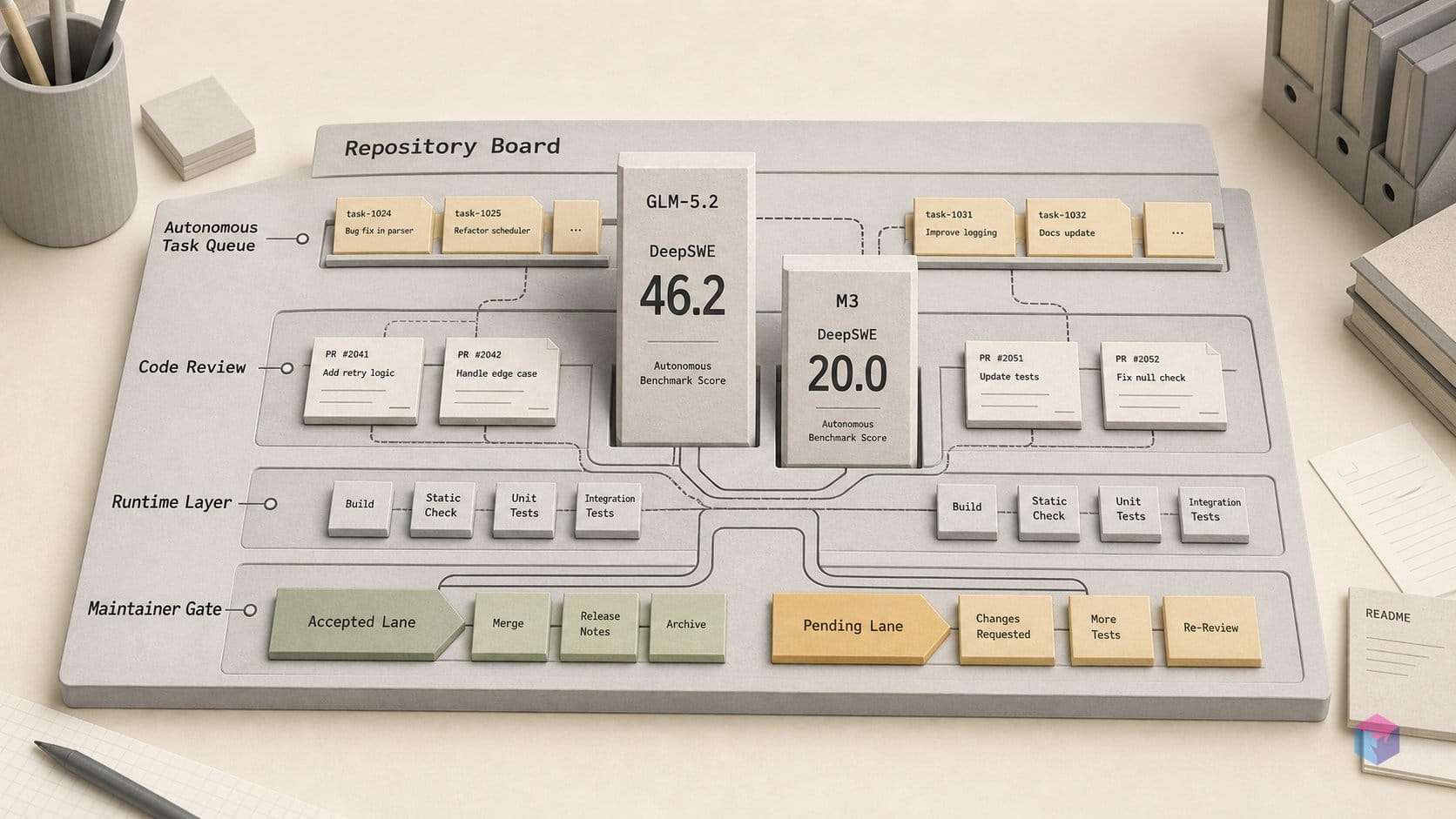
On the four benchmark rows where Z.ai publishes both models, GLM-5.2 leads each one, most sharply on DeepSWE, 46.2 vs M3's 20.0 — more than 2×. They are architecturally different beasts:
- M3 (MiniMax): a mixture-of-experts model at ~428B total / ~23B active parameters, native image+video+desktop input, 1M-token context, MiniMax Sparse Attention (MSA), and a minimax-community license.
- GLM-5.2 (Z.ai/Zhipu): text-only, 1M context / 128K max output, an MIT model license, IndexShare sparse attention, and selectable reasoning-effort levels.
Put plainly: GLM-5.2 is the more agent-tuned pure-coding engine, while M3 trades some coding lead for eyes and a desktop. The rest of this guide unpacks where each gap is real and which belongs in your stack.
GLM-5.2 vs M3 on Every Shared Row
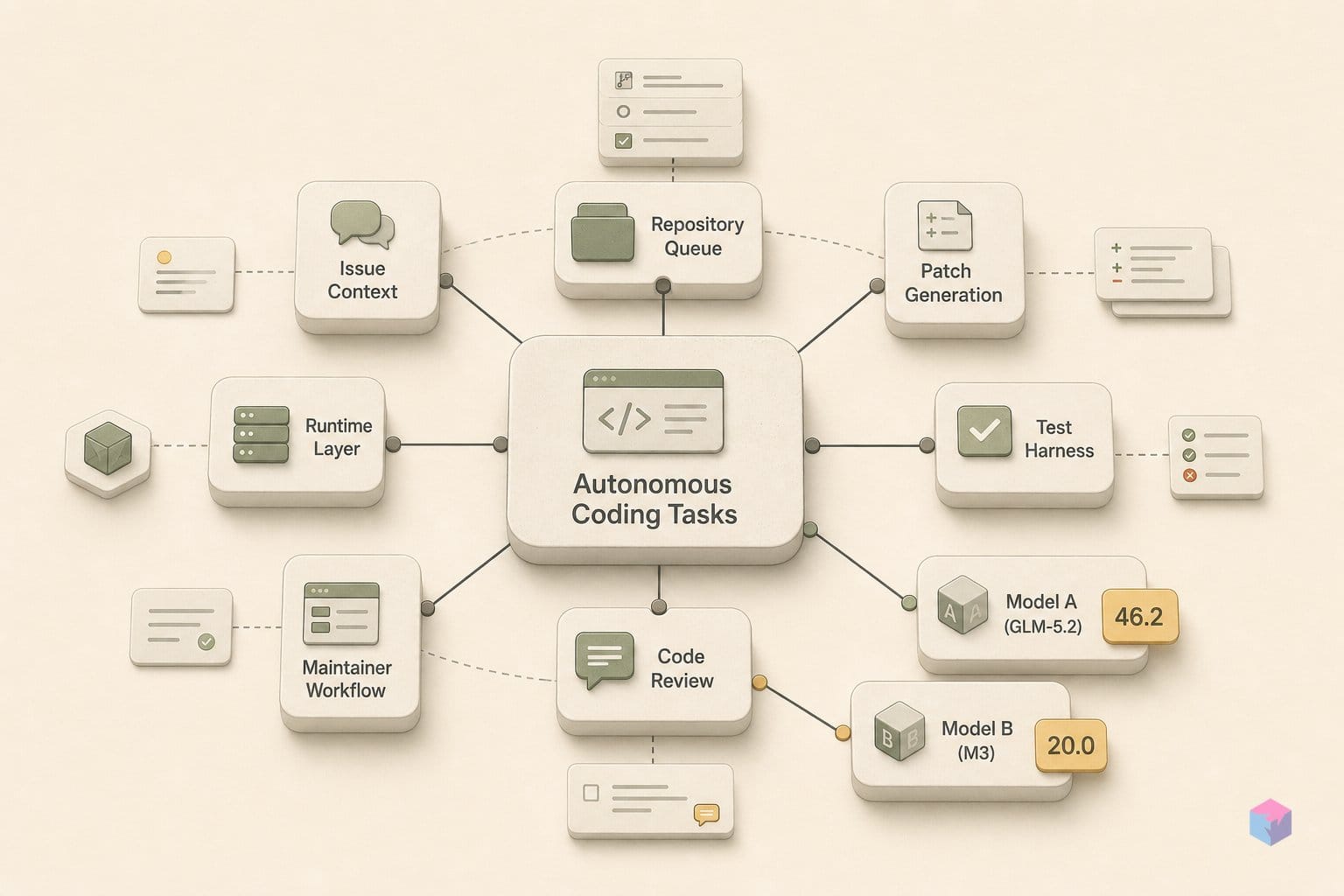
On every benchmark where Z.ai's published comparison reports both models, GLM-5.2 leads M3 — but the margins range from a rounding error to more than 2×. The narrowest gap is SWE-bench Pro, where GLM-5.2 scores 62.1 against M3's 59.0, a 3.1-point edge . The widest is DeepSWE, run on the mini-swe-agent harness with 2-hour timeouts and no internet, where GLM-5.2 posts 46.2 to M3's 20.0 .
| Benchmark (harness) | GLM-5.2 | M3 | Margin |
|---|---|---|---|
| SWE-bench Pro | 62.1 | 59.0 | +3.1 |
| MCP-Atlas (public set) | 76.8 | 74.2 | +2.6 |
| NL2Repo | 48.9 | 42.1 | +6.8 |
| Terminal-Bench 2.1 (Terminus-2) | 81.0 | 65.0 | +16.0 |
| DeepSWE (mini-swe-agent) | 46.2 | 20.0 | +26.2 |
The shape matters more than the totals. On the two rows closest to single-shot patch-and-fix work — SWE-bench Pro and the MCP-Atlas public set (76.8 vs 74.2) — the models are near parity . The gaps blow open on the long-horizon, terminal-driven tasks: Terminal-Bench 2.1 runs 81.0 vs 65.0, a 16-point spread, and DeepSWE more than doubles M3's score . If your agent lives in a shell and iterates for hours, that is where the daylight is.
Several rows have no M3 number to compare against. GLM-5.2 alone reports FrontierSWE 74.4, ProgramBench 63.7, PostTrainBench 34.3, Tool-Decathlon 48.2, and SWE-Marathon 13.0 . Read those last two as a caution, not a flex: a 13.0 on SWE-Marathon and a sub-50 Tool-Decathlon signal that GLM-5.2's lead narrows on extended, multi-tool orchestration — the very workloads where a coding agent chains dozens of calls without losing the thread . One more caveat carries across the whole table: these are vendor-run numbers under mixed scaffolding, so treat the gaps as directional until third-party harnesses reproduce them.
Where GLM-5.2 Pulls Far Ahead
On the benchmarks where an outside party — not the vendor — holds the scoreboard, GLM-5.2 keeps its footing while M3 is largely absent. The independent FrontierSWE leaderboard ranks GLM-5.2 third with roughly 74% dominance, behind Claude Opus 4.8 (~75%) and ahead of GPT-5.5 (~73%) . M3 does not appear on that list at all , so the cleanest cross-vendor comparison available is one M3 has not entered.
PostTrainBench tells a similar story. Its changelog records GLM-5.2 reaching number 1 on 2026-06-17, after Opus 4.8 Max was updated to two runs . That table is externally run rather than Z.ai-administered, which is the part worth weighting — when a third party controls the harness, GLM-5.2's coding-agent lead holds up against frontier closed models, not just against M3.
The largest head-to-head spreads, though, came from runs each vendor scaffolded itself, and the rigs did not match. Z.ai ran DeepSWE through mini-swe-agent with 2-hour timeouts and no internet access, and Terminal-Bench through Terminus-2 capped at 256K context, while MiniMax measured M3 on different internal infrastructure with its own context and output limits .
"SWE-bench Pro via OpenHands at 400K context; DeepSWE via mini-swe-agent with 2-hour timeouts and no internet; Terminal-Bench via Terminus-2 at 256K context," — Z.ai's published GLM-5.2 benchmark documentation (source: datanorth.ai).
Read with that in mind, the gaps sort into two buckets. The 26-point DeepSWE spread (46.2 vs 20.0) and the 16-point Terminal-Bench spread (81.0 vs 65.0) are wide enough to survive scaffolding noise — directionally real, but tentative until one lab replicates both models under a single controlled harness . The 3.1-point SWE-bench Pro margin (62.1 vs 59.0) and the 2.6-point MCP-Atlas margin (76.8 vs 74.2) sit inside harness-noise range and should not be cited as a settled lead .
M3 Has Eyes. GLM-5.2 Doesn't.
The clearest split between the two models is not a benchmark row — it is what each can ingest. M3 is natively multimodal: it accepts image, video, and desktop/computer-use input, and MiniMax frames it as the only open-weight model in this class to combine frontier coding, 1M-token context, and native multimodality . GLM-5.2 is text-only . That distinction matters the moment your agent has to read a screenshot, parse a rendered page, or drive a UI: with M3 the vision step is in-model, while a GLM-5.2 pipeline needs a separate vision component bolted on. On the relevant signal, M3 posts BrowseComp 83.5, ahead of Claude Opus 4.7's 79.3 — evidence the browsing/agentic-search path is more than a checkbox.
MiniMax leans into long-run demonstrations rather than comparison tables. It reports M3 reproducing an ICLR 2025 Outstanding Paper across roughly 12 hours, landing 18 commits and 23 experimental figures, and separately optimizing a Hopper FP8 GEMM kernel over about 24 hours — 147 benchmark submissions, 1,959 tool calls, pushing peak hardware utilization from 7.6% to 71.3%, a 9.4× speedup . These are vendor traces, not standardized scores, so read them as capability demos rather than head-to-head proof — but the duration and tool-call volume are the kind of stress test a SWE-bench row never captures.
MiniMax positions M3 as "the first open-weight model combining frontier coding, 1M context, and native multimodality" (source: MiniMax).
The efficiency stories diverge too. M3's MiniMax Sparse Attention (MSA) claims 28.4× lower per-token attention compute at 1M context and up to a 15× decode speedup — but those figures come from a 109B-parameter experimental setting, not the shipped ~428B model . GLM-5.2 takes a different route with IndexShare for sparse attention, a stated 2.9× FLOP reduction at 1M context .
GLM-5.2's coding focus carried a cost worth flagging before you commit. General-reasoning metrics slipped: Humanity's Last Exam and GPQA-Diamond are down 5–10 points . Math reasoning, though, survived the coding-tuning pass intact — GLM-5.2 posts AIME 2026 at 99.2% . If your agent stays inside code and terminals, that tradeoff barely registers; if it also does open-ended reasoning or vision work, M3's breadth starts to matter more than GLM-5.2's coding lead.
What Each Charges and Who Can Redistribute
On raw token economics, MiniMax M3 is the cheaper model by a wide margin, while GLM-5.2 charges a premium for its agentic coding lead. M3 lists at $0.60 per 1M input tokens and $2.40 per 1M output, dropped to a week-one launch rate of $0.30 / $1.20. GLM-5.2 lists at $1.40 input, $0.26 cached input, and $4.40 output per 1M tokens. That makes GLM-5.2's output roughly 3.7× more expensive per token than M3's launch rate — a real cost for agents that emit long diffs and tool calls all day.
| Plan / metric | MiniMax M3 | Z.ai GLM-5.2 |
|---|---|---|
| Input / 1M tokens | $0.60 (launch $0.30) | $1.40 |
| Cached input / 1M | blended as low as ~$0.06 | $0.26 |
| Output / 1M tokens | $2.40 (launch $1.20) | $4.40 |
| Monthly token plans | ~1.7B/$20 · ~5.1B/$50 · ~9.8B/$120 | not listed |
| Model license | minimax-community | MIT |
MiniMax pushes further on volume buyers with monthly Token Plans of ~1.7B tokens for $20, ~5.1B for $50, and ~9.8B for $120, and cache-optimized blended rates as low as ~$0.06 per 1M. If your bottleneck is inference spend on a high-throughput agent fleet, that gap compounds quickly.
Licensing inverts the calculus. GLM-5.2 ships under MIT terms, with weights on Hugging Face and ModelScope and no stated regional restrictions — commercial use, fine-tuning, redistribution, and derivative works all need no approval. M3 ships under a minimax-community license, and MiniMax's previous flagship required authorization for commercial use, so verify the current model card before shipping commercial derivatives.
One enterprise wrinkle: GLM-5.2 API access via Z.ai has been flagged for China-data-handling concerns by some buyers. Because the MIT weights are public, self-hosting GLM-5.2 on your own infrastructure sidesteps that data-residency question entirely — a path the more restrictive M3 license does not open as cleanly.
Which One to Put in Your Stack
Pick GLM-5.2 when your agent is text-only repository work, you need the cleanest license for commercial redistribution, or your evaluation harness mirrors the Terminal-Bench and DeepSWE methodology Z.ai used. Its MIT weights remove regional and commercial-use friction, and its DeepSWE 46.2 vs 20.0 and Terminal-Bench 2.1 81.0 vs 65.0 leads are the widest reported gaps for pure coding agents.
Pick M3 when your pipeline ingests screenshots, video, or desktop state, when compute-efficient self-hosting at 1M context matters, or when per-output-token cost is the binding constraint. Its launch output rate of about $1.20 per million tokens runs roughly 3.7x cheaper than GLM-5.2's $4.40 , and MiniMax Sparse Attention makes long-context inference cheaper to host .
Treat the DeepSWE and Terminal-Bench gaps as migration signals, not verdicts, until a third party replicates both under matched scaffolding — the 3.1-point SWE-bench Pro and 2.6-point MCP-Atlas margins sit within harness noise. The concrete takeaway: if you are paying closed-model rates for long-horizon sessions today, trial either open weight at its current API price before committing to a full stack migration.
Frequently asked questions
Is GLM-5.2 definitively better than M3 for coding agents?
Not definitively — directionally. On all four rows where Z.ai's table reports both models, GLM-5.2 leads: DeepSWE 46.2 vs 20.0, Terminal-Bench 2.1 81.0 vs 65.0, SWE-bench Pro 62.1 vs 59.0, and MCP-Atlas 76.8 vs 74.2 . But the runs used different scaffolding, so treat the result as directional until a third party replicates both under identical conditions. The DeepSWE and Terminal-Bench gaps are large enough to survive some noise; the 3.1-point SWE-bench Pro and 2.6-point MCP-Atlas margins sit within harness-noise range. For most agentic coding workloads GLM-5.2 is the safer current bet, but it is not a settled verdict.
Can I run either model locally?
Yes — both ship open weights on Hugging Face. GLM-5.2 is published under an MIT model license with no regional restrictions, making it the cleaner option for self-hosting and redistribution . M3 is a mixture-of-experts model at roughly 428B total parameters with about 23B active, under a minimax-community license , so multi-GPU self-hosting is feasible and its sparse-attention design keeps per-token inference cost low. GLM-5.2's vendor materials reviewed here do not disclose an active-parameter count; check its Hugging Face card before sizing hardware.
What does the minimax-community license restrict compared to MIT?
MIT grants commercial use, fine-tuning, redistribution, and derivative works with no approval step — that is GLM-5.2's grant . M3 ships under a minimax-community license rather than MIT, and MiniMax's predecessor model required authorization for commercial use . Read the current M3 license card before shipping a commercial product on the weights; for commercial teams that want redistribution without an approval gate, GLM-5.2's MIT terms are the simpler grant.
Why is the DeepSWE gap so large if both models target the same task?
Because the two scores were not produced under one controlled harness. Z.ai ran DeepSWE via mini-swe-agent with 2-hour timeouts and no internet access, while MiniMax used different scaffolding, context limits, and judge models . Gaps as wide as 46.2 vs 20.0 frequently reflect timeout, retry, and context-window choices as much as raw model capability. Neither vendor published a matched head-to-head, so the DeepSWE spread is the row most likely to compress once an independent harness runs both under identical conditions.
Does M3's 24-hour autonomous run make it better for long-horizon tasks in practice?
Not on its own. M3's reported FP8 GEMM optimization over roughly 24 hours — 147 benchmark submissions and 1,959 tool calls, lifting peak utilization from 7.6% to 71.3% — shows it can sustain very long traces . But that is a vendor demo, not a standardized benchmark, and both models carry 1M-token context and are built for long-horizon work . In practice, achievable run length depends more on your orchestration framework, retry logic, and per-session cost tolerance than on the model alone.