
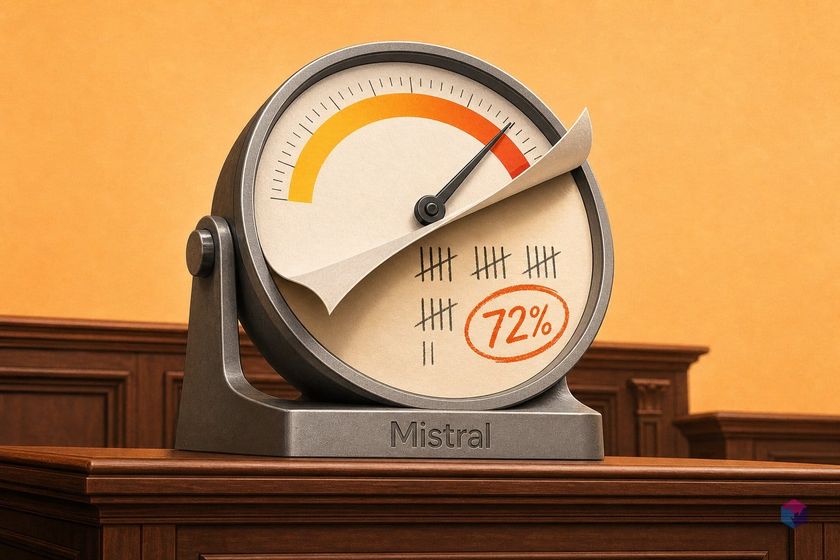
Mistral's launch post for OCR 4 leads with one number — a 72% win rate — and most coverage has repeated it verbatim. Before you treat that figure as a benchmark, it helps to know exactly how it was produced, because the answer is "a vote," not "a score."
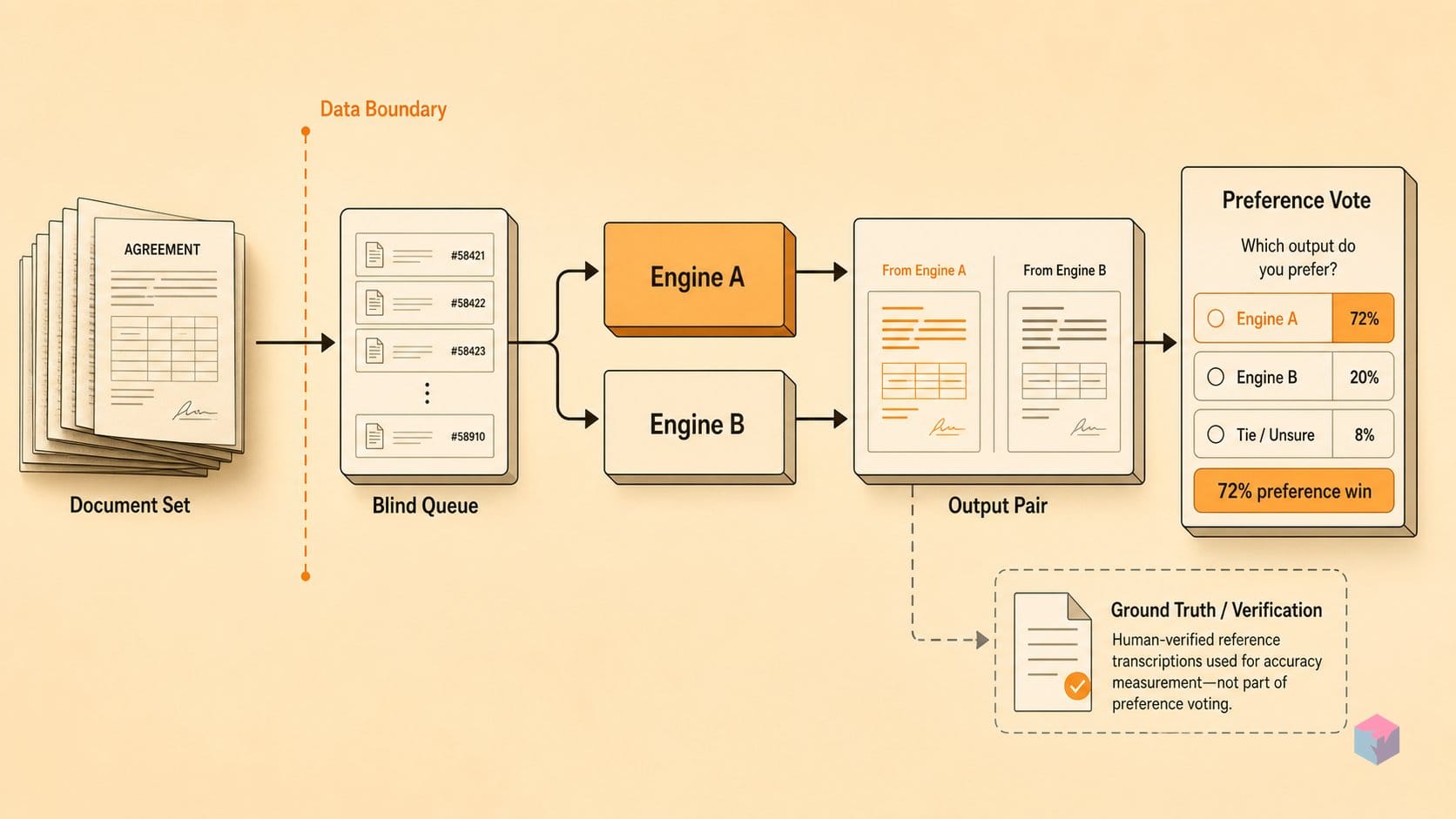
How the 72% is counted: pairwise preference annotators
The 72% is a human-preference win rate, not an accuracy metric. Mistral announced OCR 4 on June 23, 2026 and reported that independent annotators, shown OCR 4's output beside a competitor's output one document at a time and blind to which system produced which, preferred OCR 4 in an average of 72% of those pairwise comparisons (the-decoder, 2026-06). In other words, it measures which output a person liked better, not how many characters or fields were extracted correctly.
The evaluation set was 600+ real-world documents across 12+ languages, sourced from third-party vendors to represent industry use cases rather than curated test pages (Mistral, 2026-06). Mistral states OCR 4 outperformed every leading system it tested across all comparisons. That is a real signal — blind side-by-side ranking is a reasonable way to capture output quality humans actually notice — but it is a vendor-run, vendor-reported study, and the aggregate hides as much as it shows.
What the public post does not disclose matters for anyone trying to reproduce or weight the claim:
| Disclosed | Not disclosed |
|---|---|
| Blind, pairwise (head-to-head) format | Competitor identities |
| 600+ documents, 12+ languages | Number of annotators |
| Third-party-sourced document set | Per-competitor win rates |
| 72% aggregate win rate | Raw model outputs and the document set itself |
| Annotators were independent | Statistical confidence intervals / annotator instructions |
Each omission removes a lever you would normally use to interpret a benchmark. Without per-competitor breakdowns, you cannot tell whether 72% reflects a narrow edge over a strong system or a blowout against a weak one. Without the competitor list, "outperformed every leading system" is unfalsifiable from outside. Without annotator count or confidence intervals, there is no way to judge whether the margin is stable or noise. And because the document set stays private, no third party can rerun the comparison.
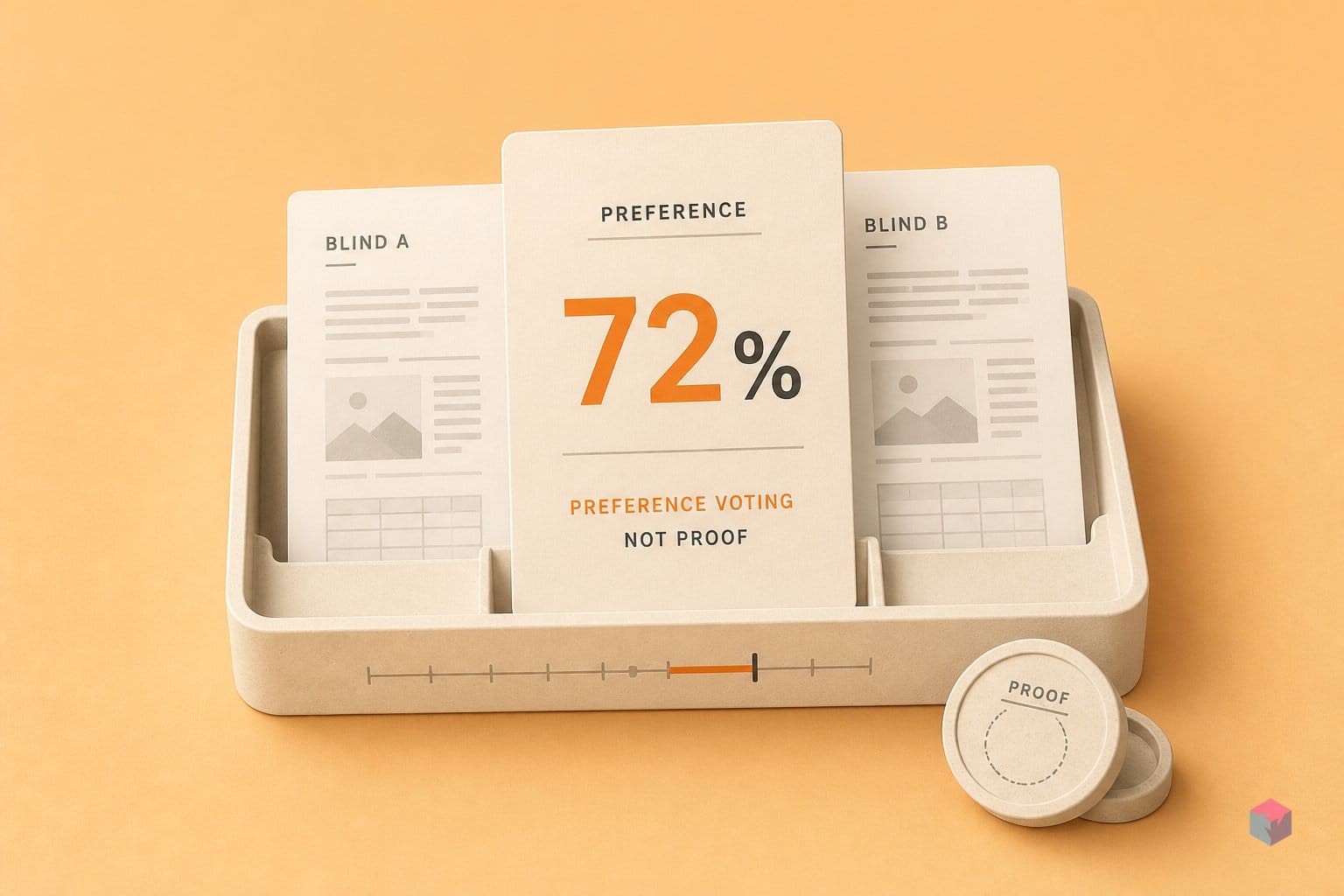
The practical read for builders: 72% is an aggregate from blind third-party annotation, not an independently reproducible benchmark (Mistral, 2026-06). It is evidence that human reviewers liked OCR 4's output on a vendor-chosen corpus — useful directionally, but not a number to design a procurement decision around until you have run the model on your own documents.
OCR 4's fault zones: equation notation, column layouts
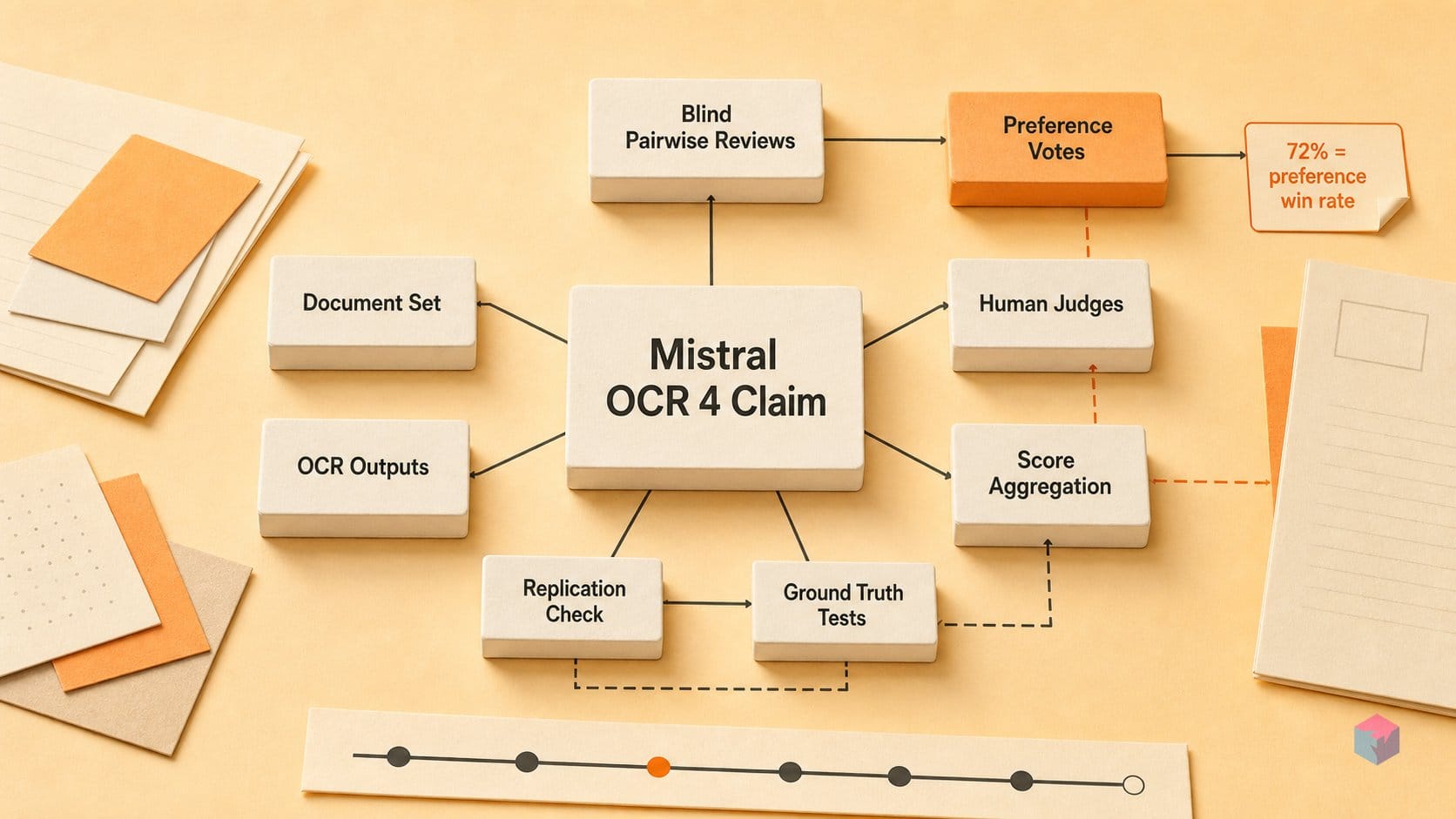
The more useful artifact in the OCR 4 launch is not the win rate — it is the transparency section where Mistral audits the scoring failures it hit while benchmarking. For production builders, that self-audit is the part to read first, because it names exactly where automated OCR scores stop tracking real quality: mathematical, scientific, and multi-column documents . Those are the same document classes most enterprise ingestion pipelines actually care about, so the caveats matter more than the headline.
Mistral's audit flags several concrete artifact types. First, ground-truth annotation errors: the reference labels in public automated suites are themselves wrong in places, with errors concentrated in math and science documents — meaning a correct OCR output can be scored as a miss against a faulty answer key . This is not a Mistral-specific complaint. The PureDocBench study independently audited OmniDocBench-style evaluator-scored blocks and found a 12.08% annotation-error rate — 2,580 confirmed errors — while noting top scores on these suites now saturate above 90%, leaving little headroom to distinguish systems .
Second, math and LaTeX notation gaps. Equivalent expressions written in different but valid notation are scored as mismatches against the reference answer — the same equation, formatted differently, registers as wrong . Mistral lists equation-segmentation differences in the same category: where a reference splits an equation into a different number of blocks than the model does, the comparison penalizes a structurally fine result. If your corpus is equation-dense, an aggregate benchmark number tells you almost nothing about whether OCR 4 reproduces your formulas usefully.
Third, layout attribution in column-heavy PDFs. Multi-column reading-order assumptions and header/footer block attribution are the remaining fault concentrations: the model and the reference can disagree on which column to read first, or on whether a running header belongs to the body, and the scorer treats either disagreement as an error . Mistral's stated position is that these artifacts inflate apparent error rates rather than reflect extraction failures — which is also why it urges users to evaluate on their own documents instead of trusting the suite totals.
The takeaway for an evaluation plan: the fault zones are predictable and they cluster. If your documents are plain prose in a single column, OCR 4's benchmark numbers are probably honest about its behavior. If they are scientific papers, financial statements with footnotes, or two-column reports, treat published scores as directional and build a small gold set from your own files — scored by a reviewer who can tell a real miss from a notation disagreement.
Why Mistral calls its automated suite 'directional, not definitive'
Mistral's automated scores are strong on paper but carry a self-imposed asterisk: the company labels them "directional rather than definitive" and tells users to evaluate on their own documents . OCR 4 reports 85.20 on OlmOCRBench (described as the top overall score among tested models), 93.07 on OmniDocBench, and 0.98 on an internal 'Crawl Multilingual' set . The catch is in the footnotes: every competitor number is Mistral's own internal reproduction, not an official leaderboard entry, and Mistral flags both benchmarks as having known limitations .
The public record reinforces the caution rather than the marketing. The live OmniDocBench leaderboard (through v1.7) still lists "Mistral OCR" at version 2503 — an older release, not OCR 4 — scoring around 85.66 and sitting below OCRVerse, MonkeyOCR-pro-3B, GPT-5.2, Dolphin-1.5, MinerU-Pipeline, and olmOCR . That doesn't contradict OCR 4's 93.07, but it does mean the only Mistral number under public, identical scoring rules is the prior model — and it isn't at the top. OCR 4's headline figures have not yet appeared as an official public entry anyone else can replicate.
| Score / signal | Value | Who produced it |
|---|---|---|
| OmniDocBench (OCR 4) | 93.07 | Mistral internal reproduction |
| OlmOCRBench (OCR 4) | 85.20 | Mistral internal reproduction |
| OmniDocBench public (Mistral OCR 2503) | ~85.66, ranked below 6+ systems | Public v1.7 leaderboard |
| OmniDocBench reference-annotation error rate | 12.08% (2,580 confirmed errors) | PureDocBench audit |
There is also reason to distrust the yardstick itself. PureDocBench audited OmniDocBench's own ground-truth annotations and found a 12.08% annotation-error rate — 2,580 confirmed errors in evaluator-scored blocks — with top scores already saturating above 90% . When the reference is that noisy and the ceiling is that compressed, a one- or two-point gap between systems is closer to measurement jitter than to a meaningful capability difference.
The multilingual story has a harder ceiling. GlotOCR Bench, evaluating across 100+ Unicode scripts, found that even frontier OCR systems generalize to only about 30 scripts before quality collapses . OCR 4 advertises 170 languages across 10 language groups, including low-resource ones, but that low-resource ceiling almost certainly applies to it too — and no public benchmark currently isolates how OCR 4 behaves on the long tail of scripts. None of these papers test OCR 4 directly. They simply echo Mistral's own warning: a single aggregate score can mislead, so validate on your own document mix before you trust the leaderboard.
Element coordinates, typed regions, inline confidence: what OCR 4 extracts
OCR 4 returns three structural signals that prior versions did not: paragraph- and element-level bounding coordinates, a typed category label for every block, and confidence scores at per-page and per-word granularity — all layered on top of the Markdown text the model already produced . The practical effect is that extraction output stops being a flat string and becomes a spatially grounded, machine-classified map of the page. For builders, that is the difference between "here is the text" and "here is the text, where it sits, what kind of element it is, and how sure the model is."
The bounding boxes are the most consequential addition. Because every paragraph and element carries coordinates, you can trace a RAG citation back to the exact region it came from, or drive a redaction pass that blacks out a signature block by its geometry rather than by brittle string matching . Spatial grounding is what makes "show me the source" auditable instead of approximate.
Typed block classification runs alongside it. Each page element is tagged with a category — title, table, equation, signature, header, or footer — so downstream code can route or filter by type without re-parsing layout heuristics . An invoice pipeline can pull only table blocks; a compliance step can isolate signatures; a search index can drop headers and footers before chunking.
The inline confidence values are the human-in-the-loop hook. Per-word and per-page scores flag low-certainty extractions so you can queue exactly those pages for review or quietly filter them out, rather than trusting or auditing the whole document . Pair that with the equation- and column-handling caveats Mistral itself documented, and confidence scores become the cheapest way to catch the failure modes before they reach production.
"Every request runs the same underlying OCR model and always returns extracted content, bounding boxes, block types, confidence scores, and markdown text," — Mistral AI, in its OCR 4 release notes (source: Mistral AI). The higher-tier Document AI layer adds schema-shaped JSON extraction and custom-prompt interpretation, with structured output handled through mistral-small-2603.Coverage matches the enterprise pitch: 170 languages across 10 language groups, including low-resource ones, with input accepted as PDF, DOC, PPT, and OpenDocument files . The service is identified as Premier v4.0, model identifier mistral-ocr-4-0+2, per the model card . Taken together, these outputs are why Mistral frames OCR 4 as an ingestion component for RAG, agentic, and human-verification pipelines — not an end-user product.
OCR 4's $4 page fee: where it earns the premium
OCR 4 costs $4 per 1,000 pages on-demand through the API (mistral-ocr-latest) — roughly four times the original Mistral OCR, which launched in March 2025 at about 1,000 pages per dollar. The premium is defensible when OCR 4's typed blocks, coordinates, and confidence scores replace a second parsing layer you would otherwise build and maintain; for flat text extraction at volume, open-source parsers remain hard to beat on cost-per-page.
There are three price points to keep straight. The base OCR model runs at $4 per 1,000 pages, but routing requests through the Batch API halves that to $2 per 1,000 pages for non-interactive, throughput-oriented jobs. The higher-tier Document AI product, which adds schema-shaped JSON extraction, image annotation, and custom-prompt interpretation — with structured output handled by mistral-small-2603 — lists at $5 per 1,000 pages.
| Tier | What you get | Price / 1,000 pages |
|---|---|---|
| Original Mistral OCR (2503, Mar 2025) | Markdown text extraction | ~$1 |
| OCR 4 — Batch API | Same model, throughput jobs | $2 |
| OCR 4 — on-demand | Bounding boxes, block types, confidence, markdown | $4 |
| Document AI | OCR 4 + schema JSON, annotations, custom prompts | $5 |
The math turns on what the extra dollars displace. Every OCR 4 request returns extracted content, paragraph-level bounding boxes, typed block classification, per-page and per-word confidence scores, and markdown in one pass . If your pipeline currently bolts a layout parser, a table reconstructor, or a confidence heuristic onto a cheaper text extractor, OCR 4 collapses that stack — and the $4 (or $2 batched) buys back the engineering you would otherwise own.
Where it does not pay off: high-volume, plain-text ingestion with no structural requirement. If you only need clean markdown from clean PDFs, a self-hosted open parser will undercut $4 per 1,000 pages on raw cost, and the gap widens at scale. The decision is not "is OCR 4 good" but "does structured output replace a layer I would otherwise ship." When it does, the premium is an integration savings; when it does not, it is overhead.
On-premise OCR 4: air-gapped container, confidential-PDF extraction
OCR 4's most consequential capability for regulated builders is fully self-hosted deployment in a single container, letting an organization run the model entirely inside its own network with no document ever leaving the perimeter . Announced alongside the model on June 23, 2026, this is the line that separates OCR 4 from a cloud-only API: the same underlying model — Premier v4.0, identifier mistral-ocr-4-0+2 — that you would call over the network can instead be air-gapped behind your own firewall .
The target is explicit: data-residency, sovereignty, and confidentiality constraints in finance, legal, and healthcare, where routing sensitive PDFs to a third-party cloud endpoint is contractually or legally off the table . Pair the air-gapped container with the per-element bounding boxes and per-word confidence scores covered earlier, and you get grounded, auditable extraction inside the trust boundary — the combination that regulated retrieval and human-in-the-loop review pipelines actually need.
That positioning puts OCR 4 directly opposite the managed cloud document-AI services — Google Document AI, Azure Document Intelligence, and AWS Textract — for any on-premise regulated workflow, since none of those run inside a customer's own air-gapped infrastructure the way a single self-hosted container does . It also pressures open OCR stacks, which previously owned the "we host it ourselves" segment by default.
VentureBeat framed the shift bluntly in its launch coverage: "Mistral launches OCR 4, turning document extraction into a full enterprise AI play" — VentureBeat, 2026-06. The enterprise framing is the point: this is an ingestion component sold on deployment control, not an end-user product.
One caveat before you provision hardware. The launch did not fully detail self-hosting licensing terms or minimum hardware specifications . Whether the container demands specific GPUs, what throughput it sustains, and how the license is priced against the $4 per 1,000 pages API rate are open questions. Confirm those terms with Mistral before committing infrastructure or budgeting a migration off your current stack.
Where to focus your OCR 4 trial: math-heavy PDFs, column-dense layouts
Run your OCR 4 trial on the document types Mistral's own audit flags as weakest — equation-heavy, scientific, and multi-column layouts — not on the clean pages where any modern parser scores well. Mistral explicitly urges evaluation on your own document mix and warns that aggregate scores are "directional rather than definitive" . The 72% blind-preference win rate is an average across 600+ documents in 12+ languages ; it will not hold uniformly, and the gap between your content and that aggregate is exactly what a trial exists to measure.
Prioritize the fault zones the launch surfaced itself. Mistral's transparency section concentrates its scoring artifacts — equivalent LaTeX/math notation marked as mismatches, equation-segmentation differences, multi-column reading-order assumptions, and header/footer block-attribution issues — in mathematical, scientific, and multi-column documents . If your corpus is financial filings, research papers, or dense technical manuals, these are the pages that will decide whether OCR 4 earns its place, and they are where the headline numbers are least informative.
If your documents span scripts beyond the common set, test them deliberately. OCR 4 advertises 170 languages across 10 language groups , but independent work tempers that breadth: GlotOCR Bench, evaluating over 100 Unicode scripts, found even frontier OCR systems fail to generalize beyond roughly 30 scripts . Stated coverage is not the same as reliable extraction. Verify low-resource scripts against ground truth you trust rather than assuming the language list translates to accuracy.
Structure the comparison so it produces a decision, not a vibe. Feed identical PDFs to OCR 4 and to a cheaper alternative — an open parser or a lower-cost specialist — and compare the concrete outputs OCR 4 charges a premium for: element bounding-box coordinates, typed block classification, and per-word confidence values, against the $4 per 1,000 pages API rate (or $2 with the 50% Batch discount) . Check whether the boxes land precisely, whether confidence scores actually predict errors on your hardest pages, and whether downstream RAG or extraction quality improves enough to justify the cost.
The takeaway: treat the 72% as a reason to trial OCR 4, not a reason to adopt it. Validate on your own math-heavy, column-dense, and multi-script documents before committing at scale — the only benchmark that binds your pipeline is the one run on your documents.
Frequently asked questions
Is Mistral OCR 4's 72% win rate independently verified?
No. The 72% average win rate is vendor-run and vendor-reported . Independent third-party annotators did the blind pairwise comparisons across 600+ documents in 12+ languages, but Mistral does not publish the competitor list, the annotator count, the per-competitor breakdowns, or confidence intervals . As of launch, OCR 4 has not appeared on a public leaderboard under its own version identifier — the public OmniDocBench listing still shows the older Mistral version 2503, not OCR 4 . Treat it as a marketing claim pending replication.
What does OCR 4 add that OCR 3 did not return?
OCR 4 layers three structural outputs inline with the Markdown text that OCR 3 (released January 2026) did not return: typed block classification (titles, tables, equations, signatures, headers, and footers), paragraph- and element-level bounding coordinates, and confidence scores at per-page and per-word granularity . The model card identifies the service as Premier v4.0, model identifier mistral-ocr-4-0+2 . These make outputs citation-ready for RAG, form and invoice extraction, redaction, and human-in-the-loop verification.
Why did OCR pricing jump four-fold?
The original Mistral OCR API launched at roughly 1,000 pages per dollar . OCR 4 is $4 per 1,000 pages on demand, dropping to $2 with the 50% Batch-API discount, while the higher-tier Document AI product is $5 per 1,000 pages . The increase reflects the shift from plain text extraction to structure-aware output — bounding coordinates, typed block labels, and confidence values — plus expanded coverage of 170 languages across 10 language groups .
Where does OCR 4 perform worst?
Mistral's own transparency audit flags the weakest zones: mathematical and LaTeX notation scored as mismatches even when equivalent, multi-column reading-order errors, equation-segmentation differences, and header/footer block-attribution issues . The company notes these concentrate in mathematical, scientific, and multi-column documents. Independent work reinforces the caution: PureDocBench reports a 12.08% annotation-error rate (2,580 confirmed errors) in audited evaluator-scored blocks, underscoring why single aggregate scores can mislead on hard pages .
Can I run Mistral OCR 4 on my own servers?
Yes. OCR 4 supports fully self-hosted deployment in a single container, aimed at organizations with data-residency, sovereignty, or confidentiality constraints that cannot route sensitive documents to third-party cloud APIs . Combined with bounding boxes and confidence scores, this targets regulated workflows in finance, legal, and healthcare . Licensing terms and minimum hardware specs were not published at release, so confirm them in Mistral's enterprise documentation before planning a deployment.