
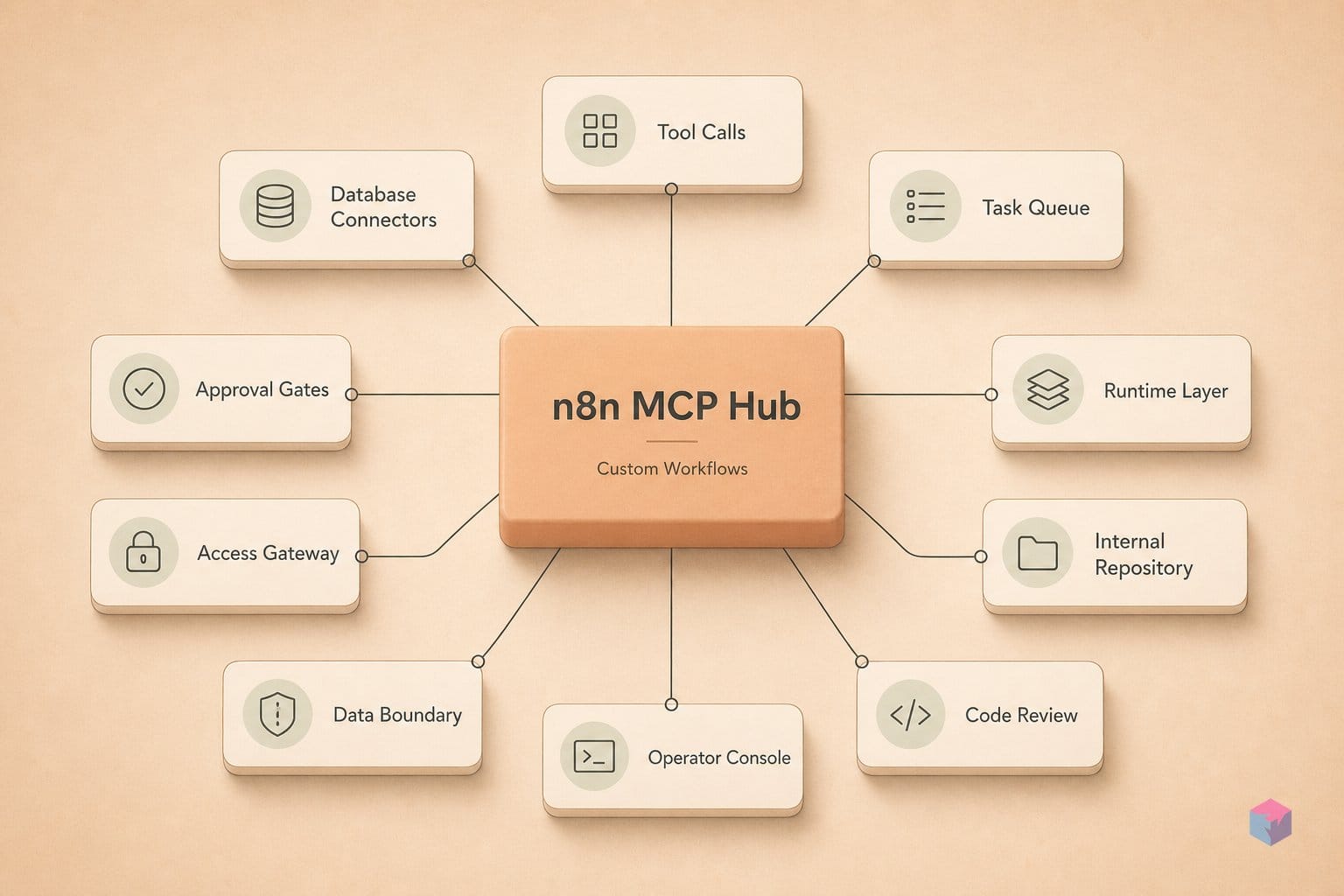
Point Claude at one n8n instance instead of a dozen separate MCP servers, and the model's tool list shrinks from chaos to a handful of named actions. What that buys you — and what it can't touch — is worth getting straight before you wire anything up.
What n8n offloads from Claude — and what stays the same
Using n8n as an MCP hub collapses many SaaS integrations into a few coarse tools Claude actually sees — create_invoice, triage_ticket, or research_account instead of dozens of raw per-app API operations. n8n becomes the single Model Context Protocol endpoint; Claude reasons over a narrow, curated tool surface while n8n fans each call out to downstream apps. This is a consolidation pattern, not a circumvention of Anthropic's limits.
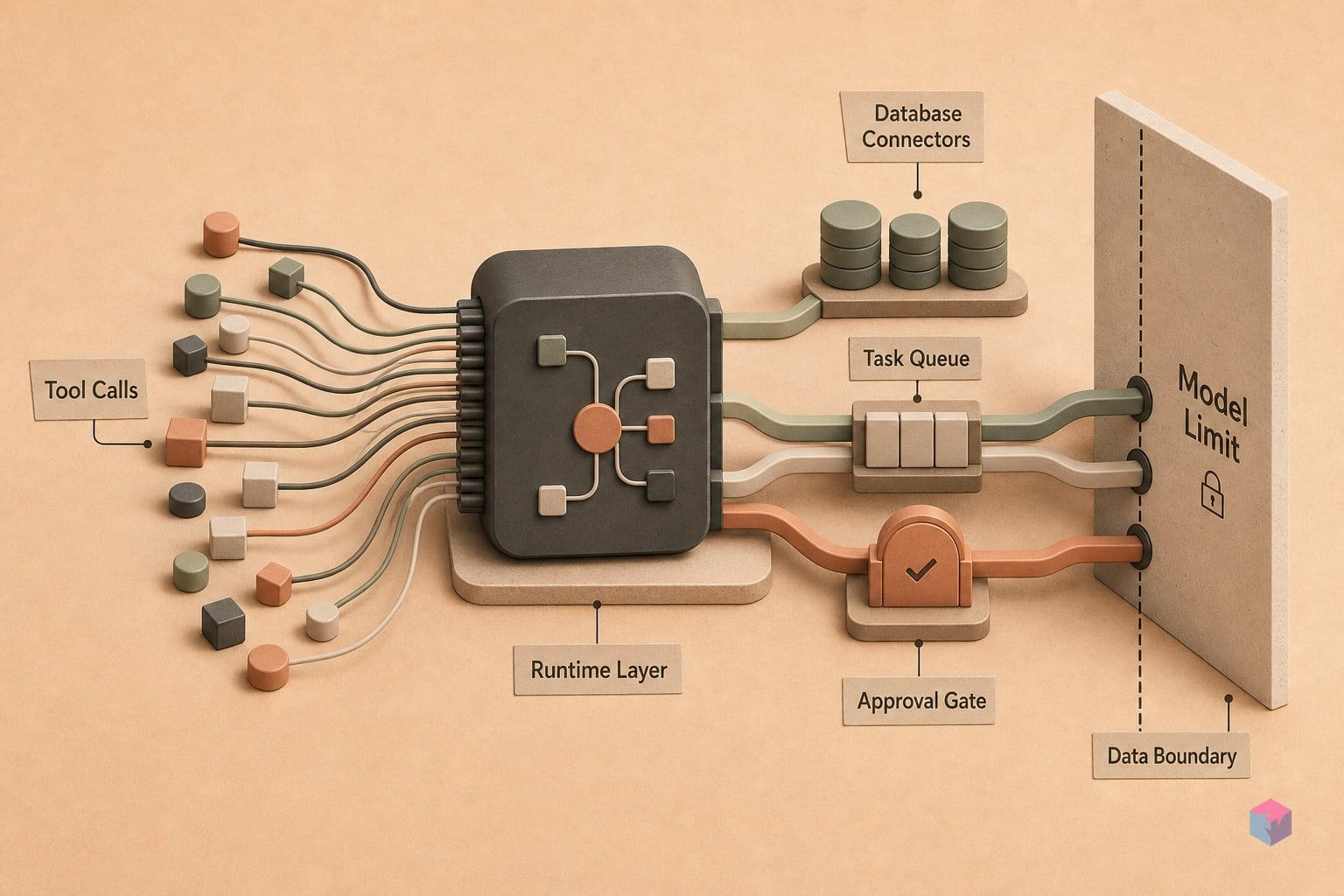
What moves into n8n: credential storage, retry logic, rate limiting, conditional branching, and execution fan-out across services like Gmail, Slack, Notion, Postgres, and Stripe. A single Claude tool call can trigger a long workflow with many internal steps — though it still burns n8n executions and downstream API quotas.
What does not move: Anthropic's context-window budget, plan-based usage caps (Claude Pro $20/month monthly, Max from $100/month ), the 25,000-token default MCP output ceiling and 500,000-character hard limit , and safety constraints. A well-designed hub reduces the schemas Claude must reason over; it cannot make the model generate unlimited tokens or dodge usage caps.
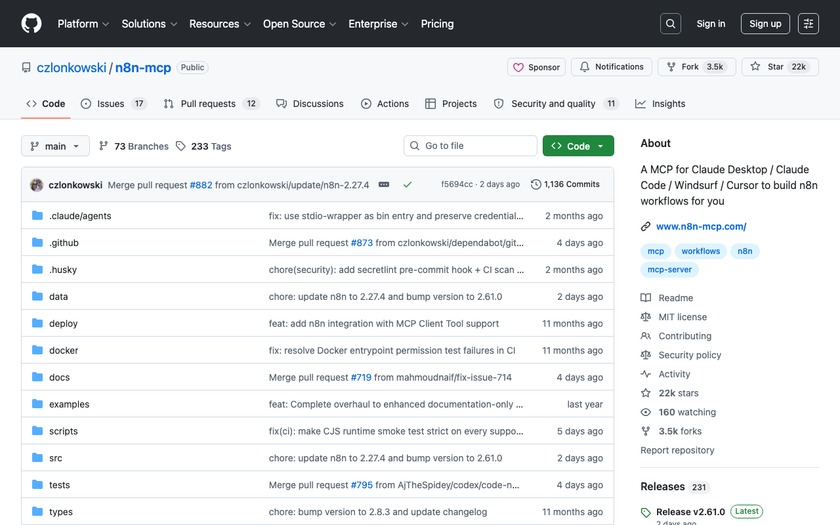
The most common building block, czlonkowski/n8n-mcp (v2.61.0, released June 26, 2026, 22,000+ GitHub stars ), gives Claude documentation access for 2,063 n8n nodes — a schema-discovery layer, not a limit bypass.
What to have ready: n8n v2.18.4+, MCP enabled, an SSE-capable host
Before Claude can call anything, three things have to line up: a recent n8n build, MCP switched on, and a transport Claude can actually reach. n8n recommends v2.18.4 or higher for reliable workflow generation, since earlier builds make more silent design choices during creation . MCP is off until you enable it at the instance level, then again per workflow — both toggles are required before any tool is exposed .
On the Claude side, what you can connect depends on your plan. Custom connectors over remote MCP are in beta across all tiers, but the registration path differs:
| Claude plan | Remote MCP connectors | Who adds them |
|---|---|---|
| Free | 1 custom connector (beta) | The user |
| Pro / Max | Add via settings by entering a remote MCP server URL | The user |
| Team / Enterprise | Org-wide connectors, then members connect individually | Owners / Primary Owners |
Those limits hold today . The transport detail trips most people up. n8n's MCP Server Trigger only exposes Server-Sent Events (SSE) or streamable HTTP; stdio is explicitly unsupported . Claude Desktop's config historically expects a stdio server, so you need an mcp-remote proxy to bridge it to the SSE endpoint — covered in the next section.
For claude.ai remote connectors there is one more hard requirement: the endpoint must be publicly HTTPS-reachable from Anthropic's cloud. Private networks, VPN-only hosts, and firewalls that don't allowlist Anthropic IP ranges fail — often silently .
Making the MCP Server Trigger callable from Claude Desktop
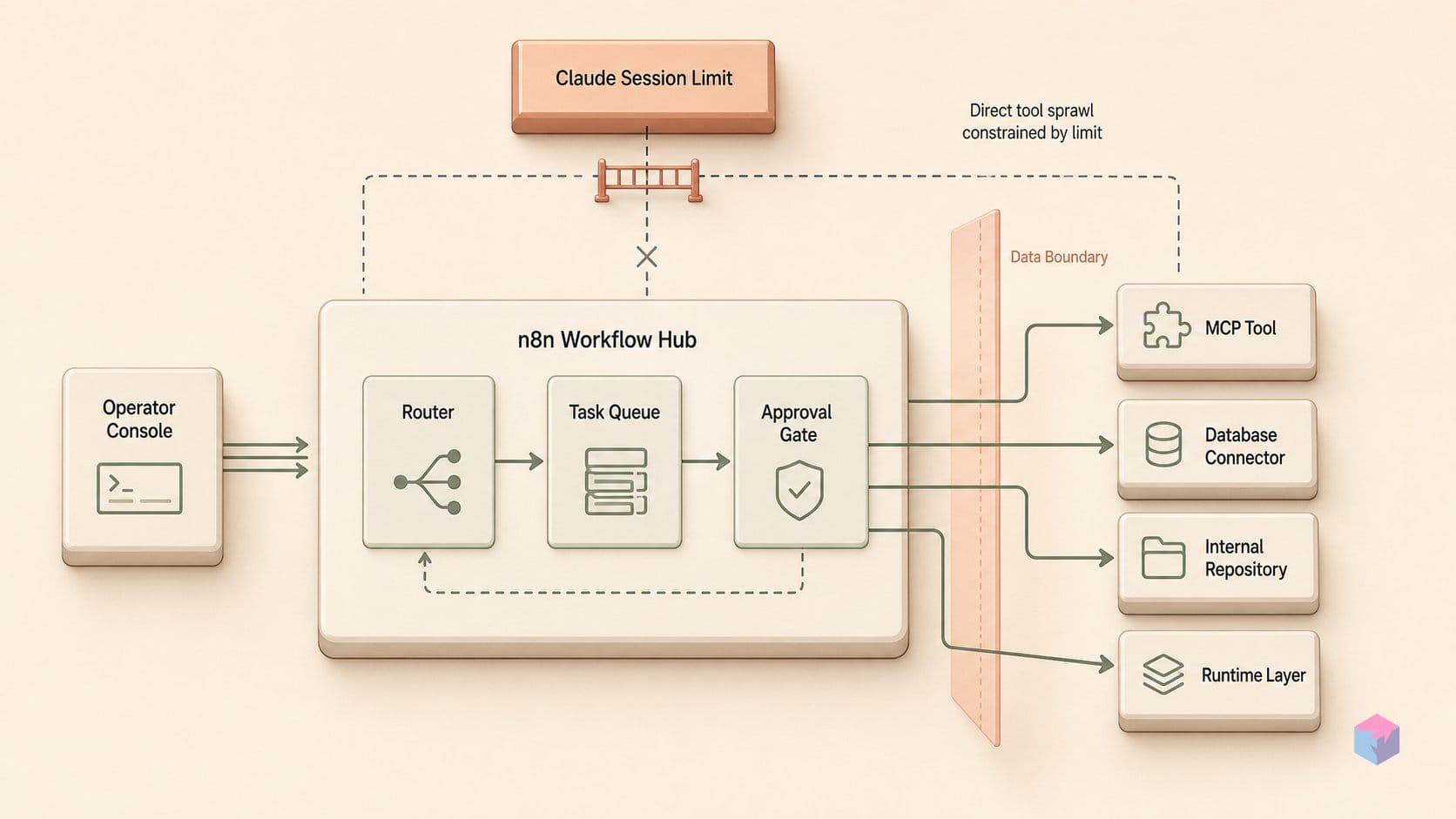
The MCP Server Trigger node is what turns one n8n workflow into a targeted MCP server. Unlike a normal trigger, it exposes a URL, executes the tool nodes attached to it, and lets clients list and call only those tools . Four steps connect it to Claude Desktop.
Step 1 — Add the trigger. In a fresh n8n workflow, add the MCP Server Trigger node as the starting node. It auto-generates two endpoints: a test MCP URL (active only while the editor listens) and a separate production MCP URL . Transport is SSE or streamable HTTP — stdio is not supported — and you set auth here as a Bearer token or custom-header credential.
Step 2 — Attach sub-workflows as tools. Connect each bespoke multi-step workflow to the trigger through a workflow-tool node. Each attached workflow then appears to the client as a single named, invocable MCP tool — this is where your coarse tools like triage_ticket or create_invoice come from .
Step 3 — Bridge with mcp-remote. Claude Desktop's config expects stdio servers, so add an mcp-remote proxy entry pointing at the n8n SSE URL:
{
  "mcpServers": {
    "n8n-hub": {
      "command": "npx",
      "args": [
        "-y", "mcp-remote",
        "https://your-n8n-host/mcp/your-id/sse",
        "--header", "Authorization: Bearer YOUR_TOKEN"
      ]
    }
  }
}
Step 4 — Restart and verify. Quit and reopen Claude Desktop, then issue a list_tools call. The returned tool names should match your attached workflow names exactly; a mismatch usually means the workflow isn't connected to the trigger or the token is wrong.
For claude.ai web, skip mcp-remote entirely. Paste the production MCP URL into Settings → Integrations → Add connector — Pro and Max users add it via the remote server URL, while Team and Enterprise connectors are added only by Owners . The host must be publicly HTTPS-reachable from Anthropic's cloud, and the connector stays in beta.
Where n8n MCP can fail: SSE drops, node mismatches, and malicious payloads
Most n8n MCP failures trace to three sources: broken streaming connections, wrong auto-generated nodes, and untrusted tool descriptions. The MCP Server Trigger depends on persistent Server-Sent Events or streamable HTTP connections, so anything that interrupts the stream — load balancers, proxy buffering, network blips — drops the tool call mid-flight, often without a useful error.
The first trap is queue mode. If you run multiple webhook replicas behind round-robin load balancing, all /mcp* traffic must route to one dedicated webhook replica; standard round-robin breaks SSE connection persistence because follow-up requests land on a replica that never held the stream . The second is reverse-proxy buffering. Disable it explicitly — nginx proxy_buffering off;, Caddy flush_interval -1 — or buffered responses kill the connection mid-stream with no actionable message .
The third is generation quality. n8n's native MCP workflow generator can select the wrong node when several candidates share similar names, and complex conditional branches need manual review after auto-generation — early iterations also make silent design choices . Always inspect the generated workflow before publishing it as a callable tool.
Security is the failure mode with the worst blast radius. The MCP specification (version 2025-06-18) is blunt about it:
"Tools represent arbitrary code execution and must be treated with appropriate caution. In particular, descriptions of tool behavior such as annotations should be considered untrusted, unless obtained from a trusted server." — Model Context Protocol specification (source: MCP spec 2025-06-18)
Anthropic echoes this: custom connectors are unverified, can read, create, modify, or delete data, and are exposed to prompt injection. For Research mode, which can invoke connector tools automatically, it recommends disabling write-action tools and watching for large numbers of connector requests . Expose read-only triage tools first; gate writes behind explicit consent.
Expanding your n8n MCP hub: what to build next
The highest-leverage next step is designing intent-shaped coarse tools instead of thin per-API wrappers. Expose one tool per meaningful job — research_account, not GET /accounts/:id — so Claude reasons over a handful of clear schemas rather than dozens of raw SaaS operations, cutting context budget and ambiguity. Push the branching, retries, and joins down into the n8n workflow where they belong.
If you work in the terminal, the same czlonkowski/n8n-mcp project runs for Claude Code, installable via npx or Docker. As of v2.61.0 it covers 816 core and 1,247 community nodes with roughly 99% node-property coverage , giving the agent grounded documentation when it builds workflows.
Before you scale, cap execution billing: set per-workflow admin API call limits in n8n, and remember the Starter tier ceiling is 2,500 executions/month at €20/month — a single Claude call can fan out into many internal steps.
For air-gapped or cost-sensitive setups, Claude Code paired with Ollama (Qwen 3 Coder ~30B, GLM 4.7 Flash with 198K context) preserves MCP servers and sub-agents without an Anthropic API key (video: Leon van Zyl). Start small: one read-only coarse tool, verify it, then add writes behind consent.
Frequently asked questions
Does n8n actually bypass Anthropic's rate limits or usage caps?
No. n8n absorbs fan-out, retries, rate limiting, and credential management outside Claude, but Anthropic's constraints are unchanged: the context-window budget, the 25,000-token default MCP output ceiling, and plan-based usage caps all still apply. "Bypass" here means tool-management friction only — Claude Pro remains $17/month annually or $20 monthly, and Max starts at $100/month. Wrapping workflows behind one coarse tool reduces schemas Claude must reason over; it cannot make Claude generate unlimited tokens or dodge plan caps.
Why does Claude Desktop need mcp-remote to connect to n8n?
Because the transports don't match. Claude Desktop's config historically expects stdio MCP servers, while n8n's MCP Server Trigger node exposes only Server-Sent Events (SSE) or streamable HTTP — stdio is explicitly unsupported . The mcp-remote gateway/proxy bridges the gap, translating stdio commands from Claude into HTTP requests against the n8n endpoint. You configure it in Claude's settings, pointing at the node's production MCP URL with its Bearer token or custom header credential.
What is the difference between n8n's native MCP server and the MCP Server Trigger node?
They solve different problems. n8n's native MCP server, which entered public preview on April 29, 2026 and is built into n8n v2.18.4+, generates, validates, and runs entirely new workflows on demand from an MCP client such as Claude . The MCP Server Trigger node instead turns one existing workflow into a named, callable tool. A third, separate project — czlonkowski/n8n-mcp — gives Claude access to n8n's own node documentation across 2,063 nodes.
How many custom MCP connectors can I add in Claude?
It depends on your plan. Free users are limited to one custom connector, and the feature remains beta . Pro and Max users add connectors by entering a remote MCP server URL in settings, with no fixed cap on entries. For Team and Enterprise, only Owners or Primary Owners add connectors for the organization, after which individual members connect to them on their own.
How do I prevent runaway n8n execution billing when Claude calls my tools frequently?
Cap and coarsen. Set per-workflow API call limits in n8n admin settings so a chatty client can't trigger unbounded executions, and design each tool to map to one meaningful outcome (create_invoice, triage_ticket) rather than one micro-API-call. Monitor execution counts against your tier ceiling: n8n's Starter plan is 2,500 executions/month at €20/month annually, and a single Claude call can fan out into many internal steps that each consume downstream API quota.