
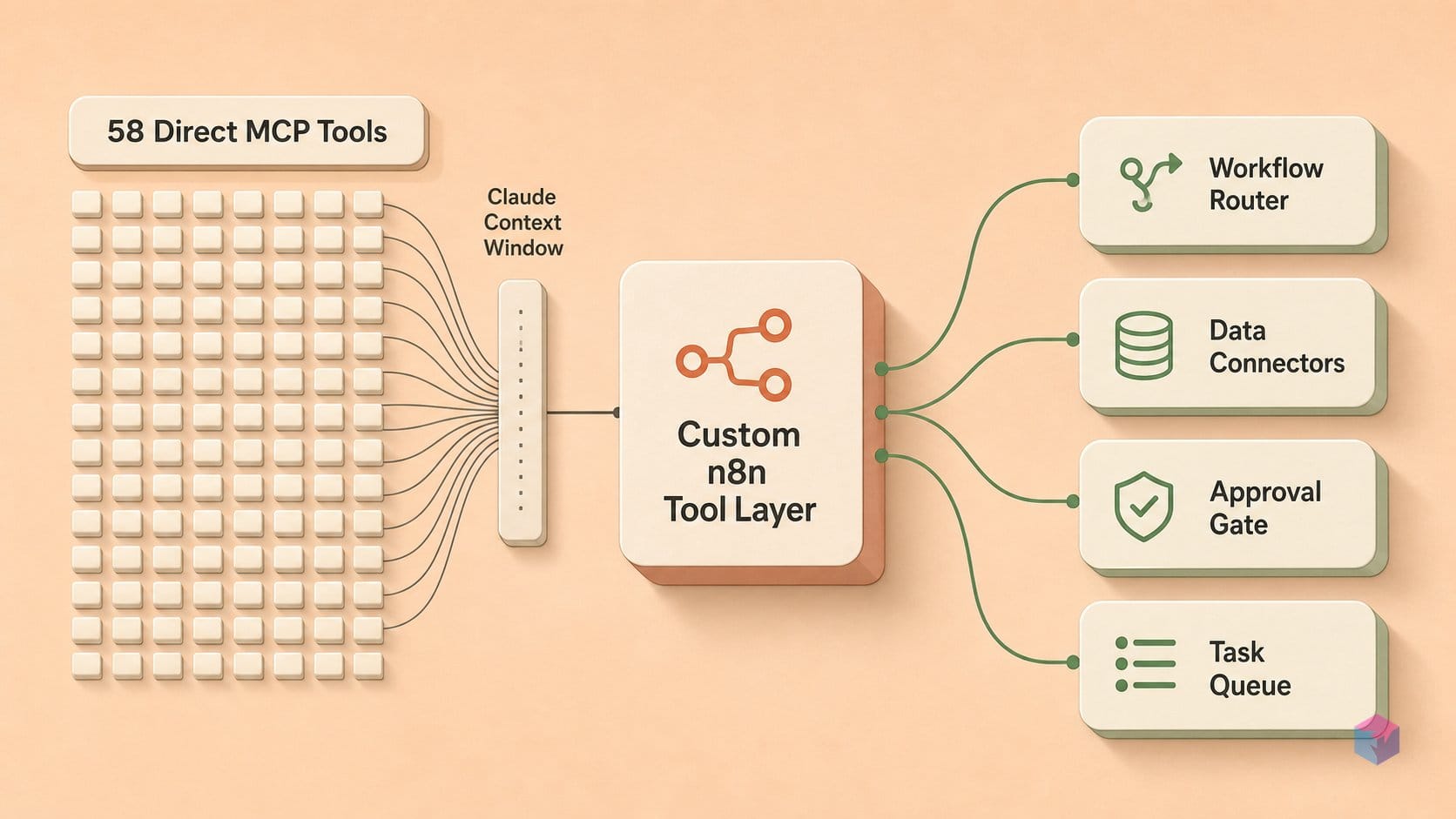
Add a few MCP servers to Claude and the cost shows up before you type a word: dozens of tool definitions land in context up front, and accuracy starts slipping. The fix is not a bigger context window — it is exposing fewer, smarter tools.
Why does context bloat when you add many MCP tools to Claude?
Context bloats because every connected tool's definition is loaded into the prompt up front, before any user message. Anthropic shipped the Model Context Protocol in November 2024 , and adoption surfaced a scaling problem. A typical multi-server stack — GitHub, Slack, Sentry, Grafana, Splunk — runs about 58 tools and roughly 55,000 characters of definitions loaded before you say anything . Two soft limits then bite.
First, tool-selection accuracy degrades once an agent sees roughly 30–50 available tools — a practitioner-observed threshold, not an official Anthropic hard cap, so treat it as directional . Second, results bloat: Claude Code warns when a single MCP output exceeds 10,000 tokens, defaults to a 25,000-token ceiling, and lets you tune it via MAX_MCP_OUTPUT_TOKENS .
Anthropic's own remedy, "code execution with MCP" (November 4, 2025), pairs progressive disclosure with a search_tools function and processes large intermediate results in a sandbox before they hit context; one worked example cut a task from about 150,000 tokens to 2,000 — a 98.7% reduction . The same thesis is what n8n lets you apply at the orchestration layer.
| MCP surface | Result size cap | Timeout | Plan requirement | Transport / stdio |
|---|---|---|---|---|
| Claude.ai / Desktop custom connector | ~150,000 chars | 300 s | Free (1 connector), Pro, Max, Team, Enterprise | Streamable HTTP / SSE; no stdio |
| Messages API MCP connector | 25,000 tokens default (10k warning) | Tunable | API key + beta header | Streamable HTTP / SSE; no stdio |
What to prepare before hooking n8n to Claude's MCP
Before you expose a single tool, line up four prerequisites. First, the n8n version: the MCP Server Trigger is a LangChain core node, so confirm it appears in your node palette — it ships on n8n Cloud and the self-hostable Community edition . Second, a public URL: Claude connects from Anthropic cloud infrastructure, so a localhost-only instance is unreachable. Front it with a public domain, a Cloudflare Tunnel, or ngrok .
Third, the Claude surface matters. Claude.ai custom connectors (beta as of April 2, 2026) limit the Free plan to one connector URL and require Streamable HTTP or SSE transport . The Messages API additionally requires the header anthropic-beta: mcp-client-2025-11-20 — the older mcp-client-2025-04-04 is deprecated . Fourth, for Claude Desktop's stdio config, bridge to the remote endpoint with npx mcp-remote <MCP_URL> plus a bearer Authorization header; the trigger node does not support local stdio directly .
How to expose n8n workflow logic as Claude MCP tools
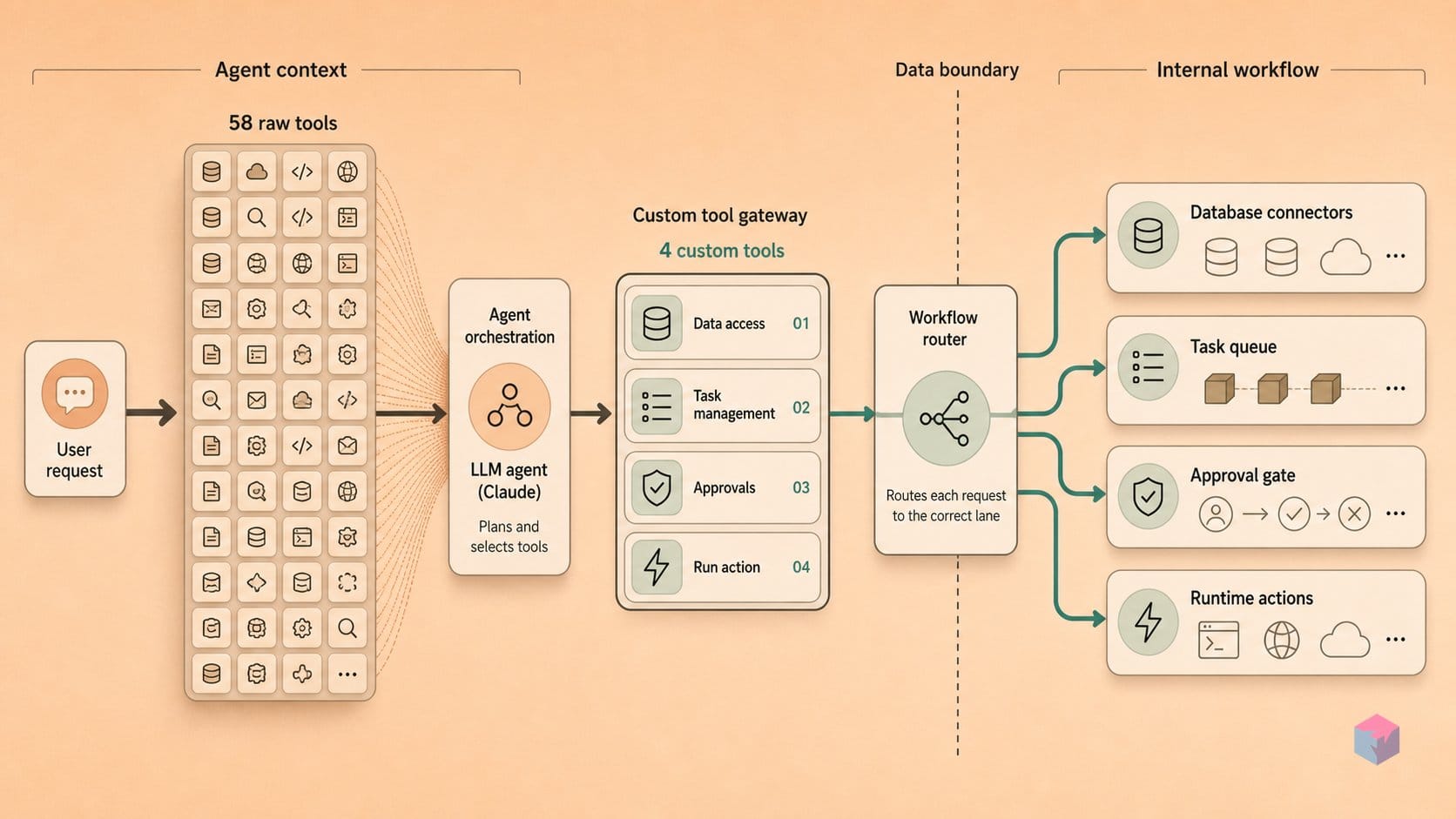
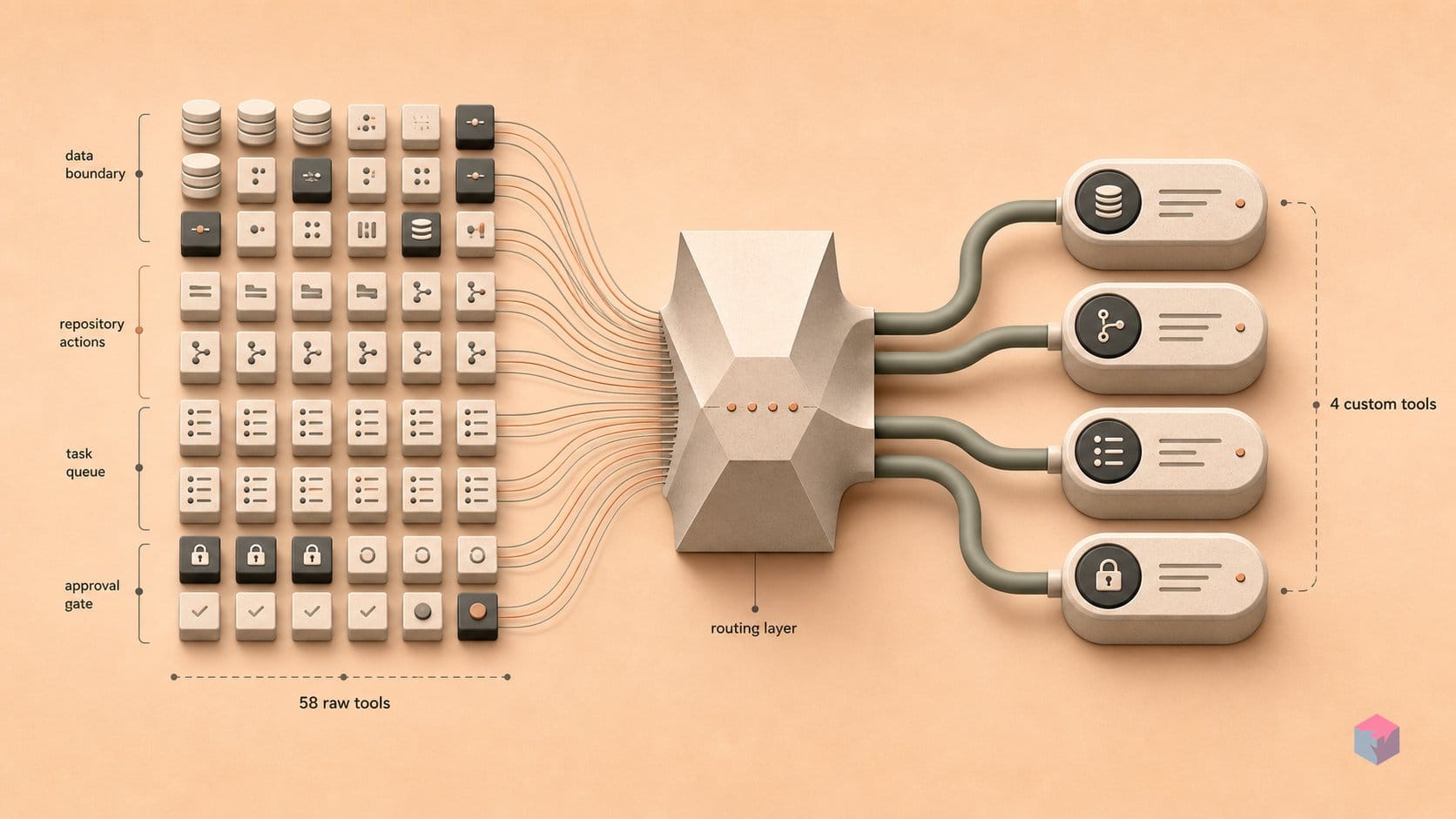
Exposing n8n logic to Claude means publishing a small, curated tool surface from an n8n workflow instead of wiring raw vendor nodes into the model. The pattern is one MCP Server Trigger node plus a handful of Call n8n Workflow Tool nodes, each wrapping a multi-step workflow that returns a compact result n8n MCP Server Trigger docs. Claude sees four intent-named tools, not 58 plumbing calls.
1. Add the MCP Server Trigger. Open a new workflow and drop in the MCP Server Trigger as the entry node. Its output panel generates a /mcp base path — copy that, since it becomes the public endpoint Claude connects to over Streamable HTTP or SSE n8n docs.
2. Attach Call n8n Workflow Tool nodes. Each Claude-callable tool hangs off the trigger as a Call n8n Workflow Tool node, so a single tool can encapsulate auth, branching, retries, and post-processing while returning only what the model needs Call n8n Workflow Tool docs. The node's description field is what Claude reads to decide when to invoke it — write it intent-driven, not implementation-driven.
3. Map inputs with $fromAI(). For arguments the model supplies at runtime, use $fromAI('param_name', 'description', 'string'); for fixed or context-derived values, use expression mode n8n docs.
4. Verify the exposed surface. Point any MCP client at the /mcp URL and run list_tools. Confirm only your curated subset appears — not every node, credential, or workflow in the instance.
5. Register in Claude. In Claude.ai, paste the public MCP URL under Settings → Integrations → Custom Connector Anthropic custom connectors. For the Messages API, pass the URL in the tools array with the beta header anthropic-beta: mcp-client-2025-11-20 and confirm the server answers on Streamable HTTP or SSE Claude MCP connector docs.
Naming carries the most weight, because Claude routes on the name and description, never the node graph. Prefer lookup_customer_context over get_postgres_row_by_id, and draft_invoice_followup over call_gmail_send_api. This mirrors Anthropic's own remedy at the orchestration layer:
"Presenting tools with progressive disclosure — loading only what a task needs — cut one worked example from roughly 150,000 tokens to about 2,000, a 98.7% reduction." — Anthropic Engineering, "Code execution with MCP" (source: anthropic.com)
What can fail when n8n serves as an MCP server
The facade pattern shifts your failure modes from context bloat to infrastructure and quota management — five issues bite most often. The first is silent: Server-Sent Events and Streamable HTTP need response buffering disabled. If your reverse proxy (nginx, Caddy) buffers /mcp* paths, the SSE connection hangs without an error. n8n's docs are explicit that reverse proxies must disable buffering for SSE and streamable HTTP paths — set proxy_buffering off on those routes.
The next two are deployment and cost traps:
- Multi-replica routing. If you run multiple webhook replicas, all
/mcp*traffic must hit one dedicated replica; round-robin load balancing breaks session continuity. Configure sticky routing at the proxy layer. - Execution quota burn. One MCP tool call triggers one full workflow execution regardless of node count. On n8n Cloud Starter — 2,500 executions/month at €20/month — a chatty Claude session can drain quota in hours. Keep tools coarse-grained and idempotent.
Then there is trust. Anthropic's April 2026 connector docs warn that custom connectors are unverified services able to read, modify, or delete data in connected apps . Review permissions, avoid unnecessary write-side tools, and never enable "Allow always" for untrusted server/tool combinations. Watch for prompt injection arriving through tool output.
Finally, mind the Claude.ai payload ceiling. Tool results approaching the ~150,000-character cap or the 300-second timeout must be trimmed inside the workflow — post-process raw API responses into a compact structured summary before the result leaves n8n.
Extending the n8n MCP facade: more intelligent tools, less context noise
Once a curated tool surface works, two extensions push the facade further. First, add a search_tools meta-tool: one workflow that accepts a natural-language query and returns the 3–5 best-matching tool names with descriptions, mirroring Anthropic's progressive-disclosure catalog so the agent never loads every definition upfront . Second, post-process results inside each workflow — strip raw API payloads and return a 3–5 field structured object instead of a full JSON blob, which keeps responses under Claude Code's 10,000-token output warning .
Two adjacent projects go the other direction — authoring, not serving. n8n's own MCP client (requires n8n 2.18.4+) lets Claude, Cursor, or Windsurf generate new workflows from natural language, emitting type-checked TypeScript with self-correction . The community czlonkowski/n8n-mcp project gives Claude deep knowledge of n8n's 400+ node library to produce valid workflow JSON — a complementary pairing for building automations, not running them in production.
The takeaway: keep the serving surface thin and the workflows fat. Curated coarse tools, a search meta-tool, and trimmed responses turn 58 noisy definitions into a handful Claude can actually reason over.
Frequently asked questions
Do I need a public URL to use n8n as an MCP server with Claude?
Yes. Claude connects from Anthropic's cloud infrastructure, so a localhost endpoint is unreachable — your n8n instance must be publicly addressable over HTTP (Streamable HTTP or SSE, not local stdio) . Self-hosted n8n needs a public domain or a tunnel such as Cloudflare Tunnel or ngrok. For Claude Desktop's local stdio config, bridge to the remote endpoint with npx mcp-remote <MCP_URL> plus an Authorization bearer header .
How many n8n executions does one Claude MCP tool call consume?
One tool call triggers one full workflow execution, no matter how many nodes that workflow contains — n8n Cloud bills per execution, not per step . On the Cloud Starter plan (2,500 executions/month at 20 EUR/month billed annually) a chatty Claude session that invokes a tool on every message can burn quota quickly . Design coarse-grained tools that batch work internally rather than many fine-grained calls.
What is the difference between n8n's MCP Server Trigger and n8n's own MCP client?
They run in opposite directions. The MCP Server Trigger turns an n8n instance into a server that Claude calls — outbound from Claude, inbound to n8n — exposing only the tools you attach . n8n's first-party MCP client (n8n 2.18.4+) goes the other way: it lets Claude, Cursor, or ChatGPT build and modify n8n workflows from natural language . The two features are frequently conflated.
Which Claude plan supports custom MCP connectors?
Free, Pro, Max, Team, and Enterprise plans all support custom connectors, in beta since April 2, 2026 . The Free plan is capped at one connector URL. Pro and Max users add connector URLs directly in Settings, while Team and Enterprise owners configure them at the organization level .
Is the 30–50-tool accuracy degradation an official Anthropic limit?
No. The point where tool-selection accuracy degrades — roughly 30–50 available tools — is a practitioner-observed threshold from community analysis, not an officially published hard cap, so treat it as directional . Anthropic does not publish a maximum tool count per conversation. The documented hard limits are result size (~150,000 characters for Claude.ai), the 300-second tool timeout, the Free-plan one-connector cap, and Claude Code's 25,000-token output ceiling .