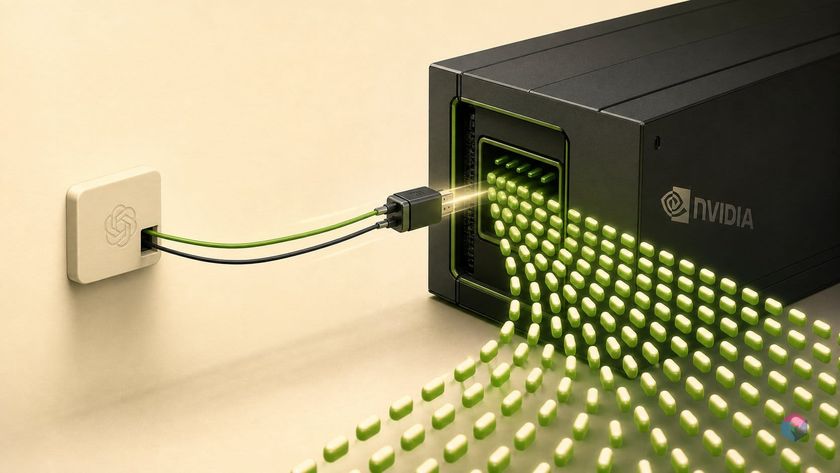
Paid API keys are no longer the only on-ramp to frontier open models. NVIDIA quietly built a free, OpenAI-compatible gateway to a large hosted catalog — and switching to it is a two-line edit, not a migration.
What NIM's free developer tier gives you
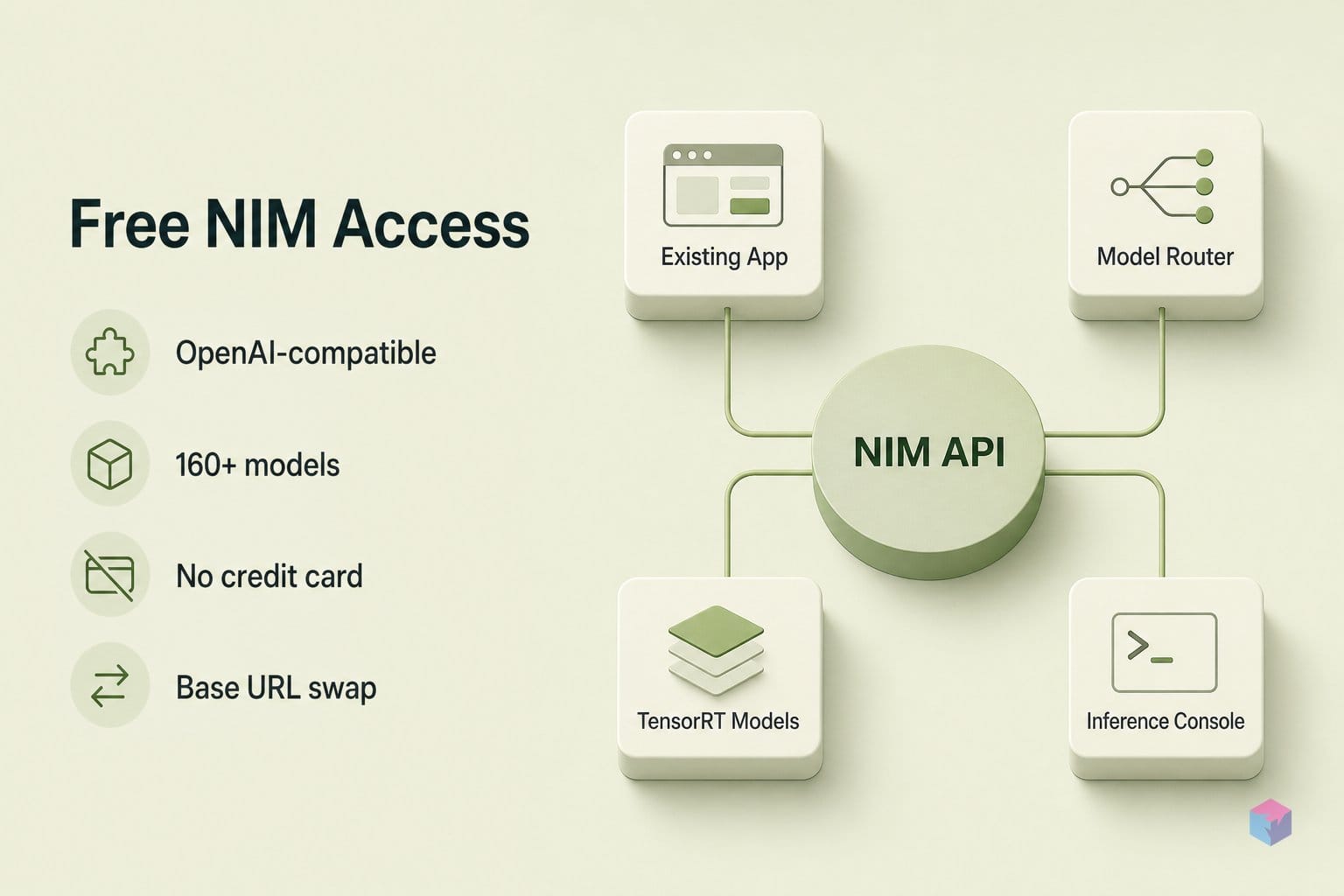
NVIDIA NIM (NVIDIA Inference Microservices) is a hosted, OpenAI-compatible API that lets any developer call NVIDIA-hosted, TensorRT/TensorRT-LLM-optimized models without a credit card. NVIDIA's NIM FAQ states that Developer Program members and 90-day AI Enterprise Trial users can prototype against free API endpoints for 160+ leading models. This is not a fresh launch: the free tier opened on July 29, 2024, and the catalog at build.nvidia.com has expanded substantially since.
Quick Answer: NVIDIA NIM's free developer tier exposes 160+ TensorRT-optimized models through an OpenAI-compatible endpoint at integrate.api.nvidia.com/v1. No card, no expiry — only a free NVIDIA Developer Program membership. Swap the base URL and model string; your existing OpenAI client works unchanged.
The hosted LLM catalog spans model families including:
- Meta Llama, Mistral/Mixtral, and NVIDIA Nemotron
- DeepSeek, Qwen, and Moonshot AI's Kimi K2
- Google Gemma, Microsoft Phi, IBM Granite, and OpenAI gpt-oss
Everything runs on NVIDIA DGX Cloud. Because the endpoint speaks the OpenAI Chat Completions schema at https://integrate.api.nvidia.com/v1, the only changes are the base URL and a namespaced org/name model ID such as meta/llama-3.3-70b-instruct. The same endpoint family also covers NeMo Retriever embedding and reranking APIs — bge-m3, nv-embedqa-e5-v5, llama-nemotron-embed-1b-v2, and llama-nemotron-rerank-1b-v2 — so RAG stacks can source both generation and retrieval from one key (NVIDIA docs).
Sign in at build.nvidia.com and generate your nvapi- key
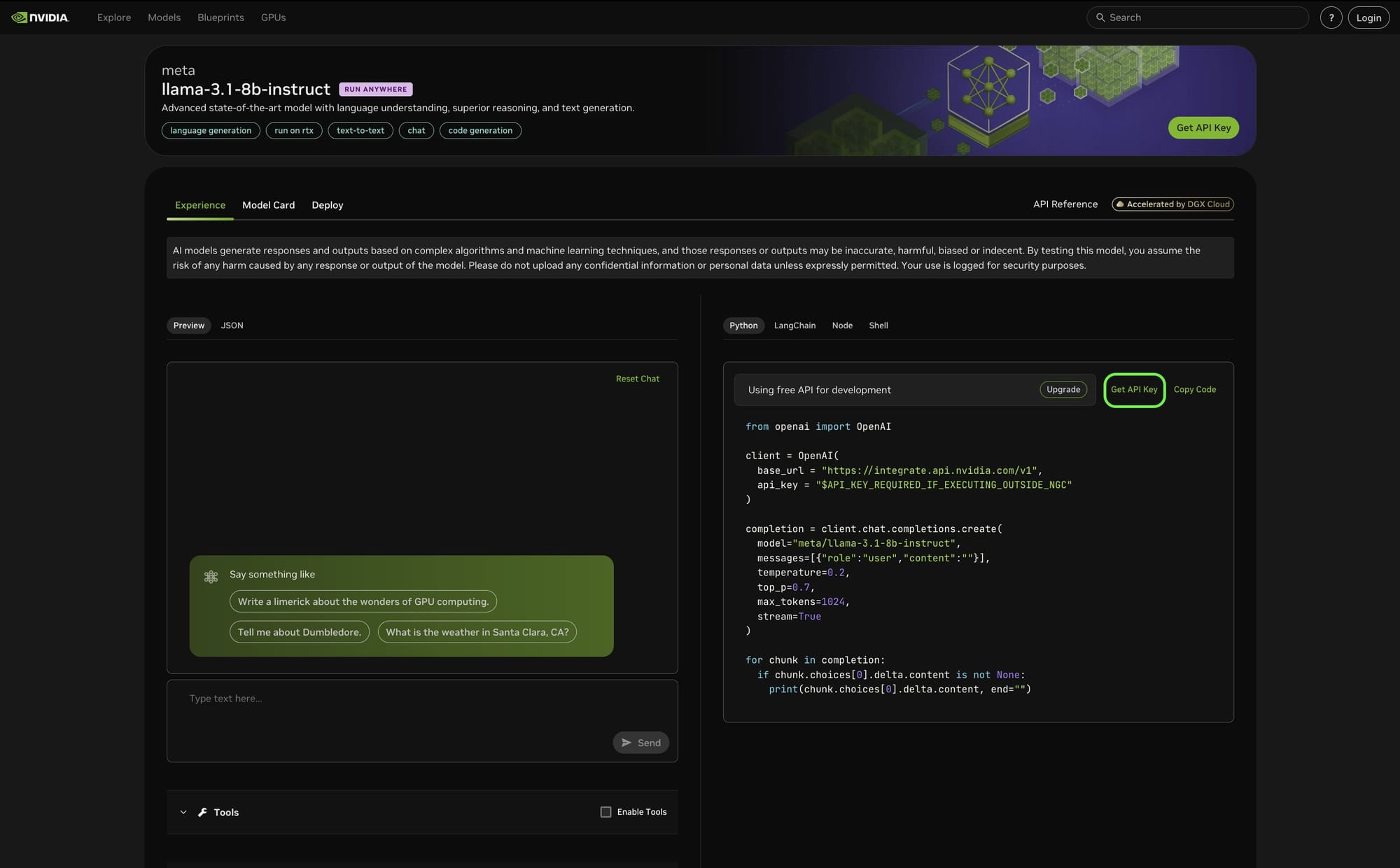
Getting a key takes about a minute. Open build.nvidia.com and sign into an existing NVIDIA account or create one — no credit card is required, and registration enrolls you in the Developer Program automatically, which is what unlocks the free hosted endpoints .
Once signed in, click Get API Key on any model card, or go straight to build.nvidia.com/settings/api-keys. One key works across the entire catalog — it is account-scoped, not per-model, so you don't regenerate it when you switch from Llama to Qwen or Kimi . The key carries an nvapi- prefix; export it as NVIDIA_API_KEY and read it from the environment rather than hardcoding it.
Your account navigation surface also shows your personal rate limit. Check that figure there instead of assuming a fixed 40 RPM as a guaranteed SLA — the cap varies by model and current platform load .
Redirect to integrate.api.nvidia.com
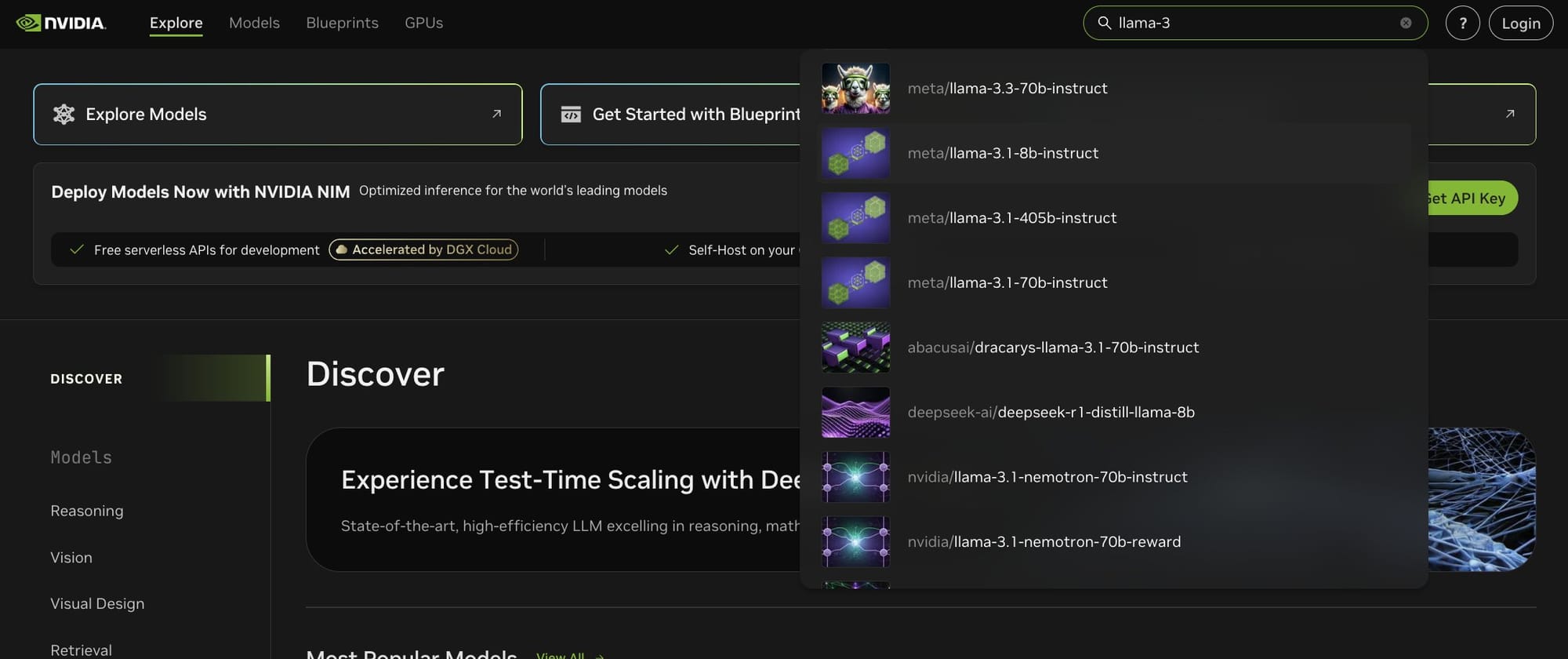
Because the hosted endpoint speaks the OpenAI Chat Completions spec, redirecting an existing app is a two-line change: point the client at NVIDIA's base URL, https://integrate.api.nvidia.com/v1, and swap the model string for a namespaced org/name catalog ID. Nothing else in your request or response handling changes.
In Python with the OpenAI SDK, pass base_url and your key to the constructor, then use a model like meta/llama-3.3-70b-instruct, moonshotai/kimi-k2-instruct, or qwen/qwen3-coder-480b-a35b-instruct. The snippet below is illustrative and was not executed here, but it reflects the documented pattern:
import os
from openai import OpenAI

client = OpenAI(
    base_url="https://integrate.api.nvidia.com/v1",
    api_key=os.environ["NVIDIA_API_KEY"],
)

response = client.chat.completions.create(
    model="meta/llama-3.1-8b-instruct",
    messages=[{"role": "user", "content": "Say hello in exactly five words."}],
    max_tokens=20,
)

print(response.choices[0].message.content)
In TypeScript, the Vercel AI SDK uses createOpenAICompatible with the same baseURL and an Authorization: Bearer header, then calls a catalog ID such as deepseek-ai/deepseek-r1 or openai/gpt-oss-120b. A raw curl POST to /v1/chat/completions with that Bearer header and a standard messages array is structurally identical to an OpenAI call.
"NIM microservices... support industry-standard APIs" including "the OpenAI API specification for large language model (LLM)-based NIM microservices" — NVIDIA Developer Blog, 2024-07 (source: NVIDIA).
For self-hosted NIM containers, the application layer stays the same — point base_url at your local /v1 endpoint, and depending on local auth config the API key may be a placeholder (LiteLLM docs).
Where NIM's free tier slows you down
The free tier's hard edge is throughput, not model access. Developers report a practical ceiling of roughly 40 requests per minute on the hosted endpoints, and an NVIDIA Developer Forum moderator explicitly acknowledged "the 40 rpm rate limit" in threads from April–May 2026. NVIDIA publishes no per-model SLA — its FAQ says limits vary by model, use case, and current platform traffic — so treat 40 RPM as an observed current ceiling, not a guarantee. The account navigation at build.nvidia.com surfaces your personal figure.
"We are aware of the 40 rpm rate limit," — NVIDIA Developer Forum moderator, April–May 2026 (source: NVIDIA Developer Forums).
This bites hardest on fan-out agentic workloads. One forum poster notes the quota "runs out in 2–3 minutes" of interactive coding, throwing HTTP 429 errors mid-task . Budget for it from day one rather than retrofitting later:
- Token-bucket queue: gate outbound calls to a per-second rate so bursts never exceed your ceiling.
- Exponential backoff on 429: retry with growing delays instead of hammering the endpoint.
- Prompt-level caching: collapse repeated or identical calls before they reach the wire.
One more caveat the RPM number hides: the hosted catalog is documented for prototyping and evaluation only, and NVIDIA notes latency may increase under high overall platform load (NVIDIA LLM API reference). Steady request pacing helps; it won't fully insulate you from shared-tier congestion.
What comes after the free developer tier
When prototyping outgrows shared-tier congestion, the same OpenAI-compatible surface follows you off the hosted catalog. Developer Program members can download NIM containers and self-host them free — for research, development, and experimentation — on up to 16 GPUs . Your client changes almost nothing: point base_url at a local /v1 endpoint instead of integrate.api.nvidia.com, often with a dummy key .
Production traffic is where licensing kicks in. Serving real users requires an NVIDIA AI Enterprise license — roughly $4,500 per GPU per year, or about $1 per GPU-hour via cloud partners — which adds enterprise support, security patches, and API stability guarantees . Teams needing commercial rights first can apply for a 90-day AI Enterprise evaluation through NVIDIA's enterprise portal .
The takeaway: proxy layers like LiteLLM let you route between the hosted free endpoint and a self-hosted or cloud NIM with zero application-layer changes — so the two-line swap that got you started scales all the way to production.
Frequently asked questions
How many models are available on the NVIDIA NIM free developer tier?
NVIDIA's official NIM FAQ lists 160+ hosted models available to Developer Program members and 90-day AI Enterprise Trial users for free prototyping. The exact count you see varies with catalog updates, geography, and account type, so treat that number as the authoritative published figure rather than a fixed guarantee. Model families include Meta Llama, Mistral, NVIDIA Nemotron, DeepSeek, Qwen, Moonshot AI's Kimi K2, Google Gemma, Microsoft Phi, and IBM Granite, with concrete IDs such as meta/llama-3.3-70b-instruct and moonshotai/kimi-k2-instruct documented in the LLM API reference.
Is the NVIDIA NIM API genuinely OpenAI-compatible?
Yes. NVIDIA's hosted endpoint speaks the same Chat Completions request/response schema as OpenAI, so you change only the base_url and the model string — the rest of your code is untouched. NVIDIA's July 2024 announcement states NIM exposes "the OpenAI API specification for large language model-based NIM microservices." Third-party tooling confirms this in practice: LiteLLM and Promptfoo both register it as an OpenAI-compatible provider natively, and LangChain and Cursor work the same way.
What is the rate limit on the NVIDIA NIM free tier?
The commonly observed free-tier ceiling is roughly 40 requests per minute, a figure NVIDIA forum moderators acknowledged in April–May 2026 threads. NVIDIA does not publish a universal per-model SLA — hosted limits vary by model, use case, and current traffic. Your build.nvidia.com account dashboard shows your personal limit and is the source of truth. For agentic fan-out workloads, add client-side throttling and exponential backoff on HTTP 429.
Can I route production traffic through the NVIDIA NIM free tier?
No. The hosted free-tier endpoints are explicitly for prototyping and evaluation, not production, and may show extended latency under load. Production use requires an NVIDIA AI Enterprise license — priced from about $4,500 per GPU per year — or self-hosted NIM containers. A free 90-day enterprise evaluation is available for teams needing commercial rights, and Developer Program members can self-host NIM containers free for research and development on up to 16 GPUs.
Do I need a GPU to call the NVIDIA NIM API?
No local GPU is required. The hosted free-tier endpoints run on NVIDIA DGX Cloud, so all inference happens on NVIDIA's infrastructure. You only need a free NVIDIA Developer Program account and a personal API key with the nvapi- prefix, generated from build.nvidia.com — no credit card, no cloud account, and no GPU of your own. A local GPU only becomes relevant if you later self-host NIM containers.
Enjoyed this article? Subscribe to get new stories by email whenever they're published.