
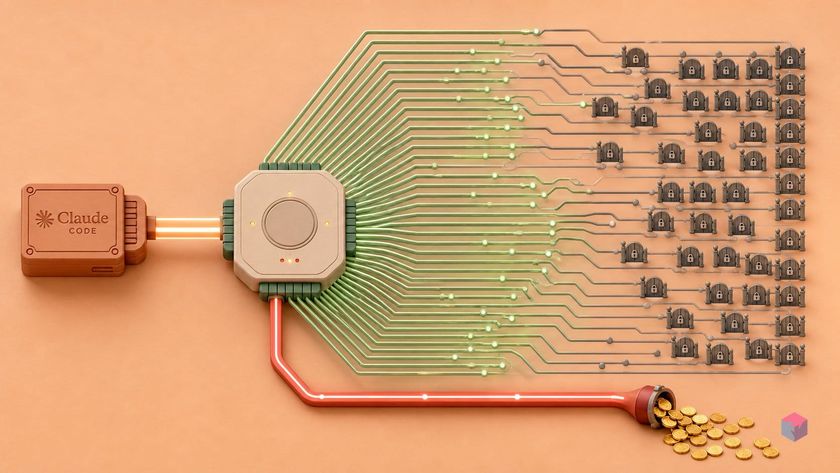
The viral pitch is "200+ free AI providers." The actual number is closer to 90 — and it depends on which OmniRoute page you read.
How OmniRoute counts its 264 providers — and which 90 carry no charge
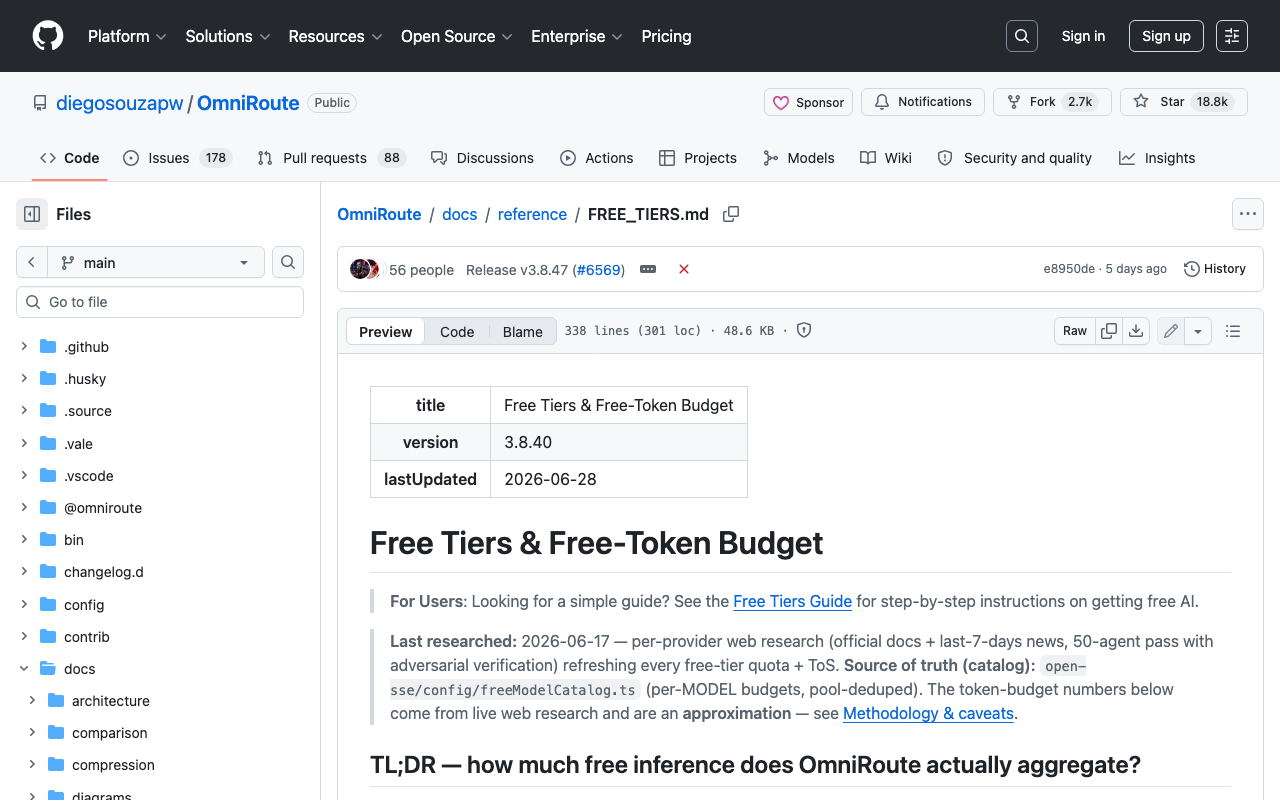
OmniRoute's README catalogs 264 total providers, of which 90+ carry a free tier and roughly 11 are labeled "free forever" . The often-repeated "200+ free" figure conflates two different numbers: the size of the full catalog and the subset that costs nothing. Those are separate counts, and OmniRoute's own surfaces don't even agree on the totals — the README says 264, the website says 236, and the auto-generated Provider Reference dated 2026-07-13 says 250 . The count shifts weekly as the v3.8.x changelog moves.
A short script makes the distinction concrete (this snippet was executed successfully):
import re

claim = "OmniRoute: 250 providers, 90+ free providers."
total, free = map(int, re.search(r"(\d+) providers, (\d+)\+ free", claim).groups())

print(f"catalog providers: {total}")
print(f"free-tier providers: {free}+")
print(f"paid/other providers: {total - free}+")
assert free == 90 and free != 200
print("OK: 'unlimited free' means 90+ free providers, not 200.")
Provider categories span OAuth, web-cookie, API-key, local, search, audio, cloud-agent, and system . Only the API-key and select OAuth providers expose a genuine no-cost path; the rest are paid backends, local models, or utility services. The ~11 "free forever" entries — Kiro, Qoder, Pollinations, LongCat, Cloudflare AI, NVIDIA NIM, and Cerebras among them — each ship hard per-day or per-month ceilings rather than open-ended throughput . So "unlimited free" is best read as bounded free: 90-odd tiers, each rate-limited, layered behind one router. The framing traces back to a YouTube walkthrough that headlined "200+ providers"; the repo's numbers tell a narrower story.
Pointing Claude Code at OmniRoute: three environment variables
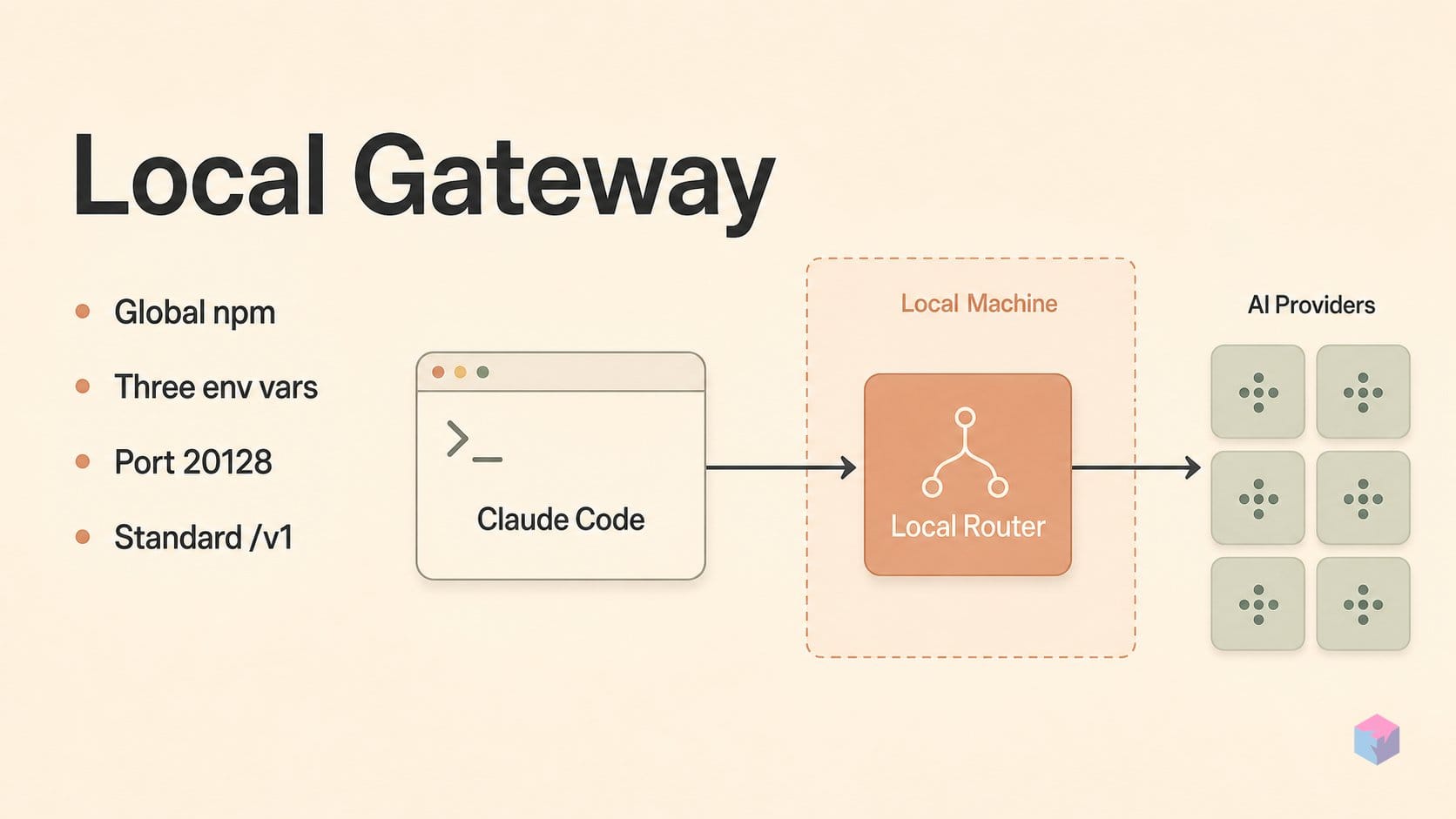
OmniRoute installs as a global npm package and runs entirely on your machine, so wiring Claude Code to it takes one install and three environment variables. Install with npm install -g omniroute, then launch it by running omniroute; the process brings up a dashboard and an OpenAI-compatible API on port 20128, exposing a standard route at http://localhost:20128/v1 .
Claude Code supports proxy routing natively, so no patching is required — you point it at the local gateway. Per OmniRoute's CLI guide, export two variables so Claude Code sends traffic through the router instead of Anthropic's endpoint:
export ANTHROPIC_BASE_URL="http://localhost:20128"
export ANTHROPIC_AUTH_TOKEN="sk-your-omniroute-key"
OpenAI-compatible agents — Codex, Cursor, Cline, Continue and similar — use a different variable pointing at the versioned route:
export OPENAI_BASE_URL="http://localhost:20128/v1"Both patterns come from OmniRoute's official CLI documentation . The auth token is your OmniRoute key, not an Anthropic key — the router decides which backend actually answers.
That decision is driven by virtual model IDs. Instead of naming a specific model, you can request auto, auto/coding, auto/fast, auto/cheap or auto/offline, and OmniRoute builds a routing chain from your active credentials, filtering candidates by capability and scoring them before dispatch . For staying on no-cost backends, auto/cheap and auto/offline are the conservative picks. If you want a stronger guarantee, release v3.8.46 — shipped 2026-07-07 — added a hidePaidModels option that strips paid-only candidates out of the auto/* pool, so a session won't silently fall through to a billed backend when free-tier quotas drain mid-run .
The quota math: Mistral contributes ~1B and everyone else is secondary
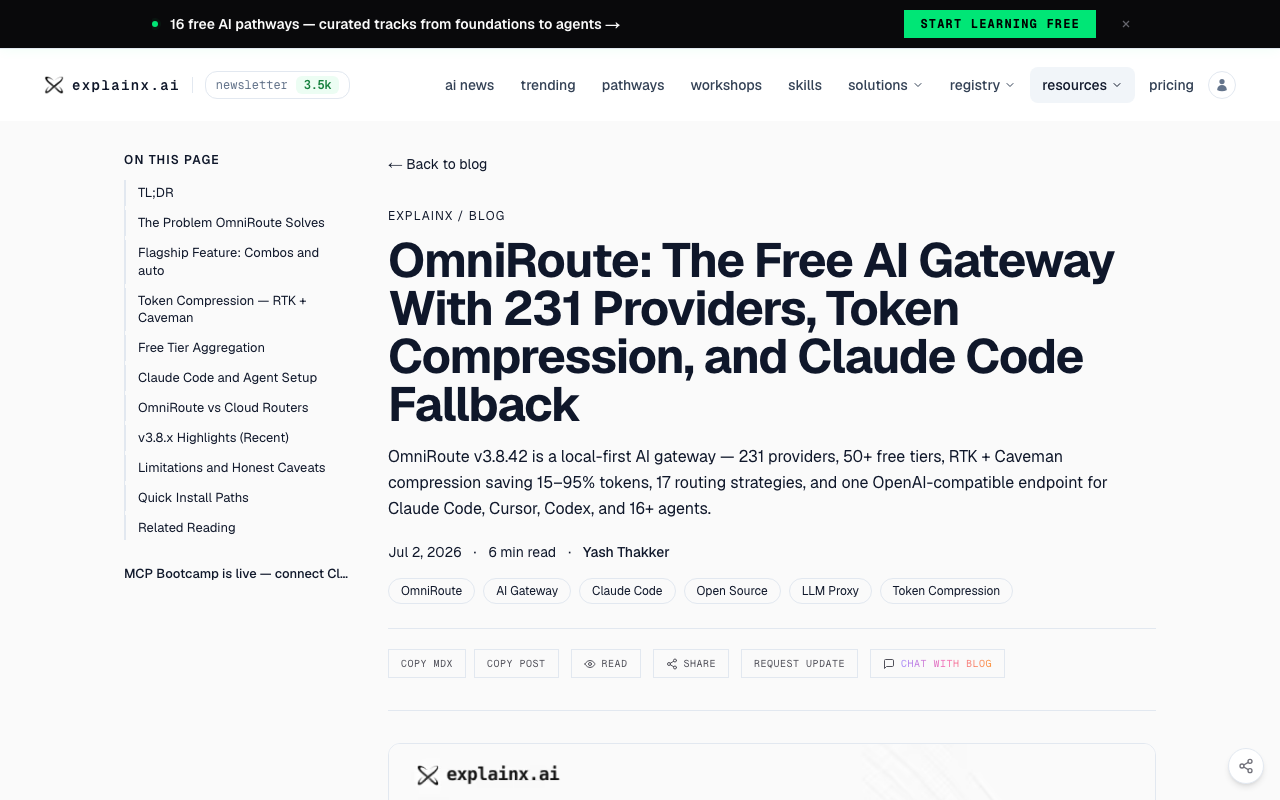
OmniRoute's headline "1.6 billion free tokens" is a rounded marketing figure derived from its own free-tier reference (version 3.8.40, last updated 2026-06-28), which calculates a defensible recurring grant of about 1.54B tokens/month across 40+ free-tier pools and 500+ models . First-month signup credits push the one-time total to roughly 2.15B . The document itself warns that a theoretical 24/7 rate-limit ceiling near 10B tokens/month is not a guarantee and should not be headlined .
The important detail for planning your usage: that grant is concentrated, not evenly spread. Mistral alone supplies about 1.00B tokens/month — roughly 65% of the headline figure — with everything else trailing far behind :
- Mistral — ~1.00B tokens/month
- LLM7 — ~150M/month
- Gemini — ~60M/month
- Cerebras — ~30M/month
- Cloudflare AI — ~30M/month
- Groq — ~15M/month
If Mistral tightens its free tier or your account loses eligibility, the recurring budget effectively collapses to a few hundred million tokens. Per-provider ceilings compound this: Kiro grants roughly 50 credits/month, Pollinations throttles anonymous use to about one request every 6–15 seconds, LongCat is a one-time 10M-token grant requiring KYC, and Cerebras caps at 30K tokens/minute with a 1M/day ceiling .
Several "free forever" entries — siliconflow, glm-cn, tencent and baidu — publish no token cap at all, but they are rate- and concurrency-limited, so their throughput is unquantifiable and excluded from the 1.54B calculation . Independent coverage makes the same point plainly: the token figures come from OmniRoute's own documentation, are not third-party audited, and free models "won't match" frontier models on hard agent work — the router stretches access, not capability . Treat 1.6B as a ceiling gated by one provider, not a floor you can bank on.
ToS fine print: which providers prohibit proxy harnesses by name
The legal exposure is where "unlimited free Claude Code" gets thinnest, because several of OmniRoute's highest-value free tiers restrict exactly this kind of routing. OmniRoute's own free-tier reference flags many providers as caution, avoid, or ambiguous rather than clearly permitted . Read the clauses before you point a team workload at them:
- Kiro — its FAQ "explicitly prohibits use with OpenClaw and similar tools that leverage third-party harnesses," language that targets proxy routers like OmniRoute directly .
- Mistral — the largest recurring token contributor limits its consumer API to "personal needs" and forbids sharing keys, which cuts against team or commercial routing .
- Together — section 4.3(d) bars reselling or offering the service on a standalone basis .
- SiliconFlow — clauses ban exposing the service to third parties .
OmniRoute states plainly that its ToS summary is "informational, not legal advice" and recommends verifying each provider independently . That disclaimer is the honest read: the router makes it trivial to fan a request across providers whose terms may prohibit proxying, and enforcement risk lands on your account, not the tool. Before routing commercial or team traffic, check the current terms yourself rather than trusting a summary that changes across the project's own surfaces.
Scoping to two confirmed free providers before enabling all ninety
Start with exactly two providers: Cerebras and Cloudflare AI. Both are documented as "free forever" in OmniRoute's own notes, both publish explicit rate limits — Cerebras caps at 30K tokens/minute with a 1M/day ceiling and contributes roughly 30M tokens/month, matched by Cloudflare AI — and neither carries a caution or proxy-ban label in the provider reference . That makes them the lowest-risk on-ramp before you widen the pool.
Set hidePaidModels before wiring up Claude Code. Release v3.8.46 (2026-07-07) added the flag so auto/* routing filters paid-only models out of the candidate pool. Without it, once a free-tier quota exhausts, the router can silently escalate to a paid backend — no warning is surfaced to the client, and the upstream charge lands on your key.
Prompt compression (the RTK Rust filter plus rule-based Caveman compaction) engages automatically. OmniRoute claims ~89% average reduction on tool-heavy sessions, but no independent benchmark confirms output holds up — verify quality against your own tasks before relying on it.
Keep the counts in perspective. The "unlimited free" framing means 90+ free-tier providers, not 200:
import re

claim = "OmniRoute: 250 providers, 90+ free providers."
total, free = map(int, re.search(r"(\d+) providers, (\d+)\+ free", claim).groups())

print(f"catalog providers: {total}")
print(f"free-tier providers: {free}+")
print(f"paid/other providers: {total - free}+")
assert free == 90 and free != 200
print("OK: 'unlimited free' means 90+ free providers, not 200.")
This snippet was executed (exit 0) and prints a 160+ paid/other remainder. Repo signal as of 2026-07-19 is strong — 18.7k stars, ~2.7k forks, 100K+ Docker Hub pulls, publishing at v3.8.49 — but provider counts and eligibility shift weekly. Treat 90 as a floor, not a guarantee: pin two known-free backends, gate paid escalation, measure compression on your real workload, then expand.
Frequently asked questions
Does OmniRoute give you free access to Claude specifically?
No. OmniRoute does not unlock Anthropic's models for free — it redirects the Claude Code CLI to other backends by overriding ANTHROPIC_BASE_URL, a proxy setting Anthropic's own docs confirm points Claude Code at a different endpoint . Free-tier requests are served by providers like Mistral, Gemini and Cerebras, so Anthropic's infrastructure is never involved. What you get is Claude Code used as a client pointed at non-Claude models, not free Claude .
How many free-tier providers does OmniRoute actually have?
Around 90+ providers carry a free tier, and roughly 11 are listed as "free forever" (Kiro, Qoder, Pollinations, LongCat, Cloudflare AI, NVIDIA NIM, Cerebras and others). That is not the same as the catalog total, which conflicts across surfaces — the README says 264, the website 236, and the auto-generated Provider Reference 250 (last generated 2026-07-13) . The viral "200+ free" figure conflates the full catalog with the free subset.
Is the 1.6 billion tokens/month figure accurate?
It is OmniRoute's own calculation, not independently audited. The free-tier reference (version 3.8.40, last updated 2026-06-28) puts the defensible recurring grant at about 1.54B tokens/month across 40+ pools, rounded to ~1.6B in marketing, with Mistral alone contributing roughly 1.00B of that total. First-month signup credits can push it to about 2.15B. OmniRoute's own docs warn that the theoretical 24/7 ceiling of ~10B tokens/month is not a guarantee and should not be headlined.
Could using OmniRoute violate a provider's terms of service?
Yes, for several named providers. OmniRoute's own documentation marks multiple high-value providers as caution or avoid: Kiro's FAQ explicitly prohibits use with third-party harnesses, Mistral's consumer ToS limits API use to "personal needs" and forbids key sharing, and SiliconFlow clauses bar exposing the service to third parties . The project stresses this is informational, not legal advice, so the compliance burden falls on you — check each backend's terms before routing production work through it.
What does the hidePaidModels option do, and when should I enable it?
Added in release v3.8.46 on 2026-07-07, hidePaidModels filters paid-only backends out of the auto/* routing candidate pool . Enable it whenever the goal is zero spend. Without it, auto routing can silently fall back to a paid provider once free quotas exhaust mid-session — the exact failure mode that turns a "free" run into an unexpected bill. With it on, a route that runs out of free capacity fails or stalls rather than quietly escalating cost.
Enjoyed this article? Subscribe to get new stories by email whenever they're published.