

OVHcloud just made a move that says more about its ambitions than its checkbook: the Roubaix-based cloud provider wants to own a voice-AI engine outright, and the founder it is negotiating with used to work there. Here is what the announcement actually confirms — and what it pointedly leaves out.
The deal OVHcloud announced: confirmed facts and deliberate gaps
On June 11, 2026, OVH Groupe (OVHcloud) entered exclusive negotiations to acquire Gladia, a Paris-based speech-to-text and audio-intelligence specialist . Read that phrase precisely: this is a negotiation phase, not a signed term sheet and not a closed acquisition. Until a definitive closing announcement lands, nothing about Gladia's API, pricing, or contracts changes .
The gaps are as informative as the facts. The corporate release discloses no consideration, no valuation, no ownership percentage, and no expected closing date. It carries no employee-retention terms and no executive quotes — unusual for an acquisition announcement, and a signal that this was filed at the earliest disclosable stage rather than as a finished story .
Quick Answer: On June 11, 2026, OVHcloud entered exclusive negotiations to buy Gladia, a Paris voice-AI (speech-to-text) firm — not a closed deal. The official statement names no price, stake, or closing date, and French works-council (CSE) review must finish before any close, a process that typically runs weeks to months.
OVHcloud frames Gladia as the second acquisition strengthening the newly formed AI Lab inside its OVHai division, whose stated goal is to build "the next generations of sovereign generative, agentic and multimodal AI technologies." The first acquisition is not named in the release . The strategic logic is straightforward: a cloud provider that has lived at the IaaS layer wants to climb into applied generative AI by owning a production-grade transcription stack rather than reselling someone else's API.
One procedural detail matters for timing. Under French labor law, an acquisition of this kind triggers mandatory works-council (Comité Social et Économique, or CSE) consultation before the transaction can close — a review that commonly runs from several weeks to a few months. Combined with the usual regulatory and antitrust checks, that means a signed close is not imminent even in the best case, and the deal could still fall through during the exclusivity window. Developers and enterprise teams running on Gladia today should treat the existing API, pricing, data-processing terms, and support channels as the operating baseline until a closing is confirmed .
Gladia: a Paris STT startup with a notable founder-acquirer link
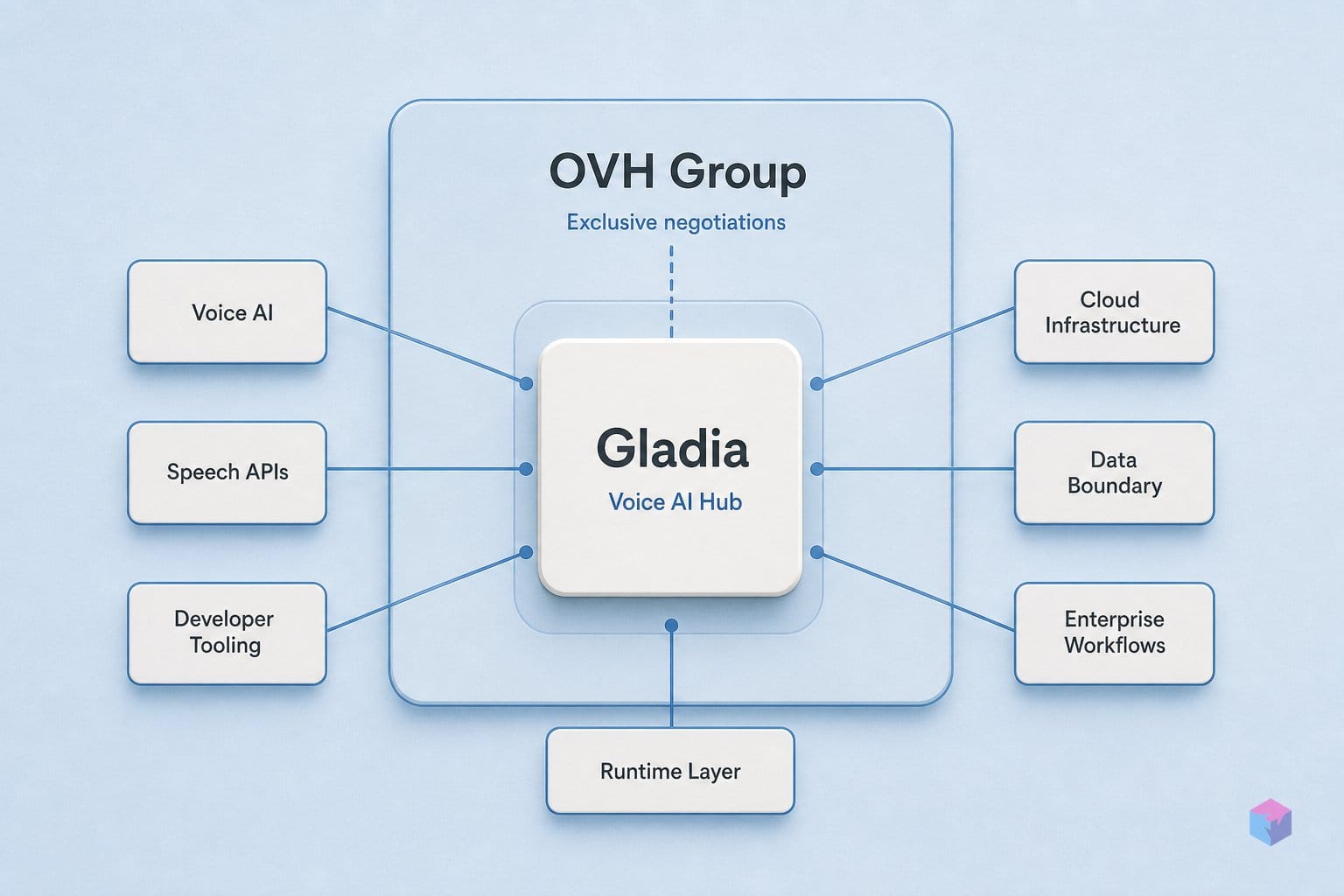
Gladia is a Paris-based speech-to-text company founded in 2022 by Jean-Louis Queguiner, himself a former OVHcloud executive . That detail reframes the transaction: OVHcloud is not buying a stranger but bidding to bring an alum's company in-house, a founder who left the infrastructure provider and built an applied voice-AI layer that his former employer now wants to own outright.
The startup raised roughly $20.3 million in total, anchored by a $16 million Series A backed by Sequoia Capital, New Wave, and XAnge . Company profiles list around 38 employees spread across offices in Paris, Cesson-Sévigné, and Toulouse . By acquisition standards this is a small, focused team — closer to an engineering-led model shop than a sprawling platform vendor, which is consistent with OVHcloud framing it as a capability tuck-in for its AI Lab rather than a large standalone business unit.
The self-reported scale is larger than the headcount suggests. Gladia's homepage claims more than 2 billion minutes of audio transcribed, over 300,000 developer signups, more than 2,000 enterprise teams, and a 99.95% uptime SLA . Named customers include HeyGen, Livestorm, Circleback, Recall.ai, and Leexi — voice agents, meeting tools, and recording infrastructure that depend on a single API for both real-time and batch transcription across more than 100 languages . Treat these as vendor figures; none are independently audited.
What likely made Gladia attractive to a sovereignty-focused acquirer is its compliance posture. The company advertises GDPR, SOC 2 Type II, HIPAA, and ISO 27001 coverage, 100% EU data residency, and a stated policy of no training on customer audio . For a European cloud provider selling against US-based STT incumbents, an EU-resident transcription engine with that certification stack is a cleaner fit than reselling a third-party API.
What Solaria-3 transcribes and where it falls short
Solaria-3 is Gladia's current speech-to-text model, built for noisy, fast-paced production audio and handling both real-time and batch transcription across more than 100 languages through a single API . Gladia reports a 9.6% word error rate (WER) on an internal English real-customer-audio dataset — a 26% improvement over Solaria-1 — with English and French as launch languages and reported gains for French, Italian, Spanish, and German . That headline figure rests on a proprietary dataset and methodology; treat it as vendor-reported until you validate it on your own audio.
For voice agents, the relevant spec is latency, not just accuracy. Gladia's real-time engine advertises sub-300ms partial transcripts, the interim outputs that let an agent begin reacting before a speaker finishes — the difference between natural turn-taking and awkward pauses . It ships Python and Node.js SDKs plus WebSocket streaming, and claims integration time under four hours .
Gladia's own benchmark page is more candid than its marketing. Methodology: production APIs at default settings, OpenAI Whisper text normalization, 74 hours of audio across 7 datasets . Solaria leads decisively on hard conversational telephony but trails on cleaner read-speech and earnings audio (lower WER is better):
| Dataset | Gladia WER | Best competitor | Result |
|---|---|---|---|
| Switchboard | 35.8% | Deepgram Nova v3 — 65.2% | Gladia leads |
| Common Voice 24 | 6.7% | Speechmatics — 3.8% | Gladia trails |
| VoxPopuli | 2.2% | ElevenLabs Scribe v2 — 1.7% | Gladia trails |
| Earnings22 (full) | 11.8% | ElevenLabs Scribe v2 — 9.4% | Gladia trails |
| Pipecat (real-time) | 2.7% | AssemblyAI Universal v3 — 2.0% | Gladia trails |
The pattern is worth reading carefully . Gladia's edge shows up where audio is messy — overlapping speakers, telephony artifacts — which matches its positioning toward call-center and voice-agent workloads. On well-recorded benchmarks like Common Voice and VoxPopuli, Speechmatics and ElevenLabs come out ahead. None of this is independently audited; it is a vendor-run comparison, and the choice of datasets and normalization favors the vendor running it. The takeaway for builders: pick the model that wins on audio resembling yours, not on a single aggregate number.
Transcription is only the entry point. Solaria sits inside a feature stack that includes speaker diarization, automatic language detection and code-switching, any-to-any translation returned alongside the transcript, named-entity recognition, PII redaction, sentiment analysis, chapterization, summarization, and an Audio-to-LLM pipeline that supports native or bring-your-own models . On diarization, Gladia's DIHARD III table lists Solaria-1 at 17.2 simple-average DER, ahead of NVIDIA NeMo Sortformer, pyannoteAI Community-1, and Speechmatics in that same table . Native integrations cover Pipecat, LiveKit, Twilio, Retell, Recall, Zapier, Make, and n8n — the connective tissue most voice-agent and meeting-assistant stacks already depend on .
OVHcloud's AI Lab bet: owning STT rather than reselling it
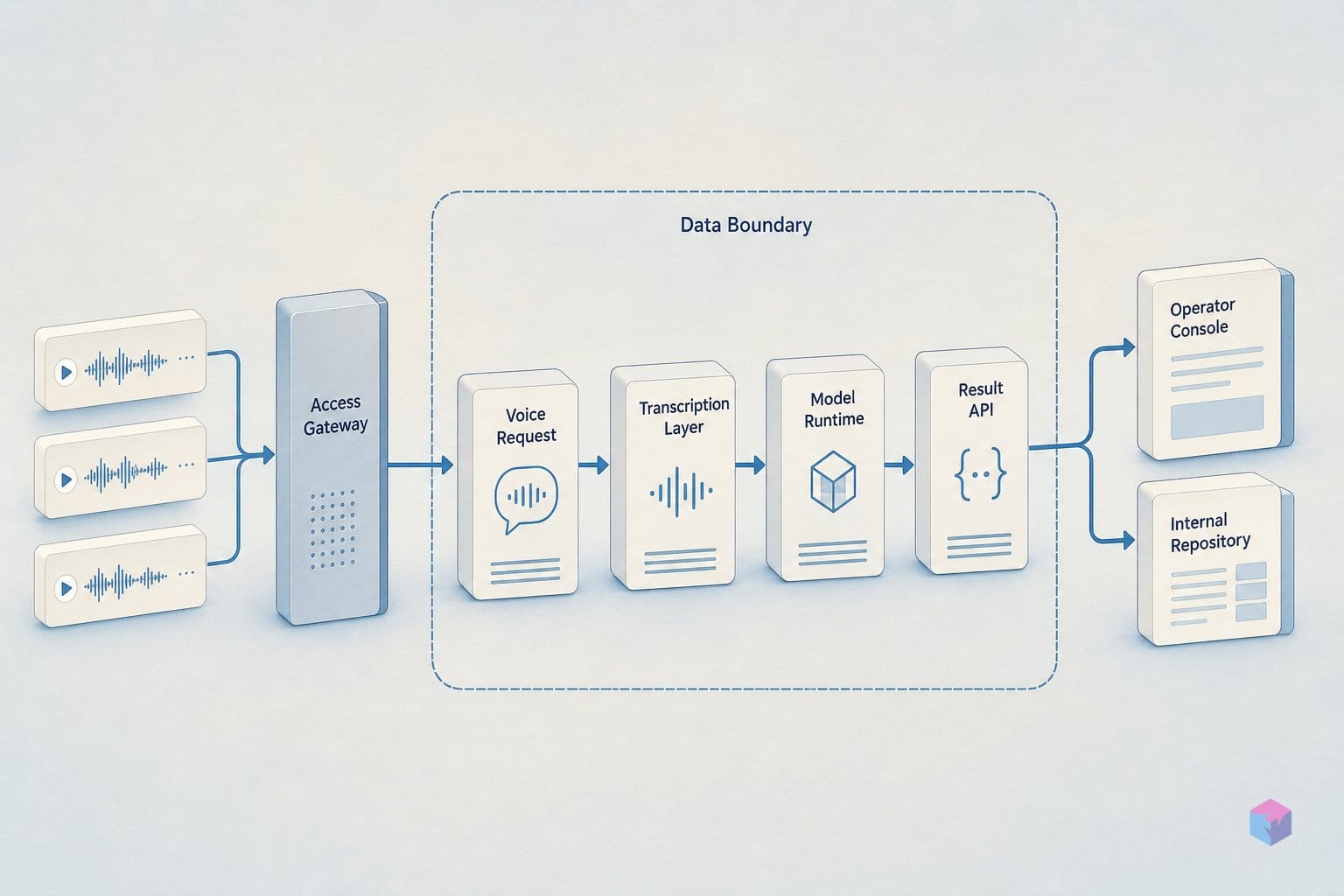
OVHcloud is buying Gladia to move up the stack — from selling bare compute to operating its own voice-AI application layer. The strategic premise is straightforward: rather than reselling a third-party transcription API or routing customers to Deepgram or OpenAI's Whisper, OVHcloud wants first-party speech-to-text it controls end to end, inside an EU sovereign perimeter. Gladia is framed as the second acquisition for OVHcloud's newly formed AI Lab, whose stated ambition is to build "the next generations of sovereign generative, agentic and multimodal AI technologies" [1].
"The next generations of sovereign generative, agentic and multimodal AI technologies." — OVH Groupe newsroom statement on the AI Lab's mandate (source: OVHcloud, 2026-06).
The financial backdrop frames this as a capability gap OVHcloud can afford to close, not a moonshot. Its FY2025 results show revenue of €1,084.6 million, up 9.3% like-for-like, with adjusted EBITDA of €437.8 million — a 40.4% margin — and Public Cloud revenue of €219.2 million [7]. That Public Cloud line is IaaS-grade revenue: GPUs, storage, inference endpoints. Gladia sits a layer above it — audio capture, transcription, diarization, and audio-enrichment primitives that turn raw compute into a managed product developers can call through a single API.
The compute substrate is already in place. OVHcloud's SambaNova-powered AI Endpoints target low-latency and batch inference with a stated 99.8% uptime SLA, described as available by end-2025 from regions in France with further European deployments planned [8]. Gladia's contribution is the application tier that runs on top: STT, speaker diarization, language detection, translation, and the voice-agent workflows that OVHai could expose as first-party services [2]. Owning both layers lets OVHcloud package transcription as a managed endpoint rather than a reseller margin.
The deeper logic is dependency reduction. Reselling US-hosted STT undercuts the sovereignty pitch OVHcloud sells to European buyers; internalizing Gladia removes that contradiction. With Gladia's 100% EU data residency and "no training on customer audio" stance [2], OVHcloud gets a GDPR-aligned voice stack it can position against Deepgram, AssemblyAI, ElevenLabs, and Whisper-based offerings — without sending a customer's audio outside the perimeter it markets as the whole point. Whether that stack ships intact or gets folded into AI Endpoints is the open question, and one the closing details have not yet answered.
What Gladia's existing customers face post-close
For now, nothing changes. The June 11, 2026 announcement covers exclusive negotiations only — no signed deal — so Gladia's existing API, current pricing, data-processing terms, and support channels remain the operating baseline until a definitive closing announcement appears . Developers and enterprise teams should treat every term as unaltered, not at risk, until OVHcloud publishes new commercial and contractual conditions.
That baseline includes concrete, published pricing. Gladia's tiers on record are as follows:
| Plan | Async STT | Real-time STT | Key limits / terms |
|---|---|---|---|
| Starter | $0.61/hr | $0.75/hr | 10 free hours/month, 30 real-time concurrent, 25 async concurrent |
| Growth | as low as $0.20/hr | as low as $0.25/hr | volume-based discounting |
| Enterprise | custom | custom | unlimited concurrency, zero data retention, default training opt-out, SLAs, custom hosting |
Those figures are current published terms , and the free tier of 10 hours with no credit card stays in place . Whether a Growth-tier $0.20/hour rate survives a packaging change — for instance, if Gladia's STT is folded into OVHcloud's AI Endpoints metering — is exactly the kind of detail the negotiation has not disclosed.
Partner integrations carry the same uncertainty. Teams building voice agents and meeting assistants on Pipecat, LiveKit, Twilio, Retell, and Recall have had no roadmap guidance issued since the announcement . The integrations function today and Gladia advertises setup under four hours, but continuity of those native connectors post-close is unconfirmed. If you depend on a specific integration for production traffic, the prudent move is to keep an abstraction layer over the transcription call so a future endpoint or auth change is a config edit, not a rewrite.
The most consequential open item is data handling. Gladia's "no training on customer audio" commitment, 100% EU data residency, and zero-retention Enterprise option are current contractual terms — and, as the prior section noted, the reason OVHcloud wants the stack at all. But a buyer can revise terms and conditions after close. Until OVHcloud republishes the data-processing agreement under its own name, treat the EU-residency and no-training guarantees as Gladia's promises, not yet OVHcloud's. Enterprises with regulated audio should ask for written continuity language before the close, not after.
The sovereignty angle: EU-resident STT against Deepgram, ElevenLabs, AssemblyAI
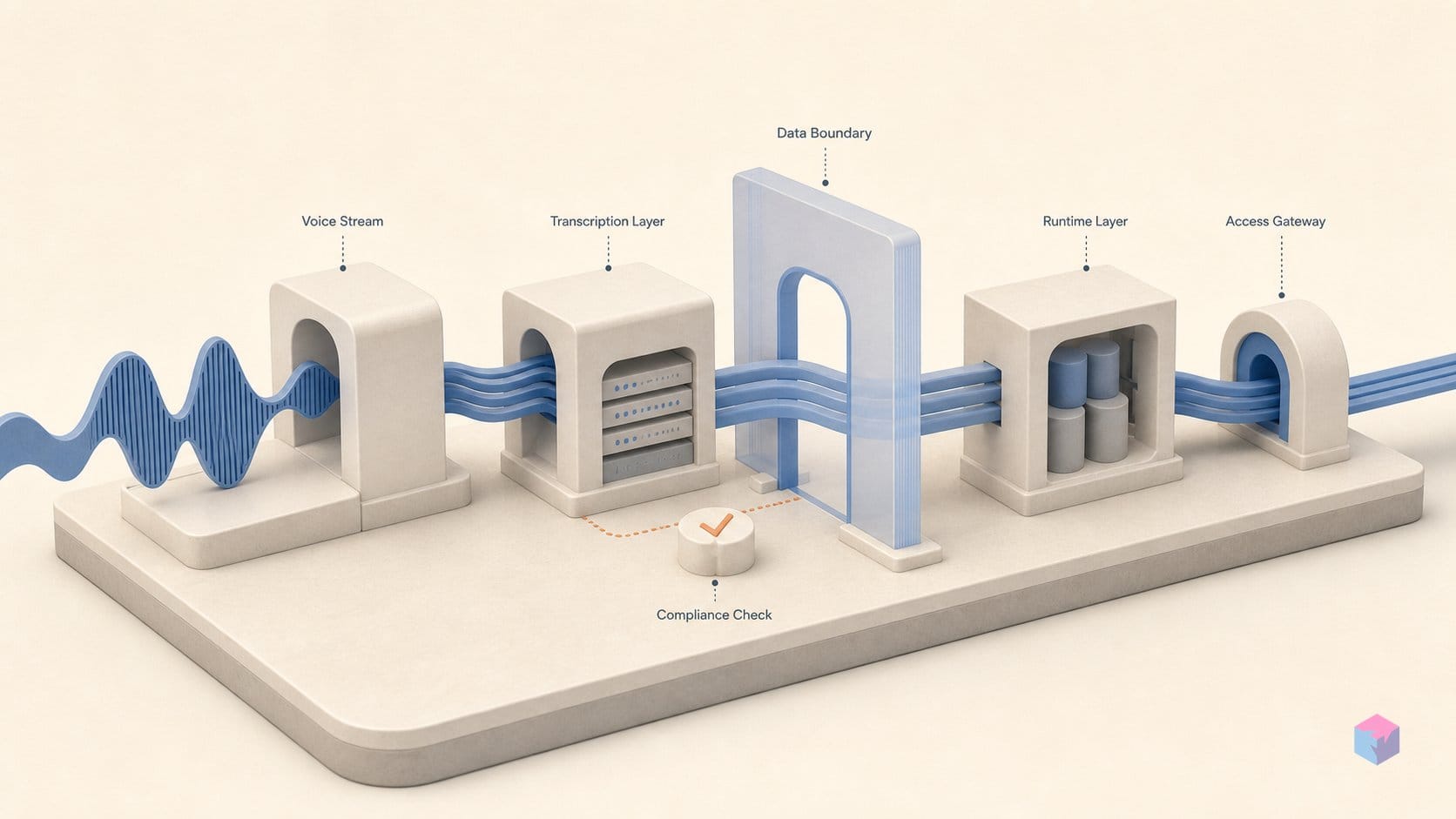
The clearest reason OVHcloud wants Gladia rather than a US transcription vendor is jurisdictional. Gladia advertises GDPR compliance, SOC 2 Type II, HIPAA, and ISO 27001 alongside 100% EU data residency and a stated policy of no training on customer audio . No US-headquartered competitor — Deepgram, AssemblyAI, or ElevenLabs — matches that full stack under European jurisdiction. For regulated audio in France, Germany, and the EU broadly, that combination is the differentiator, not a marketing footnote.
It matters precisely because accuracy is close to parity, not because Gladia wins on every benchmark. On Gladia's own vendor-run tables, ElevenLabs Scribe v2 outperforms it on VoxPopuli (1.7% vs 2.2% WER) and on Earnings22 full (9.4% vs 11.8%), and AssemblyAI Universal v3 leads on Pipecat real-time (2.0% vs 2.7%) . When word error rates cluster this tightly across providers, the deciding variable for a regulated buyer shifts from a fraction of a percentage point to where the audio is processed and under whose contractual terms. Sovereignty is the tiebreaker, and Gladia holds it.
There is demand-side evidence that this addressable market is real, not aspirational. OVHcloud's FY2025 results report SecNumCloud ARR of €24 million, up 63% year on year — SecNumCloud being the French ANSSI security qualification that public institutions and regulated private firms increasingly require. That growth signals existing appetite from exactly the buyers a sovereign voice-AI service would target: French government bodies, healthcare, finance, and defence-adjacent contractors that cannot route call recordings or meeting audio through US-jurisdiction infrastructure.
What the acquisition would assemble, if it closes, is structurally distinct. OVHcloud already operates GPU compute and SambaNova-powered AI Endpoints from French regions . Adding Gladia's transcription and audio-intelligence layer would make the combined entity the only EU-headquartered offering covering compute, inference, and speech-to-text under one sovereign-certified roof. US incumbents can host in EU regions, but the corporate parent — and therefore exposure to extraterritorial data law such as the CLOUD Act — remains American.
The caveat from the prior section still applies: these are Gladia's certifications today, and a combined entity's compliance posture is only as good as what OVHcloud republishes post-close. But the strategic logic is coherent — OVHcloud is not buying the best WER on every dataset; it is buying the one accuracy-competitive transcription engine it can legitimately call sovereign.
Before the deal closes: valuation, team retention, and contract continuity
For now, almost everything that determines the deal's value to a Gladia customer is unpublished. OVHcloud's June 11, 2026 announcement discloses no purchase price, deal structure, or ownership percentage — which is normal, not evasive, at the French exclusive-negotiation stage. This is a phase of talks, not a signed transaction , and the standard sequence — works-council (CSE) consultation, then any required antitrust clearance — only firms up once the final structure exists. The deal could still not close at all .
The gaps that matter most to builders are equally open:
- Timeline and conditions: no expected closing date and no regulatory or works-council conditions are published .
- Founder's role: what Jean-Louis Queguiner — the former OVHcloud executive who founded Gladia in 2022 — does inside OVHcloud post-acquisition is unspecified .
- Team: the fate of Gladia's roughly 38 employees and any retention terms appear in no official material .
- Product packaging: there is no guidance on whether Gladia is absorbed into OVHai's AI Endpoints with revised pricing, or continues standalone at its current tiers — Starter at $0.61/hour async and $0.75/hour real-time .
That last point is the one to watch. A transcription engine repackaged inside a managed cloud endpoint can carry very different per-hour economics, concurrency limits, and data-retention defaults than a standalone STT API — and Gladia's current Enterprise tier already ships zero data retention and a no-training-on-customer-audio policy that customers chose it for.
The concrete takeaway: until a definitive closing announcement lands, treat the existing Gladia API, pricing, data-processing terms, and SDKs as the operating baseline . Keep building, but read the contract-continuity clauses when the close is announced — that document, not this week's press release, is where pricing and SLA commitments will actually be settled.
Frequently asked questions
Has OVHcloud completed the Gladia acquisition?
No. As of June 11, 2026, this is an exclusive-negotiation announcement, not a signed or closed deal. Under French M&A practice, a works-council review is legally required before signing, and the official materials disclose no price, ownership stake, or closing date . The deal could still fall through before a definitive agreement is reached.
Will Gladia's API pricing change after the acquisition?
There are no confirmed changes. The current published tiers remain operative until close: Starter at $0.61/hour async and $0.75/hour real-time with 10 free hours monthly, Growth advertised from $0.20/hour async, and a custom Enterprise tier . Post-close structure — including possible bundling into OVH AI Endpoints — is undisclosed .
How does Gladia Solaria-3 accuracy compare to Deepgram, ElevenLabs Scribe, and AssemblyAI?
Results are mixed across Gladia's own vendor-run benchmarks (74 hours of audio, 7 datasets, production APIs at default settings). Gladia leads Switchboard at 35.8% WER versus Mistral STT's 50.1%, but ElevenLabs Scribe v2 leads VoxPopuli (1.7% vs 2.2%) and Earnings22 full (9.4% vs 11.8%), AssemblyAI Universal v3 leads Pipecat real-time (2.0% vs 2.7%), and Speechmatics leads Common Voice 24 (3.8% vs 6.7%) . These figures are vendor-reported and lack independent third-party validation, so test on your own audio corpus before committing.
Is Gladia's EU data residency guaranteed after OVHcloud takes over?
It is currently contractual — Gladia advertises 100% EU data residency and a "no training on customer audio" policy . OVHcloud has not confirmed it will maintain identical data-processing terms after close . For GDPR-sensitive workloads this is the highest-stakes contractual question — watch for revised terms and conditions at deal close rather than relying on this week's announcement.
What SDKs and partner integrations does Gladia ship today?
Gladia ships Python and Node.js SDKs plus WebSocket streaming for real-time transcription. Native integrations cover Pipecat, LiveKit, Twilio, Retell, Recall.ai, Zapier, Make, and n8n, with advertised integration time under four hours . A free tier offers 10 hours per month with no credit card required , which is enough to validate accuracy on your own audio before any contract decision.