
For the first time, an everyday listener can flag a machine-generated track while it plays — no audio engineering, no upload, just a button. A free tool out of the University of Chicago wants to make AI-music provenance a one-click question.
What Quicksilver Does: Play Thirty Seconds, Receive a Judgment
Quicksilver is a free browser extension and macOS app that detects AI-generated music in real time as you stream audio on your computer. You install it, start playing a track from any streaming service — YouTube, Spotify, Apple Music — and hit an "Analyze" button. The extension listens to roughly 30 seconds of audio and returns a binary verdict: "Likely AI" or "Likely Non-AI," accompanied by a confidence reading . There is no account to create and nothing to configure; the workflow is install-then-click.
The privacy design is the part developers will notice first: all analysis runs locally, and no audio is uploaded to external servers — a deliberate contrast with cloud-based detectors . Each check costs about 30 seconds of uninterrupted playback. Availability spans the Chrome Web Store and the Microsoft Edge Add-ons store, with a separate standalone macOS app that covers system-level audio outside the browser .
The tool was released publicly on May 21, 2026, built by UChicago's SAND Lab (Security, Algorithms, Networking and Data) in partnership with ETCH, a nonprofit launched by the same lab leads . That pedigree matters: this is the group behind Glaze and Nightshade, the defensive tools that shield artists' work from nonconsensual AI training and have been downloaded more than 13 million times across 160+ countries . Lead developer is graduate student Stanley Wu, working with SAND Lab co-directors Ben Zhao and Heather Zheng.
Wu frames the motivation plainly:
"Given that there is so much AI music out there, and that normal users can't tell the difference, giving users a tool to identify these AI songs was a very natural solution," — Stanley Wu, graduate student, UChicago SAND Lab (source: CBS News Chicago).
Thirty Seconds of Listening, 37KB of Classifier
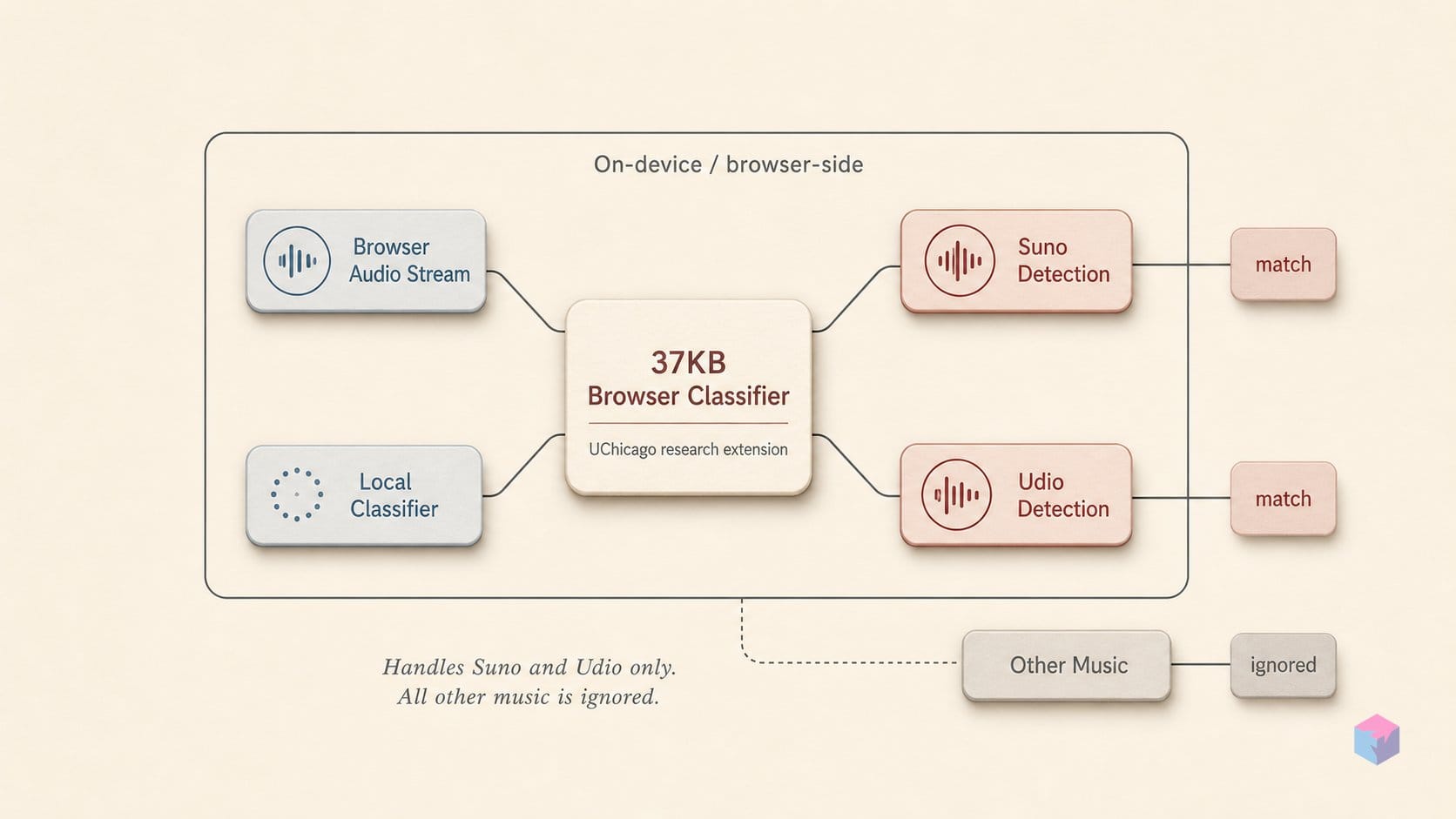
The technical surprise in Quicksilver is the size of the model doing the work: roughly 37KB. That is orders of magnitude smaller than a typical audio ML classifier, which usually ships as megabytes — sometimes hundreds of megabytes — of weights. The compactness is the point. A 37KB model is small enough to run synchronously inside a browser tab on about 30 seconds of captured audio, without spinning up a WebAssembly runtime or a native helper process, and without shipping any of that audio off-device. All inference happens locally, which is the privacy property the team leans on (source: UChicago News, 2026-05).
The methodology is not invented from scratch. The detector is built on the approach Deezer published for spotting AI-generated music, and the French streaming platform reportedly gave the team supportive feedback during development (source: ETCH, 2026-05). The underlying idea is that generative synthesis pipelines leave statistical fingerprints — regularities in how the audio is constructed that differ from how a human performance and conventional studio production introduce noise and micro-timing variation. Where a recorded performer's phrasing drifts and a real signal chain adds its own irregular artifacts, a generator's output carries the residue of how it was assembled. The classifier is tuned to listen for that residue rather than for anything a human ear would name.
What makes this inspectable rather than a black box is that the code is open-sourced on GitHub (source: ETCH, 2026-05). The architecture, the weight format, and the feature-extraction stage that turns 30 seconds of waveform into the inputs the model scores are all there to read, audit, and fork. For developers, that matters more than the headline accuracy number: a published 37KB classifier is something you can actually pull apart to see which spectral or temporal features it keys on, test against your own audio, and extend. It also lowers the bar for someone to integrate the same detection logic into a different surface — a server-side check, a CI step for an audio catalog, or a separate client — instead of treating provenance detection as a proprietary cloud API.
The Self-Reported 98%: Why Skepticism Is Warranted
Quicksilver's headline accuracy figures come from the team's own test suite, not an independent benchmark — which is reason to treat them as a starting claim rather than a settled result. The project reports detecting AI-generated songs about 98% of the time with a false-positive rate below 0.02% , but those numbers were published with the May 21, 2026 release and have not been confirmed by a peer-reviewed paper or a public leaderboard entry. Self-reported metrics from the model's authors set the ceiling for what the tool might do, not the floor for what it does in the wild.
The gap matters most at the edges. The published materials describe accuracy on the model's evaluation data, but say nothing about heavily layered production, AI-generated stems mixed into otherwise live recordings, or remixes that pass machine-made audio through human post-processing . A sub-0.02% false-positive rate is a strong claim precisely because it is easy to violate: one unusual mastering chain or genre the test set under-sampled can move that number by orders of magnitude. Until someone runs the open-source classifier against a diverse, externally curated corpus, the per-genre behavior is undocumented.
| Reported metric | Project's figure | Independent verification status |
|---|---|---|
| Detection accuracy | ~98% | Self-reported; no peer review or leaderboard entry as of the May 2026 release |
| False-positive rate | <0.02% | Self-reported; depends on test-set composition, not externally audited |
| Sample size / test corpus | Not disclosed in public materials | Unknown — no published dataset breakdown |
| Peer-review status | None as of 2026-06 | Open-sourced code, but no academic publication confirming the numbers |
| Genre / edge-case coverage | Not documented | Layered production, remixes, AI stems in live tracks untested publicly |
There is also a domain-transfer question worth naming directly. SAND Lab earned its reputation in adversarial machine learning for images, with Glaze and Nightshade downloaded more than 13 million times across 160-plus countries . That track record is real, but audio forensics is a separate discipline with its own evaluation norms — robustness to codec compression, resampling, and time-stretching that have no clean analog in still-image attacks. The methodology is reportedly based on Deezer's research approach to AI-music detection, with supportive feedback from the platform , but research-level feedback is not the same as an adopted, audited labeling standard. The credible read: promising numbers from a credible lab, awaiting the independent benchmark that would let a developer trust them in production.
Suno v5, Udio v1.5: What the Classifier Was Taught
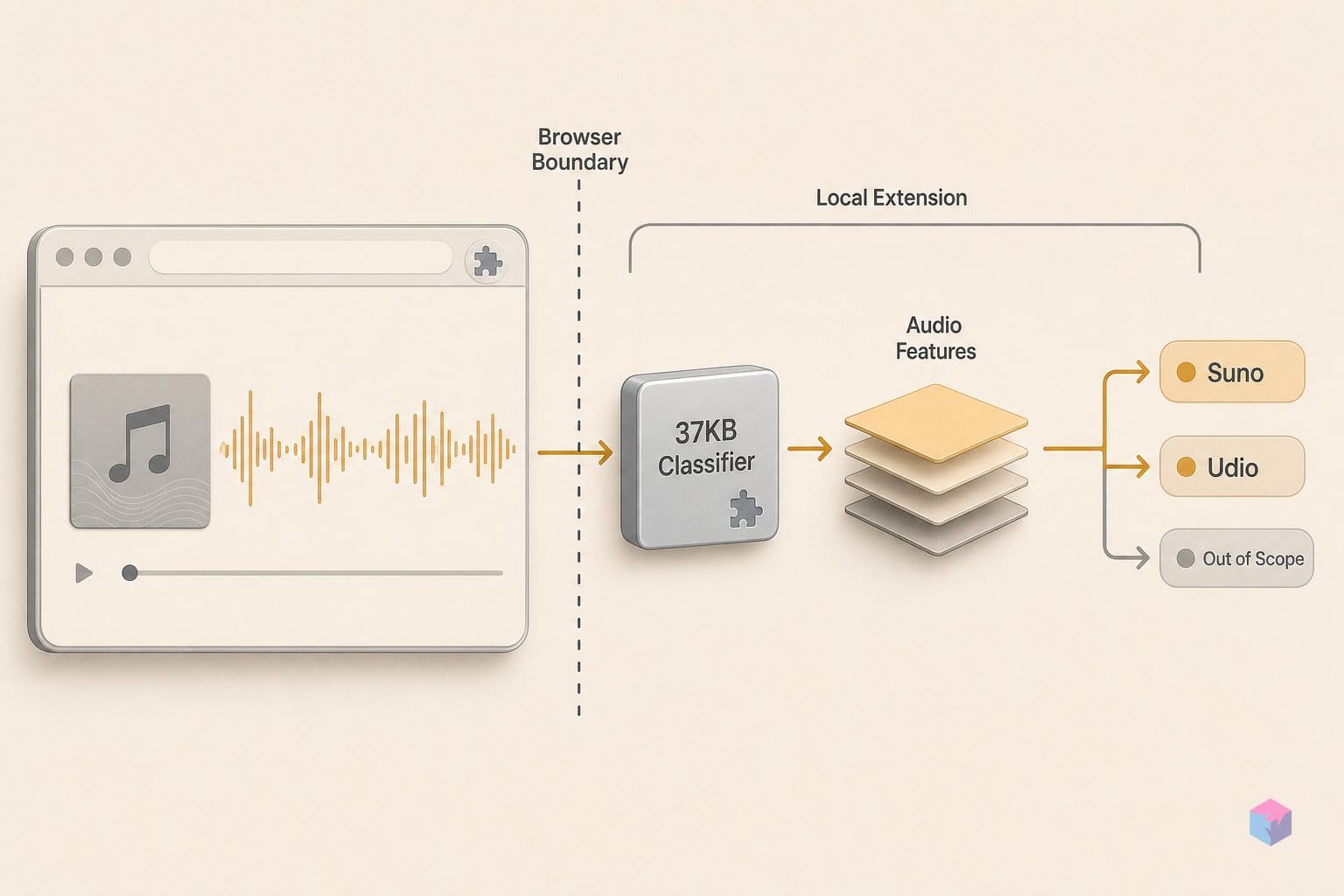
Quicksilver's accuracy claims only apply inside a deliberately narrow boundary: the classifier was trained exclusively on outputs from Suno v5 and Udio v1.5, the two dominant commercial music generators as of early 2026 . Knowing the exact training scope matters more than the headline percentage, because it tells a developer precisely what the model has actually seen — and what it has never been shown.
The reason a tool-assisted approach exists at all is a measurable detection gap on the human side. Studies cited by the team find that even professional musicians perform only marginally better than chance at distinguishing AI-generated tracks from human-made ones . If trained ears can't reliably hear the difference, an automated artifact detector becomes a reasonable provenance signal rather than a redundant one.
The scale of the problem explains the timing. Since 2024, AI-generated songs have surged onto streaming platforms and now account for nearly half of all newly uploaded tracks, though most receive minimal plays — what the team calls "AI slop" . A flood of low-engagement machine output is exactly the environment where a lightweight, listener-facing classifier earns its keep.
The practical consequence is a sharp in-scope/out-of-scope line that the team states honestly:
| Status | Generator | Coverage notes |
|---|---|---|
| In scope | Suno v5 | Directly trained target |
| In scope | Udio v1.5 | Directly trained target |
| Out of scope | DiffRhythm | Open-source; not reliably detected |
| Out of scope | ACE-Step | Open-source; not reliably detected |
| Out of scope | Stable Audio, MusicGen | Untrained generators; behavior unverified |
| Out of scope | Older Suno / Udio versions | Version drift; artifacts differ from trained targets |
The design logic is defensible: concentrate a 37KB model on the artifacts of the generators most listeners actually encounter, and accept blind spots elsewhere. But the same logic exposes the model's fragility — its competence is pinned to two specific product versions. The moment Suno or Udio ships a new release, the trained target shifts beneath the classifier, which is precisely the retraining pressure the next section examines.
DiffRhythm, ACE-Step, Evasion: Outside the Classifier's Reach
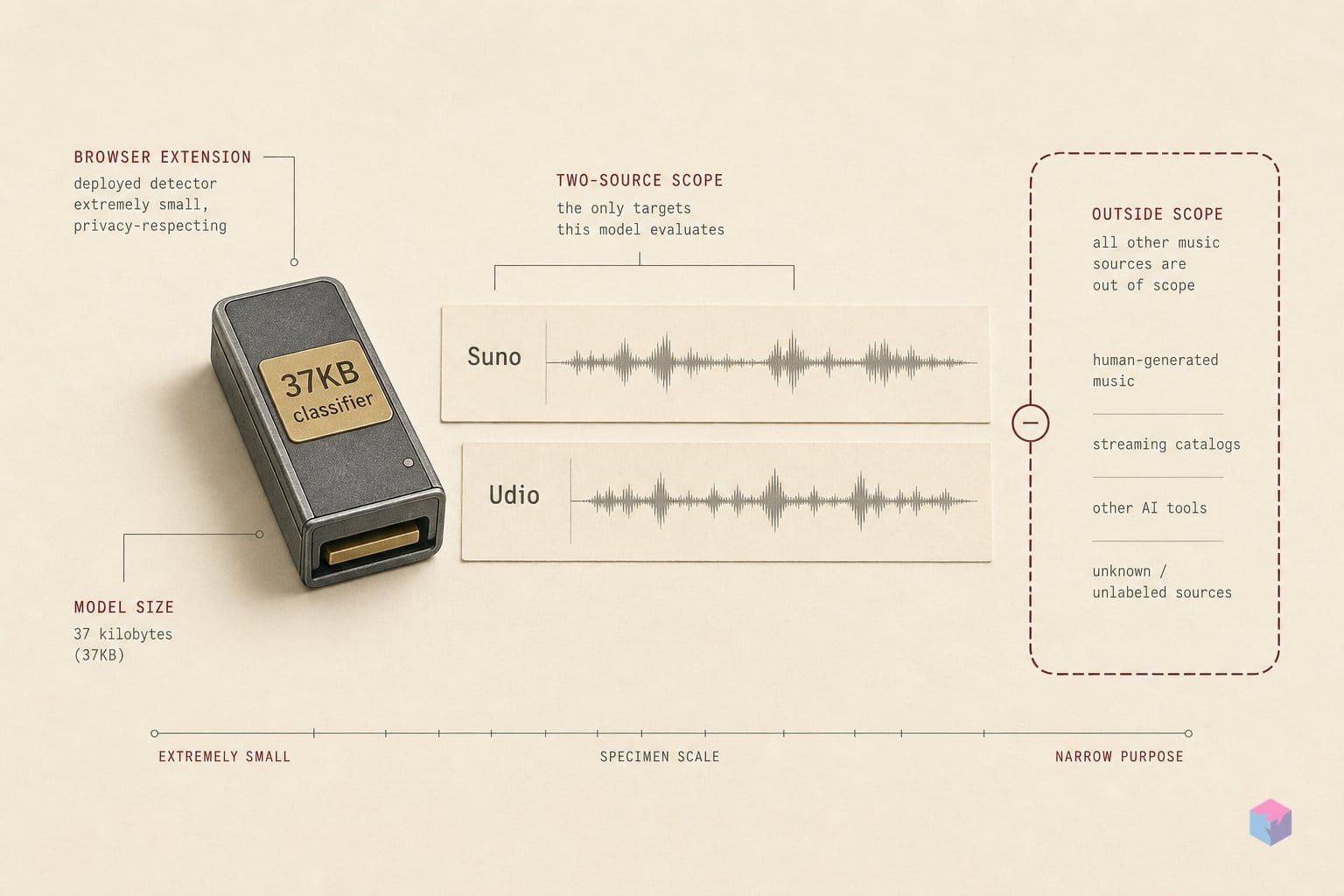
Quicksilver's blind spots are not edge cases — they are categories. The team states plainly that the detector is trained on Suno v5 and Udio v1.5 and does not reliably flag open-source generators such as DiffRhythm or ACE-Step . Those models — alongside others in the open-source tier like Stable Audio and MusicGen — emit different acoustic fingerprints than the two commercial systems the classifier learned. A track from one of them is more likely to return "Likely Non-AI" than a true positive. For anything generated outside the trained target, false negatives are the expected outcome, not an anomaly.
The scope is also bounded by content type. Quicksilver was built for generated music; the team explicitly excludes audio deepfakes and pure speech synthesis from what it can detect . Pointing it at a cloned voice or a synthetic narration is outside its design, and a verdict there carries no weight.
Then there is deliberate evasion. The researchers acknowledge the classifier is not robust against audio manipulation intended to defeat it . Common transforms — pitch-shifting, time-stretching, or injecting high-frequency noise — can perturb the artifacts the model keys on without changing what a listener hears. No adversarial hardening was applied, so an uploader motivated to launder a track's provenance has cheap, well-known options.
For developers, these gaps define what Quicksilver is and is not. It is a free, on-device provenance hint for the two generators most listeners encounter. It is not a moderation or compliance layer. Wiring a 37KB classifier into an ingestion pipeline as a gatekeeper would clear Suno and Udio uploads while passing open-source output untouched and folding to trivial evasion. Production use would demand retraining on a far broader corpus and evasion-aware data augmentation — work the open-source GitHub release invites, but that the shipped model does not yet do .
As Generators Iterate, Retraining Becomes Mandatory
The harder problem is time. Quicksilver is a snapshot classifier — tuned to the specific artifacts that Suno v5 and Udio v1.5 leave behind — and both generators ship major versions every few months. Each new release reshapes the noise and post-processing signature the 37KB model keys on, so detection accuracy degrades the moment a vendor pushes an update the classifier has never seen. A tool released on May 21, 2026 is therefore accurate against a frozen target, not a moving one.
The open-source GitHub release is the practical mitigation. Because the code and approach are public , teams that collect fresh Suno or Udio output can retrain the classifier on the newest version and contribute updated weights without waiting for an official SAND Lab cut. That distributes the retraining burden across anyone with a labeled corpus — the same audit-and-extend model that the lab's earlier Glaze and Nightshade tools relied on to reach more than 13 million downloads across 160+ countries .
Platform interest exists but stops short of adoption. Deezer reportedly gave the team supportive research feedback and informed the detection methodology , yet no major streaming service — Spotify, Apple Music, or YouTube — has adopted Quicksilver as an official labeling mechanism as of May 2026 . Provenance signaling, for now, lives client-side in a browser extension, not in the platforms' own ingestion pipelines.
The open architectural question for builders is whether artifact-based detection scales with the arms race. A 37KB classifier works precisely because today's generators leave detectable fingerprints; as Suno and Udio improve noise modeling and post-processing to sound more human, those fingerprints thin out, and a tiny artifact detector may simply run out of signal — forcing a move to a fundamentally larger model. The concrete takeaway: treat Quicksilver as a working reference implementation and a retraining pipeline, not a permanent oracle. Its value to developers is the open codebase and the honest scope, both of which assume continuous maintenance is the price of staying accurate.
Frequently asked questions
Does Quicksilver work with Spotify, Apple Music, and YouTube Music?
Yes. Quicksilver captures tab audio inside the browser regardless of which streaming service is playing, so YouTube, Spotify, Apple Music, and YouTube Music all work the same way: play a track, hit Analyze, and let it listen for roughly 30 uninterrupted seconds before it returns a verdict . For sources that live outside the browser, the separate standalone macOS app handles system-level audio instead of tab audio .
Is the 98% accuracy figure independently verified?
No. The reported ~98% detection rate and sub-0.02% false-positive rate come from the project's own published test materials, not from an external source . As of the May 21, 2026 release there is no peer-reviewed paper, third-party leaderboard, or independent audit confirming the numbers . Treat them as vendor-reported until real-world performance across genres, remixes, and newer generator versions is measured by someone other than the team.
Can post-processing defeat Quicksilver?
Yes. The team states plainly that the classifier is not robust against deliberate manipulation intended to evade detection . Pitch-shifting, time-stretching, added noise, or aggressive re-encoding can obscure the spectral artifacts the model targets, pushing a genuinely AI-generated track toward a "Likely Non-AI" reading. Because the detector keys on generator-specific fingerprints, any transformation that smears those patterns reduces its reliability.
Will Quicksilver flag AI music from DiffRhythm or ACE-Step?
No, not reliably. Quicksilver was trained specifically on Suno v5 and Udio v1.5, and the team explicitly notes it does not reliably detect open-source generators such as DiffRhythm or ACE-Step . Those models sit outside its training distribution, so expect false negatives rather than dependable catches. It also does not handle audio deepfakes or pure speech synthesis .
Can I embed Quicksilver's classifier in my own pipeline?
Yes. The code is open-sourced on GitHub, and at a reported 37KB the model is small enough to run inside a browser extension or server-side without meaningful overhead . Two caveats before you ship it: the scope is narrow (Suno v5 and Udio v1.5 only), and the methodology builds on Deezer's detection research, so plan for retraining as generator versions change . Budget for continuous maintenance rather than a one-time integration.