

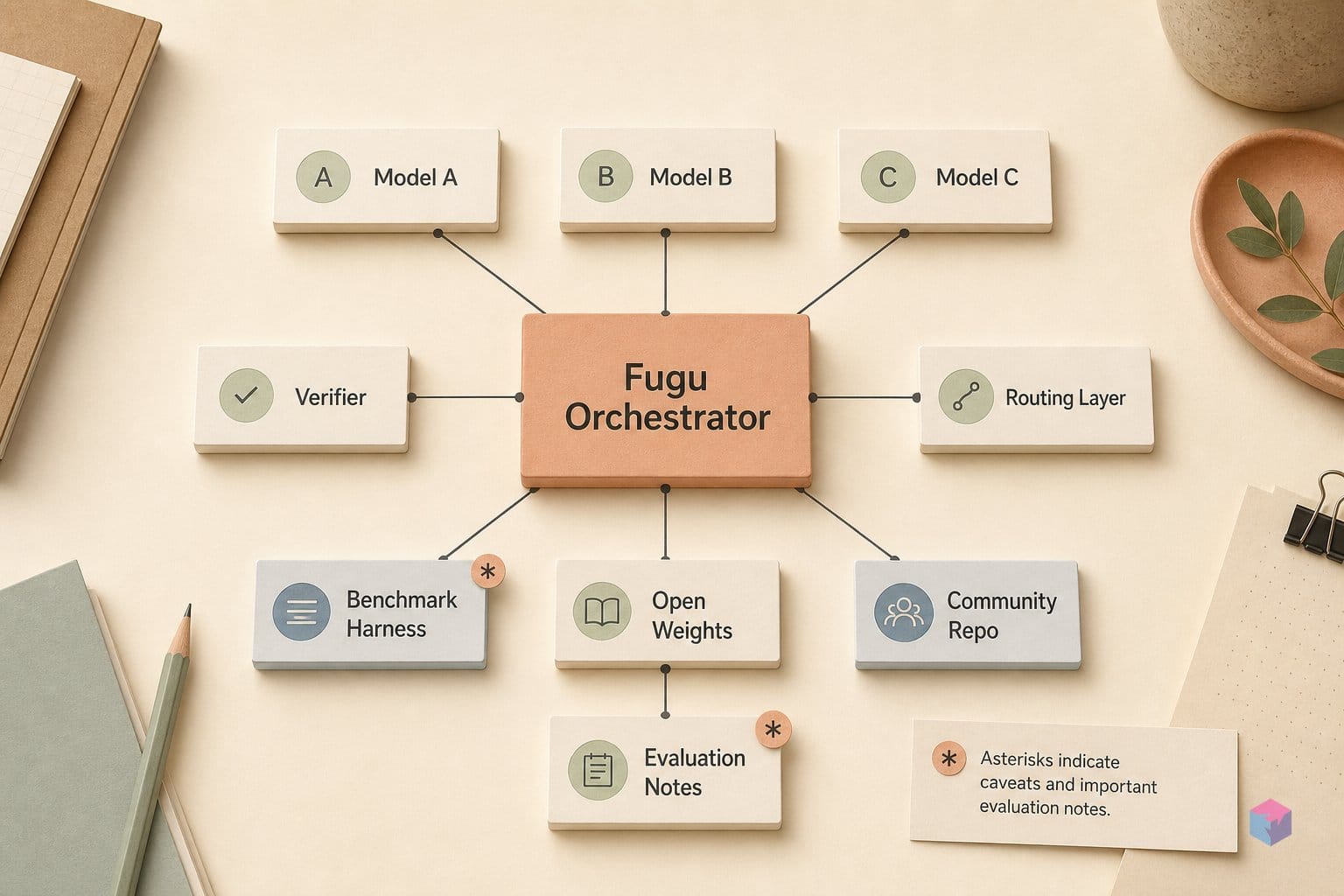
Sakana AI's pitch for Fugu is unusual: instead of training one larger model, it trained a model whose job is to drive other models. The result, launched on June 22, 2026, behaves like a single API endpoint but runs a coordinated pool of frontier LLMs underneath.
Fugu Is a Trained Coordinator, Not a Static Router
Fugu is itself a language model trained to call and coordinate other LLMs — not a prompt-routing wrapper or a mixture-of-experts subnetwork. Tokyo-based Sakana AI publicly launched it on June 22, 2026, marketing it as a "multi-agent system as a model" that selects, delegates to, and synthesizes across a swappable set of external frontier agents (source: MarkTechPost, 2026-06). The distinction matters: in a mixture-of-experts model, the experts are internal subnetworks; in Fugu, the "experts" are separate, independently hosted models the coordinator learns to operate.
To a developer, that complexity is invisible. Fugu ships behind a single, OpenAI-compatible API — one model ID, one endpoint — so it is positioned as a drop-in replacement that needs no SDK migration (source: The Decoder, 2026-06). What looks like one request to your client is, internally, a full inference cycle: task assignment, delegation to selected agents, inter-agent communication, verification, and final synthesis — all resolved before the response returns. The caller never sees which models ran or in what order; the per-query routing policy is proprietary and deliberately hidden.
Two tiers ship at launch, and the difference is more than branding:
- Fugu (standard): tuned for balanced latency and quality on everyday tasks. Developers can opt out of specific providers or models in its pool, which gives some control over what runs behind the endpoint (source: The Decoder, 2026-06).
- Fugu Ultra: model ID
fugu-ultra-20260615, tuned for maximum accuracy on harder, higher-stakes multi-step problems using a deeper, fixed agent pool. You cannot filter providers on Ultra — the pool is locked (source: MarkTechPost, 2026-06).
Sakana reports per-request token usage and cost so teams can monitor spend in real time, and frames the whole design as an alternative route to frontier capability: learning how to assemble and route existing models rather than training one ever-larger network (source: The Decoder, 2026-06). Whether that orchestration actually beats the models it coordinates is the claim the rest of this analysis tests.
Fugu Ultra: Ahead on Most Criteria, Trailing on MRCRv2
On Sakana's own June 2026 scorecard, Fugu Ultra (model ID fugu-ultra-20260615) leads the publicly available Claude Opus 4.8 on most listed benchmarks. It posts SWE-Bench Pro 73.7 vs 69.2, TerminalBench 2.1 82.1 vs 74.6, LiveCodeBench 93.2 vs 87.8, LiveCodeBench Pro 90.8 vs 84.8, GPQA-D 95.5 vs 92.0, SciCode 58.7 vs 53.5, CharXiv Reasoning 86.6 vs 84.2, Long Context Reasoning 73.3 vs 67.7, and a narrow Humanity's Last Exam edge of 50.0 vs 49.8 . The headline Sakana wants you to read is that the orchestrator collectively beats the individual foundation models it coordinates.
The exception is MRCRv2, a long-context retrieval benchmark. Here Fugu Ultra scores 93.6, ahead of Opus 4.8's 87.9 — but it is not the top of the row. GPT-5.5 leads at 94.8, and Gemini 3.1 Pro trails at 84.9 . Standard Fugu actually drops below Opus 4.8 on this metric, scoring 86.6 against Opus's 87.9. So the "beats everything it calls" framing has at least one visible asterisk: on the workload that most directly stresses long-context routing, a model in Fugu's own coordinated pool outscores it.
Standard Fugu — tuned for everyday latency rather than maximum accuracy — remains competitive across the board: SWE-Bench Pro 59.0, TerminalBench 2.1 80.2, LiveCodeBench 92.9, HLE 47.2, GPQA-D 95.5 (matching Ultra), and CharXiv Reasoning 85.1 . The gap between the two tiers is widest on the agentic coding rows, which is where the deeper fixed agent pool in Ultra appears to earn its cost.
| Benchmark | Fugu Ultra | Standard Fugu | Opus 4.8 | Row leader |
|---|---|---|---|---|
| SWE-Bench Pro | 73.7 | 59.0 | 69.2 | Fugu Ultra |
| TerminalBench 2.1 | 82.1 | 80.2 | 74.6 | Fugu Ultra |
| LiveCodeBench | 93.2 | 92.9 | 87.8 | Fugu Ultra |
| GPQA-D | 95.5 | 95.5 | 92.0 | Fugu Ultra / Standard (tie) |
| HLE | 50.0 | 47.2 | 49.8 | Fugu Ultra |
| MRCRv2 | 93.6 | 86.6 | 87.9 | GPT-5.5 (94.8) |
Two methodology caveats matter before you treat these as settled. First, Sakana states the baseline numbers are provider-reported, not re-run by Sakana inside one normalized harness — so the Opus, GPT-5.5, and Gemini figures come from each vendor's own conditions. Second, Fugu's SWE-Bench Pro result used mini-swe-agent scaffolding, which means even the row Fugu Ultra wins most clearly is not an apples-to-apples single-harness comparison . The scorecard is internally consistent and detailed, but it is a vendor evaluation, not an independent leaderboard run — a distinction worth holding onto before the parity claims in the next section.
Sakana's Boldest Claim vs. What the Scorecard Shows
Sakana's headline positioning — that Fugu stands "shoulder-to-shoulder with Fable 5 and Mythos Preview" — cannot be verified from any public table, because neither model appears as a data row in Fugu's visible comparison sheet . The numbers Sakana actually publishes line up Fugu against Claude Opus 4.8, Gemini 3.1 Pro, and GPT-5.5 — not the two Anthropic tiers its marketing invokes. The parity claim and the auditable scorecard are pointing at different models.
"Shoulder-to-shoulder with Fable 5 and Mythos Preview," — Sakana AI's framing of Fugu's frontier positioning (source: The Decoder).
The timeline explains the gap. Anthropic launched Claude Fable 5 and Mythos 5 on June 9, 2026, billing Fable 5 as a Mythos-class, state-of-the-art model . Three days later, on June 12, 2026, Anthropic suspended access to both following a U.S. government directive . By the time Fugu launched publicly on June 22, 2026, neither model was reachable . A comparison against a model nobody outside Anthropic can currently run is, by construction, not reproducible.
The presentation format compounds the problem. Anthropic published its Fable/Mythos scorecard only as an image, while Sakana's row-by-row sheet omits those entries entirely . There is no shared table, no overlapping harness, and no live endpoint that would let a third party place Fugu Ultra and Fable 5 in the same column. The parity statement therefore lives in prose and positioning, not in any dataset a developer can re-derive.
What is auditable is narrower and worth stating plainly: Fugu's published numbers compare directly against Claude Opus 4.8, which Anthropic launched on May 28, 2026 at $5 per million input and $25 per million output tokens . That is the public, still-accessible baseline behind the row-level wins covered earlier — Fugu Ultra at 73.7 on SWE-Bench Pro against Opus 4.8's 69.2, and similar margins across the listed suites .
The practical read for a builder: treat "matches Anthropic's frontier" as two separate claims. The Opus 4.8 comparison is concrete and checkable; the Fable 5 / Mythos parity is Sakana's broader narrative, unsupported by any public row-by-row data. Conflating the two is how a vendor evaluation gets repeated as an independent result.
The Misleading 'Smaller' in Sakana's Positioning
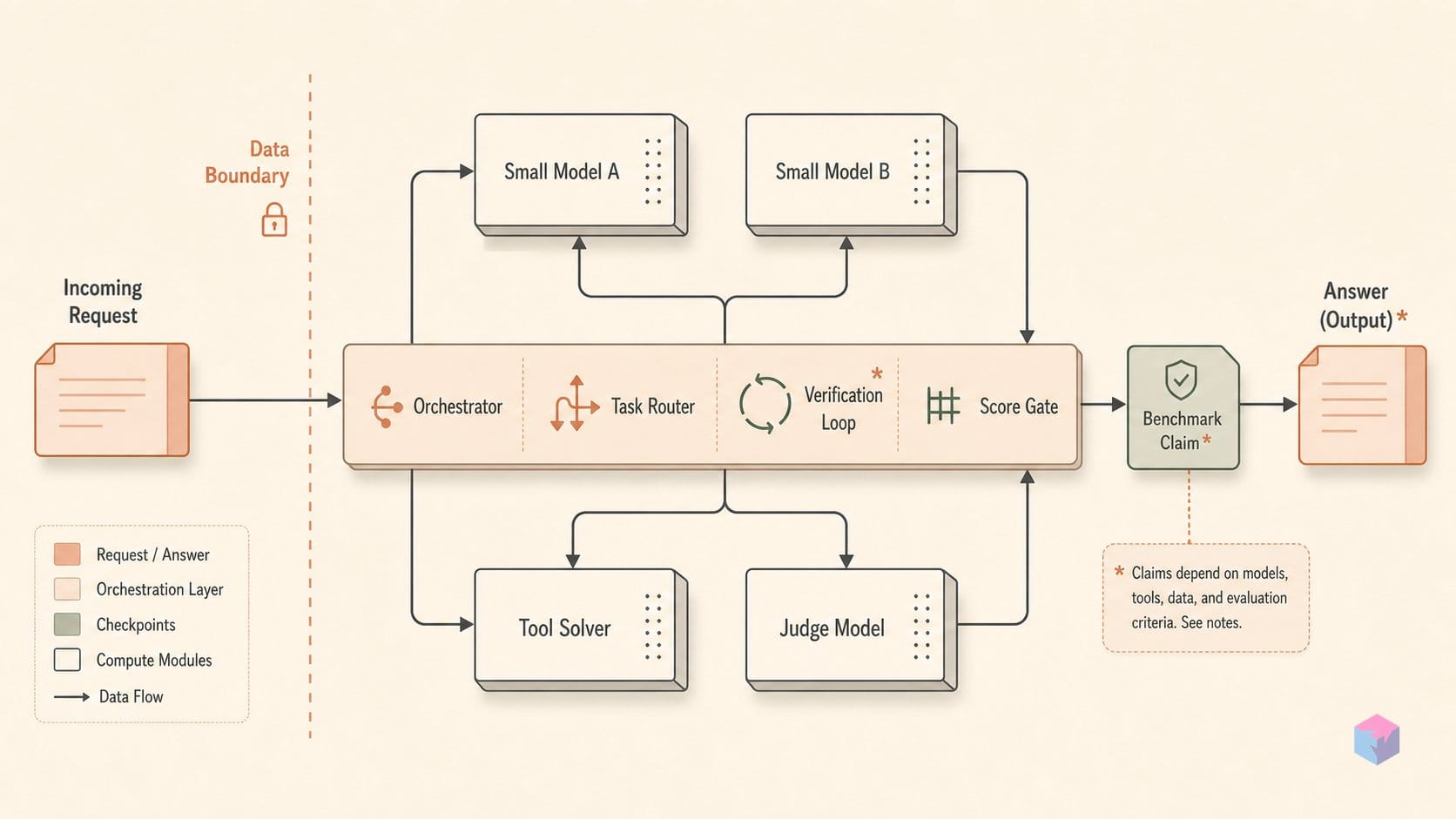
Sakana's framing of Fugu as a way to reach frontier capability by coordinating "smaller" models is accurate about the coordinator and misleading about the pool it drives. The trained orchestrator is genuinely small — TRINITY's coordinator is 0.6B parameters with a head under 20K learnable parameters, and Conductor's is a 7B model trained with reinforcement learning . But the workers those coordinators call are not small in any cost or capability sense.
Fugu's production pool is composed of publicly available frontier models — Claude Opus 4.8, Gemini 3.1 Pro, and GPT-5.5-class systems — the same top tier of paid inference a developer would reach for directly . Opus 4.8 alone bills at $5 per million input and $25 per million output tokens . "Smaller" describes the conductor; it does not describe the orchestra. Sakana's messaging conflates the two — the modest size of the routing model with the cost and capability of the worker pool it invokes.
The research lineage shows the same pattern. TRINITY's pool mixed closed frontier models — GPT-5, Gemini 2.5 Pro, Claude 4 Sonnet — with open-weight systems like DeepSeek-R1-Distill-Qwen-32B and Qwen-3-32B variants . Even the open-weight members are 32B-class models, not lightweight ones. The novelty is the learned coordination layer, not a downgrade in the underlying compute being orchestrated.
This reframes the resilience pitch a builder should weigh carefully. Fugu does not remove vendor lock-in so much as redistribute it. Instead of one dependency on a single frontier provider, standard Fugu introduces simultaneous dependencies on all three — Anthropic, Google, and OpenAI — with a per-query routing policy that is proprietary and hidden, and the weighting between them undisclosed and able to shift over time . Sakana's own argument is that this is a feature: if a provider is restricted, acquired, or raises prices, the orchestrator can route around it by swapping the pool . The trade is real, but it is a swap of one exposure for a broader, less transparent one — not its disappearance.
TRINITY and Conductor: The ICLR 2026 Papers Behind Fugu
Fugu's learned orchestration rests on two Sakana papers accepted for ICLR 2026: TRINITY and Conductor. TRINITY trains a 0.6B-parameter coordinator paired with a lightweight head carrying under 20K learnable parameters to orchestrate open and closed LLMs over up to five turns, assigning each call a Thinker, Worker, or Verifier role . That tiny head, not a giant model, is what decides who does what — the core idea Fugu now commercializes.
The reported numbers explain the bet. TRINITY posts a LiveCodeBench V6 pass@1 of 0.862, ahead of GPT-5 at 0.838, Gemini 2.5 Pro at 0.672, and Claude 4 Sonnet at 0.465, and its held-out scores — 50.00 on AIME, 35.80 on BigCodeBench, 9.60 on MT-Bench, and 76.82 on GPQA-D — average 54.21, beating every individual model in that table . The research pool spanned GPT-5, Gemini 2.5 Pro, Claude 4 Sonnet, Gemma-3-27B-It, DeepSeek-R1-Distill-Qwen-32B, and Qwen-3-32B variants — a deliberate mix of frontier and open weights.
Conductor scales the same principle. It trains a 7B coordinator with reinforcement learning to write natural-language coordination workflows and communication topologies for worker LLMs, rather than emitting a single answer. Its Conductor-Recursive variant scores 66.67 on AIME, 40.0 on BigCodeBench, and 82.32 on GPQA-D, against Claude Sonnet 4 at 35.33/35.8/67.30 and GPT-5 at 46.67/33.8/72.73 in one reported comparison .
The distinction from mixture-of-experts is the load-bearing one for anyone evaluating the architecture. In MoE, a router activates internal expert subnetworks within a single model's forward pass; the experts are weights you own. Fugu's coordinator instead calls separately hosted external frontier models over the network — Opus 4.8, Gemini 3.1 Pro, GPT-5.5-class systems — coordinating, verifying, and synthesizing their outputs . The intelligence lives in the routing, not in any one set of weights.
That framing shapes what Sakana actually sells. "Instead of training one ever-larger model, you learn how to assemble and route multiple existing ones," is the company's stated alternative path to frontier capability . Crucially, Fugu commercializes this orchestration line rather than releasing the coordinator weights. The product is the trained coordinator plus its proprietary routing policy — not the sub-models, which you could already call yourself. You are buying the decision layer, and that layer stays closed.
Operational Constraints: EU Barred, Opaque Pools, and Unforeseeable Invoice Totals
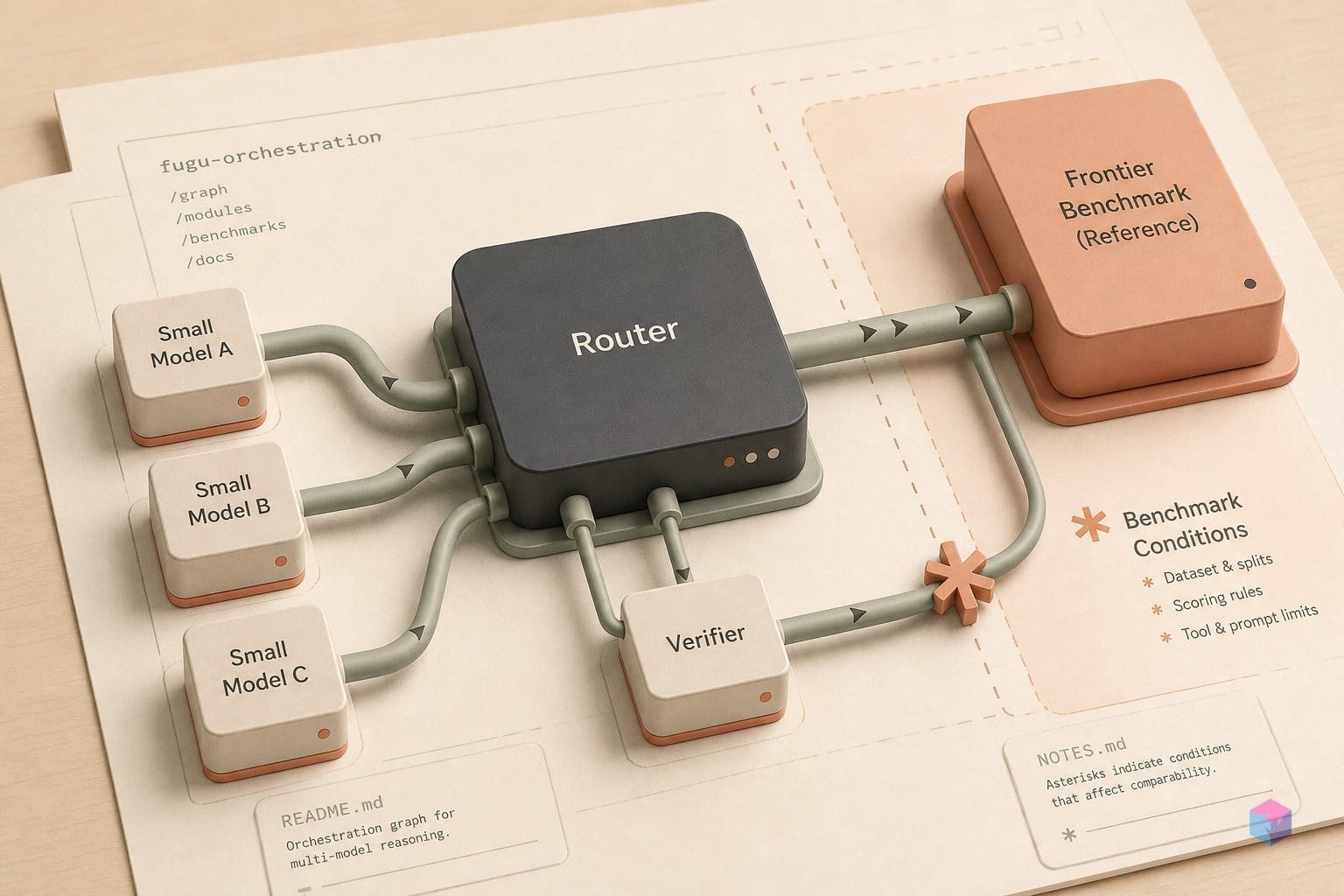
Buying a closed decision layer comes with three concrete trade-offs you should price in before adopting Fugu: it is geographically restricted, its routing is unauditable, and per-request cost is hard to forecast. Sakana states Fugu is not available in the EU/EEA at launch while it works toward GDPR and EU-specific compliance, with no published availability date . EU-based developers need a different path today — calling the underlying frontier models directly, or routing through a provider that already operates in-region.
Control over the model pool depends on tier. With standard Fugu, you can opt out of specific providers or sub-models per request — useful if a compliance, data-residency, or vendor policy rules out a given supplier. Fugu Ultra removes that lever: its agent pool is fixed and cannot be provider-filtered . If your higher-stakes workloads need the Ultra accuracy tier, you accept whatever models Sakana routes to, including instances it does not disclose per query.
That opacity is by design. The per-query routing policy is proprietary and deliberately hidden, so you cannot see which sub-model answered a given request . Sakana reports aggregate token usage and the invoice amount per request for real-time spend monitoring, but not the component breakdown behind that number . Because the coordinator can call several models — and instances of itself — over multiple turns, two structurally similar requests can produce very different totals. Cost is observable after the fact, not predictable before it.
Pricing reflects that variable-fan-out reality. Fugu Ultra pay-as-you-go and the subscription tiers break down as follows :
| Plan | Rate / price | Notes |
|---|---|---|
| Ultra input (≤272K context) | $5 / 1M tokens | Pay-as-you-go |
| Ultra output (≤272K context) | $30 / 1M tokens | Pay-as-you-go |
| Ultra cached input (≤272K) | $0.50 / 1M tokens | Pay-as-you-go |
| Ultra above 272K context | $10 / $45 / $1.00 per 1M | Input / output / cached |
| Standard subscription | $20 / month | Both tiers included |
| Pro subscription | $100 / month | 10× Standard usage |
| Max subscription | $200 / month | 20× Standard usage |
The practical takeaway: if your team is in the EU, needs provider-level control for compliance, or has to forecast per-request spend tightly, those constraints are blockers today — not edge cases.
Vetting Fugu Yourself: What to Measure Before Committing
Before routing production traffic through Fugu, benchmark it on your own workload rather than trusting the launch scorecard. Sakana's June 2026 evaluation reports Fugu Ultra ahead of public Claude Opus 4.8 on most listed benchmarks — SWE-Bench Pro 73.7 vs 69.2 and LiveCodeBench 93.2 vs 87.8 among them — but those are aggregate, Sakana-reported figures with provider-reported baselines, not a single independently normalized run . Public averages do not predict your per-task delta. Run your real task distribution against Fugu Ultra and, where you can access them, the individual frontier components it coordinates, then compare on the metrics that bind your application.
Four measurements matter most:
- Quality on your tasks, not the leaderboard. The orchestrator reportedly beats the foundation models it routes across, but Fugu does not lead every row — on MRCRv2, Opus 4.8 (87.9) tops standard Fugu (86.6), and GPT-5.5 leads the row at 94.8 . Where your workload looks like that row, a single component may still win.
- Tail latency (P95/P99). Multi-hop coordination traverses several sub-model calls per request, so the tail can diverge sharply from any single-component baseline. Median latency hides this; measure P95 and P99 under realistic concurrency.
- Per-query token inflation. Coordination expands input tokens across sub-calls. Sakana reports per-request token usage and cost for spend monitoring , which helps at the invoice level, but aggregate totals obscure the overhead on individual task types. Track it per task to find which ones the orchestration tax makes uneconomical.
Prototype with standard Fugu first. You can opt out of specific providers or models there, whereas Fugu Ultra's deeper pool is fixed and cannot be provider-filtered, and the per-query routing policy is proprietary and hidden . That opt-out control is what makes standard Fugu auditable for compliance and cost-control reviews before you commit to an opaque, fixed pool.
The takeaway: treat Fugu as a routing layer to be measured, not a benchmark headline to be adopted. If your own quality, P99 latency, and per-task token numbers hold up — and EU availability and provider-filtering constraints don't block you — the vendor-resilience case is real. If they don't, a single frontier model behind your own thin router may still be the cheaper, more predictable choice.
Last updated: 2026-06-23.
Frequently asked questions
Does Fugu replace my existing LLM API calls without code changes?
Mostly, yes. Fugu ships behind a single OpenAI-compatible API and is positioned as a drop-in replacement that needs no SDK migration . In practice that means most SDK integrations point to a new base URL and model ID and keep working. Before production, verify the edge cases the wrapper does not guarantee: streaming chunk behavior, context-window limits (Fugu Ultra shifts pricing tiers above 272K tokens), and any response-format assumptions your specific SDK version makes. The endpoint contract is compatible; your particular client's edge handling still needs a test pass.
Why is Fugu Ultra's sub-model pool fixed, and why can't I filter providers?
Sakana tuned Fugu Ultra for maximum accuracy on harder, higher-stakes multi-step problems, using a deeper fixed agent pool, and provider opt-out is offered only on standard Fugu . The tradeoff is control versus peak accuracy: locking the pool lets the orchestrator route freely for the best result, but removes your ability to exclude a specific provider or model. If your compliance posture requires excluding a particular vendor, Fugu Ultra is not the right tier — use standard Fugu, where you can opt out of specific providers, and accept the lower benchmark ceiling.
Is Fugu available for developers in the EU?
No. Sakana states Fugu is not available in the EU/EEA at launch while it works toward GDPR and EU-specific compliance . No availability timeline was published. EU-based developers cannot rely on Fugu for now and need an alternative — for example, a single frontier model behind your own routing layer — until Sakana confirms compliance and opens regional access.
How does Fugu Ultra pricing compare to calling frontier models directly?
Fugu Ultra pay-as-you-go is $5 per 1M input tokens and $30 per 1M output, with $0.50 per 1M cached input, rising to $10/$45/$1.00 above 272K context . Anthropic's public Claude Opus 4.8 is $5 per 1M input and $25 per 1M output ($10/$50 in fast mode) . The headline rates look close, but orchestration adds inter-agent token overhead — delegation, verification, synthesis — that never appears in a single-model quote. Benchmark on your actual task mix before estimating budget, because the real cost depends on how many internal calls a query triggers.
Can I see which sub-model handled each Fugu request?
No. Per-query routing is proprietary and deliberately hidden; Sakana reports aggregate per-request token usage and cost but not individual component attribution . You get a total spend figure for real-time monitoring, but not a breakdown of which frontier model — Opus 4.8, Gemini 3.1 Pro, or GPT-5.5 class — served any given step. This opacity is a documented design choice, and it is a known limitation for debugging non-deterministic outputs and for compliance workflows that require knowing exactly where data was processed.