

Snap reportedly wants its generative-AI video work off the books, but not gone. On June 18, 2026, TechCrunch reported the company is carving that team out into a standalone venture called Dotmo, with cost pressure cited as the driver.
What TechCrunch reports about the Dotmo carve-out
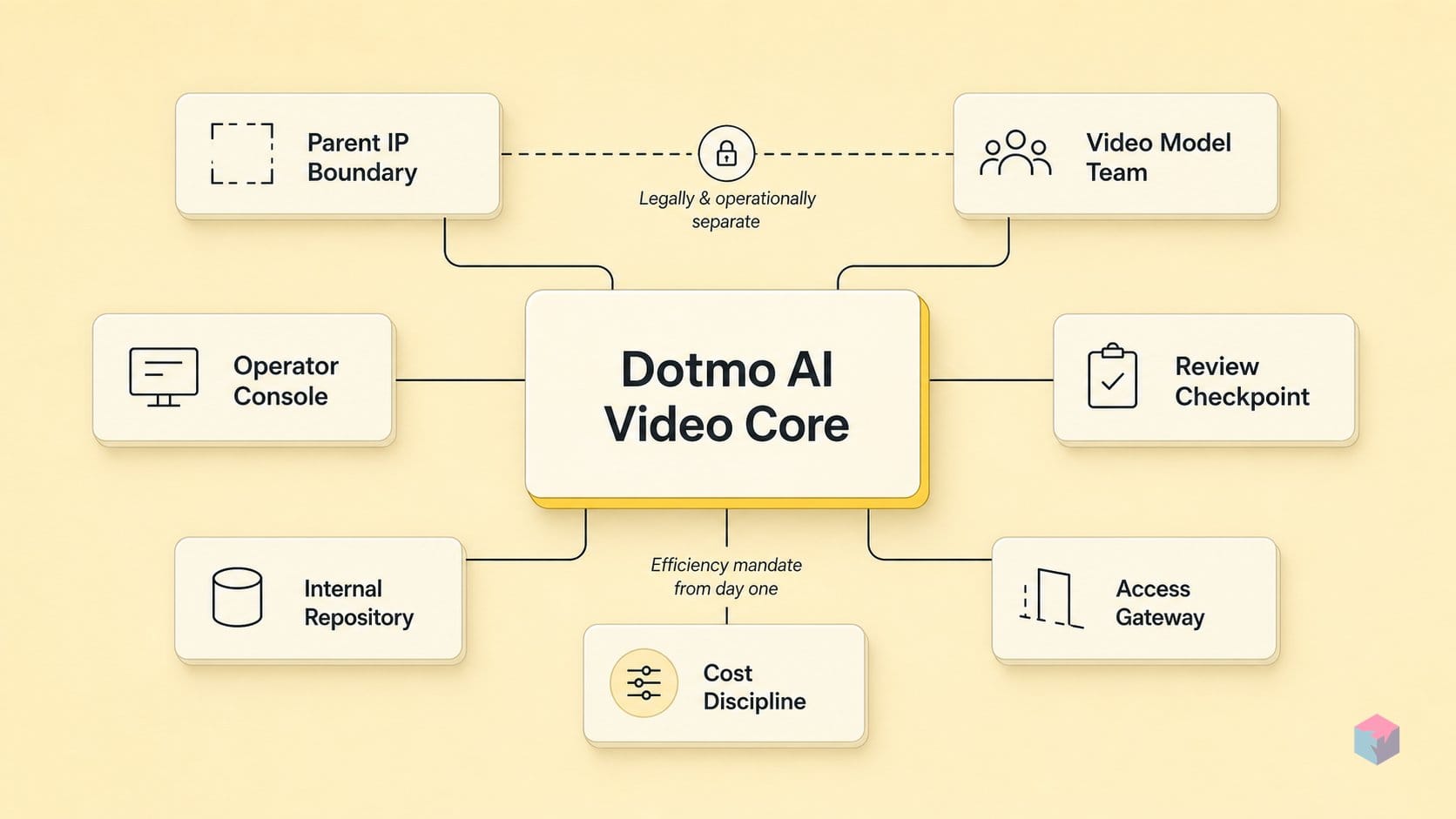
Dotmo, as reported by TechCrunch on June 18, 2026 , is a full carve-out, not an internal reorg. A group of current Snap staff would leave to launch Dotmo as a new, legally separate company, a more complete separation than Specs Inc., which Snap structured as a wholly owned subsidiary on January 28, 2026 .
The deal mechanics, as described, are an exchange of talent and technology for equity:
- License, not sale: Snap would grant Dotmo a license to adapt its generative AI video technology for gaming and interactive-entertainment platforms .
- Equity in return: In exchange for the transferred employees and that license, Snap would take a large equity stake, without directly funding the new firm .
- Lead investor: Bobby Murphy, Snap's co-founder and CTO, would be lead investor with a significant personal stake, reportedly staying at Snap full-time and continuing to lead its generative-AI R&D .
The stated focus is AI models that generate interactive gaming experiences and digital entertainment, distinct from Snap's core augmented-reality Lenses and camera business . The structure lets Snap keep financial upside through equity instead of absorbing ongoing research and infrastructure costs.
For builders, there is nothing actionable yet. As of June 19, 2026, no employee count, funding size, ownership split, product roadmap, model name, API, or pricing has been disclosed . On this account, Dotmo sits at the formation stage: an announced intent, not a shipping product.
The AI video tech that would anchor Dotmo
Whatever Dotmo becomes, the underlying capability is documented and partly independently verifiable. It traces to Snap Video, a Snap Research text-to-video project whose arXiv paper was submitted on February 22, 2024 with 11 authors, including Snap Inc. researchers . The model is video-first and transformer-based rather than U-Net, and the project page reports concrete efficiency gains alongside state-of-the-art benchmark and user-study results at publication .
Those numbers are the part a developer can scrutinize against the literature, not a vendor press line:
| Claim (Snap Video) | Reported figure | What it measures |
|---|---|---|
| Training speed | 3.31x faster than U-Net baselines | Throughput during training |
| Inference speed | ~4.5x faster | Generation latency at runtime |
| Scale | Billions of parameters | Model capacity ceiling |
| Quality | SOTA on benchmarks + user studies | Output fidelity vs. peers (at publication) |
The research left the lab. On March 12, 2025, Snap shipped AI Video Lenses on Snapchat Platinum (the first three being Raccoon, Fox, and Spring Flowers), explicitly powered by its in-house generative video model, with more promised weekly . That ships the technology past the paper stage into a consumer feature, which is why a standalone team built on it has plausible commercial value independent of the Dotmo claim itself.
The split that the report describes is one of application layer, not core technology. Snap's existing deployment targets augmented-reality Lenses inside the camera. Dotmo's stated focus is AI models that generate interactive gaming experiences and digital entertainment, a different product surface and go-to-market than Snap's AR business . That distinction is the cleanest argument for housing it in a separate commercial entity: same model lineage, different market, different cost and partnership structure. For now, no Dotmo-specific model name, API, or benchmark has been disclosed, so the verifiable tech remains Snap Video and the 2025 Lenses, not anything Dotmo has shipped.
Snap's cost pressure by the numbers
Snap entered 2026 spending more than it earns, which is the financial backdrop TechCrunch names as the reason for the Dotmo carve-out . The 2025 numbers are not a rumor: they come from Snap's own Form 10-K. That makes the cost environment primary-sourced even though Dotmo itself rests on a single press report.
| Metric (FY2025, per 10-K) | Value |
|---|---|
| Revenue | $5.9B |
| Total costs and expenses | $6.5B |
| Net loss | $460.5M |
| Cash, equivalents & marketable securities | $2.9B |
The response was headcount. In April 2026 Snap cut about 1,000 jobs (roughly 16% of full-time staff) and closed more than 300 open roles, per The Verge . CEO Evan Spiegel's staff memo framed the move as a faster, more efficient operating model and pointed to AI for reducing repetitive work and increasing velocity.
The financial framing is concrete:
- Severance: $95M to $130M expected, per AP, citing Snap's regulatory filing .
- Target savings: more than $500M in annualized cost-base reduction by the second half of 2026, per The Verge .
Read against that, a carve-out makes structural sense: moving a capital-intensive generative-video team off Snap's books while keeping equity upside is a cost lever, not a growth flex. The dollar figures and the layoffs are verifiable from filings and named outlets; only the Dotmo transaction sitting on top of them is not.
Bobby Murphy's dual role and what it raises

The structural detail worth flagging sits with one person. As reported, Snap co-founder and CTO Bobby Murphy would act as Dotmo's lead investor with a significant personal stake while staying at Snap full-time and continuing to lead Snap's generative-AI R&D, the same R&D that produces the video technology Dotmo would be licensed to adapt . He sits on both sides of the license.
No conflict-of-interest disclosure, board process, or shareholder approval has been reported alongside the spinout. That gap is partly mechanical: as of June 19, 2026 there is no Snap announcement, SEC filing, or Dotmo website to attach such disclosures to, so the governance picture is simply absent rather than confirmed clean .
Snap has run structural separations before, but more conservatively. On January 28, 2026 it created Specs Inc. as a wholly owned subsidiary inside Snap Inc., complete with a full newsroom announcement citing operational focus, partnership flexibility, and possible minority investment ahead of the consumer Specs launch .
"Specs Inc. is a distinct, wholly owned subsidiary created for operational focus, partnership flexibility, possible minority investment, distinct branding, and clearer valuation," per Snap Inc. (source: Snap Newsroom, 2026-01).
That precedent is the tell. Dotmo's reported shape goes further than Specs:
- Specs: wholly owned subsidiary, employees stay, full official announcement.
- Dotmo: departing employees, an outside lead investor, and only a single press report .
For builders, the practical consequence is the licensing perimeter. If Dotmo ever ships an API or SDK, Murphy's continued Snap role and the explicit gaming-and-interactive-entertainment scope of the license likely constrain which model weights and IP can travel into the new company, and which stay locked inside Snap's core AR business.
Why there is only one primary source on Dotmo
That perimeter is the part you can plan around. The carve-out itself, however, rests on a single press report. As of June 19, 2026, only TechCrunch's June 18 story names Dotmo, describes the equity-for-talent structure, and ties it to cost . Everything downstream traces back to it.
Independent checks against Snap Newsroom, SEC filings, and the major wires returned nothing corroborating. Specifically, there is:
- No Snap Newsroom post announcing Dotmo;
- No SEC filing or 8-K describing the carve-out or its terms;
- No live Dotmo website, product page, or corporate registration;
- No named-source report from Reuters, Bloomberg, The Information, or Business Insider .
The silence matters because Snap publishes structural moves when it makes them. On January 28, 2026, Snap put up an official Newsroom post the same day it created Specs Inc. as a wholly owned subsidiary . Dotmo, by contrast, has no first-party page at all. Subsequent outlets that picked up the story are derivative of TechCrunch, and the original carries no named sources and no transaction terms .
For technical readers, draw the line cleanly. The underlying capability is verifiable: the Snap Video text-to-video model, with its arXiv paper and benchmark claims, is documented . So is the cost backdrop: the roughly 1,000-role cut in April 2026 and the $500 million-plus targeted annualized reduction .
What is not verifiable is Dotmo itself: its existence, the equity split, the license value, and the employee count. Treat those as single-source until Snap confirms them in a statement or filing. The tech is real; the spinout, for now, is one report.
Frequently asked questions
What is Dotmo?
Dotmo is a planned standalone company that would be formed from departing Snap AI video staff, targeting AI-generated gaming and interactive entertainment under a license to Snap's video technology, per TechCrunch . As of June 19, 2026, no official Snap announcement, filing, or Dotmo website corroborates it; treat the entity as single-source.
What is Snap Video, and how does it relate to Dotmo?
Snap Video is a transformer-based text-to-video model from Snap Research, described in an arXiv paper submitted February 22, 2024 . It trains 3.31x faster than U-Net baselines and runs about 4.5x faster at inference . Snap shipped it live in Snapchat Platinum AI Video Lenses on March 12, 2025 . It is reportedly the technology Dotmo would license and adapt for gaming.
Why would Snap spin out its AI video team rather than keep it in-house?
Cost. Snap posted a $460.5 million net loss in 2025 , cut roughly 1,000 roles (about 16% of staff) in April 2026, and is targeting more than $500 million in annualized reductions by the second half of 2026 . Frontier video R&D carries heavy ongoing compute and talent cost; a carve-out keeps equity upside while moving that expense off Snap's P&L.
How is a Dotmo spinout different from what Snap did with Specs Inc.?
Structurally, the risk is different. Specs Inc., announced January 28, 2026, is a wholly owned Snap subsidiary; Snap keeps full ownership and made an official statement . Dotmo is reported as a fully external company with departing employees and an outside personal lead investor . One is an internal reorganization; the other is a complete separation.
Is there anything builders can use from Dotmo right now?
No. No API, SDK, pricing, availability date, model name, or benchmark has been disclosed. Dotmo is at the formation stage, and even that stage lacks primary confirmation from Snap as of June 19, 2026 . There is nothing to build against yet.