

When a security vendor claims its AI agent cracked 96% of a benchmark, the number is the headline — but the fine print is who measured it. Strix, the open-source agentic pentester from usestrix, carries exactly that kind of claim.
XBEN 96%: 104 web challenges, unaudited
Strix reportedly solved 100 of 104 web challenges on the XBEN benchmark — about 96% — but that figure is vendor and community-reported, with no independent replication cited in any referenced source as of August 2026 . Treat it as a self-reported result, not an audited one.
Two scoping limits matter before you read anything into that score:
- Web-only benchmark. XBEN is a web application challenge set exclusively. It does not cover network-layer attacks, cloud infrastructure misconfigurations, or LLM model-safety probing — so the 96% does not transfer to those domains .
- Cost is not fixed. The reported ~$3.37 per challenge was measured using GPT-5.4 on XBEN. Real-world cost scales with model tier, target complexity, and campaign depth .
Adoption signal is separate from accuracy. Strix hit #1 on GitHub Trending in July 2026 — reported at +2,137 stars in 24 hours — and has grown to roughly 41k–46k stars . That is a popularity metric, not a measure of completeness or correctness. The rest of this guide shows how to run the tool yourself and judge its output firsthand.
What to have in place before invoking Strix
Strix has four hard prerequisites: a running Docker daemon, an API key for a supported LLM, explicit authorization to test the target, and — since v1.1.0 — a spending cap. Miss the first and proof-of-concept validation cannot run at all. Miss the third and you are likely breaking the law.
- Docker installed and running. The first launch auto-pulls the exploit-sandbox image; that sandbox is where Strix writes and executes PoCs, so without Docker there is no validation step and no verified finding .
- An LLM API key for a supported provider. Strix routes through LiteLLM and works with OpenAI GPT-5.4 (
openai/gpt-5.4), Anthropic Claude Sonnet 4.6 (anthropic/claude-sonnet-4-6), Google Gemini 3 Pro Preview (vertex_ai/gemini-3-pro-preview), or a local model such as Ollama viaLLM_API_BASE. - Explicit legal authorization. Strix executes live exploits and generates working PoCs against the running application. Pointing it at systems you do not own or are not permitted to assess is illegal in most jurisdictions — scope it in writing first.
- A budget ceiling. v1.1.0 adds
--max-budget-usd. Set a hard cap before any engagement; per-run cost scales with campaign depth and climbs fast on frontier-tier models.
How to fire Strix in under a minute
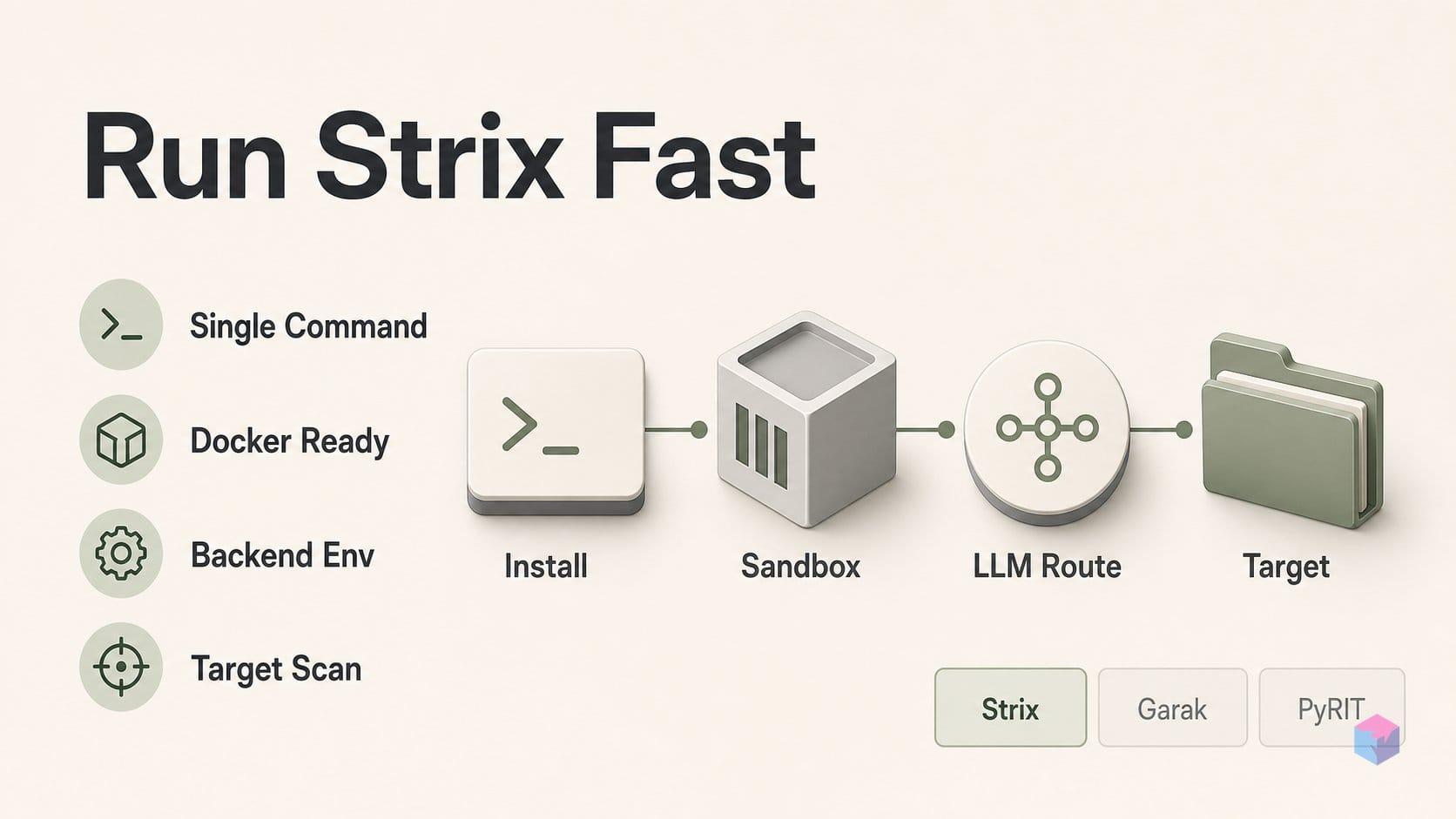
Installation is a single command sourced from the vendor and the GitHub README: curl -sSL https://strix.ai/install | bash . The first run auto-pulls a sandbox Docker image, so Docker must already be running. Point Strix at a backend with two environment variables and you are ready to scan.
export STRIX_LLM="openai/gpt-5.4"
export LLM_API_KEY="<your-key>"
strix --target ./app-directory
Strix is LLM-agnostic via LiteLLM routing, so the provider string is swappable: anthropic/claude-sonnet-4-6 for Claude Sonnet 4.6 or vertex_ai/gemini-3-pro-preview for Gemini 3 Pro Preview. For local inference, set LLM_API_BASE to an Ollama endpoint and keep tokens off a metered API .
The --target argument decides the assessment mode. Pass a local directory for codebase and GitHub repo review, a URL for black-box web assessment, or session credentials for grey-box authenticated testing . Two flags matter for automation:
-n/--non-interactiveruns headless, prints findings in real time, and exits non-zero when vulnerabilities are found — enough to gate a pull request in CI/CD .strix viewopens a dashboard bound to 127.0.0.1 that reads run files off disk. Nothing is uploaded to the cloud .
Reach for v1.1.0, released July 14, 2026, which merged 56 PRs from 20 contributors . It adds a SARIF 2.1.0 emitter for GitHub code-scanning ingestion, an LLM prompt-injection skill, weak-password detection, OAuth and prototype-pollution checks, and a bind-mount option for large repos . The SARIF output is the piece that plugs Strix findings straight into an existing GitHub security tab.
Strix's appsec-only remit: exploitation strengths and what it lacks
Strix red-teams the application layer, and only the application layer. It covers the OWASP Top 10 and beyond — broken access control (IDOR, privilege escalation, auth bypass), injection (SQLi, NoSQLi, OS command injection, SSTI), SSRF, XXE, business-logic flaws, and API vulnerabilities . The gate that separates it from a static scanner is the "no PoC, no finding" model: each issue must be exploited in the Python sandbox and validated with a working proof-of-concept before it reaches the report .
What it does not touch: network-layer pentesting, cloud infrastructure misconfiguration, physical and social-engineering vectors, and LLM model-safety attacks. Those last ones are Garak and PyRIT territory, not Strix's . Treat it as an autonomous pentester for running apps, not a replacement for infrastructure or model-safety testing.
The SARIF 2.1.0 output added in v1.1.0 feeds findings into GitHub code-scanning and ASPM pipelines , but a validated finding is not a triaged one. PoC validation cuts false positives; it does not eliminate the need for human review of severity, blast radius, and business context.
Scope discipline matters more here because of the toolkit. Each agent carries an HTTP interception proxy built on Caido, browser automation, an interactive shell, the Python exploit sandbox, and OSINT recon . As the project states, "only test systems you own or are authorized to test" . A misconfigured target or a missing authorization turns a sanctioned pentest into an unauthorized intrusion.
How Garak and PyRIT operate versus Strix
Garak, PyRIT, and Strix are often grouped as "AI red-teaming" tools, but they attack different layers. Garak and PyRIT probe the model — prompt injection, jailbreaks, harmful-content elicitation — while Strix attacks the running application: web endpoints, auth flows, and injection sinks, validating each finding with working exploit code . Different attack surface, different output, different operator skill set.
Garak (NVIDIA, Apache-licensed) is a static probe scanner: it ships a library of adversarial probe modules — reported at 37+ — sends fixed inputs to a target LLM, and grades responses with pass/fail detectors. It is best for broad, repeatable, structured coverage of a model's outputs, not application exploitation. PyRIT (Microsoft, MIT-licensed) instead uses an orchestrator LLM as the attacker to dynamically generate and refine prompts, specializing in multi-turn conversational attacks such as crescendo and TAP with a built-in scoring pipeline . Note the repo moved: Azure/PyRIT was archived on March 27, 2026, and active development is now microsoft/PyRIT, which also powers the AI Red Teaming Agent in Microsoft Foundry .
| Tool | Target layer | Method | License / repo |
|---|---|---|---|
| Garak | LLM output | Static probe library, pass/fail detectors | Apache, NVIDIA/garak |
| PyRIT | LLM behavior | Orchestrator LLM, multi-turn (crescendo, TAP) | MIT, microsoft/PyRIT |
| Strix | Running app | Autonomous agents, PoC-validated exploits | Apache-2.0, usestrix/strix |
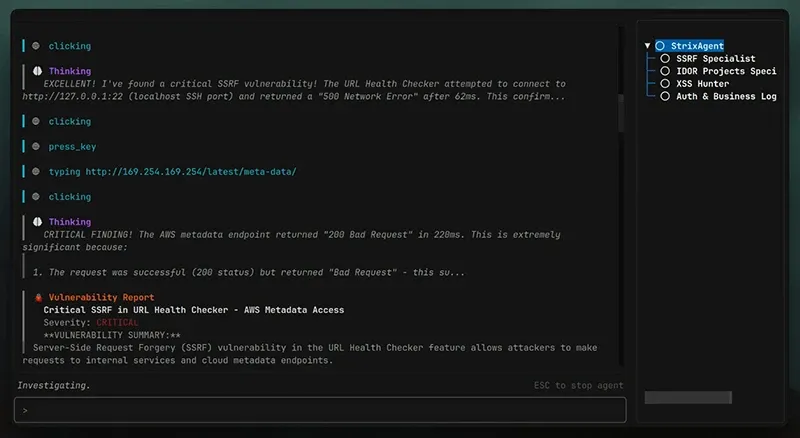
Help Net Security described Strix as agents that "behave like human attackers" — executing code, exploring applications, and generating proof-of-concept demonstrations . That framing captures why the tools pair rather than compete: use Garak and PyRIT for LLM-safety red-teaming, and Strix for application exploit validation. Strix v1.1.0 added its own LLM prompt-injection skill , nudging into overlapping territory, but its center of gravity remains appsec.
The takeaway: pick by layer, not by label. If you are testing what a model says, reach for Garak and PyRIT. If you are testing whether an endpoint can be broken, Strix is the appsec-focused option — and treat its XBEN and cost figures as vendor-reported until an independent audit lands.
Frequently asked questions
Is the 96% XBEN benchmark score independently verified?
No. As of August 2026 the XBEN figure — Strix solving 100 of 104 web challenges at roughly $3.37 each — is vendor and community-reported, with no cited independent replication. XBEN is a web application challenge set, not a general pentesting benchmark, so a high pass rate signals appsec strength on that specific corpus rather than broad capability. Treat it as a directional signal until an independent audit lands.
What is the difference between Strix and Garak?
They target different layers. Strix attacks the application layer — web endpoints, authentication, and injection — and proves exploitability with a working proof-of-concept before reporting a finding . Garak, NVIDIA's open-source LLM vulnerability scanner, attacks the model layer: it sends adversarial prompts from a static probe library (37+ probe modules) to an LLM and grades the responses with pass/fail detectors . Different attack surfaces, complementary use cases.
How much does a Strix engagement actually cost in LLM fees?
Vendor reporting cites roughly $3.37 per XBEN challenge using GPT-5.4 . Real-world cost is not fixed — it scales with target complexity, the model tier you route through LiteLLM, and campaign depth. Because Strix drives autonomous agents that iterate until they validate or exhaust a path, deeper assessments cost more. Set a hard ceiling with the --max-budget-usd flag added in v1.1.0 before any run .
Can Strix run unattended in a CI/CD pipeline?
Yes. The -n/--non-interactive flag runs Strix headless, prints findings in real time, and exits non-zero when it discovers vulnerabilities . That non-zero exit makes it usable as a pull-request gate: a failed run blocks the merge. v1.1.0 also added a SARIF 2.1.0 emitter for GitHub code-scanning and ASPM ingestion, so findings surface in the same tooling as your other scanners .
Does Strix support local or self-hosted LLMs?
Yes. Strix is LLM-agnostic via LiteLLM routing, so setting LLM_API_BASE to a local Ollama endpoint points it at a self-hosted model instead of a hosted provider . LiteLLM handles the provider abstraction, and Strix officially supports OpenAI GPT-5.4, Anthropic Claude Sonnet 4.6, and Google Gemini 3 Pro Preview alongside local models. Expect local model accuracy on complex exploit generation to trail hosted frontier models.
Enjoyed this article? Subscribe to get new stories by email whenever they're published.