
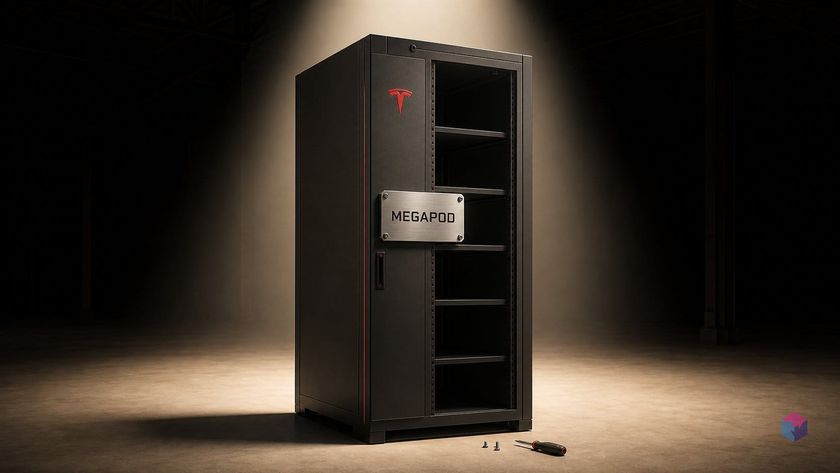
Tesla has a new name on file, but you can't buy what it points to. On June 18, 2026, the company filed a trademark for "Megapod," and a name is currently all it is.
Megapod: what Tesla's intent-to-use filing describes
Megapod is, for now, a reserved name and nothing more. Tesla filed a U.S. Patent and Trademark Office intent-to-use (ITU) application for the standard-character mark MEGAPOD, serial number 99893717, with a reported filing date of June 18, 2026, first surfaced by Electrek on June 21, 2026 . An ITU means Tesla is claiming a name for a product it has not launched. The filing itself is the news, not an unveiling.
Quick Answer: "Megapod" is a Tesla intent-to-use trademark (USPTO serial 99893717, filed June 18, 2026) for modular AI data-center hardware. An ITU reserves a name only. There is no product page, spec sheet, price, or ship date. Nothing about Megapod is buyable today.
The application describes "modular data center hardware systems for artificial intelligence computing": computer servers, AI data-processing hardware, networking equipment, power distribution units, and cooling systems, sold as a single integrated unit and bundled with "downloadable software to monitor, manage, and optimize" . In plain terms, it describes a turnkey, rack-scale compute building block, not individual chips or a battery.
What an ITU grants matters here. The filing confers no right to sell. To keep the mark, Tesla must later file proof of actual commercial use, typically within six months of approval (extendable), or the application lapses . So nothing in this document confirms specs, silicon, pricing, or a ship date.
Two things follow for developers tracking the AI-infrastructure stack:
- No procurement signal. There is no order page, datasheet, or customer deployment for any Tesla AI-compute module as of June 22, 2026 .
- A forward-looking marker. The story rests on one primary document plus press interpretation. Treat Megapod as intent, not inventory.
The rack segment Tesla would enter: GB200 NVL72, Dell, and Supermicro
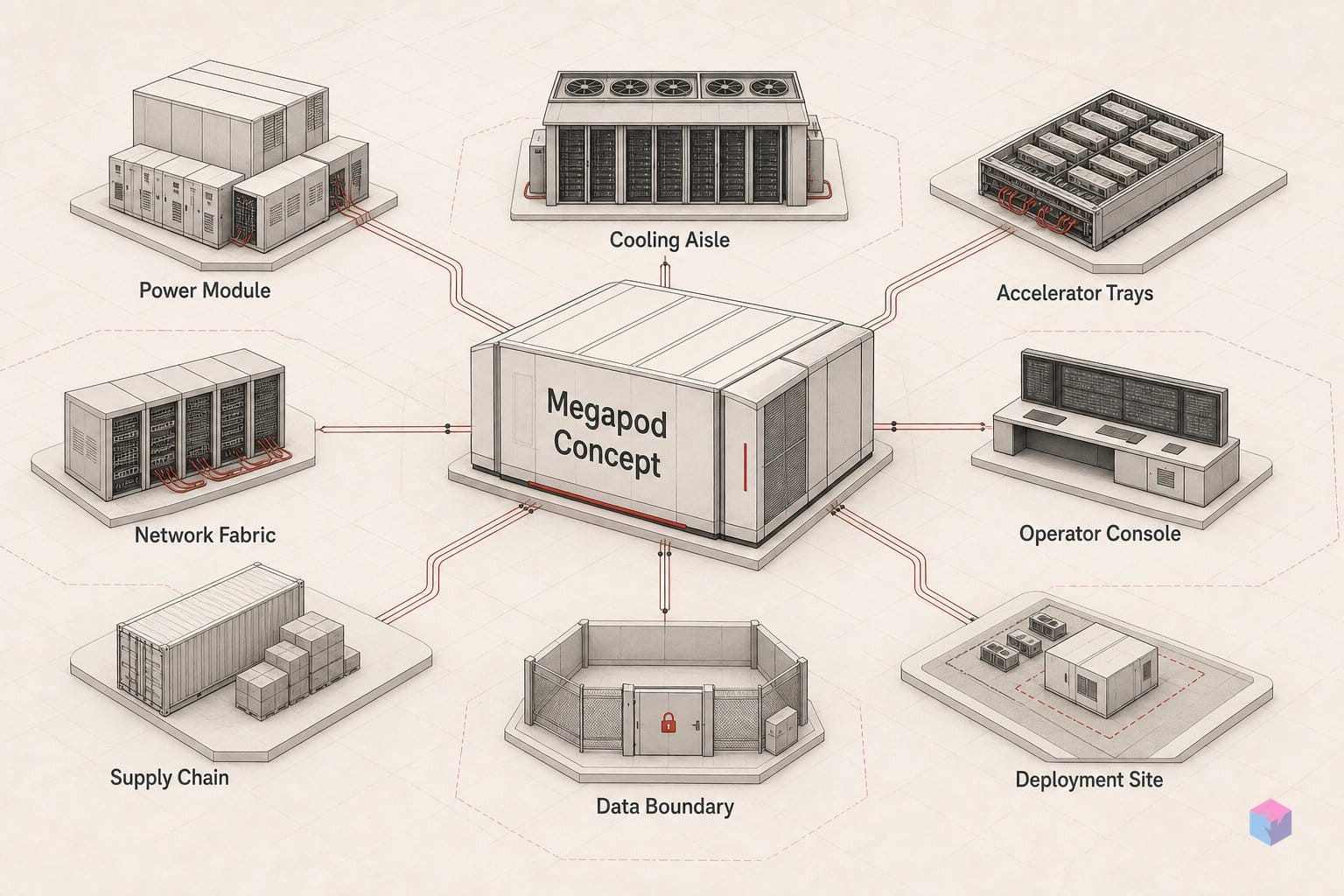
If Megapod ships as the filing describes (servers, networking, power, cooling, and management software sold as one integrated unit), it lands in the rack-scale AI segment that Nvidia currently defines. The reference design for "buy a rack, not a chip" is the liquid-cooled GB200 NVL72, which packs 72 Blackwell GPUs and 36 Grace CPUs into a single integrated system .
Tesla would not be alone against Nvidia. Dell's PowerEdge XE9712 and Supermicro's GB200 SuperCluster sit in the same integrator tier: vendors that bundle Nvidia silicon into turnkey, deployable racks rather than selling loose components . That is the competitive set a Tesla compute rack would join, assuming it carries third-party GPUs.
The name itself is already crowded. Submer already holds a registered "MegaPod" mark for an immersion-cooled product cited at roughly 800 kW and a 1.03 PUE . AMD's reported MI500 "MegaPod" is a tentative 2027 rack-scale system: 256 Instinct MI500 GPU packages across 64 EPYC Verano CPUs, linked over three racks .
Neither is Tesla. Tesla filed in a computer-hardware class specifically to sidestep a direct conflict with the existing marks . When three separate companies reach for the same "Pod" naming in one segment, it tells you how saturated integrated AI infrastructure already is before Tesla has shipped anything.
Here is the practical difference for anyone tracking procurement: three products share a namespace, but only two can be bought today.
| Product | Status | Configuration | Procurable now? |
|---|---|---|---|
| Tesla Megapod | Intent-to-use filing (Jun 2026) | Unspecified; "modular data center hardware" bundle | No |
| Nvidia GB200 NVL72 | Shipping | 72 Blackwell GPUs + 36 Grace CPUs, liquid-cooled | Yes |
| Submer MegaPod | Registered, shipping | Immersion-cooled, ~800 kW, 1.03 PUE | Yes |
| AMD MI500 MegaPod | Reported, targeted 2027 | 256 Instinct MI500 GPUs, 64 EPYC Verano CPUs, three racks | No |
Megapod's eventual rivals already define what an integrated AI rack looks like and what it costs to operate. Tesla's filing claims a slot in that lineup without yet disclosing the silicon, density, or thermal approach that would let a buyer compare it against a GB200 NVL72.
Megapack and Megablock: what Tesla already sells
Where Tesla can ship today is power, not compute. The Megapack 3 is a commercial, utility-scale battery you can order now: per-unit specs of 1,927 kW / 3,854 kWh in a 2-hour configuration at 92.0% round-trip efficiency, 480V AC three-phase interconnection, with UL/IEC certifications and a $10,000 non-refundable reservation deposit on the configurator . That is the contrast Megapod throws into relief: a real order page versus a name on a form.
In 2025 Tesla layered Megablock on top: a pre-engineered, medium-voltage product that integrates four Megapack 3 units into a single plug-and-play block. Tesla claims 23% faster installation and up to 40% lower construction cost versus the prior generation, plus a simplified thermal bay with 78% fewer connections . Its Q1 2026 deck says a Houston-area Megafactory will build Megapack 3 for Megablock, with start of production on track for later in 2026 .
The AI angle is explicit. Tesla's Q1 2026 10-Q ties energy-storage demand to AI-driven load growth: grid stabilization, energy shifting, and added power capacity . A November 2025 report says Tesla pitched Megapack to smooth GPU-cluster load swings of up to 90% at frequencies up to 30 Hz, claiming up to 90% reduction in AI-induced oscillations and a $50B/GW lifetime value over 20 years for a 2-hour system .
Treat those last numbers with caution. They are Tesla marketing figures relayed by third parties; the measurement methodology, sizing, topology, and demand-charge economics were never disclosed . What is verifiable, and what is a claim, splits cleanly:
- Verifiable today: orderable Megapack 3 specs, the $10k deposit, and UL/IEC certification on the live configurator.
- Vendor claim: the 23% / 40% Megablock install and cost figures.
- Unverified marketing: the 90% oscillation-damping and $50B/GW lifetime-value numbers, with no published methodology.
The throughline for builders: Tesla's demonstrated credibility sits in power stabilization adjacent to AI workloads, not in compute silicon. As The Verge framed the 2025 launch, "Megablock is Tesla's bet that the data-center bottleneck is power, not chips," reported by The Verge. That is the lens to carry into Megapod: a company strong on integrated power and cooling claiming a slot in a rack market defined by GPUs it does not yet make.
Tesla's AI5 chip, Cortex, and the $2B acquisition: kept proprietary
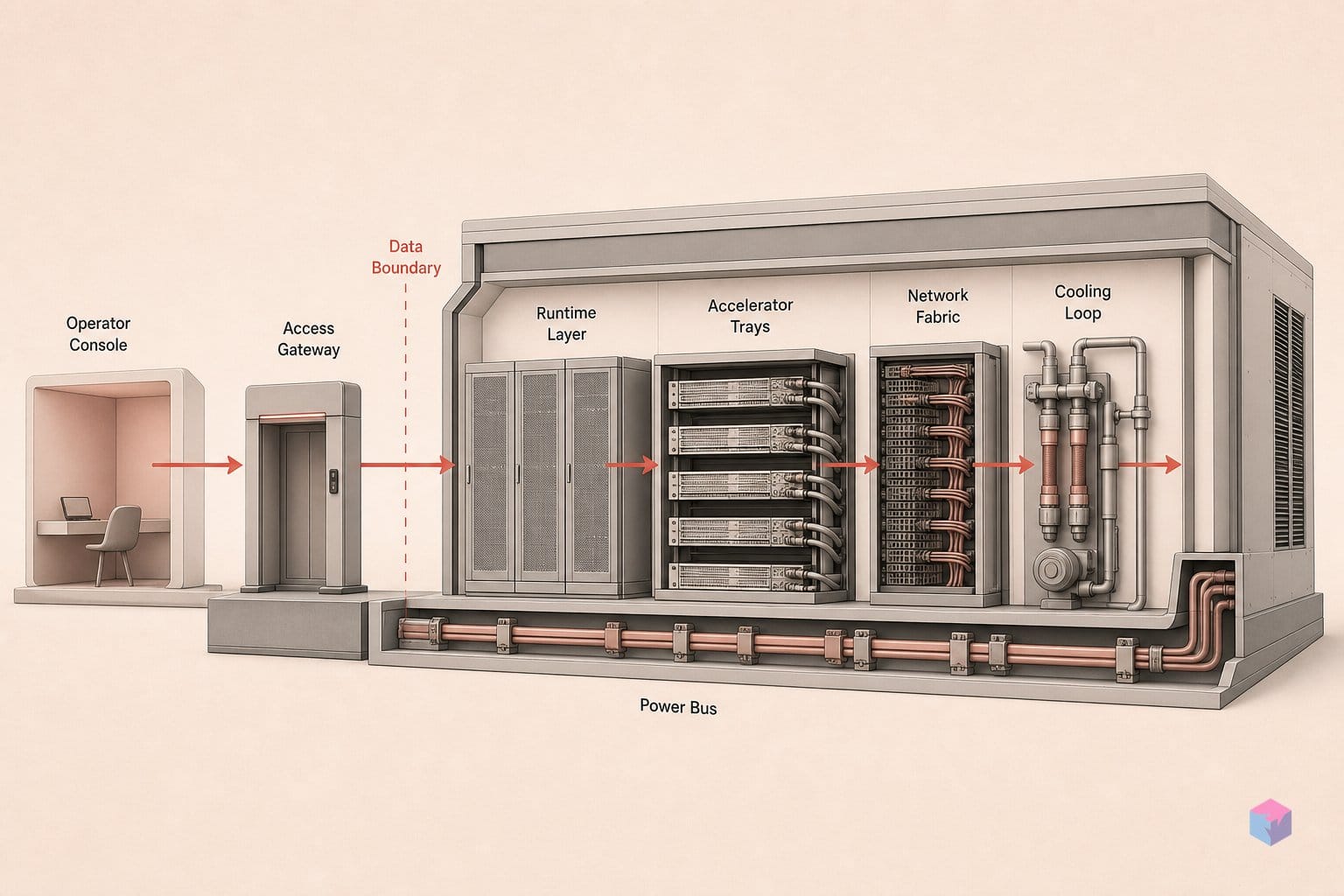
Tesla's most advanced AI hardware is built to be consumed internally, not sold. The Q1 2026 shareholder deck details large training clusters, a finished inference chip, and a new fab, but none of these disclosures describe a branded compute rack offered to third-party buyers. That gap matters: it means Megapod's underlying silicon is still an open question, because the chips Tesla controls are pointed at its own workloads.
The two clusters are sizable. Cortex 1 in Texas runs more than 100,000 H100-equivalent GPUs in production, and Cortex 2 holds more than 130,000 H100-equivalent GPUs in early ramp, already executing training workloads . Both are infrastructure Tesla operates, not products on an order page.
On custom silicon, Tesla says it completed the final chip design of its next-generation AI5 inference processor in April 2026, and is standing up a Tesla-owned Research Fab at Gigafactory Texas through a SpaceX partnership . The stated goal is vertical integration alongside continued Dojo 3 work, owning the stack rather than licensing it.
Tesla's Q1 2026 update frames its roadmap (AI5, Dojo 3, and the Research Fab) as vertical integration of "logic, memory, and advanced packaging," with no mention of selling these systems to outside customers (source: Tesla Q1 2026 Update).
The spending follows the same inward logic. Tesla disclosed in April 2026 an agreement to acquire an unnamed AI hardware company for up to $2.00 billion, with roughly $1.8 billion contingent on milestones or service conditions; the target and intended use were not named . Capital expenditure for 2026 is expected to exceed $25 billion, driven partly by AI compute infrastructure and data centers .
Here is what the official record does and does not say:
- Confirmed, internal: Cortex 1 and Cortex 2 clusters, the AI5 design, the SpaceX-linked Research Fab, and Dojo 3, all described as Tesla's own compute.
- Confirmed, undisclosed: a sub-$2B AI hardware acquisition whose target and product role Tesla did not reveal.
- Absent: any statement (in the Q1 10-Q, the Q1 deck, or the earnings call) about selling Cortex, Dojo 3, AI5 systems, or a branded AI compute rack to outside customers.
So the picture is consistent: Tesla is pouring capital into AI compute it keeps for itself. Megapod's trademark sits next to a silicon program with no external sales channel on record, which is exactly why the question of what powers a Megapod (Tesla's own AI5 or third-party GPUs) remains unanswered.
Musk's Supercharger AI vision: where Megapod might fit
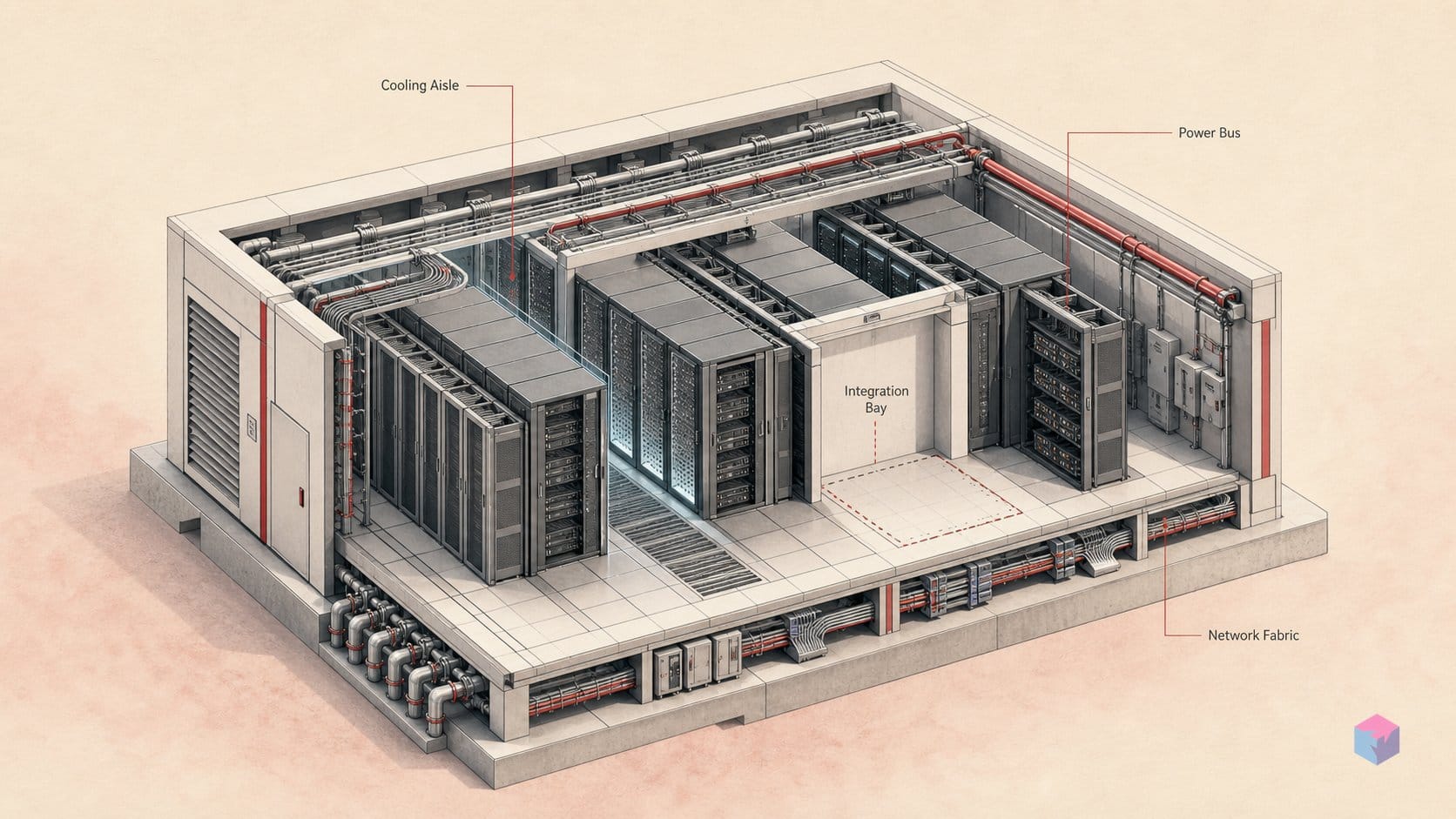
The trademark also lands against a wider Tesla pitch for distributed AI compute, which is why deployment context matters more than the name. In March 2026, Musk described turning Tesla's Supercharger network (roughly 7 GW of available power) into a large distributed AI platform, running "millions of dedicated Digital Optimus units" on AI4 inference hardware in parked or charging vehicles and at Supercharger sites . That vision describes idle inference capacity, not a physical rack for sale.
Some coverage frames an opt-in model in which vehicle owners earn roughly $100-$200/month for contributing compute . Treat those numbers with care: they are analyst and secondary speculation, not figures Tesla has disclosed. No official Tesla source confirms the dollar range, the opt-in mechanics, or a timeline. It is third-party commentary on a stated direction, not committed product behavior.
So where would a Megapod sit? The USPTO application gives no clue on deployment context. It describes modular AI data-center hardware as an integrated unit, with no mention of vehicles, Superchargers, or edge siting. That leaves at least three readings open:
- A standalone enterprise rack: a turnkey compute building block sold to outside data-center operators, competing with the integrated systems covered earlier.
- A Supercharger-integrated edge node: hardware co-located with the ~7 GW network to host the distributed inference Musk floated.
- Something else entirely: power, cooling, and integration wrapped around third-party GPUs, closer to Tesla's proven Megapack/Megablock strengths than to compute silicon.
The filing supports none of these over the others. Linking Megapod to the Supercharger vision is inference, not disclosure, and builders should weigh it that way .
From trademark to buyable: what no one knows about Megapod
The gap between a trademark and a purchase order is large, and Megapod sits entirely on the trademark side. As of June 22, 2026, there is no configurator, no order page, no published pricing, no named sales channel, and no disclosed customer pilot or reference deployment. Everything below is an open question, and the answers determine whether Megapod is ever a procurement option.
The biggest unknown is the silicon. The intent-to-use application (serial 99893717, filed June 18, 2026) names no chip. Tesla's deployed clusters run Nvidia today: Cortex 1 exceeds 100,000 H100-equivalent GPUs. But Tesla also finished its AI5 inference design in April 2026. So Megapod could ship on:
- Nvidia GPUs: consistent with Cortex, fastest to market.
- Tesla AI5/AI6: vertical integration, but unproven at rack scale.
- A third-party ASIC or a mix: the filing rules out nothing.
Scope is the second fault line. A full-stack AI rack bundling compute, power, and cooling is a different business (different margins, different competitors) than power-and-cooling integration wrapped around someone else's GPUs. The latter maps cleanly onto Tesla's proven Megapack and Megablock strengths; the former pits it against integrated systems it has never shipped.
The practical move for tracking this is documentary rather than speculative. Tesla disclosed an April 2026 agreement to acquire an unnamed AI hardware company for up to $2.00 billion. If that target is the architecture behind Megapod, the structure may surface at close. Watch SEC Form 8-K filings rather than press coverage .
In short: Megapod is a name, not a node. Treat it as a forward signal worth monitoring, not a line item you can spec, price, or buy. Let an 8-K, not a headline, tell you when that changes .
Frequently asked questions
Is Tesla's Megapod available to order now?
No. As of June 2026, Megapod exists only as a U.S. Patent and Trademark Office intent-to-use application (serial 99893717, filed June 18, 2026) . There is no order page, configurator, price, or ship date. An ITU mark grants no right to sell. Tesla must later prove actual commercial use or the mark lapses.
What does the Megapod trademark claim it will cover?
The filing describes "modular data center hardware systems for artificial intelligence computing": computer servers, AI data-processing hardware, networking equipment, power distribution units, and cooling systems, sold as a single integrated unit, plus "downloadable software to monitor, manage, and optimize" . These are filed intentions for a turnkey rack-scale compute block, not confirmed specifications, benchmarks, or a shipping configuration.
How does Megapod compare to the Nvidia GB200 NVL72?
It is premature to compare. The GB200 NVL72 is a shipping product with published specs: 72 Blackwell GPUs and 36 Grace CPUs, liquid-cooled . Megapod is a trademark with no disclosed silicon source, rack topology, or pricing. The filing places it in the same intended category as Nvidia, Dell, and Supermicro systems, not the same verified performance tier.
What is the difference between Megapack and Megapod?
Megapack is Tesla's commercially deployed grid-scale battery, orderable today via a configurator with a $10,000 non-refundable reservation deposit, published per-unit specs (1,927 kW / 3,854 kWh in the 2-hour configuration), and UL/IEC certifications . Megapod is only a trademarked name for a potential AI compute rack, a different product category. Currently only Megapack exists as a buyable product.
Does the Megapod filing tell us anything about Tesla's chip strategy?
No. The filing is silent on silicon. Tesla completed the final chip design of its AI5 inference processor in April 2026 and continues custom work on Dojo 3 for internal use, and it disclosed an agreement to acquire an unnamed AI hardware company for up to $2.00 billion in April 2026 . None of these is officially linked to Megapod in any public document.