

On June 2, 2026, the White House published an AI security order that everyone calls "mandatory" and almost no one quotes accurately. The fine print does the opposite of what the headlines imply.
What Does EO 14409 Actually Demand?
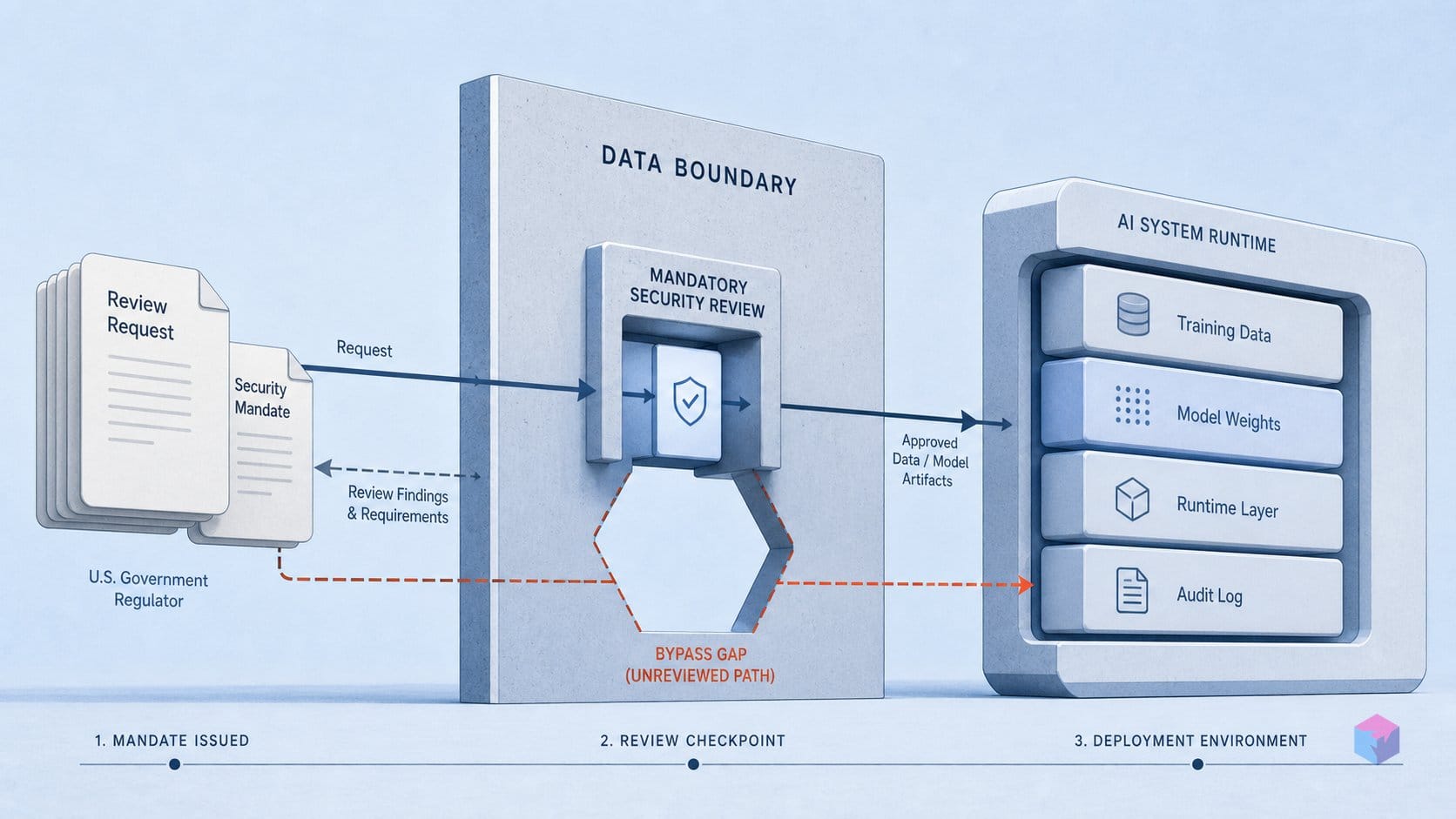
EO 14409 — signed June 2, 2026 and titled "Promoting Advanced Artificial Intelligence Innovation and Security" — grants the federal government up to 30 days of pre-release access to "covered frontier models" for cybersecurity and national-security testing . Participation is explicitly opt-in. The signed text bars any mandatory licensing or preclearance, so the working mechanism is voluntary pressure, not legal compulsion .
Quick Answer: EO 14409 lets developers give the U.S. government a window of up to 30 days to test "covered frontier models" before release. It is voluntary: the order's text bars any "mandatory governmental licensing, preclearance, or permitting requirement" for new AI models. No enforcement penalty is attached.
That anti-preclearance clause is the most-cited and least-quoted line in the coverage. Verbatim, the order states that "nothing in this section shall be construed to authorize the creation of a mandatory governmental licensing, preclearance, or permitting requirement for the development, publication, release, or distribution of new AI models," and the caveat explicitly extends to frontier models . Reporting indicates the administration earlier weighed harder, mandatory language and a longer review window before settling on 30 days, narrowing the order after industry pushback .
The order stands up a broad interagency stack with no enforcement mechanism attached. The NSA Director develops a classified benchmarking process to designate which models count as "covered frontier"; Treasury leads an "AI cybersecurity clearinghouse" for government–industry vulnerability discovery; and CISA, OMB, Commerce/NIST, and Defense are named participants . So the judgment of who is "frontier" is government-directed, even though signing up is not.
| What EO 14409 does | What it does not do |
|---|---|
| Opens a voluntary pre-release access window | Impose mandatory preclearance or review |
| Caps inspection at up to 30 days before release | Grant any licensing or permitting authority |
| Builds an NSA-run classified designation pipeline | Attach a penalty for declining to participate |
Signatories vs. Holdouts: Who Has Agreed to Advance Inspection
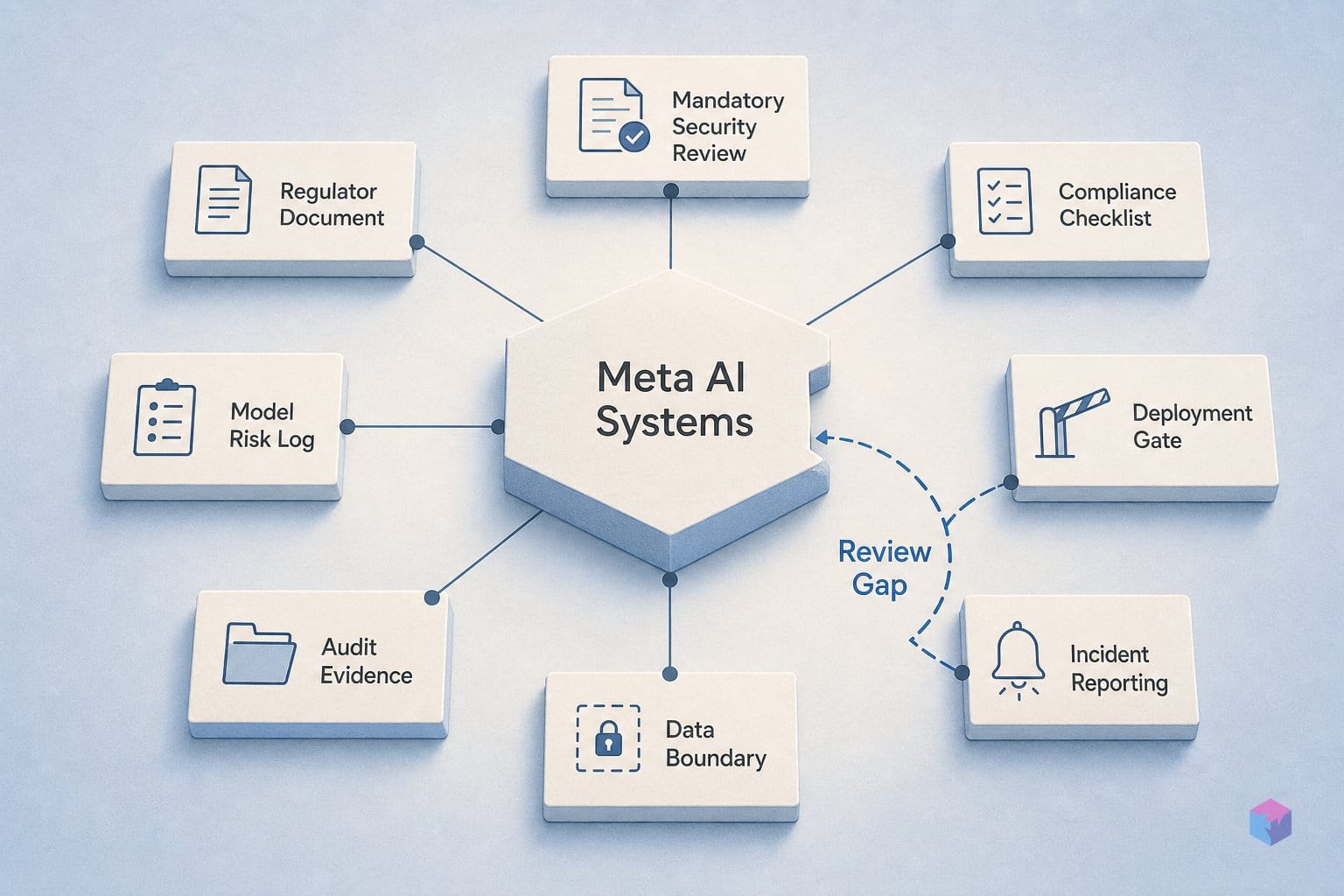
Every major U.S. frontier developer except Meta has agreed to give the government early access for national-security evaluation. OpenAI and Anthropic were already cooperating on testing of unreleased systems before the order was signed, so for those two the EO largely codified an existing informal arrangement . The signing turned a handshake into a named federal process rather than creating the cooperation from scratch.
By May 2026, the roster widened. Google (DeepMind), Microsoft, and xAI agreed to grant the government early access for national-security review . AP identifies Anthropic, OpenAI, and Google as the core group invited into review, with the others joining the same voluntary track .
Meta is the lone major U.S. developer not yet in agreement. The company has signaled openness — "We share the administration's goal of advancing U.S. leadership on robust and secure frontier AI" — and says it is "working through the details" toward a deal . As of June 24, 2026, nothing is finalized, which is why coverage frames the story as Washington pressing Meta specifically .
The pattern is the part worth flagging for anyone building on these models. Every signatory ships frontier capability behind an API — OpenAI, Anthropic, Google, Microsoft, and xAI all retain the gate. The one holdout is the one developer whose flagship line, Llama, ships as downloadable open weights. That asymmetry is not coincidence: an advance-inspection window is straightforward to honor when you control the deployment endpoint, and structurally awkward when the artifact under review is a file anyone can mirror.
Llama's Downloadable-First Strategy Complicates Advance Security Vetting
The structural awkwardness becomes concrete when you look at the product line under review. Meta released Llama 4 Scout and Maverick with downloadable open weights on April 5, 2025 — Scout a 17B-active-parameter, 16-expert multimodal model with a claimed 10M-token context window, and Maverick a 17B-active-parameter, 128-expert, 400B-total-parameter model — while previewing Llama 4 Behemoth, a 288B-active-parameter teacher model with nearly 2T total parameters still in training . For an API-only developer, a 30-day pre-release hold is operationally clean: the developer owns the deployment endpoint and can simply not flip the switch until review concludes. An open-weight release has no equivalent gate.
Once weights are published, downstream propagation starts immediately and cannot be recalled. Llama-family models are mirrored through redistribution catalogs such as Azure AI Foundry (video: Microsoft Mechanics), pulled into Hugging Face, and run on local inference hardware within hours of release. There is no central kill switch, no staged rollout to pause, and no way to claw back a file that thousands of operators have already cached . A 30-day inspection window assumes the artifact under review stays in the developer's custody until the government signs off — an assumption that holds for a closed API and breaks for a downloadable tarball.
The inspection model also has a capability-coverage problem that open weights sharpen. The Council on Foreign Relations describes frontier systems as "probabilistic, goal-directed, increasingly autonomous, and opaque," with emergent behaviors that resist advance testing — meaning a fixed pre-release window may miss capabilities that only surface post-deployment, at scale, and under adversarial probing . For an API model, a developer can patch or restrict access when those behaviors emerge in the wild. For an open-weight model, the version that passed inspection and the version fine-tuned into something else by a downstream operator are the same base file, redistributed beyond any reviewer's reach.
This is why Meta's negotiation is running longer than its peers', and it is worth being precise about the reason: it is structural, not legal defiance. Committing to a 30-day hold on a closed API is a scheduling concession. Committing to one on an open-weight release means accepting that the security guarantee a reviewer wants — that capabilities are vetted before they propagate — is weaker by construction the moment the weights ship. Agreeing to the same words means agreeing to a materially different thing, which is the real friction in Meta's still-pending accession as of June 2026 .
CyberSecEval and GOAT: What Preparedness Evidence Llama Already Discloses
Meta already publishes the evaluation evidence a federal reviewer would ask for, which is what makes the standoff more about process than data. Llama 4's safeguard stack includes Llama Guard, Prompt Guard, CyberSecEval, adversarial probing, and Generative Offensive Agent Testing (GOAT), an offensive red-teaming method that simulates multi-turn attacks against the model . That overlaps substantially with what a "covered frontier model" benchmark would demand — cyber capability scoring, prompt-injection resistance, and agentic exploitation testing — so the disagreement is less about whether Meta measures risk and more about who gets to see the results and when.
The clearest worked example is Meta's Code World Model (CWM) preparedness report from May 2026, which evaluated a 32B-parameter open-weight, open-code model before release under Meta's Frontier AI Framework . Meta benchmarked CWM against Qwen3-Coder-480B-A35B-Instruct, Llama 4 Maverick, and gpt-oss-120b, and concluded the model sat within a "moderate" risk threshold whose open release was "unlikely to meaningfully increase cyber or chemical/biological risk beyond the existing open ecosystem" . The concrete numbers are the point: they are specific, attributable, and reproducible from the published report rather than asserted.
| Evaluation | Result (CWM, 32B) | Reference / notes |
|---|---|---|
| WMDP-cyber accuracy | 63.6% (±2.2) | vs. Llama 4 Maverick 70.5% (±2.0) |
| Cybench pass@10 | 25.0% | 10 of 40 CTF challenges solved |
| Hack the Box machines | 0 of 10 fully compromised | across all tested models |
| Native-code exploitation | 1 of 12 tasks succeeded | autonomous exploit generation |
Read together, the figures describe a model with real but bounded offensive capability . CWM scored below Llama 4 Maverick on the WMDP-cyber knowledge benchmark, cleared a quarter of Cybench's capture-the-flag set, fully compromised none of the ten Hack the Box targets, and completed a single native-code exploitation task out of twelve. None of those numbers signals a step-change in attacker capability, which is exactly the conclusion Meta's framework reaches.
For developers tracking the policy fight, the takeaway is that the disclosure gap is narrow. Meta is not refusing to evaluate frontier risk; it is running a documented preparedness process and publishing the thresholds. What government vetting adds is a classified benchmark and a pre-release window the open-weight model collapses the moment it ships. The CWM report is a preview of the evidence Meta would bring to any review — and of why Meta argues its existing stack already covers most of the ground a reviewer would walk.
NSA's Classifier Role: Who Gets Designated as 'Covered' and How
The designation of a "covered frontier model" is a government call, not a vendor's self-declaration. Under EO 14409, the NSA Director — in consultation with the National Cyber Director — is tasked to develop and maintain a classified benchmarking process that assesses a model's advanced cyber capabilities and decides which systems qualify for review . Treasury, NSA, and CISA jointly build those benchmarks, and a Treasury-led "AI cybersecurity clearinghouse" coordinates government–industry vulnerability discovery .
This is where the "voluntary" framing gets thin. Participation in testing is optional, but the judgment of who counts as frontier is government-directed . A developer may not know it has crossed the threshold until the government says so — a disclosure asymmetry voluntariness does not resolve. You can decline to share a model, but you cannot opt out of being designated.
Because the benchmark is classified, a developer cannot audit the criteria or contest its status in public. For release planning that is a real operational unknown: a team cannot model whether its next checkpoint trips a line it is not allowed to see. The opacity compounds a problem analysts already flag in the systems themselves. Frontier models are "probabilistic, goal-directed, increasingly autonomous, and opaque," with emergent behaviors that resist pre-release testing, the Council on Foreign Relations notes . Now both the model and the ruler measuring it are hard to inspect.
The strategic point for developers: even without mandatory inspection today, the designation pipeline is regulatory infrastructure. The EO laid the plumbing — a classified benchmark, named agencies, a clearinghouse — that is architecturally ready to become binding the moment Congress converts the voluntary framework into law . Whether the classified process can evolve at the pace the technology demands is the open question, especially with a federal cybersecurity workforce CFR says was "cut substantially over the past year and a half" .
Pentagon Procurement and the Informal Pressure on Holdouts

The leverage over holdouts is not written into EO 14409 — it lives in procurement and access controls the government already uses. The clearest precedent is Anthropic: in February 2026 the administration designated it a "supply-chain risk" and reportedly ordered it to suspend foreign nationals' access to advanced models . That action established the operative principle: Washington will restrict who may touch a frontier system on national-security grounds, by nationality if needed, independent of any voluntary review pledge .
The flip side is revenue. Frontier AI is now embedded in defense procurement: Palantir's Maven Smart System, powered by Anthropic's Claude, was credited with compressing military targeting cycles "from days to minutes," and the administration is seeking roughly $30 billion for AI military infrastructure . A contract pipeline that large creates an informal incentive structure no executive order needs to spell out. A developer that cooperates on security review is a more comfortable counterparty for a buyer that is also a national-security customer; a holdout is not excluded by statute, but it is harder to read as aligned.
That makes the unstated consequences for a holdout like Meta worth naming precisely. Public sources do not confirm that refusal triggers procurement exclusion or an export-control designation. But the Anthropic episode shows both tools are live, and the nationality-restriction precedent is set . The pressure is informal by design — it preserves the voluntary framing while raising the cost of staying outside it.
The harder escalation is legislative. Both CFR and Roll Call flag a realistic path in which the voluntary framework is converted into binding statute . If that happens, the current opt-in positions of OpenAI, Anthropic, Google, Microsoft, and xAI stop being concessions and become the legal baseline — and a developer that never signed would be starting its compliance from behind.
The Allies' Cyber Alert: Why a Months-Not-Years Timeline Raises Stakes
The reason policymakers treat even a short advance look as valuable is timing. In June 2026, the Five Eyes agencies — the U.S., U.K., Canada, Australia, and New Zealand — warned that frontier AI could transform offensive and defensive cyber capabilities on a timeline of "months, not years," lowering the barrier for attackers and compressing discovery-to-exploitation cycles (video: Cybernews). That assessment is the direct justification for the EO's 30-day window : if the threat scales on 2026-time rather than 2030-time, a brief pre-release look at a covered model is worth the friction it creates.
The operational stakes are not hypothetical. The Council on Foreign Relations notes the Pentagon already runs frontier AI in production — Palantir's Maven system, using Anthropic's Claude, was credited with compressing targeting cycles "from days to minutes" — while the administration seeks roughly $30 billion for AI military infrastructure . When the same capability curve serves defenders and adversaries, officials read "months" as a reason to inspect earlier, not later.
There is a credibility gap on the government side, though. The federal cybersecurity workforce tasked with this evaluation was, in CFR's words, "cut substantially over the past year and a half."
"Cut substantially over the past year and a half," — Matthew Ferren, on the federal cybersecurity workforce (source: CFR).
That capacity lag is a real constraint on how fast a classified benchmarking pipeline can actually keep pace with the models it judges.
The concrete takeaway for practitioners: if you build on or integrate frontier systems — Claude via Bedrock, GPT-4o, or Llama via Azure AI Foundry — assume the trajectory bends toward stricter vetting, whether through escalating voluntary pressure or explicit legislation. As of June 24, 2026 the mechanism is still voluntary and Meta's accession is pending , but the gap between designated and non-designated models narrows from here. Plan procurement, redistribution, and release timelines on the assumption that "covered" status is a question of when, not if.
Frequently asked questions
Is Trump's AI executive order actually mandatory?
No. The executive order signed on June 2, 2026 explicitly disclaims any authority to create a mandatory governmental licensing, preclearance, or permitting requirement for the development, publication, release, or distribution of new AI models — a caveat that extends to frontier models . The "mandatory" framing came from earlier draft language that the administration weighed but dropped. Reporting indicates Trump delayed an initial signing around May 21, 2026 over concerns that hard requirements could impede U.S. leadership against China, and industry pressure narrowed the order before signing . The final framework is opt-in.
Why hasn't Meta agreed to the pre-release security review?
Meta has not formally refused. It says it shares the administration's goal and is "working through the details" toward an agreement, with no deal finalized as of late June 2026 . The structural complication is Llama's open-weight format. Meta released Llama 4 Scout and Maverick with downloadable weights on April 5, 2025 , and once weights are downloadable a 30-day hold cannot prevent downstream propagation through catalogs such as Azure AI Foundry or local inference. Agreeing to hold an open-weight release is operationally different from delaying an API launch, where post-hoc controls remain stronger.
What is a "covered frontier model" under the executive order?
A "covered frontier model" is an advanced AI system that the government designates through a classified benchmarking process — not a self-certification by the developer. The order tasks the NSA Director, in consultation with the National Cyber Director and others, to build and maintain that process, with benchmarks developed jointly by Treasury, NSA, and CISA . The criteria are not public, so a developer may not know a model qualifies until the government says so — a disclosure asymmetry that persists even though participation is voluntary.
Which AI developers have agreed to pre-release government security inspection?
Anthropic and OpenAI were already cooperating on testing of unreleased models before the order was signed, and Google (DeepMind), Microsoft, and xAI agreed in May 2026 to give the government early access for national-security review . Meta is the notable holdout as of June 24, 2026 . Every current signatory deploys primarily via API; no open-weight developer has yet agreed, which is what makes Meta's case structurally distinct rather than simply slower.
Could future legislation make the AI security review mandatory?
Yes, and analysts treat legislative escalation as a realistic path. Both CFR and Roll Call note that the executive order has already built the underlying infrastructure — the NSA classification process, interagency benchmarks, and a Treasury-led AI cybersecurity clearinghouse . Congress could activate that machinery with binding language without building it from scratch, which would convert today's voluntary positions into a legal baseline. The open question is whether a classified benchmarking process can evolve at the pace the technology demands, especially given a federal cybersecurity workforce that CFR's Matthew Ferren says was cut substantially over the past year and a half .