
Apple spent WWDC 2026 reframing Apple Intelligence as something the operating system runs, not something an app calls. The catch: almost none of it ships today.
How Complete Is Apple's AI Story After WWDC 2026?
Apple's AI story after WWDC 2026 is a roadmap, not a release. At the June 8, 2026 keynote at Apple Park , Apple previewed six OS families — iOS 27, iPadOS 27, macOS 27 (Golden Gate), watchOS 27, tvOS 27, and visionOS 27 — all labeled "coming this fall." As of June 16, 2026, none have shipped, and the rebuilt Siri AI is a beta "arriving in English later this year" .
Quick Answer: Apple's WWDC 2026 AI lineup is preview software. All six OS 27 families were shown June 8, 2026 as "coming this fall," with developer betas live in Software Update but no public-beta date set as of June 16. Siri AI ships later in 2026, English-first, only on Apple Intelligence hardware.
What changed. The positioning shifted from add-on to OS-level primitive. Apple now describes Apple Intelligence as a layer woven through Spotlight, Photos, Mail, and Siri rather than a bolt-on feature set . But the evidence behind that pitch is betas and previews, not software you can run end-to-end today.
What you can actually touch today:
- Developer betas of the OS 27 family, installable from Software Update .
- A public beta listed only as "coming soon" — no date as of June 16, 2026 .
- Siri AI: not in any beta yet for end users; English-only and gated to Apple Intelligence devices at launch .
Why it matters. The conversational, screen-aware Siri Apple is now demoing was first promised at WWDC 2024 — a roughly two-year gap between announcement and functional delivery . Press coverage reads this cycle as catch-up, and the developer-facing surfaces are where the substance lives.
Apple frames the change as AI moving "from an add-on to an OS-level layer" — deep system integration rather than a standalone chatbot (source: Apple Newsroom, 2026-06).
What to watch next. The unanswered items — public-beta date, final feature scope, and whether the on-device Foundation Models framework holds up outside Apple's own tests — decide how much of this story is real by fall. The rest of this brief works through the pieces developers can build on now.
On-Device LLMs in Swift: iOS 27 Cuts the Cloud Round-Trip
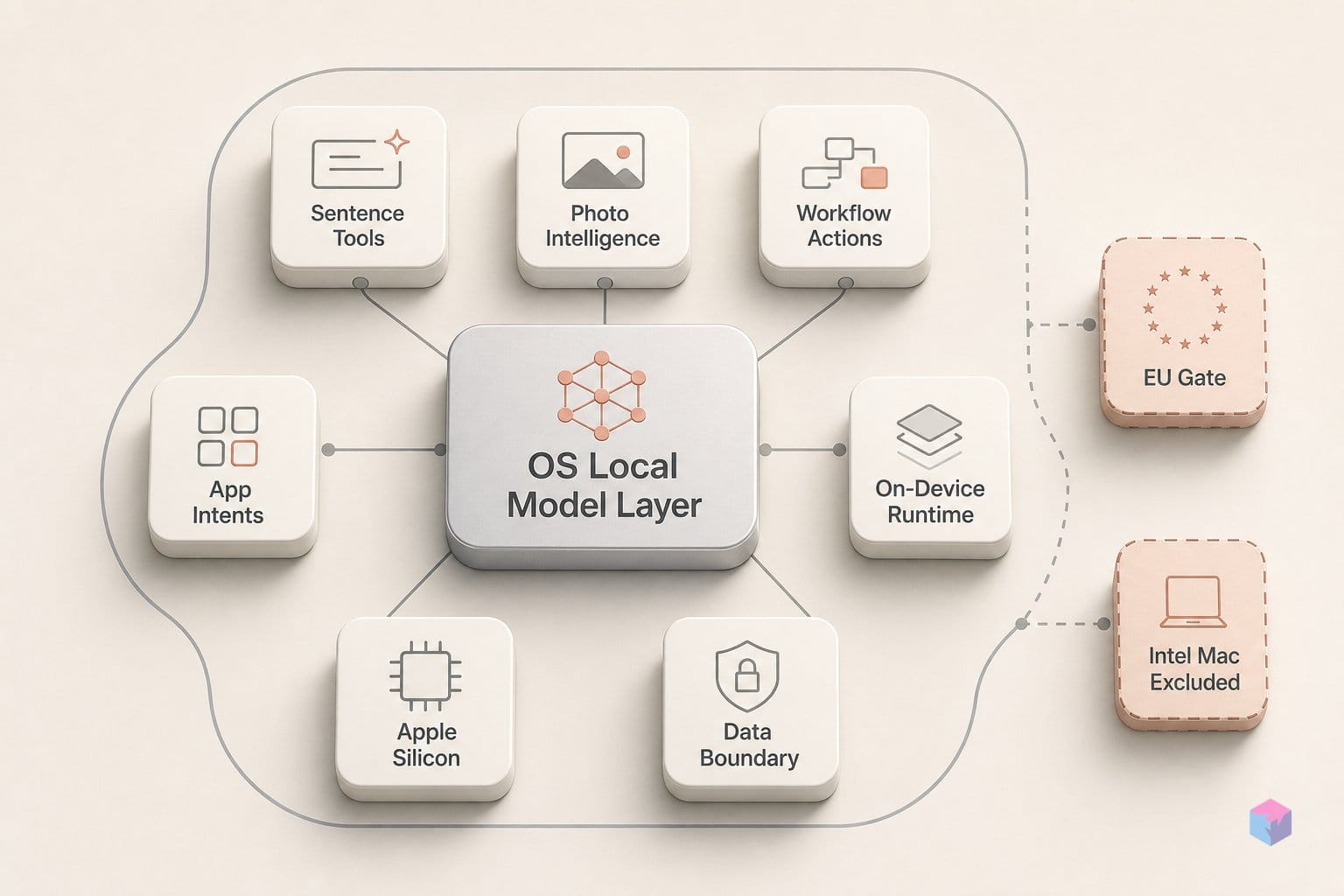
The Foundation Models framework is iOS 27's developer entry point to Apple Intelligence: native Swift access to Apple Foundation Models running on-device or in Private Cloud Compute, with no separate API key or network client to wire up . Critically, it is not locked to Apple's own weights — the framework also accepts any provider that conforms to Apple's Language Model protocol, so a team can route prompts to a self-hosted or third-party model behind the same Swift surface . For local inference, that removes the cloud round-trip entirely.
What's new this cycle is the part worth migrating for. Apple's What's New page lists several additions stacked on top of last year's text-only baseline (source: Apple Developer, 2026-06):
- Multimodal prompts — calls can now mix image and text input, not text alone.
- Dynamic Profiles — swap the model, tools, and instructions at runtime instead of baking one configuration into the build.
- Evaluations — built-in prompt regression testing, so you can catch quality drift before shipping rather than after a user reports it.
- App Intents schemas — bind model output to OS-level actions, the same plumbing Siri uses to act inside system apps.
- View Annotations — give LLM calls awareness of what's currently on screen.
- Spotlight semantic indexing — extend natural-language queries into your app's indexed content.
- Image Playground APIs — generate or transform images from inside third-party apps.
View Annotations and Spotlight semantic indexing are both opt-in adoption surfaces: they do nothing until a third-party app explicitly exposes its views or content to them, which keeps the privacy boundary on the developer's side . Standard system text fields get Write with Siri automatically; apps with custom text controls have to adopt the APIs to opt in (source: MacRumors, 2026-06).
For requests too heavy to run locally, Apple routes to Private Cloud Compute and stakes its pitch on four stated properties (source: Apple Security, 2026-06):
| Property | What Apple claims |
|---|---|
| Stateless processing | Request data is not retained after the response is returned. |
| No privileged runtime access | Even Apple staff cannot reach user data during processing. |
| Non-targetability | An attacker cannot direct a specific user's request to compromised hardware. |
| Verifiable transparency | Published software images let third parties audit what is actually running. |
The verifiability claim is the one to test: Apple says the production builds are published for independent inspection rather than asking developers to take the privacy guarantees on trust . Whether the on-device path holds up outside Apple's own benchmarks is still open, but the integration surface — local-first inference, swappable models, and OS-level action binding from Swift — is concrete enough to prototype against in the developer betas now .
iOS 27 Siri AI: Understands Your Screen, Remembers Your Questions
Siri AI in iOS 27 is a conversational assistant you drive by voice or typing, and it now keeps context across a session instead of forgetting after each command. It answers open-ended questions, searches your personal material, and takes actions inside system apps . Apple positions it as an OS-level layer, not a standalone chatbot, though a dedicated Siri app stores conversation history with iCloud sync across your devices .
The most developer-relevant addition is on-screen awareness: Siri can answer about whatever is currently displayed. System apps get this by default, but third-party apps must adopt the new View Annotations API to expose onscreen content to Siri . That is the practical line between "works everywhere" and "works where Apple ships it" — your app is invisible to on-screen Siri until you annotate the views.
Personal-content search runs against the user's own corpus. You can ask natural-language questions across photos, email, messages, and notes, with the matching handled on device rather than shipped to a server . It also pulls in online information and the richer context Siri now retains within a conversation .
In-app actions are real but narrow at launch. Siri can execute tasks across system apps including Messages, Music, and Reminders . What Apple did not announce is a general third-party deep-link control surface — the cross-app action model first promised at WWDC 2024 that contributed to roughly two years of delay . For now, App Intents remain the route to expose your app's actions.
The takeaway for builders:
- Context persists — conversations carry state and sync via the Siri app and iCloud .
- On-screen awareness is opt-in for non-system apps via View Annotations .
- Action execution is system-app-scoped at launch; no public third-party orchestration API yet .
TechCrunch's WWDC 2026 recap frames the release plainly:
"Apple is catching up after roughly two years of delays on the AI-Siri features it first promised at WWDC 2024." — TechCrunch WWDC 2026 coverage (source: TechCrunch, 2026-06)
That gap is why the shipped scope matters more than the demo: a conversational, screen-aware Siri is concrete, but the broad app-control layer developers wanted is still not in the betas.
Generative Editing and Visual Intelligence Across All Screens
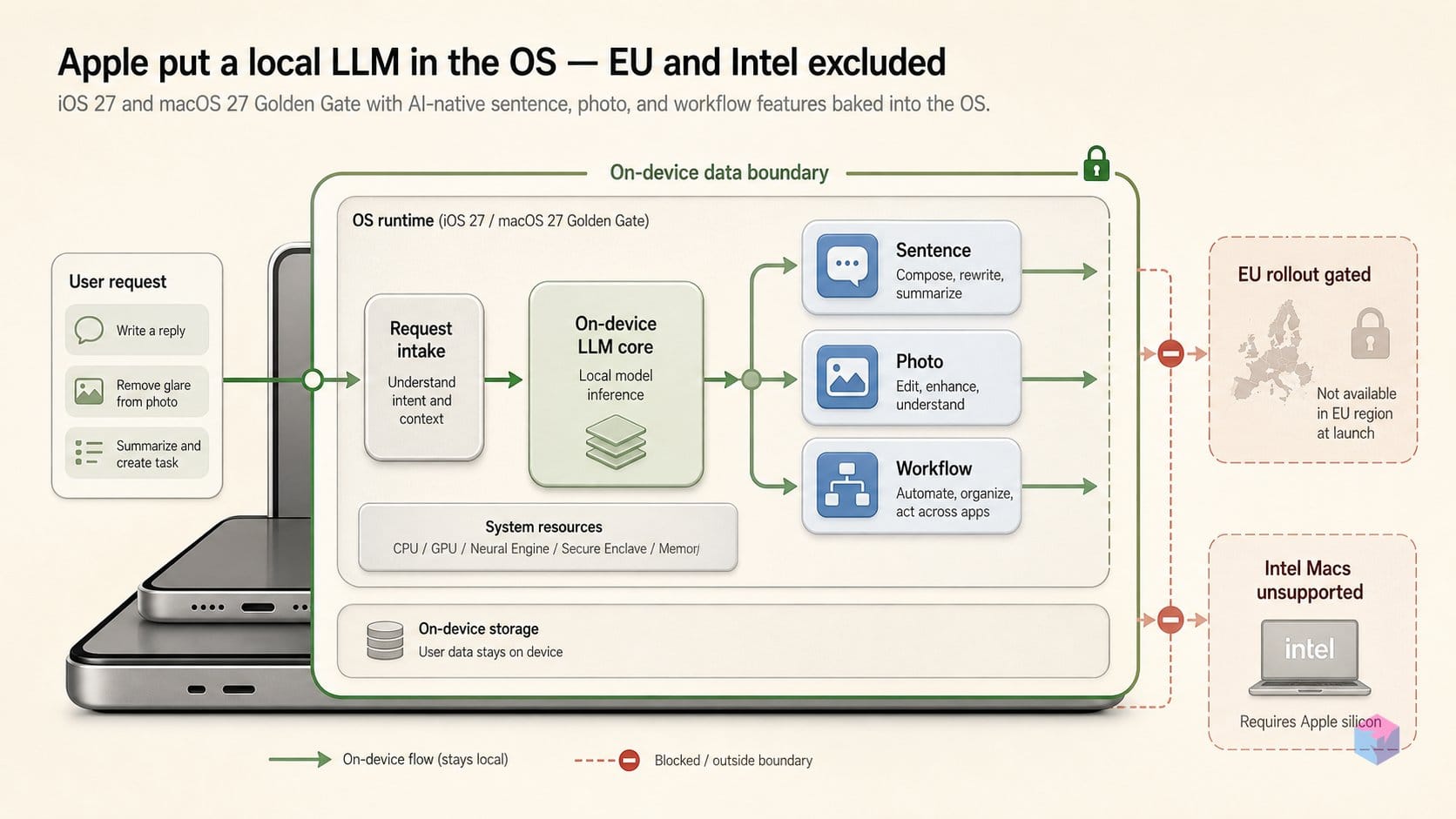
The clearest shipped wins in iOS 27 are in pixels, not app control. Apple Intelligence adds three generative editing tools to Photos and expands Visual Intelligence — the "ask about what you see" feature — from the iPhone camera to the Mac, iPad, and Vision Pro . These run through the same on-device-first, Private Cloud Compute fallback path as the rest of the stack, so the cloud-heavy variants carry quotas.
The Photos editing additions are concrete and worth naming individually:
- Spatial Reframing — post-capture composition and perspective adjustment that goes beyond a crop. It generates plausible fill for shifted framing rather than just discarding pixels .
- Extend — generative infill that expands image edges or changes aspect ratio. It enforces a daily usage quota, with higher limits tied to an iCloud+ subscription tier .
- Clean Up — now handles larger object removal, where the prior version was effectively capped at small distractors .
Image Playground sits alongside these, generating or transforming images in multiple styles including photorealistic output, again with daily limits raisable via iCloud+ . The pricing and exact quota figures for these cloud-leaning features are not yet published — a detail worth flagging before betting workflows on the higher tiers.
Visual Intelligence is the more architecturally interesting move, because it stops being an iPhone-only feature. The same query model now spans four surfaces:
- iPhone — a Siri mode inside the Camera answers object and scene questions live .
- Mac and iPad — it works from screenshots or selected onscreen content, so the input is anything on the display, not just a live camera feed .
- Vision Pro — it identifies objects in the user's actual field of view .
For developers, the takeaway is that "what's on screen" becomes a queryable input across the platform, surfaced through the same View Annotations and onscreen-awareness APIs that back Siri's screen context. The generative Photos tools, by contrast, stay largely first-party — Apple exposes Image Playground APIs, but Spatial Reframing and Extend read as system features rather than open editing primitives .
Shortcuts Learns Plain-Language in iOS 27 — No Visual Scripting
In iOS 27, Shortcuts builds automations from a plain-language description instead of drag-and-drop block composition. You describe a multi-step workflow in English, and Apple Intelligence assembles the action chain for you — the clearest AI-native automation feature in the release, per TechCrunch's WWDC 2026 rundown.
For developers, this lowers the bar for the long tail of personal automation that never justified manual scripting. Visual scripting does not disappear; the natural-language layer sits on top of the same action graph, so generated workflows remain inspectable and editable rather than opaque.
The same on-device inference surfaces inline suggestions across default apps. These are contextual, one-tap prompts rather than a separate assistant surface:
- Messages and Mail — surface one-tap actions such as adding a calendar event or finding a referenced photo, offered inline in the conversation [Apple Newsroom].
- Safari — gains Notify Me to alert you when a monitored page changes, natural-language extension creation, and automatic tab grouping by inferred topic.
- Calendar — accepts event creation or edits from a plain-text description, no field-by-field entry.
- Passwords — can update weak or compromised credentials in place.
- Call Context — surfaces relevant app data on-screen during active business calls.
The throughline is that App Intents become the connective tissue. Suggestions in Messages, Safari, and Calendar all resolve to the same intent vocabulary that Shortcuts now reads from plain language, which means apps that already expose well-defined intents inherit these one-tap prompts with little extra work, per MacRumors's recap.
That is the practical migration signal here. If your app's actions are buried behind custom UI rather than declared as intents, none of this contextual surfacing reaches your users. The work is not adopting a new framework so much as making existing capabilities legible to the system — schema-tagged App Intents, semantic Spotlight indexing, and onscreen-awareness annotations are what let Calendar, Mail, and Safari offer your features as suggestions.
One caveat worth flagging: Apple has not detailed how reliably plain-language Shortcuts assembly handles ambiguous or multi-branch workflows, and the company's own demos lean on clean, single-path tasks [TechCrunch]. Real-world robustness stays unverified until the public beta.
Siri AI's Requirements: 12 GB Minimum, English-Only, EU Exclusion
The hardware and regional gates on Siri AI are stricter than the iOS 27 install base suggests. iOS 27 itself runs on iPhone 11 and later plus iPhone SE (2nd generation) and later , but Apple Intelligence and the new conversational Siri sit behind a much narrower device list. Knowing which tier your users — and your test devices — fall into matters before you build against the Foundation Models surface.
The base Apple Intelligence tier covers all iPhone 16 models, iPhone 15 Pro and 15 Pro Max, M1/A17 Pro iPads, M1 Macs, eligible Apple Watch models, and Vision Pro . Full Siri AI and top-tier dictation accuracy ask for more, and the practical gate is a 12 GB unified-memory floor .
| Tier | Eligible hardware |
|---|---|
| iOS 27 (OS only) | iPhone 11 and later; iPhone SE (2nd gen) and later |
| Base Apple Intelligence | All iPhone 16; iPhone 15 Pro / Pro Max; M1/A17 Pro iPads; M1 Macs; eligible Apple Watch; Vision Pro |
| Full Siri AI + top dictation | iPhone 17 Pro / Pro Max / iPhone Air; M4+ iPads (≥12 GB); M3+ Macs (≥12 GB); Vision Pro M5 |
That 12 GB unified-memory minimum is the line worth watching. Advanced Siri voice customization and the strongest dictation accuracy require iPhone 17 Pro, 17 Pro Max, iPhone Air, M4-or-later iPads, M3-or-later Macs, and Vision Pro M5 . A device can run iOS 27, support base Apple Intelligence, and still miss the full Siri AI experience on memory alone.
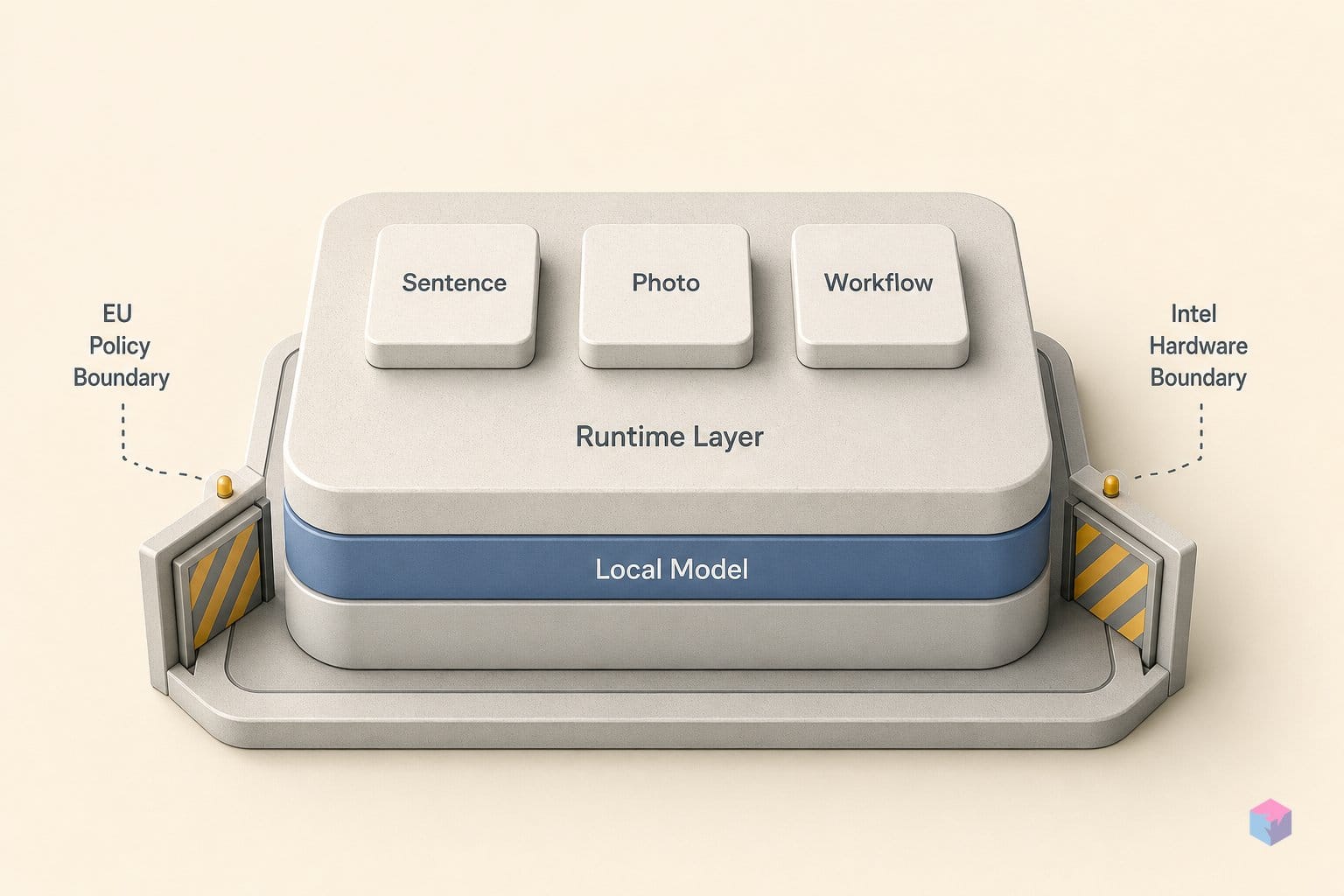
Regional holds narrow availability further. At the initial fall launch, Siri AI is excluded from the EU on iOS, iPadOS, and watchOS — a stance widely read as DMA-compliance caution . In China, both Apple Intelligence and Siri AI are unavailable pending separate regulatory approval . Siri AI also launches English-first, with broader Apple Intelligence spanning 15 languages .
On the desktop, macOS 27 Golden Gate drops Intel Macs entirely and supports Apple-silicon machines only . The supported set is:
- MacBook Air / Pro from 2020 onward
- iMac from 2021 onward
- Mac mini from 2020 onward
- Mac Studio from 2022 onward
- Mac Pro from 2023 onward
- MacBook Neo 2026
For developers, the takeaway is concrete: the addressable base for full on-device Siri AI is smaller than iOS 27's reach, region-restricted, and English-only at launch. If your app leans on Write with Siri or the heavier Foundation Models paths, plan graceful fallbacks for the large share of users who sit below the 12 GB bar or outside eligible regions .
The Unanswered Questions in iOS 27 AI as Fall Approaches
Treat Apple's headline numbers as lab figures, not benchmarks. Every performance claim from WWDC 2026 traces back to a single controlled device and a single scenario in Apple's own testing — useful as a direction signal, not a guarantee for your users' hardware. Before general availability this fall, the gaps that matter most for planning are still open: dates, pricing, regional scope, and final feature scope.
Here is what Apple actually measured. The "up to 30% faster" app-launch claim came from an iPhone 11 Pro Max comparing iOS 26.4.2 against prerelease iOS 27 in April–May 2026 . The other two flagship figures are equally narrow:
- Photos up to 70% faster to load library items — measured on an iPhone 15 with a 50,000-asset library .
- AirDrop up to 80% faster — measured on an iPhone 16 Plus moving 30 MB of photos .
- iPad external-drive transfers up to 5x faster — another single-scenario claim, with no independent verification yet .
Apple is candid about the caveat in its own framing.
"Testing conducted by Apple in April and May 2026 using prerelease software," — Apple, on its stated WWDC 2026 performance methodology (source: Bloomberg, 2026-06).
The bigger unknowns are commercial and regional. None of the following are confirmed as of June 16, 2026:
- The exact fall release date and the public-beta date .
- iCloud+ pricing tiers governing quota for cloud-heavy image features like Extend .
- Final Siri AI feature scope at GA and the EU rollout timeline .
One speculative thread is worth flagging precisely because it is unconfirmed: iOS 27 beta code contains the strings foldState and angleDegrees, read by some as a foldable-iPhone signal . There is no announced product and no timeline — code strings are a hint, not a roadmap.
The concrete takeaway: build against what shipped, not what was demoed. Validate Apple's performance claims on your own target devices once betas land, design fallbacks for users below the 12 GB bar or outside eligible regions, and hold pricing-sensitive features — anything leaning on cloud image quota — until iCloud+ tiers are published. Until fall, iOS 27's AI is a credible direction with several load-bearing details still pending .
Frequently asked questions
Does Foundation Models in iOS 27 support third-party LLM providers?
Yes. The Foundation Models framework gives native Swift access to Apple's on-device models and Private Cloud Compute, but it also accepts any provider that conforms to Apple's Language Model protocol, so the surface is not Apple-model-locked . Dynamic Profiles let an app swap model, tools, and instructions at runtime, alongside multimodal prompts, Evaluations, App Intents schemas, and View Annotations for onscreen awareness .
Why is Siri AI unavailable in the EU at iOS 27 launch?
Apple is holding Siri AI from the EU on iOS, iPadOS, and watchOS at launch, citing regulatory complexity tied to the Digital Markets Act, with no EU rollout timeline announced as of June 16, 2026 . China is a separate case: both Apple Intelligence and Siri AI remain unavailable there pending local regulatory approval .
Which Macs support macOS 27 Golden Gate?
Apple-silicon machines only. macOS 27 Golden Gate supports the MacBook Air and MacBook Pro from 2020, iMac from 2021, Mac mini from 2020, Mac Studio from 2022, Mac Pro from 2023, and the MacBook Neo 2026 . All Intel Macs are dropped, with no migration path within the macOS 27 cycle.
What is the minimum hardware for full Siri AI and top dictation quality?
Top-tier Siri voice customization and best-in-class dictation require newer hardware: an iPhone 17 Pro, 17 Pro Max, or iPhone Air; an M4-or-later iPad with at least 12 GB unified memory; an M3-or-later Mac with at least 12 GB; or Vision Pro M5 . Below the 12 GB memory floor, devices still run base Apple Intelligence but not the highest Siri AI accuracy or dictation auto-correction .
When will iOS 27 and macOS 27 ship publicly?
Apple labels the entire 27 family as "coming this fall," which historically means a September release for iOS and macOS . Developer betas are installable now via Software Update, while public betas were listed as "coming soon" and no public-beta date had been announced as of June 16, 2026 .