
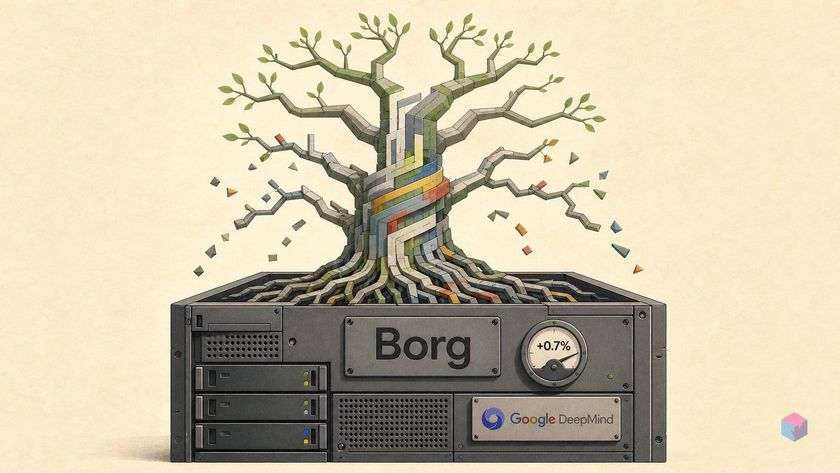
Has AlphaEvolve Shipped Anything Real?
Yes — but as an internal Google capability, not a product you can call. AlphaEvolve is a Gemini-powered evolutionary coding agent that improves executable code rather than text answers, and DeepMind's May 2026 one-year impact report frames it as moving from pilot demonstration toward recurring core infrastructure . The 2026 news is breadth and durability of verified deployment — not a new model or architecture.
The system was announced May 14, 2025, and its design is conceptually unchanged since . It pairs two models with two control loops:
- Gemini Flash — broad exploration across many candidate ideas.
- Gemini Pro — deeper refinement of the promising ones.
- Automated evaluators — verify and score each candidate program.
- An evolutionary program database — selects the best candidates and mutates them across generations.
That evaluator is also the hard constraint. AlphaEvolve only works where success can be machine-scored automatically — algorithmic and optimization problems with clean, programmatic fitness functions. It does not write open-ended product code, because there is no automatic scorer for "is this feature good." If you cannot express correctness and quality as a number, the evolutionary loop has nothing to climb.
Two production claims were independently corroborated at launch, not just asserted by Google: the Borg cluster-scheduler heuristic and a matrix-multiplication kernel optimization, both reported by VentureBeat and The Register in May 2025 . The 2026 report extends the duration and the surface area of those deployments — it does not rewrite the core mechanism.
Borg Scheduler: 0.7% of Google's Compute, for Over a Year
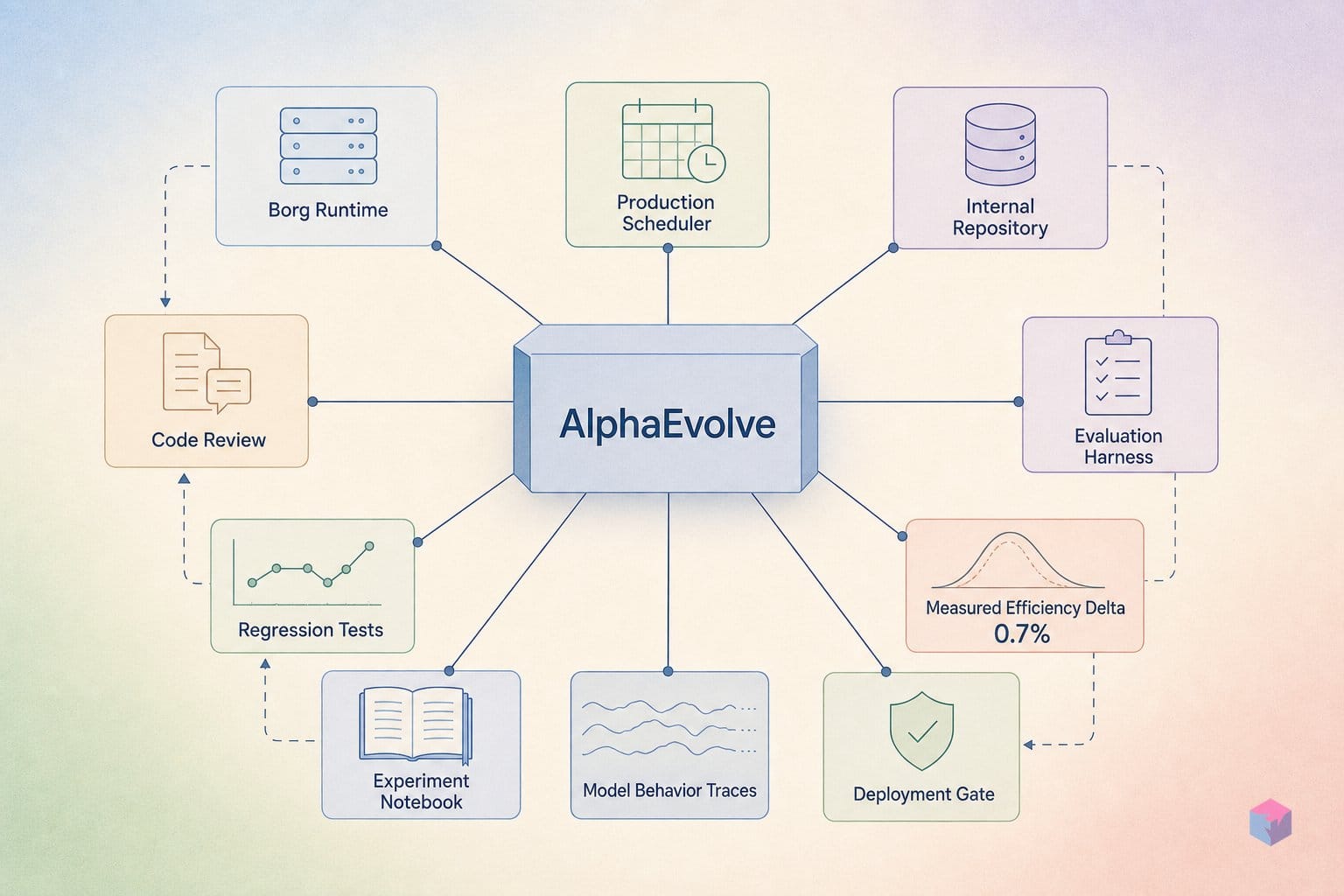
Borg is Google's cluster manager, and it is where AlphaEvolve's most durable production result lives. The system evolved a CPU/memory bin-packing heuristic taken from the scheduler already running in production, then improved how Borg packs jobs onto machines. The payoff is capacity, not a feature: across more than a year of live operation, the evolved heuristic continuously recovers on average 0.7% of Google's worldwide compute that would otherwise sit stranded .
Quick Answer: AlphaEvolve rewrote a bin-packing heuristic inside Borg, Google's cluster scheduler. Deployed fleet-wide, it has run for over a year as of May 2026 and recovers about 0.7% of Google's worldwide compute that would otherwise be stranded .
The rollout path matters for anyone skeptical of simulator-only wins. DeepMind reports the candidate heuristic was tested in a data-center simulator against historical fleet snapshots, evaluated on unseen workloads, and only then deployed fleet-wide . That ordering — replay, generalization check, production — is what separates a benchmark figure from an operational one.
Scale is the reason 0.7% is not a rounding error. Borg schedules hundreds of thousands of concurrent jobs from thousands of applications across clusters with up to tens of thousands of machines . A sub-percent efficiency gain at that footprint compounds into a large absolute capacity figure, though Google has not disclosed megawatts, server counts, or dollar savings.
| Attribute | Detail |
|---|---|
| Target system | Borg cluster scheduler (bin-packing heuristic) |
| Compute recovered | ~0.7% of Google's worldwide fleet, on average |
| Validation | Simulator on historical snapshots → unseen workloads → fleet-wide |
| Duration in production | >1 year as of May 2026 |
| Disclosed savings | None (no MW, server, or dollar figure) |
This is also the strongest externally corroborated claim in the report. The original Borg figure was reported by independent outlets at launch, not only by Google.
The May 2025 launch coverage described AlphaEvolve recovering roughly 0.7% of Google's compute capacity via the Borg heuristic — a figure VentureBeat and The Register both reported at the time (source: VentureBeat, The Register, May 2025).
The 2026 update does not revise that number upward or downward. What it adds is duration: the same heuristic has now held steady for more than a year, which is the harder thing to fake.
23% Faster Matrix Ops — What Took Months Now Takes Days
The Borg result proves AlphaEvolve survives in production; the kernel work shows it pays back the model that runs it. AlphaEvolve optimized tiling heuristics for a Pallas matrix-multiplication kernel used to train Gemini, reporting an average 23% speedup over the existing expert-designed heuristic and a corresponding ~1% cut in Gemini's overall training time . Gemini now helps improve its own training.
Correctness here is structural, not statistical. Candidates ran on real TPUs, and AlphaEvolve only changed the tile choice — how the matmul is partitioned across memory — never the underlying operation. That keeps numerical output identical while the schedule gets faster, which is why the win could be deployed rather than just benchmarked .
For practitioners, the effort-reduction claim may matter more than the percentage. Tuning that previously took several months of expert engineering was completed in days of automated experimentation . A 23% kernel gain is useful; collapsing a quarter of human work into a couple of automated runs is the structural shift.
Google reports a cluster of related internal wins, all on proprietary workloads with no external reproduction:
| Target | Reported result | How |
|---|---|---|
| FlashAttention kernel | ~32.5% speedup | XLA-generated IR optimization |
| Google Spanner | ~20% write-amplification cut | LSM-tree optimization |
| Storage footprint | ~9% reduction | New compiler strategies |
| Cache-replacement policy | Found in 2 days vs. months | Evolutionary search |
The FlashAttention figure is reported as 32.5% (32% in the white paper), with a related 15% speedup in pre/postprocessing, achieved by optimizing the compiler's intermediate representation rather than hand-writing CUDA . Independent 2025 reporting corroborated the original infrastructure and kernel claims (source: VentureBeat), but the Spanner, storage, and cache numbers rest entirely on internal measurement.
Read these as Google-internal benchmarks, not portable guarantees. The common thread is the same precondition that governs Borg: each target has a clean, machine-scored evaluator — latency, write amplification, bytes on disk — so AlphaEvolve can mutate code and measure fitness without a human in the loop.
Strassen's 56-Year Mark, Erdős Problems, and Power Grid Feasibility
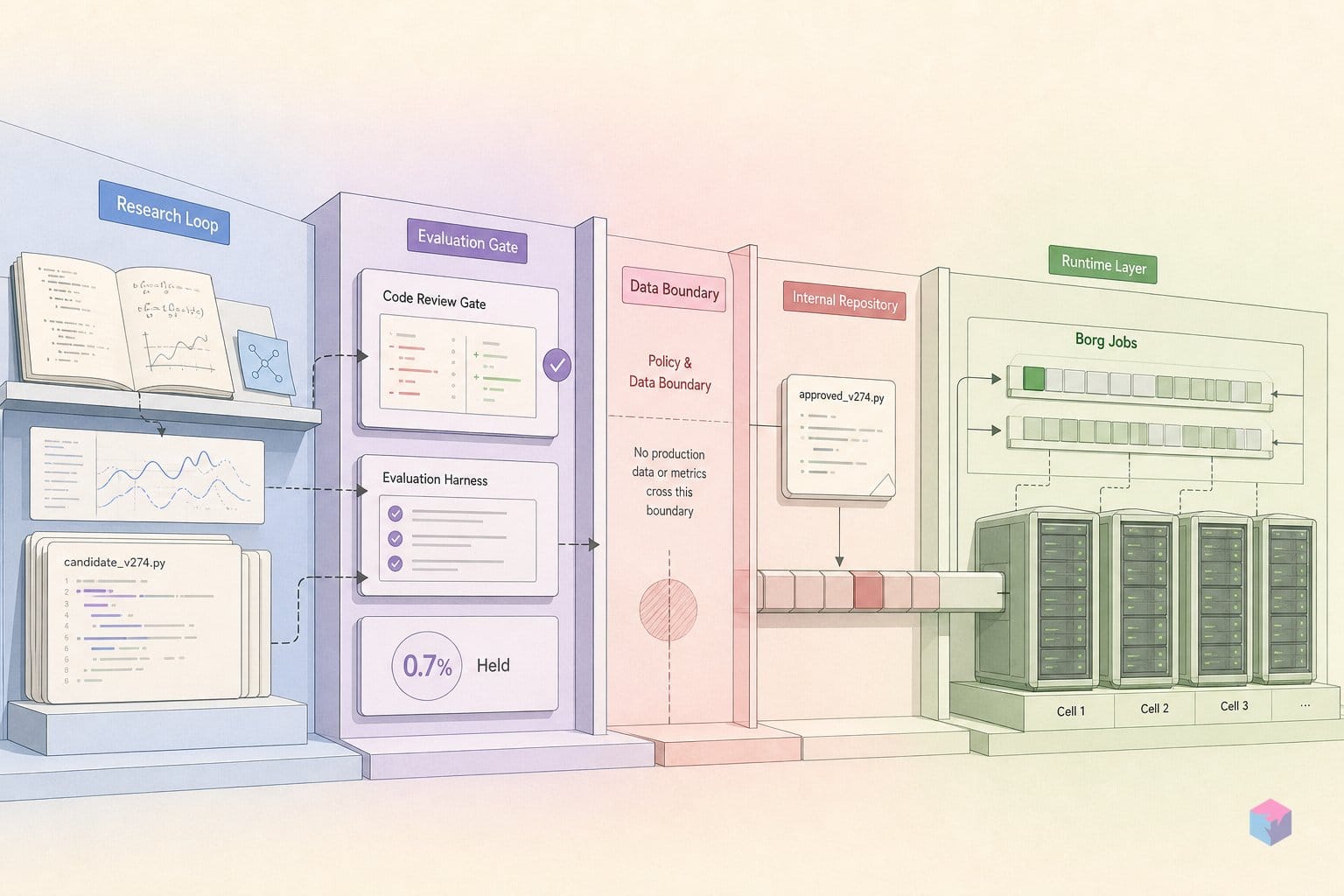
AlphaEvolve's most independently checkable results are in pure mathematics, where a discovered construction either works or it doesn't. The headline case: it found a way to multiply two 4×4 complex matrices using 48 scalar multiplications, which DeepMind describes as the first improvement on that setting in 56 years, building on Strassen's 1969 algorithm . Unlike the infrastructure numbers, anyone can verify the multiplication scheme on paper.
The breadth is consistent across the math corpus. On 50-plus tested open problems, AlphaEvolve matched best-known constructions roughly 75% of the time and improved them in about 20% . Reported advances include new Ramsey number records, tighter traveling-salesman lower bounds, and progress on Erdős problems in collaboration with mathematician Terence Tao .
The applied-science claims are larger in stated impact but rest on DeepMind's and partners' own benchmarking:
- AC Optimal Power Flow: a graph neural network's feasible-solution rate rose from 14% to over 88% .
- Genomics (DeepConsensus, with PacBio): a 30% reduction in variant-detection errors for DNA sequencing .
- Willow quantum processor: suggested circuits with roughly 10× lower error than conventionally optimized baselines .
Treat the two tiers differently. The math results are the subset you can reproduce yourself — the constructions are published and checkable, and the Erdős and Ramsey work is open to scrutiny by the broader math community. The genomics, power-grid, and quantum figures are credible but proprietary: they depend on internal datasets and evaluators that no outside group has yet reproduced. As with Borg and the kernels, every win here shares one precondition — a clean, automatic score that lets the system mutate and measure without a human deciding what "better" means.
What the 2026 Papers Add: Compiler Size and FHE Bootstrapping
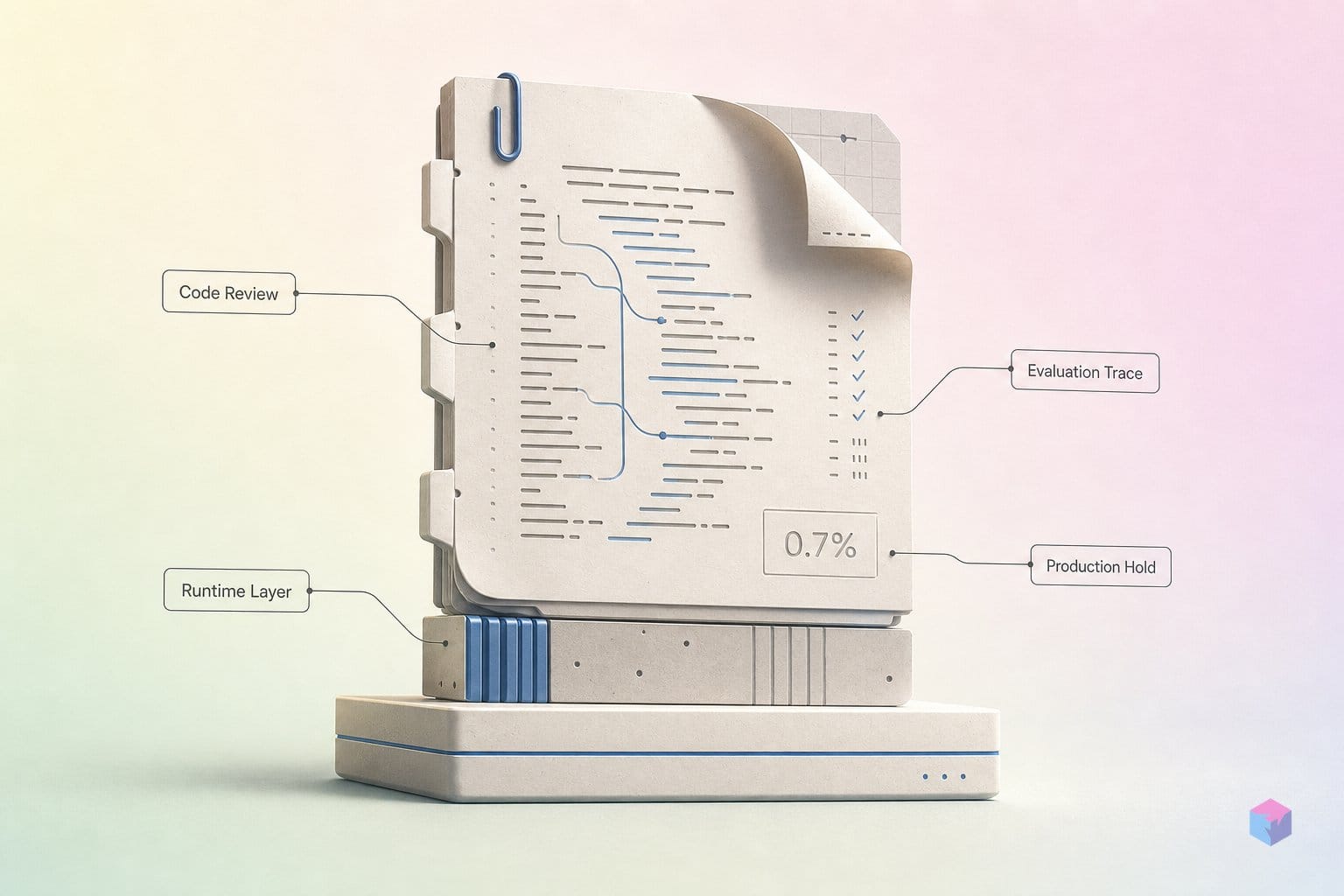
Three 2026 papers extend AlphaEvolve from infrastructure into compilers, cryptography, and game theory — and each respects that same precondition of an automatic score. The strongest reproducible artifacts come from Magellan and a Fully Homomorphic Encryption (FHE) study; the multi-agent work is more exploratory. None is a recurring production deployment in the Borg sense, but all run against real workloads with hard correctness checks.
Magellan (submitted January 28, 2026, accepted to C4ML@CGO'26) uses AlphaEvolve to synthesize deployable C++ heuristics for LLVM and XLA . It reports 4.27%–5.23% binary-size reductions for LLVM inlining-for-size in about 1.5 days, an 8.79% average across more than ten production binaries, and a 0.61% edge over LLVM's hand-tuned inliner on a clang macro-benchmark with PGO, ThinLTO, and -O3 .
The FHE paper (May 14, 2026) ran on 100 Google Cloud TPUv5e chips — 10 controllers and 10 evaluators — with real-hardware feedback and ≥128-bit security checks . Within 24 hours it cut TFHE bootstrapping from 10 ms to 4 ms (2.5×) and blind rotation from 9.4 ms to 3.5 ms (2.85×), with smaller CKKS gains; changes were linked to Google's Jaxite pull requests .
| Paper (2026) | Domain | Headline result | Hard check |
|---|---|---|---|
| Magellan (Jan 28) | LLVM/XLA heuristics | 8.79% avg binary-size cut across 10+ binaries | Compiles, runs, validity-filtered |
| FHE (May 14) | TFHE/CKKS kernels | TFHE bootstrap 10 ms → 4 ms (2.5×) | ≥128-bit security on TPUv5e |
| Multi-agent (Feb 18) | Game-solving algorithms | WOP-CFR top-3 on all 18 games | OpenSpiel exploitability |
The multi-agent paper (February 18, 2026, Gemini 2.5 Pro plus OpenSpiel) discovered WOP-CFR and VAD-CFR, with WOP-CFR ranking top-three on all 18 tested games . Its authors are unusually candid about the limits:
"No formal convergence guarantees, tabular-only baselines, and human-in-the-loop distillation" — authors, AlphaEvolve multi-agent learning paper (source: arXiv, 2026-02).
Read together, these are strong real-workload evidence, summarized in DeepMind's one-year impact update and tracked by independent coverage. But "ran in a paper" is not "runs the fleet" — only Borg has crossed that line.
No General Release: AlphaEvolve Is Not a Cloud Product Yet
AlphaEvolve is not something you can call. As of mid-2026 it remains an internal Google capability plus a short list of curated enterprise partnerships — there is no GA date, no pricing, and no self-serve endpoint . The public repo at google-deepmind/alphaevolve_results ships only verification code for the mathematical discoveries, and its README states plainly that it is not an official Google product .
Quick Answer: No. As of June 2026, AlphaEvolve has no GA date, no pricing, and no public API. It is an internal Google capability plus a handful of curated enterprise partners, and the only published code is mathematical verification code that explicitly states it is not an official Google product.
The original May 2025 announcement described a planned Early Access Program for selected academics, and Google Cloud has signaled intent to expose AlphaEvolve to Cloud customers — but no product page, launch date, or pricing tier exists yet .
What developers can see today are partner-reported wins, not audited ones. DeepMind's one-year update cites Klarna doubling transformer training speed, FM Logistic claiming 10.4% routing gains, WPP at ~10% accuracy improvement, Schrödinger reporting roughly 4x force-field speedups, and Substrate citing multi-fold lithography gains . Every figure rests on partner or DeepMind self-reporting — useful signal, not independent verification.
What to watch over the next few quarters:
- Cloud TPU and Vertex AI announcements at Google I/O and Google Cloud Next — the most likely venue for any real access tier.
- Expansion of the academic early-access cohort beyond the originally described selected researchers.
- Whether the Magellan and FHE codebases become public artifacts, which would let outside teams reproduce the compiler-size and bootstrapping numbers .
The takeaway after one year: AlphaEvolve has earned its infrastructure stripes inside Google, and the 0.7% compute recovery on Borg holds . But for anyone outside Google, it is still a research result and a roadmap hint — not a tool you can build on. Until a Cloud product page appears, treat every external claim as vendor-reported and watch the next I/O keynote.
Frequently asked questions
Is AlphaEvolve available to external developers or as a cloud API?
Not yet. There is no general availability date, pricing, or access tier as of mid-2026. The public google-deepmind/alphaevolve_results repository contains only verification code for mathematical discoveries — not the code to run the system — and states it is not an official Google product . The 2025 announcement described a planned Early Access Program for selected academics, and Google Cloud has signaled intent to expose AlphaEvolve to Cloud customers, but no product has shipped .
What does 0.7% of Google's worldwide compute actually mean in absolute terms?
Google has not disclosed megawatts, server counts, or dollar savings. What is known is the scale of the system: Borg runs hundreds of thousands of jobs from many thousands of applications across clusters with up to tens of thousands of machines . At that scale, recovering on average 0.7% of stranded compute continuously for over a year is non-trivial capacity, even without an absolute figure .
Does AlphaEvolve work on any codebase, or only specific problem types?
Only where success can be machine-scored automatically. The applicability constraint is unchanged from launch: AlphaEvolve suits algorithmic and optimization problems with clean automated evaluators — bin-packing heuristics, tiling kernels, compiler flags, mathematical search . It does not generalize to open-ended product code or any problem that lacks a clear, repeatable way to score candidate solutions.
Which of DeepMind's 2026 AlphaEvolve claims have independent verification?
The original infrastructure and math claims from May 2025 — including the Borg 0.7% result — have external corroboration from outlets such as VentureBeat and The Register . Most 2026 commercial-partner figures and follow-on paper results remain self-reported; the mathematical results are publicly verifiable through the released verification code .
How is AlphaEvolve different from prompting an LLM to write optimization code?
AlphaEvolve is not a single-pass code generator. It runs evolutionary search over many code candidates: it pairs Gemini Flash for broad exploration with Gemini Pro for deeper suggestions, uses automated evaluators to verify and score each candidate on real hardware, and keeps a program database that selects the best variants for further mutation . The evaluator is purpose-built per domain — that scoring loop, not the prompt, is what drives improvement.