
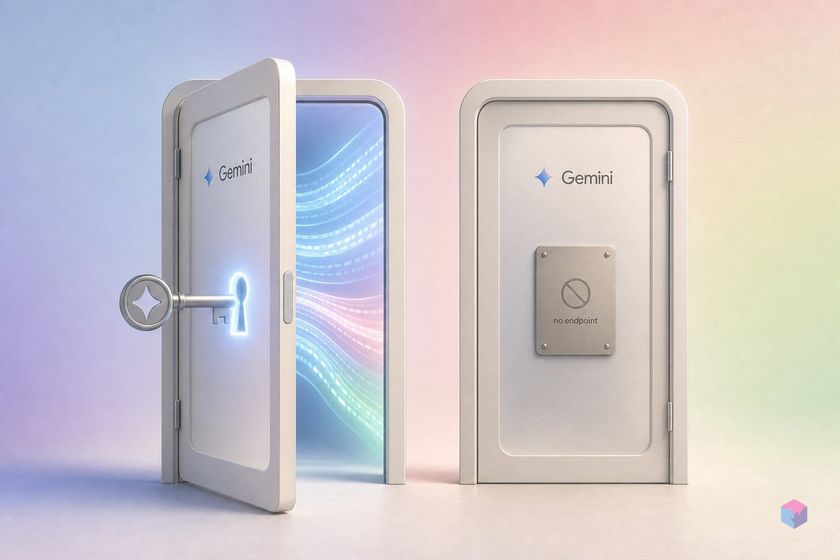
Gemini Omni vs 3.5 Flash: Not the Same Category
Gemini 3.5 Flash and Gemini Omni are not rival tiers — the choice between them is decided by what you want the model to output, not by which is "better." Gemini 3.5 Flash returns text and structured data; Gemini Omni returns generated footage with native audio. They do not overlap, so "3.5 Flash or Omni?" is the wrong framing. Pick by deliverable: text/JSON workloads call 3.5 Flash, footage deliverables go to Omni.
Quick Answer: Gemini 3.5 Flash is a callable text/structured-data model (ID gemini-3.5-flash, $1.50/$9.00 per 1M tokens ); Gemini Omni is a subscription-gated video generator with no public API endpoint. Choose by output type, not by capability tier.
Both shipped together on May 19, 2026, but under completely different access surfaces . Gemini 3.5 Flash arrived with a stable API model ID and a published billing row — the changelog records gemini-3.5-flash as generally available the same day . Gemini Omni, by contrast, has a product page and subscription access but no API endpoint, no model ID, and no pricing row in the Gemini API docs .
That gap is structural, not temporary positioning. Google DeepMind treats Omni as a separate model family from the 3.5 line — not a multimodal extension of it — which is why the API model list carries an entry for 3.5 Flash but none for Omni . Google frames Omni as the surface where Gemini's ability to reason meets the ability to create :
"Gemini's ability to reason meets the ability to create." — Google, Gemini Omni announcement (source: blog.google)
One more thing developers should internalize: most users are already on 3.5 Flash whether they chose it or not. At launch it replaced Gemini 3 Flash as the default in the Gemini app and in Google Search's AI Mode . So the practical question isn't "should I switch to 3.5 Flash" — you're likely already running on it — but "when does a task actually need Omni instead." The rest of this guide answers that.
3.5 Flash: Price Sheet, Scope, and What It Can't Do
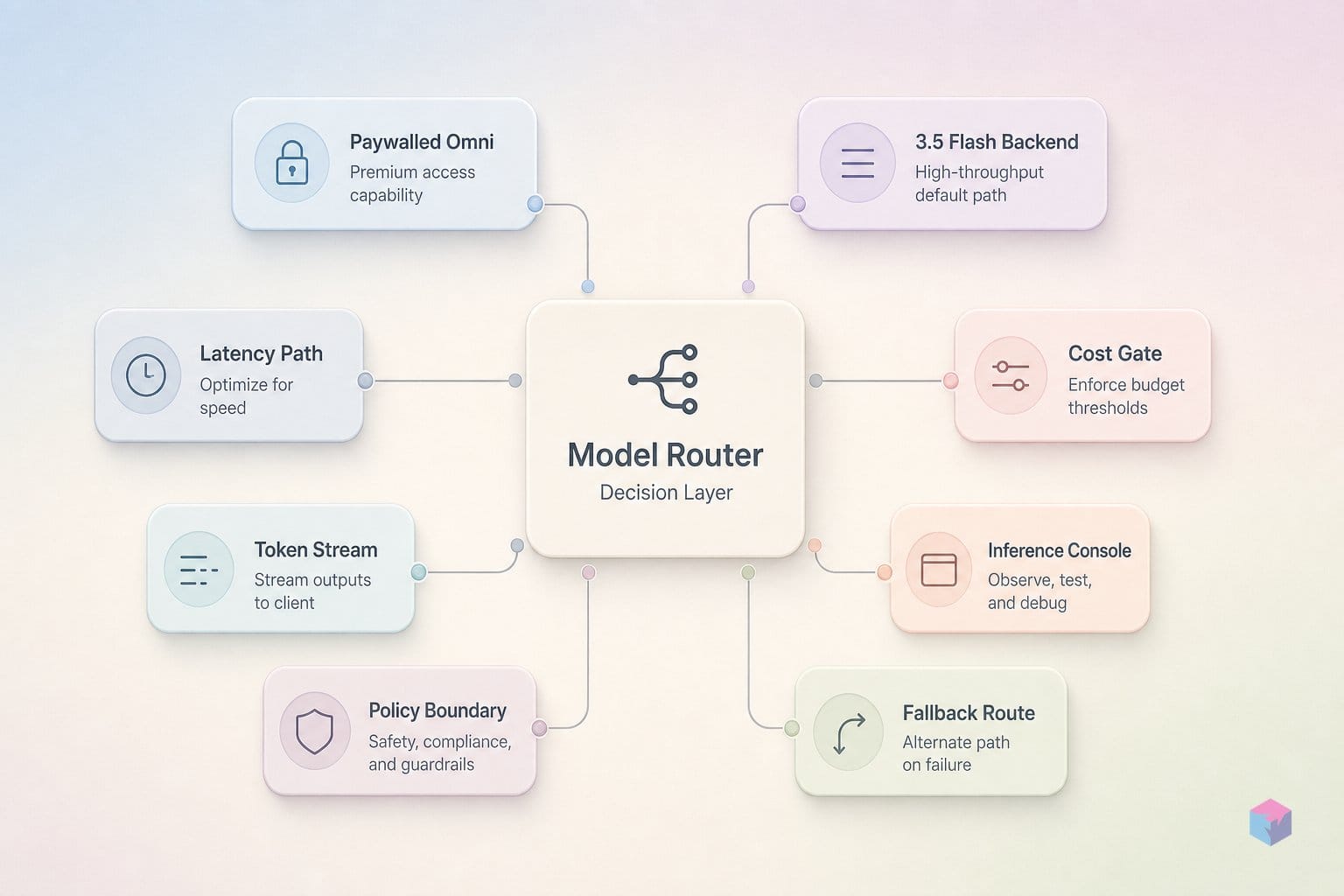
gemini-3.5-flash is the callable production model in the 3.5 generation: a text-and-structured-data engine that went generally available on May 19, 2026 . Standard pricing is $1.50 per 1M input tokens and $9.00 per 1M output tokens, with Batch/Flex at $0.75/$4.50 and Priority at $2.70/$16.20 . It accepts text, image, audio, video, and PDF input — but it returns text only.
Quick Answer: gemini-3.5-flash is Google's GA text-and-tool model: $1.50/$9.00 per 1M tokens standard, a 1,048,576-token input window, and broad multimodal input — but it cannot generate images, video, or audio. It outputs text and structured data only.
The window is large: 1,048,576 input tokens and 65,536 max output tokens . So you can feed it long PDFs, multi-file codebases, hours of transcript, or video frames for understanding — but the deliverable always comes back as text or JSON. There is no image generation, no video generation, and no audio output here; that side of the house is Omni's job. It also does not support the Live API or Computer Use .
What it does support is the agentic toolbelt most production work actually needs: function calling, thinking (medium effort by default now, with thoughts preserved across turns), code execution, Google Search and Maps grounding, context caching, the Batch API, structured outputs, file search, and URL context . Grounding for the Gemini 3 line is free up to 5,000 prompts/month, then $14 per 1,000 queries . The default-effort change matters on migration: a workload tuned around high-effort thinking on the prior preview will see different latency and token bills at medium.
| Tier | Input / 1M tokens | Output / 1M tokens |
|---|---|---|
| Standard | $1.50 | $9.00 |
| Batch / Flex | $0.75 | $4.50 |
| Priority | $2.70 | $16.20 |
Is the speed claim real? Google reports gemini-3.5-flash running roughly 4× faster than other frontier models in output tokens/sec, alongside benchmark scores of 76.2% on Terminal-Bench 2.1 (agentic coding), 83.6% on MCP Atlas, and 1,656 Elo on GDPval-AA . Worth noting: Google's own page concedes the gaps. GPT-5.5 leads Terminal-Bench 2.1 at 78.2% versus 76.2%, and Claude Opus leads GDPval-AA at 1,769 Elo versus 1,656 . These are vendor-reported figures that had not been independently reproduced at publication — read them as directional, not confirmed, and benchmark against your own task before committing a pipeline to them.
Gemini Omni: What the Footage Generator Does
Gemini Omni is Google's generative footage surface: it takes image, audio, footage, and text as input and outputs short clips — up to 10 seconds with native, embedded audio — rather than text or structured data . That single fact decides everything else about it. Omni is not a reasoning model, it is not a drop-in for gemini-3.5-flash, and as of late June 2026 it is not callable from any published API. Google introduced it at I/O 2026 on May 19 alongside 3.5 Flash, with the first variant shipping as Gemini Omni Flash .
The capability list is creation- and editing-focused. Omni Flash can generate clips from scratch, turn up to five photos into motion, run footage-to-footage editing, apply templates, and produce avatars . It also handles the kind of revision work that used to mean a round trip to an editor:
- Photo-to-motion — animate up to 5 stills into a single clip.
- Footage-to-footage editing — restyle or modify existing clips.
- Background, style, and relighting changes — swap scenes or wardrobe, adjust lighting.
- Multi-turn conversational editing — refine a clip across several prompts instead of regenerating it.
- Templates and avatars — start from a preset or a synthetic presenter.
Google frames the model as the point where reasoning and generation meet, and as a direct successor to its prior footage system.
"Gemini's ability to reason meets the ability to create," — Google, describing Gemini Omni as the model that will replace Veo in the Gemini app (source: Google blog, 2026-05).
Access is gated behind subscriptions, not API keys. Omni is available worldwide to users 18 and over on Google AI Plus, Pro, or Ultra, through the Gemini app and Google Flow, with higher Flow credit allowances on higher tiers . Outside the paid tiers, it is offered free inside YouTube Shorts and the YouTube Create app, though availability and features vary by region and tier . Standalone image and audio output are on the roadmap but not yet shipped, separate from the audio already baked into generated clips.
For builders, the gap is the headline. Google said developer and enterprise access via the Gemini API and Agent Platform API would arrive "in the coming weeks" after I/O, not at launch, and published no per-token price . There is no model ID, no pricing row in the API docs, and no confirmed availability date as of June 22, 2026. If your deliverable is a generated or edited clip, Omni is the tool — but today you reach it through the app, not a backend call.
Gemini 2.0 Flash Is Retired: The Substitutes
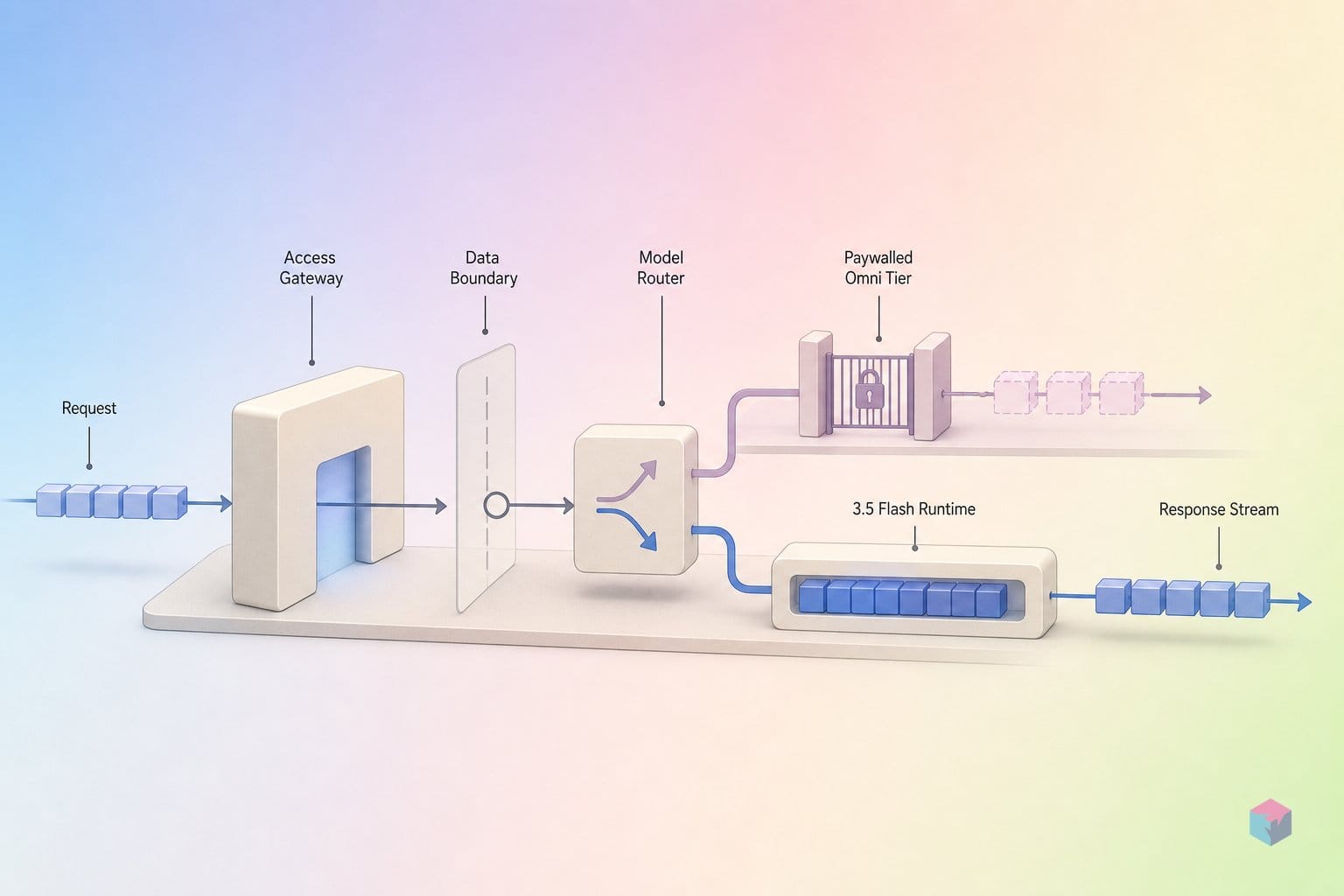
If you still have gemini-2.0-flash or gemini-2.0-flash-lite hardcoded anywhere, those calls now fail. Google shut down both models on June 1, 2026 , so any request pinned to a 2.0 model ID returns an error rather than silently routing elsewhere. The first migration task is mechanical: grep your configs, environment variables, and SDK initializers for gemini-2.0 and replace every match before the failures surface in production logs.
Google's recommended swap is gemini-3.5-flash as the primary substitute, with gemini-3.1-flash-lite for cost-sensitive workloads where thinking and grounding are not required . The price gap between the two is wide enough to matter at scale: standard gemini-3.5-flash runs $1.50 per 1M input tokens and $9.00 per 1M output, while gemini-3.1-flash-lite sits at $0.25 input and $1.50 output . For simple extraction, translation, and classification, Lite is the cheaper default; reserve 3.5 Flash for work that actually needs reasoning, tool use, or search grounding.
The migration is not a drop-in even if you were already on a 3.x model. Teams moving from gemini-3-flash-preview should retest cost and latency before going live, because gemini-3.5-flash behaves differently in three ways :
- It costs more than Gemini 3 Flash Preview, so per-request economics shift upward — model your token volume against the new rates, not the old ones.
- Default thinking effort drops from high to medium. If your prompts implicitly relied on the old default for harder reasoning, you may need to raise the thinking parameter explicitly to match prior quality.
- Thoughts are preserved by default. That changes what flows back through multi-turn and sub-agent contexts, which can alter both output and token accounting.
The hard blocker is Computer Use. gemini-3.5-flash dropped that capability entirely, and no 3.5-generation Computer Use variant has been published . Any agent that drives a browser or interface through Computer Use must stay on gemini-3-flash-preview for now — migrating it to 3.5 Flash will break it outright. Audit those workloads separately and leave them pinned until Google ships a replacement.
Omni for Footage, 3.5 Flash for Everything Else: The Matrix
The routing rule is decided by output, not by which model is "better": call gemini-3.5-flash whenever the deliverable is text or structured data, and reach for Gemini Omni only when the deliverable is generated or edited footage. As of June 2026, those two families do not overlap on any task . Inside the text-output lane there are two cheaper specializations worth knowing — a lite tier for bulk work and a live model for speech — so the practical decision is among three callable IDs plus one app-only surface.
gemini-3.5-flash is the default for production API workloads that return text or JSON: coding agents, multi-step tool use, sub-agent orchestration, document, PDF, image and audio understanding, search-grounded answers, structured-output schemas, and most chat or reasoning where latency and cost matter . It accepts five input modalities and returns text only, so it never doubles as a media generator.
Drop to gemini-3.1-flash-lite for high-volume, low-complexity jobs — extraction, translation, classification, lightweight processing. It runs $0.25 per 1M input tokens and $1.50 per 1M output, the lowest per-token cost in the 3.x line, and is the right default when you do not need thinking or grounding . For real-time speech pipelines, use the separate gemini-3.5-live-translate-preview audio-to-audio model (70+ languages) at $3.50 per 1M audio input tokens and $21.00 per 1M output, roughly $0.0368 per combined minute . gemini-3.5-flash has no audio output and cannot serve that workload.
| Model ID | Use it when | Output | Price (per 1M tokens) |
|---|---|---|---|
gemini-3.5-flash | Coding agents, tool use, grounded answers, JSON, document/audio understanding | Text | $1.50 in / $9.00 out |
gemini-3.1-flash-lite | High-volume extraction, translation, classification | Text | $0.25 in / $1.50 out |
gemini-3.5-live-translate-preview | Real-time speech translation pipelines | Audio | $3.50 in / $21.00 out (audio) |
| Gemini Omni (app only) | Generated or edited footage with audio | Video | Subscription; no API pricing |
Gemini Omni sits outside this table's logic for a reason: it belongs only when the deliverable is generated or edited footage with audio — social clips, photo-to-motion, background or style changes, conversational revision, avatars. It cannot return structured data, run function calls, or accept API credentials, because no Gemini API endpoint or model ID had shipped for it at launch . Treating Omni as a substitute for gemini-3.5-flash on any text-output or agentic task is a category error — it is reachable today only inside the paid Gemini app and Google Flow surfaces, not as a backend.
So the matrix collapses to one question per request: do you need a string back, or a video? Text, JSON, or tool calls route to the 3.5/3.1 line and pick the tier by cost and feature need; a rendered clip routes to Omni in the app. There is no overlap to optimize across.
Speech and Lightweight Extraction: Two More Gemini Options
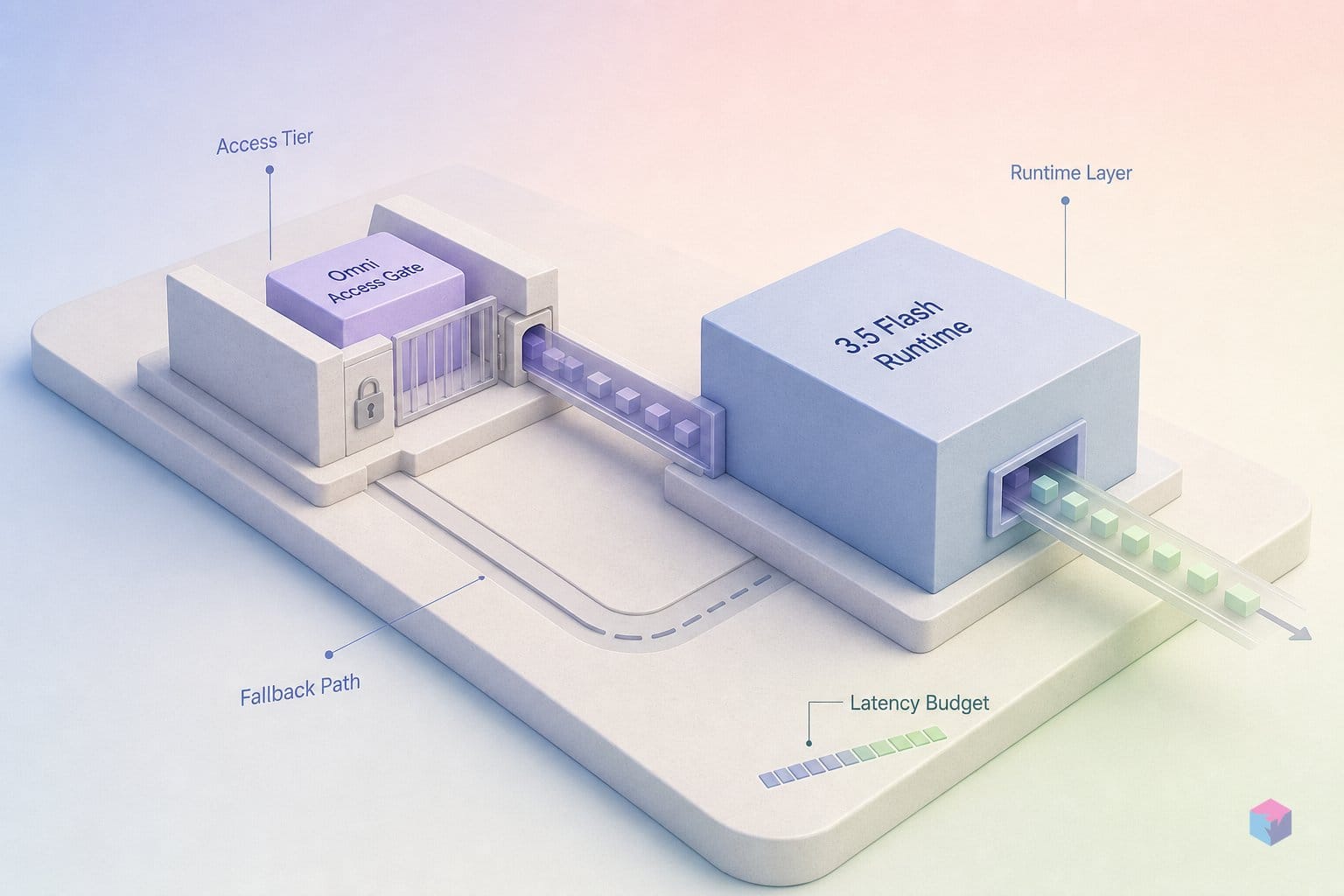
Two adjacent Gemini models exist for jobs where calling gemini-3.5-flash would be overkill or simply wrong: real-time speech translation and high-volume lightweight processing. Reaching for the flagship Flash model by brand recognition is the most common source of avoidable spend — match the model to the output type, not the name. For audio-to-audio you want gemini-3.5-live-translate-preview; for cheap text classification and extraction at scale you want gemini-3.1-flash-lite.
gemini-3.5-live-translate-preview is the dedicated audio-to-audio model for live speech, covering 70+ languages at $3.50 per 1M audio input tokens and $21.00 per 1M audio output tokens — roughly $0.0368 per minute combined . This matters because gemini-3.5-flash does not support audio generation or the Live API at all . Routing live interpretation or spoken-output workloads through Flash is not a price optimization problem — it is unsupported. Use the Live-Translate preview model directly for any real-time speech-to-speech pipeline.
For simple, repetitive work — classification, translation, key-value extraction, and lightweight document processing at volume — gemini-3.1-flash-lite is the cheapest current Gemini entry at $0.25 per 1M text, image, or video input tokens and $1.50 per 1M output tokens . Lite has no thinking step, which is exactly what you want when the task does not require reasoning: you pay for tokens, not deliberation. Against Flash at $1.50 input / $9.00 output, Lite is six times cheaper on input and six times cheaper on output — a margin that compounds fast on bulk pipelines.
One cost line is easy to miss: grounding is billed separately from token usage. Google Search and Maps grounding on the Gemini 3 line is free for the first 5,000 prompts per month, then $14 per 1,000 queries . For a search-grounded answer agent on gemini-3.5-flash, that surcharge can dominate the per-request cost once you clear the free tier, so model it explicitly rather than assuming token pricing covers everything.
The practical rule for this tier mirrors the rest of the lineup: decide by required output and reasoning depth, not by familiarity.
- Live speech in/out, 70+ languages →
gemini-3.5-live-translate-preview(Flash cannot do it). - Bulk classification, extraction, translation, no reasoning →
gemini-3.1-flash-lite(≈6× cheaper than Flash). - Reasoning, agentic tool use, structured outputs →
gemini-3.5-flash, and budget grounding queries on top.
3.5 Pro and Omni: No Date, No Price Card, No Model ID
Two of the most-discussed pieces of Google's I/O 2026 story are not yet buildable: Gemini 3.5 Pro and the Gemini Omni API both exist as announcements without the artifacts a developer needs to ship. Neither has a public model ID, neither has a pricing row, and as of late June 2026 neither has a confirmed availability date . If your plan depends on either, the correct status is "wait," not "evaluate."
Gemini 3.5 Pro was named at I/O on May 19, 2026, but Google described it as still in internal testing — no API model ID, no published context window, no pricing, and no confirmed benchmark figures . The Pro-class entry you can actually call in the API model list is still gemini-3.1-pro-preview . That gap matters for one reason in particular: any chart pitting Gemini 3.5 Pro against GPT-5.5 or Claude Opus is inference, not Google data. Hold the benchmarking until a public model ID drops and third parties can replicate the numbers — the same caution that applies to the 3.5 Flash vendor scores, which were still thinly confirmed by independent sources at publication .
Gemini Omni has the inverse problem: the consumer product shipped, but the developer surface did not. Google promised Gemini API and Agent Platform API access "in the coming weeks" after launch rather than at general availability, and published no model ID and no per-token pricing for it . A month on, that timeline remains open. So if your deliverable is generated footage, you are currently limited to the paid Gemini and Flow app surfaces — there is no backend you can wire into a pipeline yet.
One more Omni caveat for planning purposes: standalone image and audio output — distinct from the audio already embedded in generated video — is on the roadmap but has not shipped in any surface . Today Omni outputs video, full stop.
The concrete takeaway: build on what has a model ID and a price card today. gemini-3.5-flash is GA and callable; gemini-3.1-flash-lite and gemini-3.5-live-translate-preview cover the cheap and the speech edges. Treat 3.5 Pro and the Omni API as announcements to track, not dependencies to commit to — revisit each only when Google publishes the model ID, the pricing, and the date together .
Frequently asked questions
Can I call Gemini Omni from my code today?
No. As of late June 2026, Google has published no model ID, API endpoint, or per-token pricing for Gemini Omni. Developer and enterprise access through the Gemini API and Agent Platform API was promised "in the coming weeks" after I/O 2026 but has not shipped . Right now Omni is reachable only inside the Gemini app and Google Flow, gated behind a paid Google AI Plus, Pro, or Ultra subscription. Treat it as a product surface to track, not a backend you can integrate.
What model ID do I use for agentic coding tasks?
Use gemini-3.5-flash. It has been generally available since May 19, 2026 and is the recommended default for agentic workloads in the 3.5 generation . It supports function calling, thinking, code execution, multi-step tool use, and Search and Maps grounding, and Google reports a Terminal-Bench 2.1 score of 76.2% on agentic coding . Those figures are vendor-reported and were not independently reproduced at publication, so benchmark them against your own task before committing.
My code calls gemini-2.0-flash — what replaces it?
Gemini 2.0 Flash and 2.0 Flash-Lite were shut down on June 1, 2026 . Swap to gemini-3.5-flash for most workloads, or gemini-3.1-flash-lite for cost-sensitive extraction. One exception: Computer Use workloads must stay on gemini-3-flash-preview, because 3.5 Flash dropped Computer Use entirely . Also retest cost and latency: 3.5 Flash is more expensive than Gemini 3 Flash Preview and changes default thinking effort from high to medium.
Which Gemini model is cheapest for bulk classification?
Use gemini-3.1-flash-lite at $0.25 per 1M input tokens — well below 3.5 Flash at $1.50 per 1M input . Flash-Lite has no thinking and no grounding, but that is the right trade for translation, classification, and lightweight extraction at scale. Reserve 3.5 Flash for work that needs reasoning, tool use, or grounded answers, where the higher rate buys capability you actually consume.
When will Gemini 3.5 Pro be available via API?
No date has been announced. Gemini 3.5 Pro was shown at I/O 2026 but remains in internal testing with no published model ID, pricing, or context window . As of late June 2026, the Pro-class entry in the Gemini API model list is still gemini-3.1-pro-preview . Any 3.5 Pro-versus-rivals comparison circulating now is inference, not Google data — wait for the model ID, pricing, and a release date to land together.