
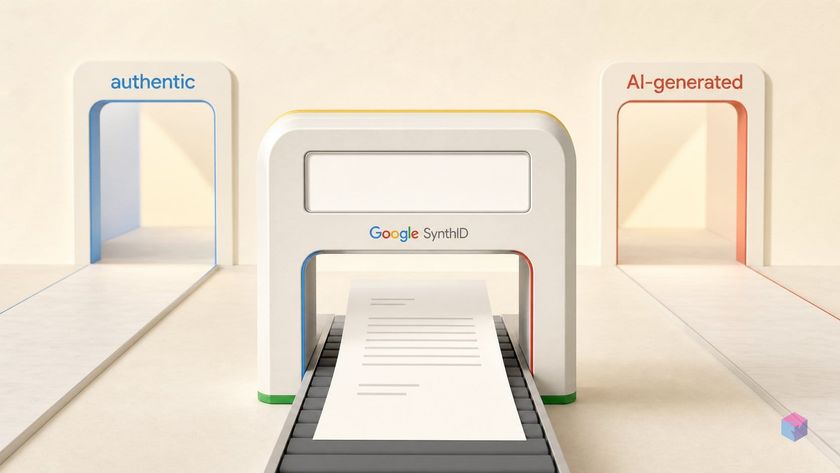
Provenance tooling just stopped being a specialist's portal. On May 19, 2026, Google folded AI-content verification into the surfaces developers and their users already touch every day — and backed it with watermark counts that have jumped an order of magnitude in twelve months.
100 Billion Watermarks: Where the Provenance Announcement Landed
Google's May 19, 2026 announcement was a coordinated multi-surface deployment, not a single product launch. It pushed AI-media identification into six places at once — Search, the Gemini app, Chrome, Pixel, Google Photos, and Google Cloud — rather than shipping one new detector . The framing matters: this is distribution, not invention. The underlying watermark and metadata standards already existed; what changed is where you can check them.
The scale numbers are the clearest signal of momentum. Google says SynthID — the imperceptible watermark from Google DeepMind — has now tagged more than 100 billion images and videos plus roughly 60,000 years of audio . That is up from the more than 10 billion pieces cited at the May 2025 SynthID Detector early-tester launch and over 20 billion at the November 2025 Gemini image-verification debut . Gemini's verification feature has itself been used about 50 million times globally since that November launch, and now covers images, videos, and audio — not just still images .
Three distinct mechanisms ship together, and the distinction is the whole point:
- SynthID watermark — embedded directly into the pixels or audio, durable through re-encodes and crops, but carrying little context .
- C2PA Content Credentials — a cryptographically signed manifest recording who, what tool, and what edits, but easily stripped by format changes or screenshots .
- Cloud AI Content Detection API — a programmatic, server-side detector on the Gemini Enterprise Agent Platform, initially for SynthID-watermarked content .
The pairing of the two consumer layers is deliberate. As Google frames it in its transparency documentation, "Content Credentials carry rich context but can be removed, while a watermark survives metadata loss" — so neither is sufficient on its own . For builders, that dual-layer logic — and its gaps — is what the rest of this analysis unpacks.
SynthID vs. C2PA: Why Neither Layer Is Sufficient Alone

SynthID and C2PA Content Credentials solve different halves of the provenance problem, which is why Google ships both. SynthID is an imperceptible watermark embedded directly in pixel or audio data, so it survives lossy re-encoding, cropping, and metadata stripping — but it carries no context beyond "a participating generator produced or edited this file." C2PA is a cryptographically-signed manifest recording origin, editing tool, timestamps, and the full edit chain — rich context, but a single screenshot, resize, or format conversion breaks the signature entirely .
The two failure modes are inverse, and that is the design. When social-media re-compression strips C2PA metadata, the SynthID layer still flags origin; when SynthID is absent because a non-participating generator made the file, surviving C2PA metadata may still document downstream edits. Google states the tradeoff plainly in its transparency documentation: Content Credentials carry rich context but can be removed, while a watermark survives metadata loss . Neither, in isolation, is a reliable signal — together they cover more of the distribution.
| Property | SynthID (watermark) | C2PA Content Credentials (manifest) |
|---|---|---|
| What it stores | Origin flag only — "watermarked by a participating generator" | Origin, tool, timestamps, full edit chain |
| Survives re-encoding / cropping | Yes | No |
| Survives metadata stripping | Yes | No — chain invalidated |
| Broken by screenshot / resize | Often survives | Yes, entirely |
| Context richness | Minimal | High |
For builders, the practical read is that you treat the two layers as an OR, not an AND. A file that fails C2PA verification is not automatically non-AI — its manifest may simply have been stripped by an intermediary, and a watermark check is the fallback. Conversely, intact Content Credentials give you the edit history the watermark cannot. Both Google and OpenAI converged on the same dual-layer baseline: OpenAI confirmed on May 19, 2026 that it is attaching SynthID to images generated through ChatGPT, Codex, and the OpenAI API alongside the C2PA credentials it already embeds .
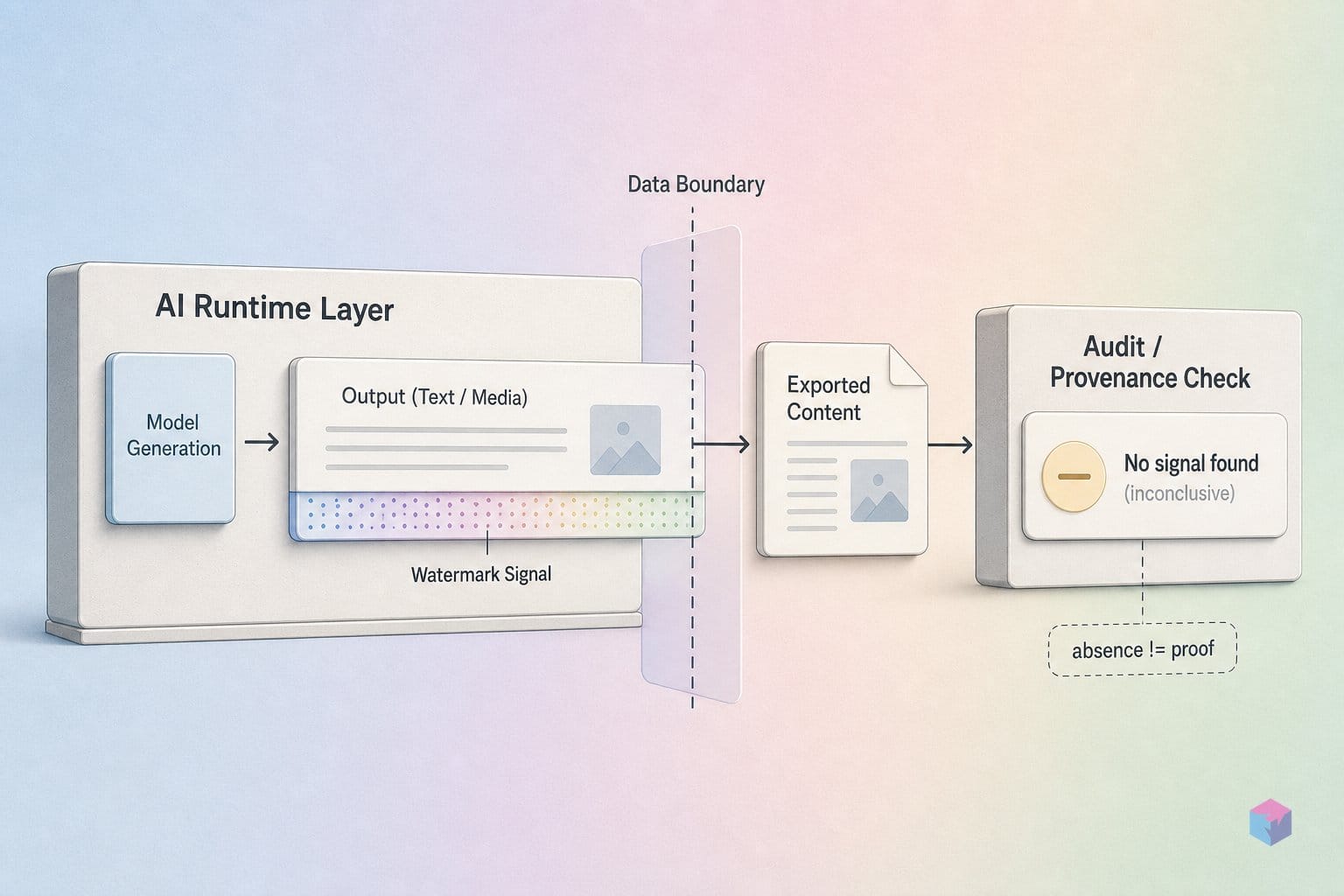
The shared blind spot is explicit in both vendors' documentation: content from a generator that opted into neither standard has no signal to read at all. A missing watermark means a file was not detected as participating-generator output — not that it is human-made . Coverage is widening regardless: the C2PA consortium launched Content Credentials 2.3 on February 9, 2026, reporting more than 6,000 members and affiliates with live applications . But broader adoption narrows the blind spot without closing it — any output outside both schemes still returns nothing, which is exactly why a blank result proves nothing on its own.
Checking a Video in the App: Concrete Thresholds and What Gets Flagged
Verifying a clip in the Gemini app is gated by hard upload limits, not just a yes/no answer. Signed-in users upload one media file per request, capped at 100 MB, with videos under 90 seconds and audio under 1 hour . Daily quotas are equally concrete: roughly 10 image checks, 10 video checks totaling 5 minutes, and 3 hours of audio per signed-in user . Plan around them before scripting any verification step into a review flow.
Quick Answer: Gemini accepts one file per check (≤100 MB, video <90s, audio <1h), with about 10 image checks, 10 video checks (5 min total), and 3 hours of audio daily per signed-in user. It returns segment-level findings — e.g., SynthID detected in audio between 10–20 seconds — not a binary verdict .
The output is more useful than a pass/fail flag. Gemini scans for the SynthID watermark across both the audio and visual tracks of a video and uses reasoning to specify which portions contain AI-generated elements — for example, flagging that SynthID was detected in the audio between 10 and 20 seconds . That segment-level granularity is what makes the feature worth wiring into a moderation or fact-check workflow rather than treating detection as a single boolean.
Rollout state matters because the surfaces lag each other. The table below summarizes where each layer stood on announcement day . Note also that C2PA version support differs by surface: Google Photos handles versions 2.1 and 2.2, while Gemini Apps accept 2.2 and later from conforming products — a compatibility gap worth checking before assuming a credential will read the same way everywhere.
| Surface | SynthID verification | C2PA Content Credentials |
|---|---|---|
| Gemini app | Live (images, video, audio) | Live from May 19, 2026 |
| Search | Expanding from May 19, 2026 | Planned in following months |
| Chrome | Rolling out over coming weeks | Planned (after Search) |
So the practical read on day one: Gemini is the only surface where you can run both checks end to end, Search gets the watermark layer first, and Chrome plus C2PA-in-Search trail by weeks to months .
Pixel's C2PA Implementation: Assurance Level 2 and the Capture Side
Pixel 10 is the first Pixel lineup to embed C2PA Content Credentials into every photo at capture time, signed by Pixel Camera and certified at C2PA Conformance Program Assurance Level 2 — the highest rating defined when it shipped . That matters because the provenance discussion so far has been about detecting AI after the fact; the capture side flips it, attaching a signed origin record the moment the shutter fires, before any AI surface ever sees the file.
The hardware chain is what earns the AL2 rating. Signing runs on Tensor G5 with the Titan M2 security chip, Android hardware-backed attestation, and StrongBox key storage, and Pixel supports on-device trusted timestamps so offline capture does not need a network round-trip to assert when a photo was taken . For developers used to reasoning about key custody, the design is deliberately privacy-preserving: each image is signed with a one-time certificate, so photos cannot be cryptographically linked to one another or traced back to a specific device owner across sessions . You get verifiable provenance without a per-device fingerprint riding along in the manifest.
"Pixel 10 is the first lineup with C2PA Content Credentials built into every photo from Pixel Camera, achieving C2PA Conformance Program Assurance Level 2 — the highest rating then defined." — Google, Pixel and Android security team (source: Google Security Blog)
The capture story is widening beyond stills and beyond the newest device. In the weeks following the May 19, 2026 announcement, Pixel 8, Pixel 9, and Pixel 10 are set to gain Content Credentials for video, extending signing to a format that has so far lagged images . On the reading side, Google Photos exposes a "How this was made" section for supported images, breaking provenance into up to four categories — media composition, AI edits, possible AI edits, and non-AI edits — on Android and iOS, though it is not currently shown on Google Photos web .
One compatibility detail is worth flagging if you build against this: Photos supports C2PA versions 2.1 and 2.2, while Gemini Apps accept 2.2 and later from conforming products . A manifest written by one surface is not guaranteed to read cleanly on another, so version negotiation is a real concern, not a footnote.
Industry Convergence: ChatGPT, Meta, NVIDIA, and YouTube Join the Standard
The version-negotiation problem matters more now because the same dual-signal stack is no longer Google's alone. On May 19, 2026, OpenAI confirmed it is adding Google DeepMind's SynthID watermark to images generated through ChatGPT, Codex, and the OpenAI API — alongside the C2PA Content Credentials it already attaches — and previewed a public verification tool that checks for both signals at once . That is the detail behind this article's title: an image you made in ChatGPT now carries a SynthID mark, so a "no watermark detected" result in Gemini or OpenAI's tool means the file was not identified as participating AI output — not that a human shot it.
Convergence is the operative word. Google's announcement lists OpenAI, Kakao, and ElevenLabs extending SynthID to more of their AI-generated content, and NVIDIA applying it to output from its Cosmos world-foundation models . Meta's Instagram will label camera-captured media with Content Credentials, pushing C2PA onto the capture side of one of the largest media pipelines on the internet .
OpenAI's position, per its May 2026 confirmation, is that durable watermarking and signed metadata are complementary rather than competing — SynthID survives metadata loss while Content Credentials carry richer edit history, so it ships both. — OpenAI, as reported by The Next Web
| Adopter | Provenance action | Signal |
|---|---|---|
| OpenAI (ChatGPT, Codex, API) | Watermark + signed manifest on generated images; dual-signal verifier | SynthID + C2PA |
| Meta (Instagram) | Labels camera-captured media | C2PA Content Credentials |
| NVIDIA | Marks Cosmos world-foundation model output | SynthID |
| Kakao, ElevenLabs | Extend watermarking to more generated content | SynthID |
The underlying standard kept moving in parallel. C2PA launched Content Credentials 2.3 on February 9, 2026, citing more than 6,000 members and affiliates with live applications, and added live video, plain text files, OGG Vorbis audio, clearer editing history, and stronger tamper validation . Its steering committee already includes Google, Meta, Microsoft, OpenAI, Sony, Adobe, Amazon, and the BBC — which is why two of those names shipping SynthID on the same day reads less like a partnership announcement and more like a baseline forming.
Distribution platforms are tightening the loop. YouTube said on May 27, 2026 that AI disclosure labels for photorealistic or meaningfully AI-altered content will move below the player on long-form videos and into Shorts overlays, and that from May 2026 it will use internal signals plus C2PA metadata from fully generative content to automatically label significant undisclosed photorealistic AI use . For builders, the takeaway is concrete: the interoperable contract is now "attach both a durable watermark and a signed manifest," and the platforms reading those signals are multiplying faster than any single detector.
The Cloud Detection Interface: Programmatic Provenance for Deployed Applications

The server-side counterpart to the consumer checks is the Google Cloud AI Content Detection API, launched on the Gemini Enterprise Agent Platform with a set of trusted partners . It is built for the case the Gemini app cannot serve: high-volume media verification inside a pipeline, not one upload at a time. Where a signed-in user checks a single file under published quotas, the API is meant to scan media programmatically as it flows through an ingestion or moderation system.
Scope at announcement is narrow and worth stating plainly. The initial capability identifies SynthID-watermarked content only — the same constraint that applies everywhere SynthID is read: an absent watermark means "not detected as Google-lineage AI," not "human-made." More relevant for anyone scoping an integration, Google has not published precision or recall figures for the API, has not listed the third-party model families it can recognize, and has not disclosed pricing tiers or general-availability terms . Treat it as a partner-gated preview, not a priced product you can wire into production today.
Text is a separate track. Google open-sourced SynthID text watermarking earlier, which means developers can embed and verify watermarks in LLM-generated text directly, without routing through the Cloud API . For text workloads, that self-hosted path may matter more than the detection endpoint.
The integration pattern is the part to internalize before writing code: no single call covers both provenance signals. The Cloud API reads the SynthID watermark; C2PA Content Credentials are signed metadata you parse yourself. Because the manifest is strippable while the watermark survives metadata loss, a robust verifier has to run both paths independently and reconcile the results . Practically:
- Watermark path: send the media to the Cloud detection API (or self-host SynthID for text) and capture the SynthID verdict per track or segment.
- Manifest path: parse any attached C2PA manifest for origin, tool, and edit history, then validate its cryptographic chain to confirm it was not broken in transit.
- Reconcile: a present watermark with a stripped manifest is still strong evidence; a valid manifest with no watermark is plausible for non-Google generators. Neither alone is conclusive.
Known Failures: What Both Layers Cannot Catch
The provenance stack has a hard coverage boundary: it only sees content that participating tools chose to mark. SynthID detection works exclusively on SynthID-watermarked media, and a clean result means "not detected as Google AI content," not "verified as human-made" . OpenAI states the same caveat for its own verification preview . The practical gap is large: most open-weight generators — Stable Diffusion, Midjourney, and the long tail of self-hosted models — emit no watermark and no signed manifest, so their output passes through every Google surface as "not detected." For a developer building a moderation pipeline, that is the defining limitation, not an edge case.
The C2PA layer fails on ordinary handling. A signed manifest breaks on the operations that dominate real-world sharing:
- Screenshotting an image or video frame
- JPEG or WebP recompression
- Re-upload through a social platform that re-encodes media
- Resizing or format conversion
Any of these strips or invalidates the cryptographic chain . That fragility is the entire reason the watermark exists as a second layer — but the watermark has its own degradation profile. SynthID detection weakens on low-detail or simple content, on very minor AI edits, under heavy repeated re-encoding, and against adversarial perturbations engineered to suppress the signal . Google is also explicit that Content Credentials do not prove a file is real or fake — only what its declared history claims .
The deeper problem for anyone deploying this is measurement. Google has not published precision, recall, or false-positive rates for the Gemini verification feature or the Cloud AI Content Detection API, has not enumerated all supported third-party model families, and has not disclosed pricing or general-availability terms for the API . Without those numbers, independent evaluation of detection reliability is not currently possible from public information — you cannot calculate how often the system misses real AI content or flags clean content in error.
The takeaway is narrow and worth holding onto: treat a positive detection as a useful signal and a negative as nearly meaningless. Build provenance checks as one input among several, log the verdict per layer rather than collapsing it to a boolean, and wait for published benchmarks before letting any of these tools gate a decision on their own.
Frequently asked questions
What is the difference between SynthID and C2PA Content Credentials?
SynthID is an imperceptible watermark from Google DeepMind embedded directly into the media bits, so it survives metadata stripping and re-encoding but carries minimal context. C2PA Content Credentials are cryptographically-signed manifests documenting origin, tools, and edit history — rich context, but broken by screenshots, resizing, or format changes . Google pairs both deliberately: each layer compensates for the other's failure mode, so neither is treated as sufficient alone .
Does a missing SynthID watermark mean content is not AI-generated?
No. A clean result means the file was not detected as SynthID-watermarked — not that it is non-AI. Non-participating generators, screenshots, adversarial perturbations, and heavy re-encoding can all return a negative on genuinely AI-generated content. Google's own documentation states this explicitly: a missing watermark means a file was not detected as Google AI content, nothing more . Simple content, very small edits, or repeated alterations can also prevent detection .
What are the verification limits for the Gemini app's media checking feature?
Files must be 100 MB or less, videos under 90 seconds each, and audio under 1 hour. Approximate daily quotas are 10 image checks, 10 video checks totaling 5 minutes of footage, and 3 hours of audio, and these apply to signed-in users uploading one file at a time . The same check is also surfaced through Lens, AI Mode, Circle to Search, and Gemini in Chrome .
Is the Google Cloud AI Content Detection API publicly available, and what does it cost?
Not generally. As of the May 19, 2026 announcement, the API launched on Google Cloud's Gemini Enterprise Agent Platform with trusted partners, giving server-side programmatic detection of AI-generated media — initially SynthID-watermarked content . Google has not published pricing tiers, SLA terms, or a general-availability date, and has not released precision or recall benchmarks for the API. Teams that need it should contact Google Cloud for early access.
Which AI generators currently embed SynthID watermarks?
Google's own generators embed SynthID: Gemini, Imagen, Lyria (audio), Veo (video), and NotebookLM podcast outputs . Confirmed third-party adopters as of May 2026 are OpenAI (ChatGPT, Codex, and API image outputs), NVIDIA (Cosmos world-foundation models), Kakao, and ElevenLabs . Open-weight and most independent generators are not covered, which is the practical reason a negative result proves nothing.