

A production team ran GPT-4o against DeepSeek V4 Flash for two weeks on real traffic. The bill fell 97.5% and the quality gap did not survive a significance test.
The $487 → $12 canary result, annotated
The migration is documented in a practitioner case study that moved a live workload off GPT-4o and measured the result over a 14-day, 10% canary. GPT-4o is the baseline here: it lists at $2.50 per million input tokens and $10.00 per million output tokens, scores roughly 33.2% on SWE-bench Verified, and serves at about 380ms time-to-first-token and ~92 tokens/sec . DeepSeek V4 Flash lists at $0.14/$0.28 — roughly 18× cheaper on input and 36× cheaper on output .
Against that line, the reported outcome was a monthly spend dropping from $487.32 to $11.94, a 97.5% reduction, with a blind 1–5 quality rubric scoring 4.31 for GPT-4o versus 4.18 for V4 Flash — a 0.13-point delta that did not reach significance (p=0.31) . V4 Flash was also faster at every latency percentile measured .
| Metric | GPT-4o | DeepSeek V4 Flash |
|---|---|---|
| Price (input/output per M) | $2.50 / $10.00 | $0.14 / $0.28 |
| Monthly bill (this workload) | $487.32 | $11.94 |
| Blind quality (1–5 rubric) | 4.31 | 4.18 |
| Latency p50 / p95 / p99 | 412 / 1,180 / 2,340ms | 385 / 980 / 1,760ms |
The headline is not that a cheaper model exists — it is that on this traffic the cheaper model won on cost and latency while the quality difference was statistically indistinguishable. As the author of the case study put it, the switch cut the bill 97.5% with no measurable user-satisfaction change . The sections below cover what to verify before you copy that path.
Before migrating: contamination caveat and scaffold variance
Before you trust a vendor's SWE-bench number, know that the leaderboard itself is under pressure. SWE-bench Verified now faces contamination concerns — OpenAI reportedly withdrew a result in February 2026 after public-repo ground-truth leaked into training data . The response was SWE-bench Pro, which draws from actively-maintained repositories with no published answers to memorize .
The bigger trap is the scaffold gap. When independent evaluators run models through identical scaffolding — as Scale AI does — scores land 10–30 points below vendor-reported numbers . The difference is not raw model capability; it is the quality of context retrieval and tool use in each vendor's tuned agent harness. A headline SWE-bench score is therefore not comparable across labs unless every model ran through the same scaffold.
That matters because the frontier is now tightly clustered. GPT-5.5 sits at ~88.7%, Anthropic's Opus 4.8 at ~88.6%, and DeepSeek V4 Pro at ~80.6% on SWE-bench Verified . A sub-one-point headline gap between two of those is noise without identical scaffolding — not signal you can act on.
The practical move: treat vendor SWE-bench scores as directional only. Rank candidates loosely by them, then run a live canary rubric on your own traffic — as the $487→$12 case study did over 14 days — before committing any volume.
Running a 10% canary on DeepSeek V4 Flash
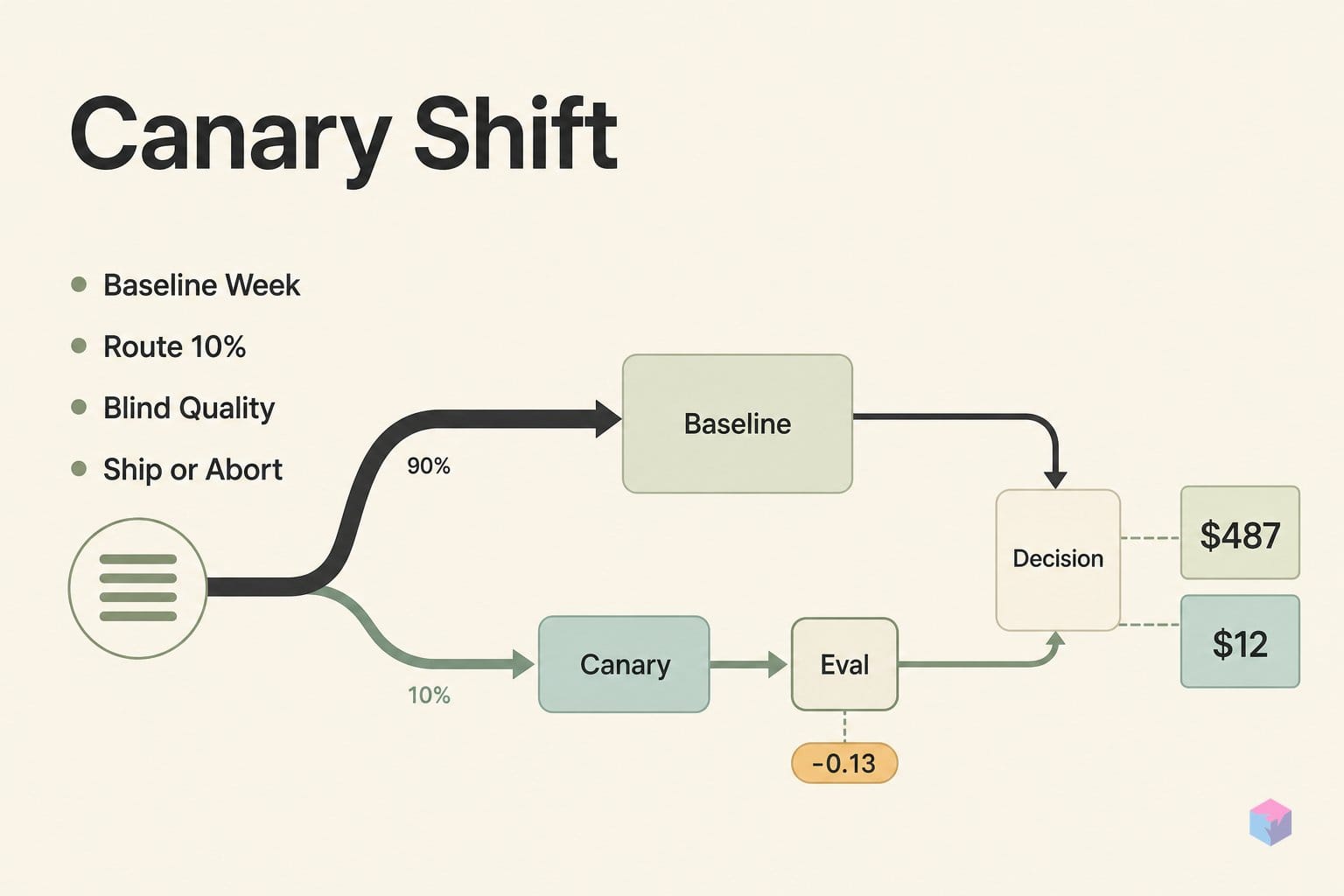
A canary migration routes a small slice of live traffic to the candidate model, measures quality and latency blind, then either ships or aborts on data. The $487→$12 case study ran exactly this over 14 days: a 10% completion canary that cut monthly spend from $487.32 to $11.94 while blind quality fell only 0.13 points on a 1–5 rubric . Here is the runnable version of that process.
- Baseline snapshot. Log a full week of GPT-4o spend broken out by call type — completions, embeddings, vision — to fix a dollar-per-call reference. Without this you can't attribute savings later. GPT-4o bills $2.50/$10.00 per million input/output tokens, versus $0.14/$0.28 for V4 Flash , so the expected delta is roughly 40x on output.
- Route 10%. Add a request-level flag or a drop-in LLM proxy that forwards 10% of completion volume to V4 Flash. Keep temperature, system prompt, and max-tokens identical across both paths — any difference contaminates the comparison.
- Blind quality rubric. Have an independent rater score 200+ paired responses on a 1–5 scale with no model label visible. The case study measured 4.31 (GPT-4o) versus 4.18 (V4 Flash) with no significant user-satisfaction difference at p=0.31 .
- Latency distribution. Capture p50/p95/p99 separately — averages hide the tail behavior that breaks interactive UX. V4 Flash returned 385/980/1,760ms against GPT-4o's 412/1,180/2,340ms , faster at every percentile.
- Ship or abort. At 14 days, if the quality delta's p-value is ≥ 0.05 and p99 latency stays inside your SLA, roll to 100%. Otherwise hold at 10% and investigate the failing slice.
Invisible surcharges and p99 spread to anticipate
The headline price is not the billed price. Reasoning-mode models generate hidden "thinking" tokens that are charged at output rates, which can push effective cost to 3–10× the sticker figure . Before you extrapolate DeepSeek V4 Flash's $0.14/$0.28 per million tokens across your volume , confirm whether thinking mode is on by default for your endpoint — a canary that silently ran in reasoning mode will understate your production bill.
Prompt caching moves the comparison the other way. Anthropic's roughly 90% cache discount drops effective Sonnet-class input to about $0.30 per million tokens . For high-repetition prompt patterns — shared system prompts, retrieval context reused across calls — that can make Claude Sonnet 5 (list price $2/$10) competitive with V4 Flash on effective input cost, so run the math against your actual cache-hit rate, not the list table.
Finally, treat pricing as drift, not a constant. Live provider pages move faster than aggregator snapshots, and 2026 has seen 60–80% average price erosion since early 2025 . Verify against the provider's own pricing page before locking in any volume commitment.
When to escalate and which alternatives to consider
Escalate only when the quality gap is measurable in your own rubric, not because a leaderboard says so. For most workloads the V4 Flash tier is enough; the ladder above it exists for specific failure modes. Hard agentic coding — multi-step, autonomous edits across a repo — is where Flash starts to slip and DeepSeek V4 Pro earns its place: it lists at $1.74/$3.48 per million tokens and scores roughly 80.6% on SWE-bench Verified, still cheaper than GPT-4o on output while materially more capable on tool-use-heavy tasks.
The frontier ceiling is real but narrow. Opus 4.8 (~88.6%) and GPT-5.5 (~88.7%) run about 10× the V4 Flash price — justified only on low-volume critical paths where a single error is expensive. If self-hosting or data sovereignty constrains you, GLM-5.2 ($1.40/$4.40 per million) is the open-weight play; it has reportedly beaten GPT-5.5 on SWE-bench Pro in select runs.
The takeaway (결): make capability-based routing your default — V4 Flash or Gemini Flash-Lite for high-volume simple calls, V4 Pro for coding, frontier models reserved for the rare tasks where your own evals show a gap. Measure, route, and re-check prices before every volume commitment.
Frequently asked questions
Is DeepSeek V4 Flash actually better than GPT-4o on SWE-bench Verified?
On aggregator leaderboards, yes: DeepSeek V4 Flash benchmarks above GPT-4o's 33.2% SWE-bench Verified score. But treat that gap cautiously — vendor-reported numbers diverge 10–30 points from independent same-harness runs because labs tune their own agent scaffolding. The stronger production signal comes from the migration canary itself: a blind 1–5 quality rubric showed only a 0.13-point drop (4.31 vs 4.18) with no statistically significant user-satisfaction difference (p=0.31). Your own eval on your own traffic beats any leaderboard row.
What is a realistic monthly saving for a mid-sized workload?
The cited case study cut a production bill from $487.32 to $11.94 per month — a 97.5% reduction over a 14-day canary, with no statistically significant user-satisfaction change. Your figure depends on your output-to-input ratio: output tokens carry the biggest multiplier, since V4 Flash lists at $0.14/$0.28 per million versus GPT-4o's $2.50/$10.00 — roughly 36× cheaper on output. Output-heavy workloads (generation, long completions) save the most; input-heavy retrieval workloads save less.
Why can't I directly compare vendor SWE-bench scores across labs?
Because each vendor runs its model through a tuned agent harness with optimized context retrieval and tool-use setup, and those harnesses are not standardized. Independent runs on identical scaffolding score models 10–30 points lower than vendor-reported numbers, and the gap is mostly harness quality rather than raw model capability. A sub-5-point difference between two leaderboard rows is likely scaffold noise, not a real capability delta. Compare same-harness numbers or SWE-bench Pro results before committing to volume.
Do thinking or reasoning tokens increase the effective API cost?
Yes. In reasoning mode, models generate hidden "thinking" tokens that are billed at output-token rates even though you never see them. For long reasoning chains this can inflate effective cost 3–10× above the headline rate. Before you benchmark cost, check whether the model's thinking mode is enabled by default and measure a representative sample of real requests — a headline per-token price tells you little if half your billed output is invisible reasoning.
When should I escalate past V4 Flash to a more expensive model?
Escalate when your blind quality delta becomes statistically significant (p<0.05), or when the task is hard agentic, multi-step coding rather than high-volume simple calls. For difficult coding, DeepSeek V4 Pro ($1.74/$3.48) scores ~80.6% on SWE-bench Verified; for the hardest reasoning, Anthropic's Opus 4.8 (~88.6%) or GPT-5.5 (~88.7%) is worth the premium. The rule is capability-based routing, not one model for every call: cheap tiers for simple high-volume work, mid-tier for coding, frontier models reserved for the rare tasks where your own evals show a measurable gap.
Enjoyed this article? Subscribe to get new stories by email whenever they're published.