
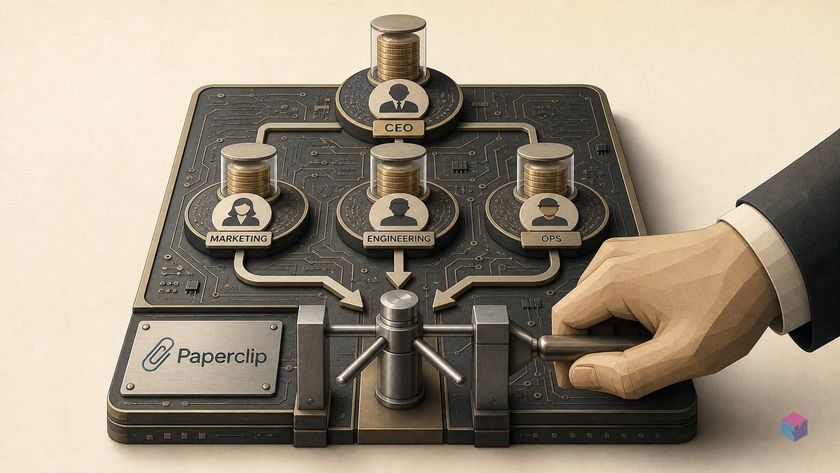
What Does Paperclip Do?
Paperclip is an open-source orchestration layer that models a business as a coordinated team of specialized AI agents rather than a single assistant answering prompts — its slogan frames it as "If Claude is an employee, Paperclip is the company" . Instead of one chat window, you define a mission and Paperclip stands up an org chart of role-scoped agents that report, delegate, and carry work along a shared goal chain.
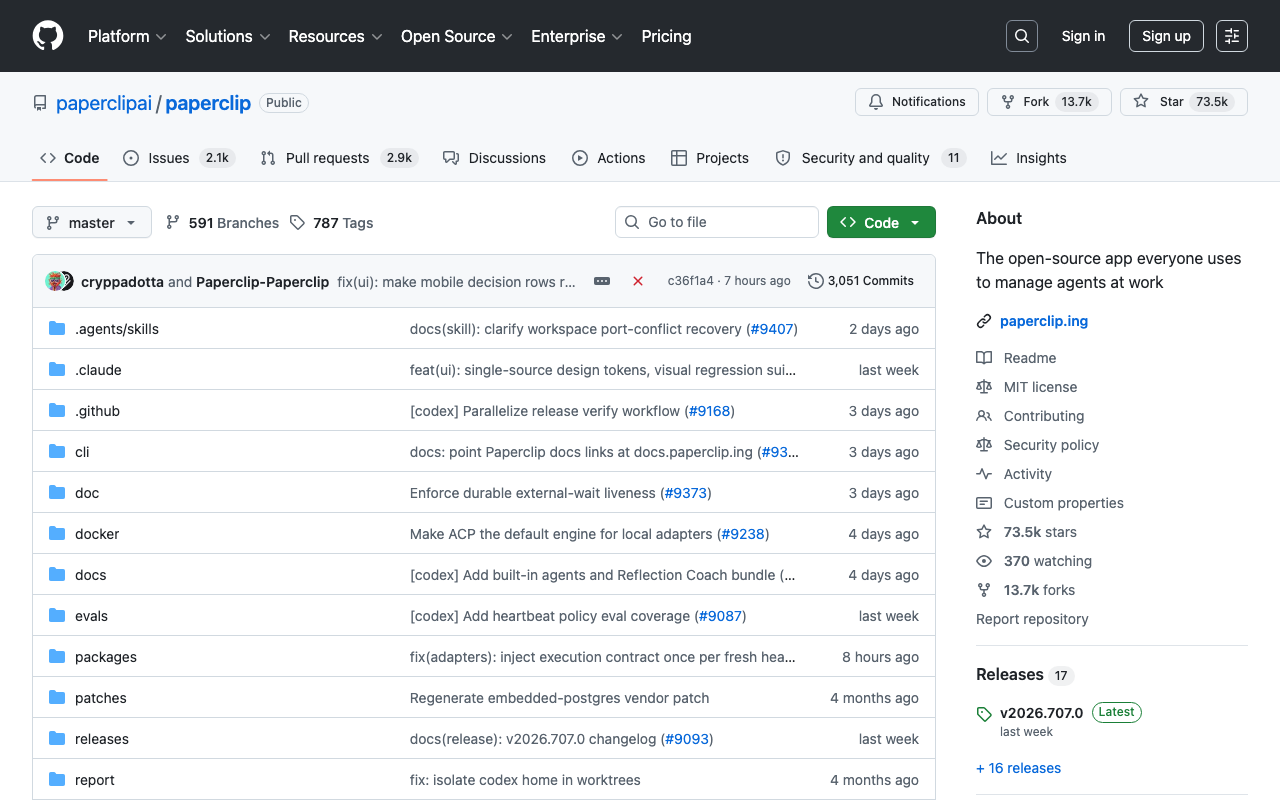
The project has traction to match the pitch. As of the July 2026 fetch its GitHub repo showed roughly 73.5k stars and 13.7k forks , with the latest release tagged v2026.707.0 on July 7, 2026 . It is MIT licensed (© 2026 Paperclip Labs, Inc.) .
Architecturally it is deliberately conventional: a Node.js server plus a React dashboard backed by PostgreSQL, fully self-hosted with no Paperclip account required . A single onboarding command launches a browser-based wizard to create your first company:
npx paperclipai onboard --yesThat command, documented on both the repo and the official site , is the fastest way to see the "company, not chatbot" abstraction in practice. The sections below unpack how it hires, throttles, and governs those agents.
How a Mission Becomes a Department
The "hiring" step is where Paperclip's company abstraction becomes concrete. During onboarding you supply a mission and a goal, and an AI CEO agent — branded "Zeus" in several write-ups — analyzes that goal, decides which roles it needs, and generates an org chart of specialized agents with titles, job descriptions, and reporting lines . Instead of one assistant answering a prompt, you get marketing, engineering, sales, and ops agents wired into a hierarchy before any work starts.
Every ticket then carries what the project calls "goal ancestry" — a mission → goal → project → task chain, so an agent picking up a task can trace the "why" above the immediate instruction rather than acting on an isolated line item . In practice this is the difference between an agent told "draft a launch email" and one that also sees the launch goal and parent mission the email is meant to serve, which shapes tone, claims, and priority.
Execution runs on a heartbeat, not a user-driven polling loop. Agents wake on a schedule, check for work that is checked out to them, act, and delegate up or down the reporting line as needed . Two reliability primitives sit underneath:
- Atomic task checkout — a task is claimed atomically so two agents cannot pick up the same ticket and duplicate work .
- Persistent agent state across heartbeats — when an agent wakes again, the task resumes with its prior context instead of restarting from scratch .
That state model is worth flagging early: continuity holds within a task's lifecycle across heartbeats, but hands-on reviewers note agents do not remember previous sessions by default, so longer-horizon memory still needs a deliberate layer . The org chart schedules the work; keeping context alive beyond a single task is still on the operator.
Enforced Throttling and the Board Seat
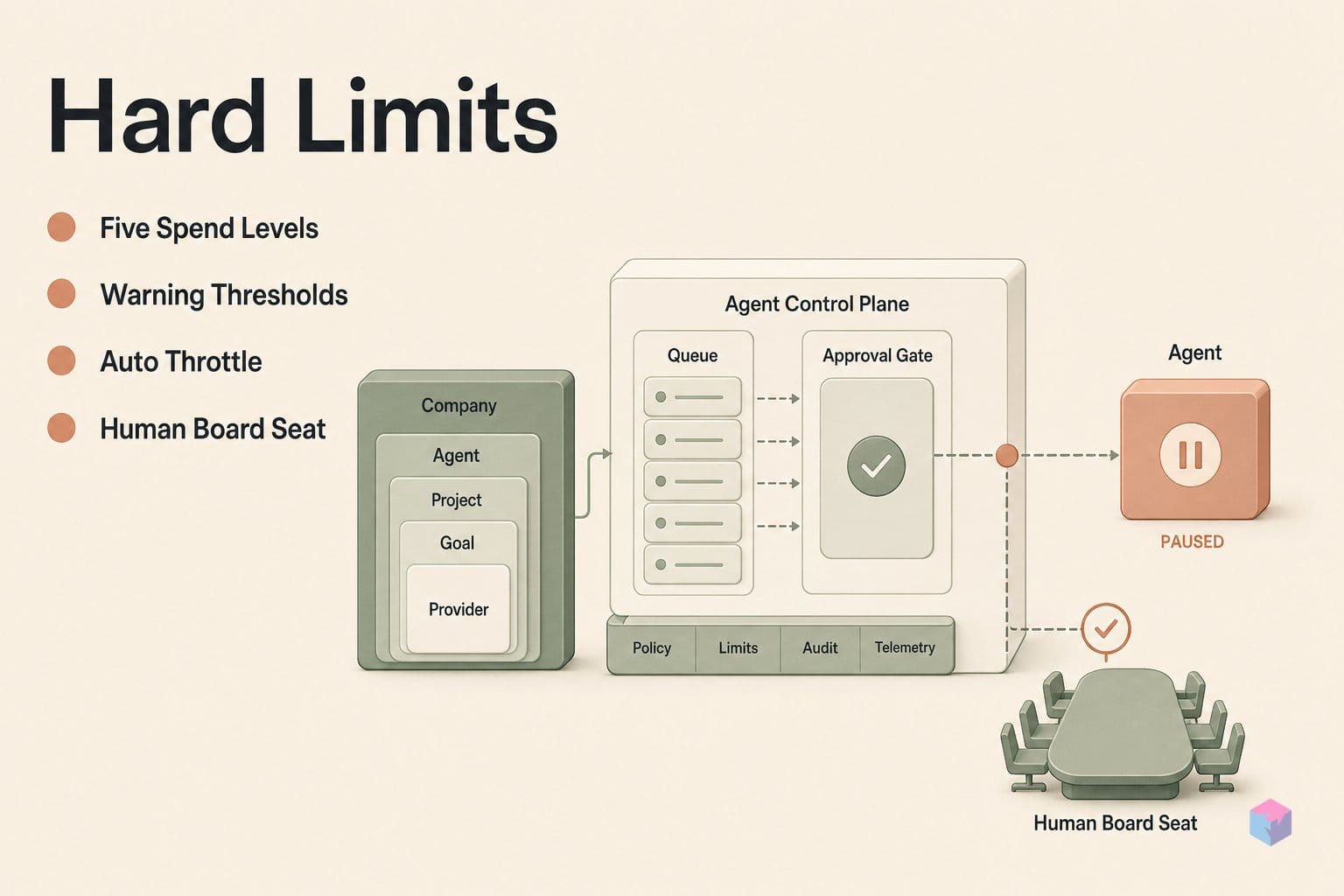
The org chart decides who works; the control plane decides how far they can go before a human intervenes. Paperclip tracks token and dollar spend at five levels — company, agent, project, goal, and provider — so cost is attributable rather than pooled . Warning thresholds fire alerts before a ceiling is reached, and at 100% utilization the system auto-throttles and pauses the offending agent rather than trusting it to stop . The framing is deliberate:
"Hard limits, enforced by the system, not by convention." — Paperclip project documentation (source: paperclipai/paperclip)
That distinction matters to anyone who has watched a tool loop burn through an API quota overnight. Most agent runtimes leave budgeting to the caller; here it is a first-class, scoped primitive, which is one of the clearer separations between Paperclip and a raw framework you wire yourself.
Governance follows a board-of-directors model. A human approves hires and strategy and retains the power to pause, resume, reassign, override, or terminate any agent at any time . Two hard constraints anchor the design: an agent cannot autonomously hire other agents, and the AI CEO cannot execute an unreviewed strategy. The stated principle — "Autonomy is a privilege you grant, not a default" — reads as a direct answer to the runaway-autonomy anxiety that dogs multi-agent demos. You hold a board seat, not a spectator ticket.
Accountability rests on an append-only audit trail. Every ticket carries an owner, a status, and a thread, and every tool call and API request is logged with no edits or deletions permitted . For an operator, that immutability is the difference between reconstructing what an agent did and merely hoping it behaved — the same reason mature workforce platforms pair autonomy with audit exports and approval thresholds . One practical note: these guardrails are only as useful as the humans reading them, so budget alerts and the audit log are worth wiring into whatever channel your team actually watches.
73.5k Stars, v2026.707.0: The Repository Snapshot
Paperclip's momentum shows up in its GitHub numbers, though they are best read as vendor-stated rather than independently audited. The open-source project launched in early March 2026 and crossed 30,000 stars within roughly three weeks . By the July 2026 fetch the repository showed about 73,500 stars and 13,700 forks, with the latest release tagged v2026.707.0 on July 7, 2026 . A date-stamped versioning scheme releasing this recently signals active maintenance rather than a one-off launch spike.
The stack is conventional and self-hosted: a Node.js server with a React dashboard on PostgreSQL, MIT licensed under Paperclip Labs, Inc. Running it locally requires Node.js 20+ and pnpm 9.15+, and it ships with an embedded Postgres for quick local runs while recommending an external Postgres for production . Onboarding is a single command, npx paperclipai onboard --yes, which opens a browser wizard to create the first company .
Two README claims matter for teams evaluating it. A single deployment supports multi-company isolation with fully separate data per company, and companies are portable as templates that export and reimport with automatic secret scrubbing for safe sharing . One caveat worth flagging: a parallel research pass could not surface official docs, pricing, or a security page in live search, so treat these figures as sourced from the repo and official site, not third-party verification .
Plug In Any Executor — If It Can Receive a Heartbeat
Paperclip is deliberately model- and runtime-agnostic: any agent that can receive a heartbeat can be enrolled into the org chart, which the repo states as its design principle — "Any agent, any runtime, one org chart. If it can receive a heartbeat, it's hired" . In practice that means Paperclip does not try to be a coding agent itself. It sits one abstraction layer above the tools that write code, send email, or open pull requests, and its job is to coordinate who does what, track spend, and enforce governance while the underlying executor does the actual work .
The listed executors span most of the current agent landscape, plus two generic escape hatches for anything not on the list:
| Executor | What it is | Paperclip's relationship |
|---|---|---|
| Claude, OpenAI Codex, Google Gemini | Frontier model coding/agent runtimes | Enrolled as workers under a role and reporting line |
| Cursor | IDE-centric agent with linter-driven self-correction | Orchestrated worker, not a rival |
| OpenCode | Open-source terminal coding agent | Orchestrated worker |
| Hermes, OpenClaw, Pi | Additional agent runtimes | Enrolled via heartbeat |
| Bash adapter, HTTP webhook | Generic execution hooks | Catch-all for anything scriptable or callable |
This reframes tools that look like competitors as staff. OpenCode is a terminal coding agent that launched with Grok Code Fast as its default free model (video: DevOps Toolbox) , and Cursor self-corrects from linter output and has been building its own multi-agent management UI (video: Greg Isenberg). Neither is an architectural rival to Paperclip; both are executors it can assign, budget, and audit. A Cursor instance can hold the engineering seat while a webhook adapter posts to an internal ops endpoint, and both report up the same mission → goal → project → task chain.
The practical upside is heterogeneity without lock-in: teams can route code tasks to a strong coding agent, drafting to a cheaper model, and glue steps to a Bash or HTTP hook, all under one governance plane. The caveat noted earlier still applies — the executor list rests on the repo and official site rather than an independently verified integration catalog , so treat the roster as vendor-stated until you test the adapters against your own stack.
Paperclip vs. LangGraph, CrewAI, Relevance AI: Side by Side
Paperclip's peers split into two camps: frameworks you assemble and products you deploy. LangGraph, CrewAI, and OpenAI's Agents SDK are libraries — you wire the graph, add persistence, and build any governance yourself. Relevance AI, and to a lesser degree Zapier, Lindy, and Cloudflare Agents, ship as products, but each targets an adjacent problem rather than the "run a company" org-chart abstraction. Paperclip's claim is narrower than "better than all of them": it is a deployable coordination layer with per-agent budget caps and audit trails built in, which most frameworks leave as an exercise for the developer.
LangGraph is a low-level runtime for stateful agent graphs — durable execution, streaming, persistence, and human-in-the-loop inspection, with LangSmith for tracing and evaluation around it (source: LangGraph docs). It gives you the primitives to reconstruct Paperclip's heartbeat-and-checkout model, but it ships no org-chart UI and no native per-agent spending ledger. You build those or you don't have them.
CrewAI is closest in philosophy: it separates deterministic Flows (state, events, branching) from autonomous role-playing Crews, and advises production apps start with a Flow and delegate to a Crew only where autonomy is genuinely needed (source: CrewAI docs). That "roles reporting into a plan" shape rhymes with Paperclip's hierarchy, but CrewAI ships no governance plane, no board-approval gate, and no immutable audit trail out of the box.
Relevance AI is the closest "AI workforce" competitor, and on compliance it is currently ahead of Paperclip: it advertises RBAC, SSO/SAML, SOC 2 Type II, monthly cost and evaluation dashboards, human approvals, and more than 1,000 integrations . Paperclip counters with full self-hosting and MIT licensing, but its security and compliance posture is not independently documented in live search .
| Tool | Category | Native per-agent budget caps + audit trail | Deployable product vs. framework |
|---|---|---|---|
| Paperclip | Agent org-chart / coordination layer | Yes (hard limits, append-only logs) | Self-hosted product |
| LangGraph | Stateful agent runtime | No (build your own) | Framework |
| CrewAI | Flows + autonomous Crews | No | Framework |
| Relevance AI | AI workforce SaaS | Partial (dashboards, approvals, RBAC) | Hosted product |
| n8n / Zapier Agents | Workflow automation | No (activity monitoring only) | Product |
| Cloudflare Agents / Lindy | Infra state / assistant | No | Product |
The remaining names solve adjacent problems: n8n embeds an agent as a node inside a conventional workflow, with a Simple Memory node that defaults to just 5 interactions ; Zapier Agents leans on its automation graph across more than 9,000 apps ; Lindy is assistant-oriented with a $49.99/month Plus tier ; and Cloudflare Agents operates at the infrastructure level. None of them models a company. Paperclip's trade is explicit: faster to a working multi-agent system than assembling LangGraph or CrewAI from scratch, at the cost of framework-level flexibility.
Brainstorming Succeeds; Polished Deliverables Need a Person
Paperclip is strongest at coordination and ideation, and weakest at shipping finished work unsupervised. Hands-on reviewers report genuine value in brainstorming, strategy scaffolding, and email drafts, but also concrete failures: at least one reviewer received a generated website that did not function and required significant cleanup . That gap between coordinated activity and usable output is the practical test any operator should run before trusting the "zero-human company" framing.
Three failure modes recur across independent reviews, and each has a direct operational consequence:
- Hallucinated statistics. Agent marketing output has surfaced invented numbers, so any figure the company produces should be verified before it reaches a customer, investor, or public channel .
- No cross-session memory by default. Agents do not retain prior sessions on their own; continuity means manually supplying earlier context or building a memory layer on top of Paperclip .
- Errors compound across handoffs. A flawed brief from the marketing agent can pass straight into the downstream engineering ticket, so a single early mistake propagates through the org chart rather than being caught .
None of this makes the tool unusable — it makes the case for treating governance as the point, not the overhead. Paperclip's own framing says as much:
"Autonomy is a privilege you grant, not a default." — Paperclip project documentation (source: github.com/paperclipai/paperclip)
The takeaway for a technical founder is narrow and testable: treat Paperclip as a coordination layer that reduces human coordination overhead without removing the need for judgment. Start with two to three agents on well-scoped, low-stakes tasks , keep a human in the loop for anything irreversible, and lean on the per-agent budget caps and append-only audit trails as the guardrails they were built to be. Expand the org chart only after you have established that handoff quality holds. Run it as a company with a working board — not as a company you have left the building on.
Frequently asked questions
Does Paperclip work with any LLM provider?
Yes. Paperclip is model- and runtime-agnostic by design, summed up in its own line: "Any agent, any runtime, one org chart. If it can receive a heartbeat, it's hired" . Listed executors include Claude, OpenAI Codex, Google Gemini, Cursor, Hermes, OpenClaw, Pi, and OpenCode, plus generic Bash and HTTP-webhook adapters . Any executor that can respond to a heartbeat signal can be registered as a node on the org chart, so the model choice belongs to you rather than the platform.
Can an AI agent hire other agents in Paperclip?
No, and the restriction is deliberate. The AI CEO agent (branded "Zeus" in several writeups) analyzes the mission and recommends the roles it thinks the goal needs, but a human board director must approve each hire before it exists . Agents cannot autonomously expand headcount, and a CEO cannot execute an unreviewed strategy. Paperclip states the principle plainly: "Autonomy is a privilege you grant, not a default" . Headcount and strategy stay gated behind the board seat.
How are cost limits enforced?
Paperclip tracks token and dollar spend across five dimensions — company, agent, project, goal, and provider . Warning thresholds surface alerts before a ceiling is reached, and at 100% utilization the system automatically throttles or pauses the relevant agent. These are hard limits enforced at the platform level, described as "Hard limits, enforced by the system" — not configurable soft caps an agent can talk its way past . Budget enforcement is a primitive of the runtime, not an afterthought.
Is Paperclip ready for production use?
Conditionally. The latest release, v2026.707.0 (July 7, 2026), is actively maintained, and the repository showed roughly 73.5k stars as of the July 2026 fetch . Known gaps remain: there is no cross-session memory by default, deliverable quality varies, and errors can compound across agent handoffs . It fits well-scoped internal tasks with human review at critical checkpoints, and less well as an unattended, end-to-end delivery system.
What is the difference between Paperclip and LangGraph or CrewAI?
LangGraph and CrewAI are libraries you assemble into an application; Paperclip is a deployable product at the coordination layer . Paperclip ships an org-chart UI, per-agent hard spending caps, an append-only immutable audit trail, and a human approval layer out of the box. LangGraph provides a low-level runtime for stateful agents, and CrewAI splits deterministic Flows from autonomous Crews — but neither natively ships budget caps, an org chart, or approval gates as defaults. You trade framework flexibility for a faster path to a governed multi-agent system.
Enjoyed this article? Subscribe to get new stories by email whenever they're published.