
Upstream of the auction: Higgsfield's role before the bid
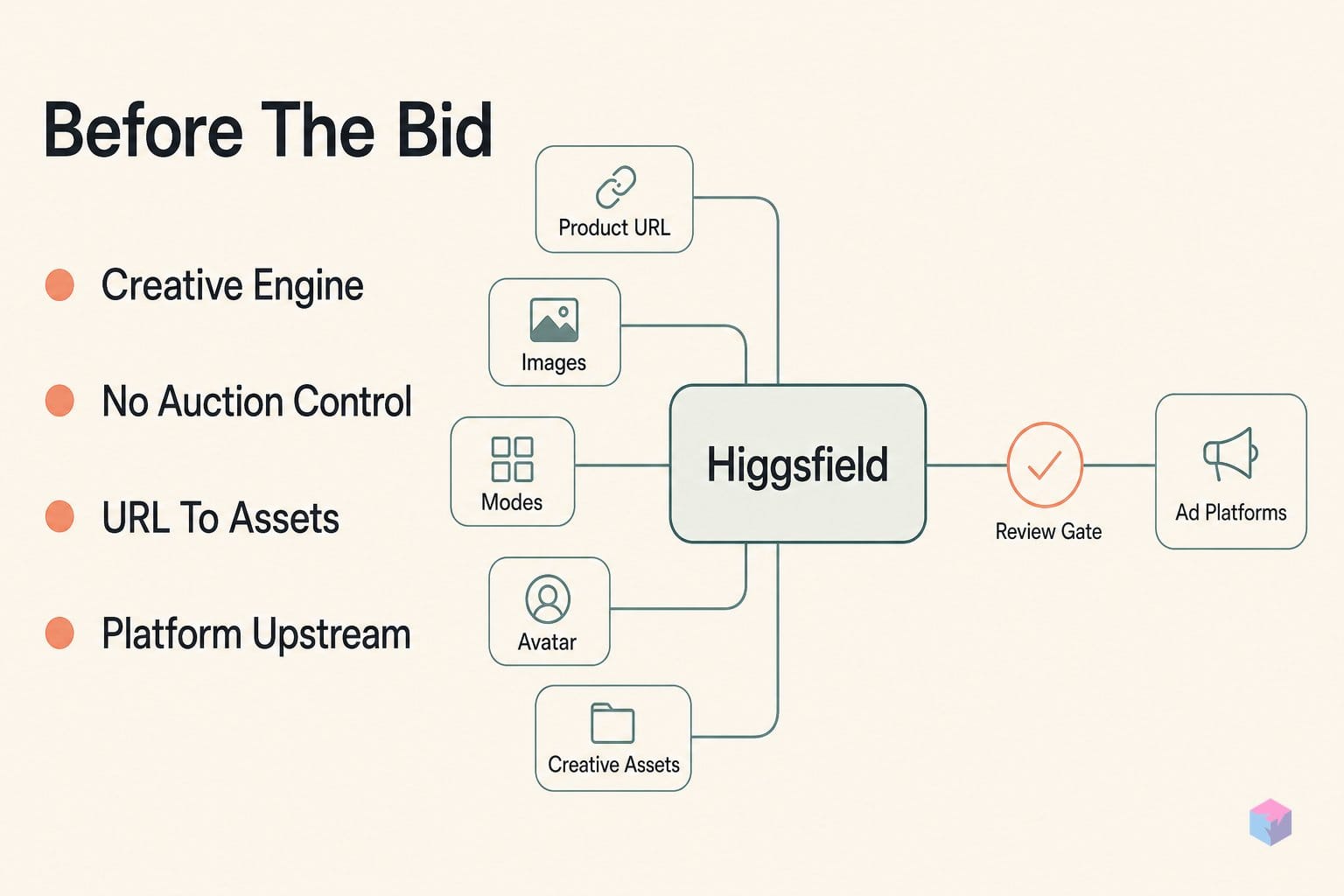
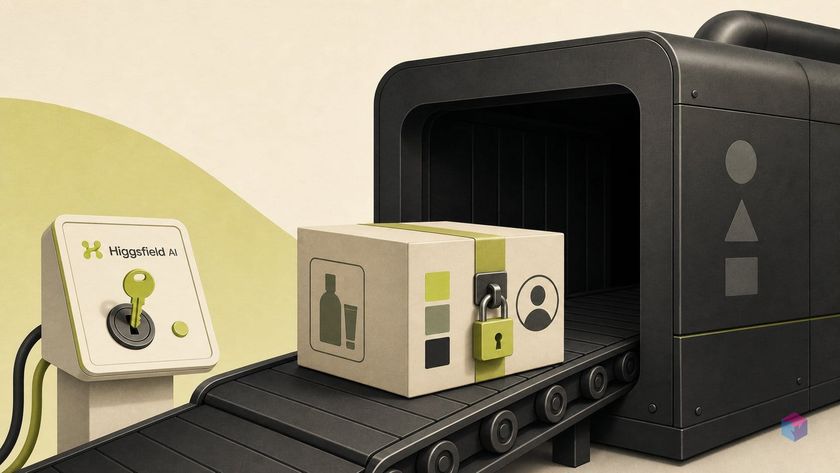
Higgsfield is a generative-media platform, not an ad delivery or targeting system. It does not run auctions, manage audiences, buy media, or optimize against CPA or ROAS goals; it produces the creative that other platforms then place and bid on. The San Francisco startup, founded in 2023 by former Snap generative-AI lead Alex Mashrabov and launched as a browser product in March 2025 , describes itself as an "AI-native advertising platform," but the shipping product is a creative-generation engine that sits upstream of Google Performance Max and Meta Advantage+ (source: Higgsfield Marketing Automation).
The core pipeline is deliberately narrow. You paste a product URL or upload up to five images, pick a mode and an avatar, and receive a publish-ready video in seconds; the system auto-extracts the product name, description, images, and brand colors from the page (source: Marketing Studio). Every output is a video file. Nothing in that flow touches an auction, an audience segment, a budget, or an attribution model.
The mode list makes the scope explicit — each is a creative template, not a media-buying option:
- UGC talking heads — avatar-fronted spokesperson clips
- Product reviews, tutorials, unboxings — social-native formats
- Virtual try-on (UGC and Pro) — the garment/product-compositing shown in the source video
- CGI Hyper Motion and TV Spot — higher-production styles
- AI-directed Wild Card — model-chosen creative direction
That set covers generation end to end and stops there. The distinction matters because both delivery systems it feeds are asset-consumers by design: Performance Max ingests advertiser-supplied assets and a product feed before Google's AI handles bidding and placement (source: Google Ads Help), and Meta Advantage+ leans on large, frequently refreshed creative libraries. Neither generates that raw creative volume for you at brand quality. Higgsfield's job is to be the factory that feeds the auction, not to replace it — a point worth holding onto, because the model-count and full-funnel claims examined later only make sense against this baseline. The source product demo that seeded this analysis is Higgsfield's own product video (video: Fixfield/Higgsfield).
The 30+ count: aggregated from licensed third-party foundations, not built in-house
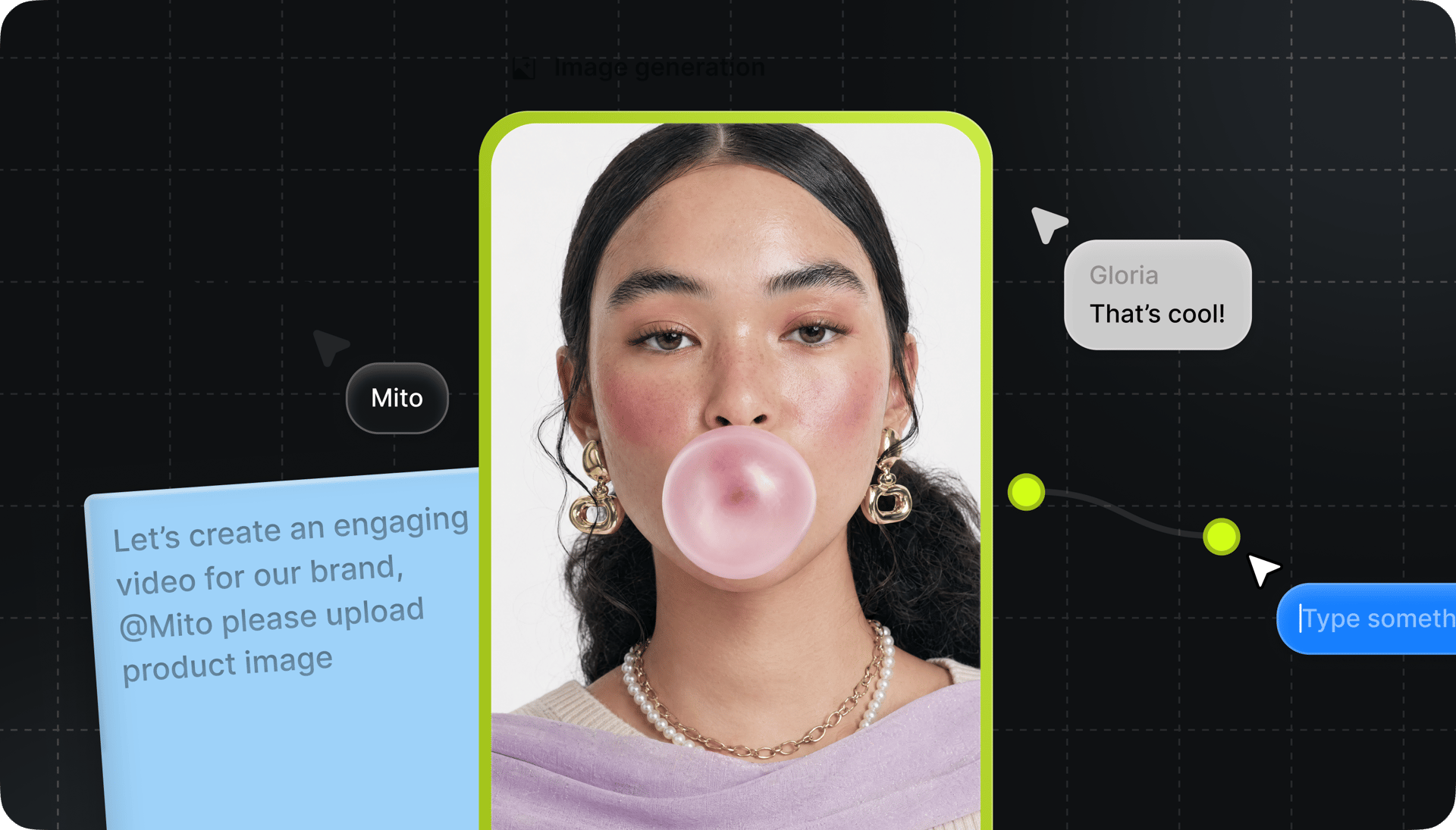
The "30+ models" figure is a count of orchestrated engines, not proprietary inventions. Higgsfield runs a multi-model layer that routes a job to whichever foundation fits the task — its own MCP manifest lets an agent pick among 30+ models, while the enterprise page separately claims 50+ unified in one workspace . The primary video foundation is Seedance 2.0 from ByteDance, which generates motion, audio and speech in a single pass with native lip-sync and physics-aware movement . That means the headline number describes breadth of integration, not depth of in-house R&D.
Alongside Seedance, users can select alternative video engines — OpenAI's Sora 2, Kling, Minimax Hailuo, Google Veo and Seedream — each with different motion, cost and content-filtering behavior . Higgsfield's actual owned IP sits in the layers wrapped around those foundations: Soul 2.0 for avatar and character consistency, the DoP ("Diffuse") image-to-video motion model with 100+ presets, Speak v2 for speech-to-video, Flux Pro / Flux Kontext for text-to-image, and Cinema Studio for assembly . The orchestration itself is explicit: Higgsfield says it uses GPT-4.1 / GPT-5 to plan and Sora 2 to create .
| Layer | Component | Provenance | Role |
|---|---|---|---|
| Video (primary) | Seedance 2.0 | ByteDance (licensed) | Motion, audio, speech in one pass; native lip-sync |
| Video (selectable) | Sora 2, Kling, Minimax Hailuo, Veo, Seedream | OpenAI, Kuaishou, Minimax, Google, third-party | Alternative generation engines per job |
| Avatars / identity | Soul 2.0 | Higgsfield | Character and avatar consistency |
| Image-to-video | DoP ("Diffuse") | Higgsfield | Motion model, 100+ presets |
| Speech-to-video | Speak v2 | Higgsfield | Drives avatars from audio |
| Text-to-image | Flux Pro / Flux Kontext | Black Forest Labs (integrated) | Still generation and editing |
| Planning | GPT-4.1 / GPT-5 | OpenAI | Job planning and shot direction |
Two caveats belong on any architecture claim here. First, the lower-level retrieval stack, routing logic and evaluation loop are not publicly documented — the 30+ count comes from product materials and the MCP tool manifest, not an open technical spec, so parts of the design are inferred from marketing surface rather than verified against a spec sheet . Second, leaning on licensed foundations from ByteDance, OpenAI, Kuaishou and Google is a genuine dependency: it exposes Higgsfield to those vendors' margins, availability and differentiation, since the same engines are, in principle, accessible to competitors. The defensible surface is the orchestration and the owned identity layers, not the video models themselves.
Where PMax and Advantage+ starve: the fresh-asset problem Higgsfield addresses
Both dominant delivery systems are engineered to consume creative faster than most teams can produce it, and that gap is Higgsfield's actual market. Google Performance Max is a single goal-based campaign that spans YouTube, Display, Search, Discover, Gmail and Maps, with Google AI managing bidding, budget, audiences, placements and attribution against a CPA or ROAS target . The catch sits on the creative side: PMax auto-generates video from supplied assets, but Google itself warns that an auto-built clip can depict a product different from the landing page unless filtered, and when no video asset is supplied the campaign defaults to weaker Display inventory . Feed the machine thin creative and it degrades quietly.
Quick Answer: Performance Max and Meta Advantage+ both reward large, frequently refreshed creative libraries — Advantage+ Shopping auto-tests up to ~150 combinations and Meta suggests ≥12 variations against a ~10-conversions-per-week learning threshold. Higgsfield's wedge is supplying that volume upstream, not running the auction.
Meta Advantage+ raises the bar further because its ranking system, Andromeda (introduced late 2024), uses the ad creative itself as the primary targeting signal rather than audience demographics alone . Low creative volume therefore directly caps how well the system can find and optimize audiences. Advantage+ Shopping can auto-test up to roughly 150 creative combinations, but its learning phase wants around 12 or more variations and about 10 conversions per week to stabilize — a refresh cadence few teams sustain by hand.
| Platform | What the AI manages | Where it starves without fresh creative |
|---|---|---|
| Google Performance Max | Bidding, budget, audiences, placements, attribution across YouTube/Display/Search/Discover/Gmail/Maps | Auto-generated video may mismatch the landing page; defaults to weak Display when no video asset is supplied |
| Meta Advantage+ | Andromeda ranks on the creative signal; auto-tests up to ~150 combinations | Learning threshold needs ~12+ variations and ~10 conversions/week; thin libraries cap audience discovery |
This is the bottleneck Higgsfield targets. Rather than compete with the bidder, it positions itself as the upstream creative supplier feeding Meta, Google, TikTok, YouTube and Amazon, generating variant volume and even scoring hooks for virality . As Higgsfield frames its own marketing-automation pitch:
"Both delivery systems are hungry for high volumes of fresh, diverse creative — the platform positions itself as the upstream supplier of that variant volume, not a reach optimizer or an auction bidder." — Higgsfield marketing-automation positioning (source: Higgsfield)
The distinction matters for anyone deciding where Higgsfield fits: it supplies variant volume and virality scoring, but not deterministic reach optimization, an auction bidder, a conversion optimizer or an attribution model . In practice that makes it a feeder for PMax asset groups and Advantage+ libraries — the layer that keeps the learning phase fed rather than the layer that spends the budget.
Brand control vs. volume: what Advantage+ advertiser blowback opened up for Higgsfield
Higgsfield's opening here is brand control. Meta Advantage+ advertisers — including True Classic, Kirruna and Lectric — reported off-brand or bizarre AI creatives, along with opt-out toggles that were difficult to keep disabled . That trust gap is the wedge: Higgsfield keeps a human in control at the creative stage and hands only delivery to the algorithm.
Meta's own generative tooling made the risk structural rather than incidental. Announced in May 2024, it let advertisers upload product images and auto-generate image and text variations, with Llama 3 planned for the text layer; Meta later tested AI video editing that animates still images and expands their borders . Because that generation lives inside the delivery system, fresh variants can enter the auto-testing loop with limited human review — Advantage+ Shopping alone can test up to roughly 150 creative combinations against a learning threshold Meta pegs near 10 conversions per week . That volume is what surfaces the occasional off-brand result at scale.
Higgsfield's counter-pitch inverts the order of control. Marketing Studio ships 40+ ready-to-use avatars plus custom avatar generation, and auto-extracts product name, description, images and brand colors from a pasted URL so output stays on-brand by default . The advertiser owns the inputs — reference images, avatar, mode and brand palette — and reviews the render before anything is exported. Safety becomes a product feature at the point of creation instead of a moderation problem after publication.
"Brand colors, product details and avatar selection are set by the advertiser before a single frame is generated — the workflow is built to keep output on-brand, then handed to the auction, not the other way around," per Higgsfield's Marketing Studio positioning.
The distinction matters because the wedge is not replacing Meta's generation. Higgsfield supplies a brand-directed upstream alternative that produces reviewed assets before they enter Advantage+'s auto-testing loop or a Performance Max asset group. Human-in-the-loop at the creative stage, algorithmic only at the delivery stage: the approved variants become the library the auction then optimizes, rather than raw model output the delivery system improvises against your brand. For advertisers burned by toggles they could not keep off, that separation of concerns — creative direction here, bidding and reach there — is the practical reason to feed Meta and Google from the outside rather than from within.
higgsfield-js v0.2.2: async polling works, no SLA or idempotency commitments
The programmatic path exists, but it is a young one. Higgsfield ships an official Node.js/TypeScript SDK, higgsfield-js, MIT-licensed, with its latest release at v0.2.2 published November 24, 2025 . It works, it supports async job patterns, and it is missing most of the contract primitives a team would expect from an ads-platform API.
On the covered surface, the SDK maps to the generation engines directly: text-to-image via Flux Pro and Soul, image-to-video via DoP, and speech-to-video via Speak v2, plus helpers such as createSoulId(), getMotions(), getSoulStyles() and uploadImage() . The v2 client is the recommended path — credentials in KEY_ID:KEY_SECRET format and a subscribe(endpoint, options) method that polls /requests/{request_id}/status automatically — while the v1 generate() client is formally deprecated . That deprecation churn, one major-version cycle in, is the first signal that the interface is still moving under you.
What is absent is the harder problem. Measured against a mature surface like the Google Ads API or Meta Marketing API, higgsfield-js has no public OpenAPI reference, no changelog, no sandbox environment, no status page, no idempotency documentation, no webhook or event model, no quota table, no versioning policy and no documented error taxonomy . For a creative workstation that a human drives, that gap is tolerable; for service-to-service calls in CI/CD, where you need to retry a failed job without double-billing a generation, the missing idempotency and webhook guarantees are the difference between "usable" and "production-hardened."
The legal and privacy terms reinforce caution. Terms §1.5 reserve the right to limit API network calls and file sizes without notice , so there is no committed rate ceiling to design against. The privacy policy, effective August 30, 2025, allows general-tier prompts, uploads and outputs to be used to train and improve models ; only the enterprise tier claims data is never used for training . Each model also applies its own content-filtering logic separately , so policy behavior is not uniform across the 30+ engines — a call that clears one model can be rejected by another.
Community footprint tells the same story quantitatively: roughly 25 GitHub stars and 3 forks on higgsfield-js as of late 2025 . That is early-adopter interest, not a production fleet stress-testing edge cases on your behalf. Teams that need a steadier contract often route through third-party gateways instead — Segmind, Pixazo and VideoGenAPI wrap the models in REST/webhook interfaces with DoP tiers (dop-lite, preview, turbo) and 5–10 second clips at 480p–1080p . That trades direct-vendor pricing and feature timing for the operational predictability the first-party SDK does not yet promise.
The ideation-to-posting pitch: how Higgsfield's full-funnel ambition changes the complement story
Higgsfield's clearest move beyond a creative workstation is its enterprise "marketing agents," announced as running on NVIDIA infrastructure and pitched to carry work from ideation through posting and into optimization . That last word matters. Optimization against a conversion goal is attribution territory — the layer Performance Max and Advantage+ actually own. Everything covered earlier keeps Higgsfield upstream of the auction; an autonomous ideation-to-posting-to-optimization loop is the first place its ambitions and the delivery platforms' core function start to overlap rather than complement.
The enterprise surface is where this shows. Higgsfield's enterprise materials claim 50+ models unified in one workspace, with SSO, role-based access, asset management, approval flows, SLA language, social-posting connectors, and SOC 2 / ISO 42001 / GDPR alignment . Read as a stack, those are the primitives of an agent that plans, generates, edits, and publishes without a human clicking through each step.
"50+ models unified in one workspace" with "an agent that plans, generates, edits and can post to socials" — Higgsfield enterprise page (source: higgsfield.ai/enterprise).
The agent hooks are already exposed. Higgsfield's MCP server (https://mcp.higgsfield.ai/mcp) publishes callable tools — video analyzer, marketing video generator, Soul character training, cinematic image-to-video, viral clip generator, and virality prediction — and lets a client pick among 30+ models . The catch for engineering teams is authentication: MCP uses account-based auth rather than API keys, which is fine for a human-in-the-loop desktop agent but awkward for service-to-service calls, CI/CD, and tenant isolation. The agentic path is more mature than the raw developer API, but it inherits the same friction the SDK section flagged.
There is capital behind the expansion. Higgsfield's $130M Series A — Accel, GFT Ventures, and Menlo Ventures — closed at a $1.3B valuation as of January 2026 , against a roughly $500M annualized revenue run rate reported by June 2026 . That is enough to fund a genuine full-funnel push, not just a creative-tool play.
The concrete takeaway: treat Higgsfield today as an upstream creative supplier that feeds your existing PMax and Advantage+ campaigns — it fills the fresh-asset gap those systems starve for, and complements them cleanly. Watch the enterprise marketing-agent rollout as the signal to re-evaluate. If the optimization-and-posting loop matures past demo stage, the complement story turns into a partial-overlap story, and that is the point where you reassess who owns the conversion goal.
Frequently asked questions
Does Higgsfield AI replace Performance Max or Meta Advantage+?
No. Higgsfield generates ad creative assets; Google Performance Max and Meta Advantage+ handle bidding, targeting, attribution, and delivery. Higgsfield sits upstream as a creative-supply layer that feeds those systems the fresh video variants they consume — it runs no auction, buys no media, and holds no first-party user graph (source: Higgsfield Marketing Automation). The complement relationship only starts to blur if Higgsfield's enterprise posting-and-optimization agents, announced on NVIDIA infrastructure, mature past demo stage (source: TNW).
What does '30+ models' actually mean — did Higgsfield build them all?
No. The count is a multi-model orchestration architecture, not 30+ proprietary inventions. It aggregates licensed third-party foundations — Seedance 2.0 (ByteDance), OpenAI Sora 2, Kling, Minimax Hailuo, Google Veo, Seedream — plus Higgsfield's own layers: Soul 2.0 for avatar consistency, the DoP image-to-video motion model, and Speak v2 for speech-to-video. Its MCP endpoint lets an agent pick among 30+ models, and the enterprise page separately claims 50+ (source: Higgsfield MCP). Dependence on those external engines carries margin, availability, and differentiation risk.
Is higgsfield-js ready for automated CI/CD ad creative pipelines?
Treat it as early-adopter tooling. The official Node.js/TypeScript SDK, higgsfield-js (MIT), is at v0.2.2, released Nov 24, 2025, and its async subscribe-and-poll pattern works for job submission (source: higgsfield-js). But it lacks the contracts a production pipeline needs: no public OpenAPI reference, no changelog, no idempotency guarantee, no webhook event model, and no documented quota table. The v1 generate() client is deprecated, and the MCP server uses keyless account auth that is weak for service-to-service and tenant isolation. Usable with caution, not a battle-hardened ads API.
Why does Advantage+'s Andromeda system make fresh creative volume so important?
Because Andromeda, Meta's ranking system introduced in late 2024, uses the ad creative itself as the primary targeting signal (source: Higgsfield). Low creative volume limits how effectively the system can discover and optimize audiences. Advantage+ Shopping can auto-test up to roughly 150 creative combinations, and Meta suggests at least 12 variations against a ~10-conversions-per-week learning threshold — so creative refresh becomes a direct performance variable, not just a brand-consistency concern.
How is Higgsfield different from Meta's own AI ad creative tools?
Meta's generation lives inside the buy-side: Andromeda controls creative testing and the advertiser gets limited toggle control, which is what produced the off-brand blowback reported by advertisers such as True Classic, Kirruna, and Lectric, who found AI creatives hard to keep disabled (source: Higgsfield). Higgsfield is an external, brand-directed alternative — advertisers control the product URL, avatars, mode, and brand colors before any asset enters Meta's testing loop. The difference is where control sits: input-side and deterministic with Higgsfield, versus delivery-side and automated inside Advantage+.
Enjoyed this article? Subscribe to get new stories by email whenever they're published.